Did the Prophet (Peace and blessings be upon him) say anything about saving our planet? Did he promote any ideas or practices relevant to the world’s growing concern about the future of the earth and its resources? Below is a collection of the Prophet’s Ahadith Plant a tree even if it is your last deed: 1. Anas (May Allah be pleased with him) reported that the Prophet (peace and blessings be upon him) said, “If the Hour (the day of Resurrection) is about to be established and one of you was holding a palm shoot, let him take advantage of even one second before the Hour is established to plant it.”(Reported by Ahmad and Al-Bukhan on the authority of Anas in Al Adab Al-Mufrad,) Planting trees is a renewable source of hasanat: 2. Anas also reported that the Prophet said, “If a Muslim plants a tree or sows seeds, and then a bird, or a person or an animal eats from it, it is regarded as a charitable gift (sadaqah) for him.“ (Bukhari) Conserve resources even when used for rituals: 3. Abdullah ibn Amr ibn Al-`Aas (May Allah be pleased with him) reported that the Prophet passed one day by Sa`d ibn Abi Waqas (May Allah be pleased with him) while he was performing wudu’ (ritual cleaning of body parts in preparation for prayer). The Prophet asked Sa`d, “What is this wastage?” Sa`d replied “Is there wastage in wudu also?” The Prophet said, “Yes, even if you are at a flowing river.” (Ahmad and authenticated Ahmad Shakir) Keeping environment clean is important: 4. The Prophet warned, “Beware of the three acts that cause you to be cursed: relieving yourselves in shaded places (that people utilize), in a walkway or in a watering place.” (Narrated by Mu`adh , hasan by Al-Albani)
5. Abu Zarr Al-Ghafari (may Allah be pleased with him) reported that the Prophet (peace and blessings be upon him) said, “Removing harmful things from the road is an act of charity (sadaqah).” (Narrated by Abu Dharr Al-Ghafari) No for over-consumption! Consider recycling and fixing before buying new items: 6. Abdullah ibn `Abbas (may Allah be pleased with him) reported that the Prophet said, “The believer is not he who eats his fill while his neighbor is hungry.” (Saheeh al-Bukharee (112))
7. Asked about what the Prophet used to do in his house, the Prophet’s wife, `A’ishah (may Allah be pleased with her), said that he used to repair his shoes, sow his clothes and used to do all such household works done by an average person. (Sahih Bukhari)
8. The Prophet said, “Whoever kills a sparrow or anything bigger than that without a just cause, Allah will hold him accountable on the Day of Judgment.” The listeners asked, “O Messenger of Allah, what is a just cause?” He replied, “That he will kill it to eat, not simply to chop off its head and then throw it away.” (An-Nasa’i) Animals should be cared for: 9. Abu Hurairah (may Allah be pleased with him) narrated that the Prophet said, “A man felt very thirsty while he was on the way, there he came across a well. He went down the well, quenched his thirst and came out. Meanwhile he saw a dog panting and licking mud because of excessive thirst. He said to himself, “This dog is suffering from thirst as I did.” So, he went down the well again, filled his shoe with water, held it with his mouth and watered the dog. Allah appreciated him for that deed and forgave him.“ The Companions said, “O Allah’s Messenger! Is there a reward for us in serving the animals?” He replied: “There is a reward for serving any living being.” (Bukhari)
10. Abdullah ibn `Umar (may Allah be pleased with him) narrated that the Prophet said, “A woman entered the (Hell) Fire because of a cat which she had tied, neither giving it food nor setting it free to eat from the vermin of the earth.” (Bukhari)
The pen is closest to my heart, so may Allah make a means of hidayat for me and a change for all. In sha Allah… Ameen
“I never asked to be born!”
“Stop trying to control my life!”
“I hate you!”
You thought you were over the hard part—changing diapers and being awakened throughout the night by your crying baby, dealing with an uncontrollable two-year-old “monster,” and trying to handle a mischievous child, who was always getting into trouble at school. But now comes the really hard part—coping with a rebellious, often rude and obnoxious, teenager.
Muslim Parents: Not Immune from Teenage Problems
The teenage years have historically been a difficult period for parents in America, with very few exceptions. Struggling to find their own place in the world, teenagers often rebel against the ways of their parents. They want to experiment to find out what is best for them. And, unfortunately, Muslim parents may also face many of the same problems with their teenagers that non-Muslim families face.
Muslim children can also be tempted to drink alcohol or take drugs, be physically attracted to someone of the opposite sex in their class, skip school, or get involved in the wrong crowd.
No doubt, it will be a traumatic experience for a Muslim family to find out that their son or daughter is taking drugs, secretly going out on dates with the opposite sex, or getting in trouble with the police, but it could happen. And what if they become addicts, contract AIDS by having unmarried sex, or become a mother or father before marriage. Our great dreams for our children could suddenly turn into nightmares. It has happened to other Muslim families.
This is, of course, a very frightening thought for most parents. Some will merely say that it won’t happen to their Muslim child. But others will take action and look for ways to prevent these problems or to better handle them if they arise.
Although no two families have exactly the same situation, there are some general guidelines for dealing with Muslim teenagers that might be useful.
We should teach them from an early age about Allah Ta’aala, the Prophets AS, the Sahabah RA, and the great heroes of Islam.
If we develop in them a love for Islam and provide them with righteous examples for their heroes, they will be much less likely to go astray. A person wants to be like his heroes. If he admires Prophet Muhammad Sallallahu Alaihi Wa Sallam, Abu Bakr Radhiyallahu Anhu, and AliRadhiyallahu Anhu, he will try to follow their example. If he admires a rock star or a gang leader, he will want to be like them. If we inspire our children with good examples, when they are tempted to do wrong, they will, InshaAllah, remember these examples and remain steadfast.
Although I was raised as a Christian and didn’t embrace Islam until I was in my 20s, I was greatly influenced by the Biblical stories of Prophets like Nuh, Ibrahim, Musa, and Isa (Peace be upon them all). Although the Biblical stories were not in their pure form, they still inculcated in me a love and respect for the way of the Prophets. Although I fell into many of the temptations of youth, Alhamdulillah, I always felt something within me holding me back from going too far. While many of my friends went headlong into a highly destructive way of life, I believe that my knowledge of, and affection for, the Prophets helped me to return to a better path.
We must be very careful about our children’s friends
During the teenage years, children often care more about what their friends say than what their parents or elders say. According to a hadith, “Man is upon the path of his intimate friend; so let each look to whom he takes as a friend.” If our children have good, sincere, and righteous friends, the chances are good that our children will be like them. If, on the other hand, our children hang around with children who take drugs and get into trouble, our children will likely take drugs and get into trouble.
Therefore, it is essential from an early age that we try to get our children involved with good children. One way to encourage this is by regularly taking them to the mosque (be careful not creating disturbance) or by sending them to an Islamic school where they will have the opportunity to meet and interact with Muslim children. We should be worried though if our children start hanging around with bad-mannered and disrespectful children.
We should encourage our children to participate in wholesome religious, social, and sports activities
Bored teenagers are more likely to look for fun and excitement in the wrong place. “Idle hands are the devil’s (shaytan’s) workshop,” someone once said. If teenagers’ lives are full of good and exciting things to do, they will not have the time or the desire to get involved in bad things.
We should try to channel their teenage zeal into constructive avenues
Sometimes, teenagers begin to criticize the way of life of their parents and society, and parents are often angered by this. However, we must keep in mind that sometimes they may be right. Our lives and our society are not perfect, and teenagers may have fresh insight into how to improve them. In Living With Teenagers: A Guide for Muslim Parents, Ruqaiyyah Waris Maqsood writes:
“Teenagers are idealists—they want to change the world, and make it a better place. These are not bad ideals, and it is a great pity that adults have forgotten their own ideals in the rat race of daily life. You, the parent, may have ended up as just a hard-working nonentity in some quiet niche in life; a teenager who is a real idealist may end up as a famous person, a reformer, a politician, an aid worker —who knows. The future lies there before them.
It is therefore a foolish parent who tries to ridicule and trample on that young idealism. If it is consistent with Islam, it should be fervently encouraged, and not set at naught.”
If a teenager is idealistic and wants to improve the world, we should encourage him and help him. If he if full of zeal but lacks the proper direction, we should help him to use that zeal constructively. If we get teenagers involved in helping those in need and in working for important causes, their zeal could make a tremendous impact.
We should sometimes admit that we are wrong
Parents make mistakes. If we admit to our children that we are wrong at times, they will not always feel that they have to rebel against us and prove that we are wrong.
We should listen to our children
Sometimes, children act out in order to get our attention. If we give them our attention freely, they will not have to seek it in destructive ways. Also, by listening to our children, there is a greater chance that they will confide in us and ask us questions, rather than seeking answers from negative sources.
We should do what we say
Teenagers hate hypocrisy, and many of them seem to have a built-in radar for detecting it. If we want them to listen to us and take our advice, they must trust us. If we tell them not to drink, but drink ourselves, they will not respect us.
The teenage years are usually difficult, and parents need to prepare for them before they arrive. If parents have built a strong, trusting, and loving relationship with their children before the teenage years, their children will be less likely to go astray. It is very difficult to see one’s child going in the wrong direction and not know how to stop him from destroying himself. But if we work hard to instill in them the right values early and try to help them develop a wholesome lifestyle without being overbearing, perhaps we can prevent such a tragedy from ever occurring.
There is no doubt marriage is becoming harder for some people. And when you go to see a potential partner you may struggle to ask the right questions. Here is a list someone sent me:
(Pick and choose the right questions, obviously you are not going to ask all the questions)
MARRIAGE
1. What is your concept of marriage?
2. Have you been married before?
3. Are you married now?
4. What are your expectations of marriage?
5. Why have you chosen me/other person as a potential spouse?
6. What are your goals in life? (long and short term)
7. Identify three things that you want to accomplish in the near future.
8. Identify three things that you want to accomplish, long term.
RELIGION
9. What is the role of religion in your life now?
10. Are you a spiritual person?
11. What is your understanding of an Islamic marriage?
12. What are you expecting of your spouse, religiously?
13. What is your relationship between you and the Muslim community in your area?
14. Are you volunteering in any Islamic activities?
15. What can you offer your spouse spiritually?
16. What is the role of the husband?
17. What is the role of the wife?
18. Do you want to practice polygamy?
FAMILY
19. What is your relationship with your family?
20. What do you expect your relationship with the family of your spouse to be?
21. What do you expect your spouses relationship with your family to be?
22. Is there anyone in your family living with you now?
23. Are you planning to have anyone in your family live with you in the future?
24. If, for any reason, my relationship with your family turns sour, what should be done?
FRIENDS
25. Who are your friends? (Identify at least three.)
26. How did you get to know them?
27. Why are they your friends?
28. What do you like most about them?
29. What will your relationship with them after marriage be?
30. Do you have friends of the opposite sex?
31. What is the level of your relationship with them now?
32. What will be the level of your relationship with them after marriage?
33. What type of relationship do you want your spouse to have with your friends?
SELF
34. What are the things that you do in your free time?
35. Do you love to have guests in your home for entertainment?
36. What are you expecting from your spouse when your friends come to the house?
37. What is your opinion of speaking other languages in home that I do not understand? (with friends or family)
38. Do you travel?
39. How do you spend your vacations?
40. How do you think your spouse should spend vacations?
41. Do you read?
42. What do you read?
43. After marriage, do you think that you are one to express romantic feelings verbally?
44. After marriage, do you think that you want to express affection in public?
45. How do you express your admiration for someone that you know now?
46. How do you express your feelings to someone who has done a favour for you?
47. Do you like to write your feelings?
48. If you wronged someone, how do you apologize?
49. If someone has wronged you, how do you want she/he to apologize to you?
50. How much time passes before you can forgive someone?
51. How do you make important and less important decisions in your life?
52. Do you use foul language at home? In public? With family?
53. Do your friends use foul language?
54. Does your family use foul language?
55. How do you express anger?
56. How do you expect your spouse to express anger?
57. What do you do when you are angry?
58. When do you think it is appropriate to initiate mediation in marriage?
59. When there is a dispute in your marriage, religious or otherwise, how should the
conflict get resolved?
60. Define mental, verbal, emotional and physical abuse.
61. What would you do if you felt that you had been abused?
62. Who would you call for assistance if you were being abused?
HEALTH
63. Do you suffer from any chronic disease or condition?
64. Are you willing to take a physical exam by a physician before marriage?
65. What is your understanding of proper health and nutrition?
66. How do you support your own health and nutrition?
MONEY
67. What is you definition of wealth?
68. How do you spend money?
69. How do you save money?
70. How do you think that your use of money will change after marriage?
71. Do you have any debts now? If so, how are you making progress to eliminate them?
72. Do you use credit cards?
73. Do you support the idea of taking loans to buy a new home?
74. What are you expecting from your spouse financially?
75. What is your financial responsibility in the marriage?
76. Do you support the idea of a working wife?
77. If so, how do you think a dual-income family should manage funds?
78. Do you currently use a budget to manage your finances?
79. Who are the people to whom you are financially responsible?
80. Do you support the idea of utilizing baby sitters and/or maids?
CHILDREN
81. Do you want to have children? If not, why?
82. To the best of your understanding, are you able to have children?
83. Do you want to have children in the first two years of marriage? If not, when?
84. Do you believe in abortion?
85. Do you have children now?
86. What is your relationship with your children now?
87. What is your relationship with their other parent?
88. What relationship do you expect your spouse to have with your children and their parent?
89. What is the best method(s) of raising children?
90. What is the best method(s) of disciplining children?
91. How were you raised?
92. How were you disciplined?
93. Do you believe in spanking children? Under what circumstances?
94. Do you believe in public school for your children?
95. Do you believe in Islamic school for your children?
96. Do you believe in home schooling for your children?
97. What type of relationship should your children have with non-Muslim classmates/friends?
98. Would you send your children to visit their extended family if they lived in another state or country?
99. What type of relationship do you want your children to have with all their grandparents?
RELATIVES
100. If there are members of my family that are not Muslim, that are of different race or culture, what type of relationship do you want to have with them?
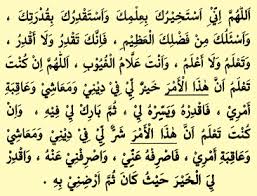
I will also add the istikhara dua, to pray after two rak’at nafl salah:
Where the words “Hathal amr” appear twice (underlined) think of the matter you are asking for.
If Cleopatra visited Swarovski Jewellery store or Claire’s, I wonder how she would feel about her jewellery?
If Kisra, the ruler of Persia spent the night sleeping in YOUR bed, what would he think of his own royal bed?
Would Caesar be proud of his luxurious life; reclining on a couch and fanned by slave girls if he knew that my living room has a more comfortable reclining chair and an A/C unit that can make it feel like an igloo even in a Texan summer?
Would Qaroon strut arrogantly about the keys to his wealth that needed strong men to carry, if he knew that the keys to my wealth are carried in plastic cards in my wallet?
In the land of Mesopotamia so mesmerized by their chariots, what would they think if they saw a Toyota Corolla?
If the people of Baghdad and Cordoba, who used to pride themselves at the vastness of the collection of their libraries, saw the number of books that can be carried by a college student on their USB drive, how would they feel?
If the kings who used to pride themselves on the quickness of their messengers and carriers were introduced to email, text messages and WhatsApp, what would they think of how we were living?
If Al-Nu’man RH, the king of Arabia, who used to drink cold water kept in a specially made skin container and the people used to envy him for that, how would they feel if they saw the water fountain in our masjid?
If the ‘Abbasid Caliph Al-Mansour RH who used to have his slaves mix hot water with cold water to create a unique bath for himself and his people used to imagine what that was like, what he would think of trying out my jacuzzi?
If the people who used to dream about items and search for them all their lives knew that we simply search and purchase them on Amazon?
If the people who used to travel for months and maybe years to reach their destinations knew that it takes us only a few hours on planes, trains, cars or motorbikes!
My brothers and sisters, we live today better than many of the kings and royals of the past, but we can’t see it! We only have eyes for what others have, remember every time your eyes wander wide, your heart constricts!
“And do not extend your eyes toward that by which We have given enjoyment to [some] categories of them, [its being but] the splendor of worldly life by which We test them. And the provision of your Lord is better and more enduring.”(Taha v. 131)
Do not focus on what you DON’T have. Focus on what you DO have!
Comprehend the following statement with your heart and memorize it on your tongue:
When you are grateful to Allah and do what He asks of you, He will give you much more than what you ask of Him.
Smiling is a great way to make yourself stand out while helping your body to function better. Smile to improve your health, your stress level, and your attractiveness. Smiling is just one fun way to live longer read about the others and try as many as you can.
Smiling Makes Us Attractive
We are drawn to people who smile. There is an attraction factor. We want to know a smiling person and figure out what is so good. Frowns, scowls and grimaces all push people away — but a smile draws them in (avoid these smile aging habits to keep your smile looking great).
Smiling Changes Our Mood
Next time you are feeling down, try putting on a smile. There’s a good chance your mood will change for the better. Smiling can trick the body into helping you change your mood.
Smiling Is Contagious
When someone is smiling they lighten up the room, change the moods of others, and make things happier. A smiling person brings happiness with them. Smile lots and you will draw people to you.
Smiling Relieves Stress
Stress can really show up in our faces. Smiling helps to prevent us from looking tired, worn down, and overwhelmed. When you are stressed, take time to put on a smile. The stress should be reduced and you’ll be better able to take action.
Smiling Boosts Your Immune System
Smiling helps the immune system to work better. When you smile, immune function improves possibly because you are more relaxed. Prevent the flu and colds by smiling.
Smiling Lowers Your Blood Pressure
When you smile, there is a measurable reduction in your blood pressure. Give it a try if you have a blood pressure monitor at home. Sit for a few minutes, take a reading. Then smile for a minute and take another reading while still smiling. Do you notice a difference?
Smiling Releases Endorphins, Natural Pain Killers and Serotonin
Studies have shown that smiling releases endorphins, natural pain killers, and serotonin. Together these three make us feel good. Smiling is a natural drug.
Smiling Lifts the Face and Makes You Look Younger
The muscles we use to smile lift the face, making a person appear younger. Don’t go for a face lift, just try smiling your way through the day — you’ll look younger and feel better.
Smiling Makes You Seem Successful
Smiling people appear more confident, are more likely to be promoted, and more likely to be approached. Put on a smile at meetings and appointments and people will react to you differently.
Smiling Helps You Stay Positive
Try this test: Smile. Now try to think of something negative without losing the smile. It’s hard. When we smile our body is sending the rest of us a message that “Life is Good!” Stay away from depression, stress and worry by smiling.
Smilling is a Sunnah
‘Abdullah ibnul-Harith ibn Hazm, may Allaah be pleased with him, said: “I never saw anyone smile more than the Prophet, sallallaahu ‘alayhi wa sallam.” [At-Tirmidhi]
Life is a challenge – meet it, Life is a gift – accept it.
Life is a sorrow – overcome it,
Life is a tragedy – face it. Life is a mystery – unfold it,
Life is an opportunity – take it. Life is a promise – complete it, Life is a struggle – fight it. Life is a goal – achieve it, Life is love – love it. Life is adventurous- have fun, Life is a duty – perform it. Life is a game – outsmart it, Life is a beauty – praise it. Life is great- make something good of it,
So life is a celebration –eat, laugh and do meditation.
MARITAL ADVICE LISTS are common to find in Muslim literature and lectures, yet the information is almost always targeted towards women. However, we all know that it takes two to tango – and so here is a list aimed at Muslim husbands in the hopes that they, too, will benefit and be able to improve their relationships.
1. Have taqwa and iḥsân
Know that you are responsible for your end of the marriage, regardless of how the other party treats you. Fulfill your wife’s rights without demanding yours first, and know that you seek Allah’s Pleasure over anyone else’s. Do your job with excellence, and don’t make it conditional. Iḥsân is not merely to worship in the ritual sense, but to conduct oneself in general with an awareness that Allah is Al-Raqîb (the Ever-Watchful), and to fulfill one’s duties in the best of manners.
Then he (Jibrîl) said, “Inform me about iḥsân.” He (the Messenger of Allah) answered, “It is that you should serve Allah as though you could see Him, for though you cannot see Him yet (know that) He sees you.” (Muslim)
2. Respect her
Remember that Allah describes marriage as a bond of love and mercy – love ebbs and flows, but mercy and respect must always be there, even – especially – in times of conflict. Unfortunately, we tend to present respect as a quality that men need (“men need respect, women need affection”). The truth is, however, that one can love someone without respecting them… and this is very, very dangerous. To have mercy and respect one’s wife is to never assume that she exists merely as an extension of you or to serve your needs. To respect her is to honor her, to defend her from harm and others’ accusations, and to have husn al-ẓann of her.
In cases of disagreement, this respect translates as not forcing your own opinion upon her when there is Islamically acceptable room for differences of opinion.
It should go without saying, but unfortunately it bears repeating nonetheless – respecting your wife means never, ever, abusing her, physically or otherwise.
“And of His signs is that He created for you from yourselves mates that you may find tranquillity in them; and He placed between you affection and mercy. Indeed in that are signs for a people who give thought.” [Sûrat Al-Rûm, 30:21]
Even in times of conflict, Allah tells us to behave in the most respectful and gracious of manners:
And do not forget graciousness between you. [Sûrat Al-Baqarah, 2:237]
Abû Mûsa Al-Ashʿari (May Allah be pleased with him) reported:
I asked the Messenger of Allah: “Who is the most excellent among the Muslims?” He said, “One from whose tongue and hands the other Muslims are secure.”[1]
3. Be emotionally intelligent
Empathy, being attuned to the other person’s preferences, learning to understand their personality and responding appropriately without expecting to change them into something they’re not… supporting and respecting each other as both individuals and as a team. The Prophet ﷺ was an emotionally intelligent husband, who knew the differences in his wives’ personalities and interacted with them in a manner best suited to each woman. He comforted Ṣufiyyah when she wept; he had spirited discussions with ʿÂishah (May Allah be pleased with her) and he encouraged Ḥafṣah’s (May Allah be pleased with her) for knowledge.
In a famous narration known as the Hadith of Abu Zarʿ(May Allah be pleased with him) [2] ʿAishah told the Prophet ﷺ the story of eleven women who sat together and described their husbands’ qualities and behaviours. The eleventh woman, Umm Zarʿ, described Abû Zarʿas a man who was extremely generous to his wife, showering her with gifts; who went out of his way to please her; who never rebuked her or verbally abused her; who made sure that she was comfortable and satisfied. To Umm Zarʿ, there was no greater husband than Abû Zarʿ- and the Prophet ﷺ himself told ʿÂishah, I am to you as Abû Zarʿwas to Umm Zarʿ, except that I will never divorce you.
4. Be a True Qawwâm
Know that being a qawwâm is a matter of being a good leader – not authoritarian or a dictator, but someone who inspires love and respect, who treats others with dignity and respect… The popular book 7 Habits of Highly Effective People is a great resource for understanding what good leadership is. There are several excellent Islamic resources discussing leadership lessons from the life of the Prophet ﷺ. [3][4] Strive to embody the Sunnah in your character, not just in how many rakʿahs a day you pray.
ʿÂishah RA described the Prophet thus: “His character was the Quran.”[5] Be the type of husband that a wife describes in such a manner.
Remember that as a qawwâm, you are responsible and accountable for the well-being of your household and those under your care.
The Messenger of Allah ﷺ said:
“Each of you is a shepherd and each of you is responsible for his flock. The amîr (ruler) who is over the people is a shepherd and is responsible for his flock; a man is a shepherd in charge of the inhabitants of his household and he is responsible for his flock…”[6]
5. Be friends before you become spouses
That might sound odd (or not) – but we often put so much pressure on ourselves to fulfill a role (husband/wife), that we forget to get to know each other as friends first. Every marriage will go through ups and downs, intimately and otherwise… and you’ll be surprised to realize how much having a solid, sincere friendship can pull you through the hard times.
One example of RasûlAllah’s “friendship” with his wives is his relationship with Sawdah bint Zamʿah RA. She was the first woman whom he married after the death of Khadijah, and although she was considered to be elderly and not as beautiful as the other women whom he would later marry, their relationship was one of camaraderie, confidence, and laughter. [7]
6. Don’t be embarrassed or ignorant of female biology
Learn about it – from menstruation to female sexuality to pregnancy and everything else. You need to know this stuff – it will impact your life significantly, intimately and otherwise. Don’t laugh it off or act as though it’s not worth your time and attention. Women’s health is sorely misunderstood, and having a disinterested (or worse, disgusted) husband can make things even more difficult for women.
The Prophet ﷺ did not shy away from these matters, either as a husband or as a Messenger of Allah. Instead, he constantly enjoined men to be aware of and sensitive to their wives’ needs – just as he was with his wives.
Narrated Umm Salamah RA:
While I was laying with the Prophet ﷺ under a single woolen sheet, I got the menses. I slipped away and put on the clothes for menses. He said, “Have you got “nifâs” (menses)?” I replied, “Yes.” He then called me and made me lie with him under the same sheet.[8]
7. Be responsible
Being “a good Muslim husband” doesn’t just mean fulfilling the basic rights as a husband and leaving it at that. Being a good Muslim husband means that you are on the ball as a responsible adult – whether it’s paying the bills, taking out the trash, cleaning a mess in the house, or being an engaged father (not ‘babysitting’). Doing these things is not a “kindness to the wife,” or “helping out at home.” It’s not “extra credit” and deserving of lavish praise. It is part and parcel of being a grown man responsible for his surroundings, his family, and himself. Do these things out of mindfulness that Allah will never waste your efforts for His Sake.
Narrated Al-Aswad RA:
I asked ʿÂishah what did the Prophet use to do at home. She replied. “He used to keep himself busy serving his family and when it was time for the prayer, he would get up for prayer.” (Bukhâri)
ʿÂishah RA reported:
I was asked, “What did the Messenger of Allah, peace and blessings be upon him, do in his house?” I said, “The Prophet was a man among men. He would remove fleas from his clothes, milk his sheep, and serve himself.” (Musnad Ahmad 25662)
8. Don’t pursue your nawâfil at the expense of your wife’s farâ’iḍ
One issue that many men fall into is that in their zeal to engage more in ʿibâda, they end up burdening their wives even more – to the extent that she is barely able to pray her five ṣalawât with khushûʿ. Both spouses should encourage and facilitate opportunities for each other to strengthen as Muslims, but mothers of young children especially need their husbands to step up so that they can have the necessary time they need to reconnect with Allah and flourish spiritually. (And no, that doesn’t just mean five minutes here and there.)
Ramadan is a time when this becomes more obvious than ever – for example, many men will go to Ṣalat Al-Ṭarâwîḥ while leaving their wives to deal with the children, in addition to having cooked ifṭâr beforehand. On a daily basis, though, go out of your way to facilitate your wife’s ʿibâda and spiritual connection.
Narrated Abû Juḥaifah RA:
The Prophet ﷺ made a bond of brotherhood between Salmân Al-Fârisi RA and Abû Al-Dardâ’ RA. Salmân RA paid a visit to Abû Al-Dardâ’ RA and found Umm Al-Dardâ’ RA dressed in shabby clothes and asked her why she was in that state. She replied, “Your brother Abû Al-Dardâ’ R is not interested in (the luxuries of) this world.”
In the meantime Abû Al-Dardâ’ RA came and prepared a meal for Salmân RA. Salmân RA requested Abû Al-Dardâ’ RA to eat (with him), but Abû Al-Dardâ’ RA said, “I am fasting.” Salmân RA said, “I am not going to eat unless you eat.”
So, Abû Al-Dardâ’ RA ate (with Salmân). When it was night and (a part of the night had passed), Abû Al-Dardâ’ RA got up (to offer the night prayer), but Salmân RA told him to sleep and Abû Al-Dardâ’ RA slept.
After sometime Abû Al-Dardâ’ RA again got up but Salmân RA told him to sleep. When it was the last hours of the night, Salmân RA told him to get up then, and both of them offered the prayer.
Salmân RA told Abû Al-Dardâ’ RA, “Your Lord has a right on you, your soul has a right on you, and your family has a right on you; so you should give the rights of all those who has a right on you.”
Abû Al-Dardâ’ RA came to the Prophet ﷺ and narrated the whole story. The Prophet ﷺ said, “Salmân RA has spoken the truth.”[9]
9. Learn conflict resolution skills
One big reason that couples end up going to Shuyûkh for counseling is because they simply haven’t learned how to communicate and resolve conflicts in a healthy manner. It’s not even about one specific issue or another; it’s about learning how to deal with whatever issues arise, in the most respectful and appropriate manner possible. [10]
The Quran and Sunnah urge positive reconciliation between believers, and especially between husbands and wives.
“And live with them honourably. For if you dislike them – perhaps you dislike a thing and Allah makes therein much good.”[Sûrat Al-Nisâ’, 4:19]
“And if a woman fears from her husband contempt or evasion, there is no sin upon them if they make terms of settlement between them – and settlement is best. And present in [human] souls is stinginess. But if you do good and fear Allah – then indeed Allah is ever with what you do, Acquainted.” [Sûrat Al-Nisâ’, 4:128]
10. Love your wife for who she is
Not because she’s the person who cooks for you or does your laundry. Not because she’s the mother of your child(ren). Not because you’ve settled into routine and you feel comfortable having her around and she knows how to work the coffee maker and where the family’s paperwork is filed. Love her for her. Her personality traits, her talents, her hobbies, the things about her that make her unique.
Notice them, appreciate them, compliment them. Let her know that you don’t just see her as wife or mother, but as an individual on her own. Know that long before she married you, indeed long before she was born to her own parents, she was created as a separate soul – a human being whose primary identity is as a slave of Allah.
And most importantly – let her know that you love her, with all the pride and openness that RasûlAllah ﷺ demonstrated when he was asked, “Who do you love most?” and he responded, simply and beautifully, “ʿÂishah.” [11]
There are of course numerous other pieces of advice that can be dispensed on the topic – everything from giving gifts to resolving in-law issues to arranging date-nights and so on. However, more important than specific behaviours are the principles behind them – and it these principles which have been highlighted.
In short, Muslim men should strive to match the standards set by RasûlAllah ﷺ when he said:
“The best of you are those who are the best to their wives, and I am the best of you to my wives.”[12]
Zainab bint Younus is a Canadian Muslimah who has been active in grassroots da’wah and writing about Islam and the Ummah for the last nine years. She was first published in al-Ameen Newspaper (Vancouver, Canada) at the age of 14, became a co-founder, editor, and writer for MuslimMatters.org at 16; and began writing regularly for SISTERS Magazine at the age of 19 until today. She also blogs regularly at The Salafi Feminist
On March 18, 2005 Amina Wadud led the first female-led Jumu`ah Prayer. On that day, women took a huge step towards being more like men. But, did we come closer to actualizing our God-given liberation?
Consultant: Yasmin Mogahed
Answer:
Salam Sarah,
Thank you for your inspiring question!
Well, answering your question, I can say that I don’t think so.
What we so often forget is that God has honored women by giving them value in relation to God—not in relation to men. But as Western feminism erases God from the scene, there is no standard left but men.
As a result, the Western feminist is forced to find her value in relation to a man. And in so doing, she has accepted a faulty assumption. She has accepted that man is the standard, and thus a woman can never be a full human being until she becomes just like a man—the standard.
When a man cut his hair short, she wanted to cut her hair short. When a man joined the army, she wanted to join the army, and so on. She wanted these things for no other reason than because the “standard” had it.
What she didn’t recognize was that God dignifies both men and women in their distinctiveness, not their sameness. And on March 18, Muslim women made the very same mistake.
For 1,400 years, there has been a consensus of scholars that men are to lead prayer. As a Muslim woman, why does this matter? The one who leads prayer is not spiritually superior in any way.
Something is not better just because a man does it. And leading Prayer is not better just because it is leading.
Had it been the role of women or had it been more divine, why wouldn’t the Prophet have asked Lady `A’ishah or Lady Khadijah, or Lady Fatimah—the greatest women of all time—to lead?
These women were promised heaven and yet they never led prayer.
But now, for the first time in 1,400 years, we look at a man leading prayer and we think, “that’s not fair.” We think so, although God has given no special privilege to the one who leads. The imam is no higher in the eyes of God than the one who prays behind him.
On the other hand, only a woman can be a mother. And the Creator has given special privilege to a mother. The Prophet taught us that heaven lies at the feet of mothers. But no matter what a man does, he can never be a mother. So why is that not unfair?
When asked who is most deserving of our kind treatment? The Prophet replied “your mother” three times before saying “your father” only once. Isn’t that sexist? No matter what a man does, he will never be able to have the status of a mother.
And yet even when God honors us with something uniquely feminine, we are too busy trying to find our worth in reference to men, to value it or even notice it. We too have accepted men as the standard; so anything uniquely feminine is, by definition, “inferior”.
Being sensitive is an insult, becoming a mother is a degradation. In the battle between stoic rationality (considered masculine) and selfless compassion (considered feminine), rationality reigns supreme.
As soon as we accept that everything a man has and does is better, all that follows is just a knee jerk reaction: if men have it, we want it too. If men pray in the front rows, we assume this is better, so we want to pray in the front rows too.
If men lead prayer, we assume the imam is closer to God, so we want to lead prayer too.
Somewhere along the line, we’ve accepted the notion that having a position of worldly leadership is some indication of one’s position with God.
A Muslim woman does not need to degrade herself in this way. She has God as a standard. She has God to give her value; she doesn’t need a man here.
In fact, in our crusade to follow men, we, as women, never even stopped to examine the possibility that what we have is better for us. In some cases, we even gave up what was higher only to be like men.
Fifty years ago, we saw men leaving the home to work in factories. We were mothers. And yet, we saw men doing it, so we wanted to do it too. Somehow, we considered it women’s liberation to abandon the raising of another human being in order to work on a machine.
We accepted that working in a factory was superior to raising the foundation of society—just because a man did it.
Then after working, we were expected to be superhuman—the perfect mother, the perfect wife, the perfect homemaker, and have the perfect career. And while there is nothing wrong, by definition, with a woman having a career, we soon came to realize what we had sacrificed by blindly mimicking men.
We watched as our children became strangers, and soon recognized the privilege we’d given up.
And so only now—given the choice—women in the West are choosing to stay home to raise their children. According to the United States Department of Agriculture, only 31 percent of mothers with babies, and 18 percent of mothers with two or more children, are working full time.
And of those working mothers, a survey conducted by Parenting Magazine in 2000, found that 93 percent of them say they would rather be home with their kids, but are compelled to work due to “financial obligations.”
These “obligations” are imposed on women by the gender sameness of the modern West and removed from women by the gender distinctiveness of Islam.
It took women in the West almost a century of experimentation to realize a privilege given to Muslim women 1,400 years ago. Given my privilege as a woman, I only degrade myself by trying to be something I’m not, and in all honesty, don’t want to be—a man.
As women, we will never reach true liberation until we stop trying to mimic men and value the beauty in our own God given distinctiveness.
If given a choice between stoic justice and compassion, I choose compassion. And if given a choice between worldly leadership and heaven at my feet, I choose heaven.
I hope my words answer your question. In case you have any comment or you need more about the topic, please don’t hesitate to contact us again.
For those going first time it is easy to get lost, there are a lot of hotels and sometimes they all look the same to you and you might be quite a distance from the Haram. For the first few days go with someone to the Haram, and remember the walk back and picture a big hotel or shop nearby, e.g my hotel is near Hilton or behind Movenpick. Keep the hotel card, especially if you have elderly parents with you.
Remember, those going for Hajj there will be approximately 3 million people in Hajj. Thinking of that should give you the ability to be more patient. Hajj is nothing but an expression of love. During the journey towards Allah, the haji bears all difficulties with great patience. Also, bear in mind there will be delays. If you arrive late at Arafat or Muzdalifah you will still be rewarded for your intention so do not fret or frown. Arafat day try and spend the most time in Dua from Dhuhr to Maghrib in a standing position (as long as possible). Arafat to Muzdalifah is usually a difficult one as most if not all of the people take the buses as it is dark after Maghrib. It is ideal to walk the rest of Hajj, saves you from the headache of buses. If your bus is late, spend the time in dhikr and Qur’an not talking or gossiping or on WhatsApp and social media. Don’t let Shaytan take advantage.
Can I also say about keeping yourself clean during the days of Hajj? Please don’t neglect personal hygiene and yes stick to the restrictions…but there are going to be millions of people there and there will be germs everywhere, keep a fragrance-free hand gel and keep washing your hands to stop spreading any unwanted germs. When sneezing and coughing remember to use tissues and wash your hands if possible after.
Allah SWT has made things easy for us now, personal hygiene is more important at times like this not just for you but to take other people into consideration too, the elderly the sick those who have terminal illnesses who will be around if you’re not washing to keep clean you will spread germs.
There are even some things that recite the talbīyah alongside a muḥrim when one recites it. “There is no Muslim who recites the talbīyah during the Ḥajj andʿUmrah but that everything which is to his right and left also recite it with him. Whether it is rocks, trees or even soil, to the farthest ends of the earth in each direction, from here and from there.” (Tirmidhī)
THE SIGNS OF HAJJ E MABROOR & HAJJ E MAQBOOL
Hajj e mabroor is where no mistake is made for which penalty will have to be given.
Hajj e maqbul is the hajj that has been accepted by Allah, this also includes performing the hajj with lawful money.
Sometimes both these words are used for the term accepted hajj.
A sign of an accepted hajj is that the pilgrims life changes from bad to good, love for the hereafter increases, and the desire for worldly things decline.
Five times daily salah ,zakah, fasting in the holy month of Ramadhan and for women a full sharee purdah.
Previous fasts and salah must be completed through qadha, unpaid zakah must be paid and the sunnah of Rasulullah SAW must be learned and practiced upon.
Become a practising muslim and abide by the laws of Shariah.
Allah grant all the hajis and hajyanis hajj e mabroor and maqbool Ameen thumma Ameen
Miscellaneous
Daily Items to take to the Haram/Masjid: Drawstring bag for slippers, musalla, water bottle, Qur’an, dua books/tasbih, mobile phone and money.
Janazah Salah Sayyiduna Abu Hurayrah (radiyallahu ‘anhu) reports that Rasulullah ﷺ said: “Whoever attends the funeral procession and offers the Janazah Salah, will get a reward equal to one ‘qirat’, and whoever accompanies it till burial, will get a reward equal to two ‘qirats’. It was asked, “What are two qirats?” He answered, “Like two huge mountains.” (Sahih Bukhari, Hadith: 1325 and Sahih Muslim, Hadith: 945)
For those travelling for the first time, there will be Janazah Salah after every Fardh Salah almost. You will hear an announcement, “As-Salah ala Al-Amwaat” or “As-Salah ala Al-Atfaal” (Prayer for the deceased or prayer for children). We should seize the opportunity as it takes only a few minutes to pray. As a lot of people tend to forget the method and women may never have prayed Janazah Salah, the method is here:
Method of Janazah Salah:
The manner of performing Salatul Janazah is as follows:
The body of the deceased must be placed in front of the Imam who leads the Salah.
The Imam stands in line with the chest of the deceased.
Everyone in the congregation must have the intention of performing Salaah Al Janazah for the sake of Allah and in prayer for the deceased.
Make the intention of praying behind Imam.
One must then say Allahu Akbar while raising both hands as in Takbeer At Tahreema (the same manner in which one raises his hands to begin the daily Salah).
Then fold your hands as one does in his daily Salah.
At this time, one must recite the 1) Thana. The Thana is:-
“Subhanakallahumma wa bihamdika wa Tabarakasmuka wa Ta’aala Jadduka wa laa ilaha Ghairuka.”
2) After this, a person must say Allahu Akbar again, but must not raise his hands.
At this time, one will recite the Durood, (preferably the same as recited in the daily Salah).
3) Then say Allahu Akbar once again without raising your hands. After this takbeer, one will make the dua for the deceased.
Based on who the deceased is, one will recite the relevant dua. That is, there is a special dua for adults, one for a minor boy and another for a minor girl.
The dua for an adult is:
Allaahurnmaghfir li hayyinaa wa mayyitinaa wa shahidinaa wa gha-ibinaa wasaghirinaa wa kabirinaa wa dhakarinaa wa unthanaa,
Allaahumma man ahyaitahu minnaa fa’ahyihi ‘alal islam wa man tawaffaitahu minnaa fatawaffahu ‘alal imaan.
O Allah! Forgive those of us that are alive and those of us who are dead, those of us that are present, those of us who are absent, those of us that are young and those of us that are adults; our males and our females. O Allah! Whomsoever of us you keep alive let him live as a follower of Islam and whomsoever you cause to die, let him die as a believer.
The dua for a girl child is :
Allaahum maj ‘alhaa lanaa fa-ra—tanw waj ‘alhaa lana aj-ranw wa zukhranw waj ‘alhaa lana shaafi’atan wa mushaf-fa;ah
O Allah, make her our forerunner, a source of reward and treasure and make her plead for us and one whose plea has been accepted.
The dua for a boy child is:
Allaahum maj ‘alhu lnaa fa-ra—tanw waj ‘alhu lana aj-ranw wa zukhranw waj ‘alhu lana shaafi’an wa mushaf-fa’aa
O Allah, make him our forerunner, a source of reward and treasure and make him a pleader for us and one whose plea has been accepted.
NOTE:If you don’t know any of the above Duas then pray Rabbana Aatina Fid Dunya hasanah wa fil Aakhirati Hasanah wa qina azaaban naar.
When the Salatul Janazah is finished the body should be taken to the cemetery for burial.
And Allah knows best.
Travel Insurance
Travel insurance is not permissible even if claims are restricted to exceptional circumstances. Hadhrat Mufti Taqi Uthmani (madda zilluhu) writes in his book, contemporary fatawa: “It is a well-settled principle of Sharî’ah that every transaction between two parties in which the payment by one party to the other is certain while payment by the other party depends upon a contingency (which may or may not occur) is included in Qimâr (gambling) and gharar (deception) and is, therefore, unlawful. (Page 122) “….all the insurance policies available with traditional insurance companies run on a commercial basis have an element of interest or Qimar or both. Hence, they are not allowed in Shari’ah.” (page 164) Allah (SWT) Knows Best.
Women and Jamat
As most women don’t attend the Masjid for Salah in the UK, they may not know how to perform missed Rak’aat with the imam:
You will stay in the sitting position with imam in the last Rak’at for tashahhud until he does the second salam in case he does sajdah e sahw after the first salam. So as soon as he finishes his second salam you will stand up to finish your missed rakats.
Method:
1 RAKAAT MISSED The Muqtadi must recite Surah Faatiha and a Surah.
2 RAKAATS MISSED The Muqtadi must recite in both Rakaats Surah Fatiha and a Surah.
3 RAKAATS MISSED In the first Rakaat, the Muqtadi must recite Surah Fatiha and a Surah and then sit for Tashahhud.
After Tashahhud, he must stand up for the second missed Rakaat and recite Surah Fatiha and a Surah.
In the third missed Rakaat, he must recite Surah Fatiha only.
4 RAKAATS MISSED In the first two Rakaats recite Surah Fatiha and a Surah.
In the second two Rakaats recite only Surah Faatiha. (Shami vol 2 pg. 346)
Witr in Ramadhan
Those who go for Umrah in Ramadhan, usually have a dilemma whether or not to pray Witr with the imam. As the imam will pray 2 rak’ah then 1 separate. It is allowed for Hanafis (people who follow Hanafi fiqh) to follow the imam in Witr. Please see fatwa below:
The preferred view of Hadhrat Mufti Muhammad Taqi Uthmani Saheb (hafidhahullah) is pray 2 rak’ah nafl with the imam and then don’t pray the 1 rak’ah separate, just make dua in the qunoot/dua after rukoo.
Also, after Taraweeh Salah there is no announcement for Witr like the Masajid in England. So many people stand up for Witr thinking it is still Taraweeh and their intention will still be for Taraweeh, which will invalidate the Salah. It would be nice if they could announce Witr Salah in the Haram, otherwise we must keep a track of Rak’ahs.
Thieves
Keep your belongings with you at ALL times. In the hotel keep your suitcase and luggage locked, do not trust anyone, not even the workers. Take minimum money to the Haram, 40-50 Riyal. You should not need more than that, maximum 100 Riyal. The day you decide to go shopping, take extra money. But on a daily basis, you might need money for a drink/ice cream or something to eat. There are thieves everywhere! As blessed as Haramayn Shareefayn are, unfortunately the thieves are NOT. They will cut your pockets and run. Men should try and sew pockets into their trousers for safety. Keep your mobile and money in there. Women keep small handbags and keep them close to you, not dangling off your shoulder. Then there are other thieves or beggars who make stories up! They lost their passports or documents. Or even say they lost their wife and children. I personally do not give a Riyal to any of these guys, not because I am stingy but I want my money to go to the right place. If you don’t believe me, read this:
If you want to give Sadaqah or Zakah give it to the cleaners in Haram. With Zakah, you have to let them know it is Zakah.
If your belongings do get stolen or lost, there is a lost and found office called “daftarul mafqoodaat” in Arabic. It is near Safa and Marwa but far, far behind it. You have to go outside and it is a long walk, I’ll be honest. Try praying these duas:
“O Allah, the Returner of the lost, and the Guide of the lost, You guide the lost. Return to me what I have lost by Your power and Your domain, for surely It was Your gift and grace in the first place”.
(Al Hisnul Haseen)
2.
يا جامع الناس ليوم لا ريب فيه
اجمع بيني وبين مالي إنك على كل شيء قدير.
Allahuma ya jami’ an-naas li yawmin laa rayba feeh ijma’ bayni wa bayna dhaallati.
“O Allah, Gatherer of mankind on the day in which there is no doubt. Connect me with my lost item.”
(Fathul qadeer)
فِيهِ آيَاتٌ بَيِّنَاتٌ مَّقَامُ إِبْرَاهِيمَ
In it are clear signs (among which is) the Maqam-e-Ibrahim.
Maqam-e-Ibrahim refers to the stone on which Nabi Ibrahimﷺ would stand when he was building the Ka‘bah. As the height of the building rose, the stone would automatically rise, lifting Nabi Ibrahimﷺ so that he could continue to build the Ka’bah, and when it was time for Nabi Ibrahim ﷺ to return to the ground, the stone would automatically descend.
The impression of the blessed footprints of Nabi Ibrahim ﷺ can be seen in the stone until today. It is obviously a miracle for a stone to automatically rise and descend, based on the need of the person standing on it, and for a hard stone to soften sufficiently so that it could be imprinted with his footsteps. It is for this reason that Allah Ta‘ala says that the Maqam-e-Ibrahim contains clear signs (that will guide one to recognize Allah Ta‘ala).
The Maqam-e-Ibrahim is housed in a round structure made from glass and metal, located on the mataf, close to the door of the Ka‘bah.
‘Abdullah bin ‘Amr (radhiyallahu ‘anhu) reports that Rasulullah ﷺ said, “The Hajr-e-Aswad and Maqam-e-Ibrahim are two precious stones from the precious stones of Jannah. Allah Ta‘ala has extinguished their radiance. Had Allah not extinguished their radiance, they would have illuminated everything between the east and the west.”(Sunan Tirmidhi #878)
Take it easy
If you are going for Umrah in Ramadhan, take it easy as you are fasting as well as doing Tawaf and other acts of Ibadah. Sometimes just going to and from the Masjid can be tiring. Be sure to look after the elderly and those in your group too. If you are going for Hajj, do not tire yourself before Hajj. Some people do excessive Tawaf and Umrah before the days of Hajj then feel weak before Hajj. Remember you are “there for Hajj” make the most of it and be prepared for the 5 main days in sha Allah.
Waqf
Ibn Majah (757) narrated a hadeeth, “Whoever removes anything harmful from the mosque, Allah will build for him a house in Paradise.”
Anything found in the masjid is Waqf, please us it carefully, including the cups for Zamzam. Many people waste the cups and do not dispose of them correctly. A masjid MUST be kept clean; whether it is your local Masjid or Masjid Haram. Just because it is an extremely large Masjid does not mean it can be littered. Also on a side note, I would just like to mention here, many mothers make their children wear socks or t-shirts with picture or cartoons. This is completely Haraam! Please avoid this.
Purpose
Keep on remembering the purpose you are here for, and make a daily schedule/routine. When the heat overburdens you, remember the heat of hell fire. If you are stood in long queues or waiting amongst crowds of people, think of Qiyamah and the multitudes of people. I believe Haram Shareef is the only place you can depict Qiyamah, truly. When listening to the Qur’an in Salah, imagine the time when Jibreel AS descended upon the Prophet (peace and blessing be upon him).
Halal Food
Beware. Not all food is reliable in Saudi Arabia, especially chicken as we all know a LOT of the chicken is imported. Try and ask a reliable mufti saheb in the UK for an up to date list of reliable restaurants/takeaways. Please don’t be naive and think it is a Muslim country, so everything is Halal. Ask the workers if the chicken is “Watani” which means local/slaughtered in Saudi Arabia. When I went for Umrah in Ramadhan 2018, I asked Mufti Ibrahim Saheb Raja of Blackburn as Mufti saheb visits Haramayn ever year. He enumerated the following: in Makkah alTazaj in Bin Dawood and also the McDonald’s, he said near Ibrahim Khaleel road there are many Pakistani restaurants that serve Watani chicken, you just need to ask and confirm. In Madinah, there are much more. To name a few, Rawi, At-Tabakh, Nirala, Miraj and Dawoodiya.
Niqab
Ma Sha Allah! I will always praise and support women who wear the niqab, it is one of the greatest Jihads of the time – whether home or away. But, sadly, many women go to the holy lands and stop wearing their niqab or it becomes part-time. My dear sisters, simple advice is that you wear a niqab for many years. Some of you since you were teenagers. Not a single non-mahram has seen your face! Then you go for Hajj/Umrah and uncover your face because it’s too hot or at lunchtime for ease or in the hotel because you feel suffocated. Remember, there will be many men travelling with you from your locality and relatives who have never seen your face. Is it worth it for a few weeks to lose this modesty? Stay strong in sha Allah, Allah’s Jannah awaits you. You will be the queens of Jannah.
Madinah Munawwarah
Shaykh Haji Faruq Saheb (Allah have mercy on him) would say, on the road to Madinah try and pray Surah Kawthar 1000 times. Once you enter Madinah start continuous durood, so before you reach Masjid Nabwi ﷺ your salutations reach the beloved Prophet ﷺ.
“There are angels of Allah SWT who convey to me the salutations of the Ummah.” (an-Nisai)
Take a booklet of forty duroods and pray daily along with a fixed amount of other duroods, 100, 200 etc.
Read Seerah books beforehand or take one with you to inculcate the love of the Prophet ﷺ
The rule is not to harm anyone, anywhere. But in particular, make an extra effort in Madinah Shareef not to argue or cause inconvenience to anyone. Even the animals, birds, plants etc. This is the City of the Prophet ﷺ, the City of Mercy.
DO NOT COMPLAIN! If you do not like something, stay quiet. Women, in particular, have a habit of commenting and criticising negatively. Such silly mistakes can deprive someone of visiting the holy lands again. There is a famous story of a man who visited Madinah and had some yoghurt. He found the yoghurt sour and complained! The same night the Prophetﷺ came in his dream and said, “If you don’t like the yoghurt of my city, then don’t come again.”
Mount Uḥud even loves those who obey Allāh and His Messengerﷺ
“Uḥud is a mountain which loves us and which we love.” (Bukhārī)
Imām al-Nawawī (Allah have mercy upon him) comments and says: “Mount Uḥud truly loves us because Allāh has endowed it with a quality whereby it is able to feel love.” (Sharḥ al-Nawawī)
Salat was Salam upon our beloved Prophet ﷺ be done from anywhere in Masjid Nabwi but better in front of the Rawdhah Mubarak.
Try and pray at least two Rak’ah in Riyadhul Jannah, without pushing or causing inconvenience.
Shaykhul hadith Hadhrat Mawlana Muhammad Zakariyya (Allah have mercy upon him) would say, “When shopping in Madinah, make an intention to benefit the people of Madinah.” And I would like to add, do not haggle too much with the residents of Madinah.
Try and visit the place of Badr about 2 hours from Madinah Shareef. And there is a well on the way Bi’r Shifa. The water is known for Shifa/cure.
For those who do not know much about which dates to buy, I am no expert but the standard dates which people generally buy are:
Ajwa
Kalmi
Sukary
Safawi
Sugai
Ambar
Try and go to a date farm rather than the date market, the farms are not far from Masjid Nabwi ﷺ. And remember each type of date has its quality. E.g. You will get cheap Ajwa 40 or 50 Riyal per kilo but that will be low quality. Whereas the 60-70 Riyal per kilo will be higher quality, much larger and softer.
There are many suggestion boxes, usually near the doors/gates. Feel free to make positive suggestions. There are definitely many improvements to make in both places, we need to think of them and criticise constructively. We need to become a thinking Ummah, we need to produce deep thinkers in sha Allah. Also, take a notebook and pen and write down any thoughts you get. Sitting in the Haram you get some remarkable thoughts, don’t let them go! It could be changes to your life or something beneficial for the Ummah. Alhumdu Lillah, both parts of these blogs were a result of taking a notepad and jotting things down which I thought would benefit people. If you are a poet, writer, blogger, pen down your love and contemplations for these places to spread the respect and sanctity of these places. Here are two poems I wrote:
Lastly, use your time wisely and make it fruitful and productive. You never know when you will go again. Avoid arguments, this is not the place for arguments. Please don’t treat it like a holiday, you are not in Dubai or Morocco! They said in Arabic, “al-Istiqamah fawqa alf Karamah.” Steadfastness is better than 1,000 miracles! When you return back to the UK, keep up with your Salah, wearing Hijab or keeping a beard and practicing every Sunnah. Especially those Sunnah connected with Hijab. Reflect on your age and life. How you can change and remove sin and vice from your life.
Allah accept your Hajj/Umrah and make it easy and bring you back safely. Fi Amanillah.
Please pray for me too.
Ismail ibn Nazir Satia (One who is in dire need of Allah’s forgiveness, mercy and pleasure)

 Did the Prophet (Peace and blessings be upon him) say anything about saving our planet? Did he promote any ideas or practices relevant to the world’s growing concern about the future of the earth and its resources?

 “I’ve come to a frightening conclusion that I am the decisive element in the classroom.

 (Pick and choose the right questions, obviously you are not going to ask all the questions)
 If Cleopatra visited Swarovski Jewellery store or Claire’s, I wonder how she would feel about her jewellery?



 Zainab bint Younus, Canada




 Maqam-e-Ibrahim refers to the stone on which Nabi Ibrahimﷺ would stand when he was building the Ka‘bah. As the height of the building rose, the stone would automatically rise, lifting Nabi Ibrahimﷺ so that he could continue to build the Ka’bah, and when it was time for Nabi Ibrahim ﷺ to return to the ground, the stone would automatically descend.


