Categories
Current Affairs articles

Drugs! Are they worth it?

Categories
Personalities

Golden Quotes

22 Shawwal 1437
Categories
Personalities

An Angel of Mercy

http://productivemuslim.com/inspired-by-abdul-sattar-edhi/?utm_source=getresponse&utm_medium=email&utm_campaign=ProductiveMuslim+NewsLetter&utm_content=%5B%5Brssitem_title%5D%5D#utm_source=rss&utm_medium=rss&utm_campaign=inspired-by-abdul-sattar-edhi

federico-beccari-633001-unsplash.jpgThis is a story that carries many life lessons for all of us. The story of Abdul Sattar Edhi, and the legacy he left behind.

‘Edhi’ became a synonym for love, humanitarian service, and selflessness in Pakistan. He commanded respect from Pakistanis and from millions across the world. He won several prominent international prizes for his outstanding humanitarian services. He was nominated for the Nobel Prize several times. He was decorated with the Nishan-e-Imtiaz, which is the highest honor given to any civilian in Pakistan for their achievements towards world recognition of Pakistan or an outstanding service to the country.

News of his illness in the last few months made many Pakistanis pray wholeheartedly for his health. His death shocked many in the nation. He was given the state funeral attended by thousands of people, including the President, chiefs of military, navy and air force, a large number of politicians, diplomats, civil servants, businessmen, etc.

He was called an Angel of Mercy. Some thought he was the greatest living humanitarian. We know that the Edhi Foundation runs 330 welfare centers across Pakistan and more than 1500 ambulances. But we do not exactly know the number of people (which could be millions without exaggeration) who have directly and indirectly benefited from Edhi ambulances, food kitchens, rehabilitation homes, shelters for abandoned women and children, and clinics for the mentally handicapped. Edhi Foundation does not just operate in Pakistan, it has carried out relief operations in Africa, Middle East, the Caucasus region, Eastern Europe and the United States. Edhi never differentiated between people, their faith, race or color. He helped everyone who needed help. He humbly requested donations from everyone who could give. He changed the face of welfare work in Pakistan and established an organization which is trusted by everyone, poor and rich, illiterate and educated, Muslims and non-Muslims alike.

The purpose of this article is not to write a biographical account of Edhi’s life. Rather, I want to list some key qualities which made him the person he was. I want every one of us to learn from Edhi. I wish we can peek through his life and emulate some of his qualities and traits so that we can also reach out to the poor and needy in the way he did. I also hope our children would be inspired by his story, and be motivated to follow suit when they grow up.

Practical compassion

Edhi’s compassion drove him to help the helpless, give shelter to the homeless women, give a roof to the street children, feed the hungry, treat the sick and bury the dead… He himself drove an ambulance for 45 years and never drove any other car throughout his life. His heart was always with the needy and deserving and he was constantly thinking about how best to help those most in need. His compassionate heart has a lot to do with serving his own mother. She was paralyzed from a stroke when Edhi was only 11 years old. Looking after his mother and seeing her suffer inspired Edhi to develop services for the aged, immobile people, and physically challenged persons. His mother taught him selflessness also when she used to give him 2 paisas, one for himself and the other for a needy person on the street. This training to be compassionate at an early age had a lot to do with what Edhi became eventually.

Living a life of simplicity

Edhi lived a very simple life. He was known for his ascetic lifestyle. He never owned more than two pairs of simple clothes and shoes. He lived in a simple home with his family. His own office remained a small room with minimum furniture. He never drove any other car except the ambulance. He never took a salary from his foundation. He inculcated this trait in his wife and children who continue to live a life without frills. Edhi remained a focus of local and international media for decades, but this attention never got him distracted or carried away. He kept to his simplicity and true authentic self. This simplicity earned him a lot of respect among the masses.

Upholding a true sense of integrity

Being the largest charitable organization in Pakistan, Edhi Foundation attracted millions of dollars of donations. In its more than five decades of existence, Edhi Foundation never came under scrutiny for misappropriation of funds. Its volunteers, staff, and management are also inspired by Edhi’s own integrity, honesty, and trustworthiness. Edhi realized that maintaining his personal, as well as organizational integrity was central to the success of his humanitarian activities which entirely depended on donations.

Dedication to one’s mission

Edhi was a full-time humanitarian worker, organizer, and mobilizer. He dedicated his whole life to the welfare work. Such was the level of his dedication to the causes he supported that he paid no heed to any kind of threats or obstacles in his way. He was criticized by some fundamentalists for supporting babies born out-of-wedlock. His ambulances were attacked by some interest groups. But nothing could deter him from serving humanity.

Being patriotic

Edhi was a true patriot. He had migrated to Pakistan from India during the partition of 1947. He believed in the country he chose to live in. Such was the level of his patriotism that he chose to be treated only in Pakistan despite offers from many for treatment abroad. He wanted to live and die in the country he loved so much. He never took donations from anyone except Pakistanis. He believed that native people can solve the problems of their country, and he proved it through the work he did that he sought help only from Pakistanis to solve issues of Pakistanis.

Taking the means and being optimistic

Edhi was a true impatient optimist. He knew that several problems of our world can be solved if we start finding solutions. He started his foundation with a second-hand ambulance. He then felt that the aged who had no one to look after needed his support. He built nursing homes for the aged. He found that children born out-of-wedlock were left on the street without any support, so he went on to put baby cradles outside the Edhi Foundation Centers. He then noticed the misery of divorced women, single mothers, and financially challenged women. He built shelters for them. He started supporting the relief work locally, as well as internationally. Edhi kept on discovering social needs and found simple solutions. Lack of formal education never stood in his way. He was able to find solutions to the social problems as he was truly immersed in the communities and was living the experience of the poor every day.

Being trustworthy out-pours the funds

He never thought that scarcity of resources would be a constraint for his foundation which is involved in a range of humanitarian activities. In fact, resources poured in for every cause he touched. He just stood in the streets and people handed him small and big notes. Children gave him their pocket money. Women gave him their jewelry. Poor gave him their savings. Rich gave him their properties. Everyone donated to Edhi and his foundation. His simplicity, integrity, dedication, and patriotism greatly helped him raise funds from the people. More importantly, his foundation delivered results and demonstrated social impact on the ground.

Sincere, calm and efficient leadership

The Edhi Foundation runs some of the most complex emergency and relief operations as its routine business. Edhi ambulances are the first to reach any emergency. Edhi himself was first to be seen on the site of natural disasters. Be it floods, earthquakes, hurricanes or man-made disasters, Edhi Foundation response time is minimum. Thousands of people volunteer for Edhi Foundation in its relief centers, as well as during emergency situations. This requires a huge and sophisticated logistical operation. A simple man that Edhi was, it is inconceivable how he spearheaded this complexity in a completely unnoticeable manner. Edhi single-handedly masterminded it with the will of Allah subḥānahu wa ta'āla (glorified and exalted be He). He mobilized millions of dollars without sophisticated media, marketing or communication strategy. His branding was his simplicity, honesty, and integrity.

Edhi himself/his foundation never made any big deal out of the massive relief work they accomplished. He received nearly 250 local and international prizes in recognition of his phenomenal work, but he hardly ever mentioned them with pride. All the pride he took was in the work he did. He was nominated for Nobel Prize several times. But people like him are beyond Nobel Prize. No prize can truly acknowledge their services or contribution to the world we live in. He silently led a large foundation which helped millions through helplessness, sickness, and emergency. According to his own words,

“Whatever I’ve done for the poor, the destitute, the orphans and the less fortunate is not for any person or even myself, it’s for Allah . I’ve always aimed to please Allah .”

Edhi was regularly invited to speak on media, but he never appeared to be pretentious or attention seeker. He did not have a charismatic personality, an articulate speech or deep vocabulary. He spoke in a simple manner but spoke his heart. His message for humanity touched every heart and people believed him without hesitation.

A deep concern for humanity

In the early years of Edhi Foundation, Edhi was often criticized by his community for helping others. But it was very clear that he would extend help to every human in need, regardless of religion, race or color. Edhi lived in Karachi, the largest city of Pakistan and one of the largest metropolises of the world. His world vision was also very cosmopolitan. He was of the view that humanity was above everything and he was a true humanitarian for everyone.

Edhi is at peace in his grave, but his eyes continue to see the world as he donated his organs after his death (but due to his poor health, only corneas could be donated). His corneas were transplanted for two blind people who were waiting for an eye donation. This is what he meant to teach each one of us, even after he is no more among us. He is justifiably referred to as ‘the richest poor man’.

[youtube https://www.youtube.com/watch?v=CVNRmsa3Gu8]

Share with us how this story inspired you to be more productive and in service to all those in need around you?

Categories
Miscellaneous

Wise words. . .

Wise-2
*Buffalos kill 7 people every year.*
*Lions kill 500 people every year.*
*Hippos kill 800 people every year.*
*Spiders kill 5000 people every year.*
*Scorpions kill 7000 people every year.*
*Snakes kill 10000 people every year.**And then, surprisingly,*

*Mosquitoes kill 2.7 million people every year. Yes, the smallest are the deadliest!*

*Small ‘sins’, hardly noticed by many, are the most deadly to your spiritual life.*

*Avoid excuses for not praying and allotting few moments of your day to your Creator.*

*Sins of omission are just as deadly as sins of commission.*

*Gossiping and small lies, are committed more frequently and are deadly.*

*Mind those little compromises that you do daily. They are the ones that will bring your downfall.*

*Successful people have two things on their lips, “Smile and silence”.*

*Smile can solve problems, while*
*Silence can avoid problems.*

*Sugar and salt may be mixed together*
*but ants reject the salt and carry away only the sugar.*

*Select the right people in life and make your life better and sweeter.*

*If you failed to achieve your dreams, change your ways not your Creator.*

*Remember, trees change their leaves, not their roots.*

*You will never reach your destination if you stop and throw stones at every dog that barks.*

*Haters will see you walking on water and say it’s because you can’t swim.*

*Even if you dance on water, Your enemies will accuse you of raising dust.*

*Make it your ambition to lead a quiet life, to mind your own business and to work with your own hands.*

*Remember Don’t ever wrestle with a pig. You’ll both get dirty, but the pig will enjoy it.*

*BE WISE!*

Categories
Personalities

Shaykhul Hadeeth Mawlana Islamul Haqq Saheb

kitab

Hadhrat Shaykh’s Teaching

Hadhrat Shaykhul Hadeeth Mawlana Islamul Haq Sahib RH, before his appointment as a Shaykhul Hadeeth of Bukhari Shareef at Darul Uloom, Holcombe, Bury, UK, taught Mishkaat Shareef at Madresa Ameeniya during the reign of Mufti Kifayatullah Sahib and gave lectures on Hadeeth at Darul Uloom, Rampura and Jamiah Hussainiya, Rander. He devoted his last fifteen years teaching Bukhari Shareef at Darul Uloom, Holcombe, Bury, UK. Despite his various illnesses, he participated in many public gatherings and made speeches at important functions. His vacations in the month of Ramadhan-ul-Mubarak were spent in Makkah Mukarrama and Madinah Munawwara (Al Haramayn Sharifayn), places he loved dearly, and many a times upon his return journey would visit Baitul Maqdis and Egypt.

The journey towards the beloved country.

This year (1996), although he was unwell and weak, he had the same determination and desire to take up the long and tiring journey and spend his holidays in the sacred places. Prior to his departure he was often heard saying, “My health is quiet bad and I have hardly any strength.” Nevertheless, on 18th January 1996, three days before Ramadhan-ul-Mubarak, he left his home in Bolton, U.K. and set off for the blessed journey with his youngest son Mawlana Nurul Haq. He spent a couple of days at his daughters house in London and during his stay managed to deliver a short speech at Balham Mosque, being his farewell speech. On Saturday 20th January 1996, after performing the Maghrib Salah and long Nawaafil, he bid farewell to his friends and relatives and left for Heathrow Airport. At the airport he felt very restless and repeatedly enquired about the sighting of the moon. Upon hearing of the sighting it brought him a lot of joy and then he relaxed. During the flight, although he felt tired and weak, he ate something for Sehri and kept the first fast of Ramadhan-ul-Mubarak.

Arriving at Makkah Mukarramah

After arriving at Makkah Mukarramah Hadhrat sahib joined the party from Darul Uloom who were staying at Darus Salaam Hotel. He was always so keen on performing Umrah that during his stay he would perform one a day and two on Fridays. However, on this occasion he could only manage one Umrah after three days when he felt better. He performed his prayers in Haram Sharif if he felt better, otherwise in his room, but the Taraweeh prayers were always performed in Haram Sharif whilst remaining seated.

In Makkah Mukarramah

In Makkah Mukarramah Hazrat sahib’s health deteriorated and he suffered from severe pains in the chest and had a fever. Doctor Shoaib Wajid of Durban, South Africa (May Allah reward him) was called who came immediately and prescribed some medication which gave him some relief. On the 17th of Ramadhan-ul-Mubarak Hadhrat sahib together with the Darul-Uloom party left Makkah Mukarramah and arrived in Madina Munawwarah (may Allah Ta’ala send his salutations and blessings upon its occupier).

The holy city of the Prophet peace be upon him

In Madina Munawwarah despite his ill-health, he performed Maghrib,Isha and Fajr Salah in Masjid-e Nabawi and spent his time between Asr and Maghreb salaah in front of the blessed tomb of Hadhrat Mohammed peace be upon him sending salutations. Again in Madina he suffered from severe pains in the chest which made him restless and was frequently heard saying “May Allah forgive me, Oh my Allah forgive me.” Seeing Hadhrat sahib in this state, the colleagues around him were contemplating to take him to hospital. Overhearing the conversation, Hadhrat sahib grievously and painfully said, “ The hospital staff will only delay my departing time.” It seems as if his instincts had indicated to him that his departure from this world had drawn near.Nevertheless, after the Isha prayer Hadhrat was taken to the hospital for medical check-up. X-rays were taken and after receiving some medicine to stabilize his condition he was discharged.

The last moments of Hadhrat Shaykh RH

The next few days Hadhrat continued his daily routine of going to Masjide Nabawi as and when he could. On the evening of 27th of Ramadhan-ul-Mubarak he returned to the hotel after the Taraweeh prayers and had some light refreshments. He looked fine and with the help of his son (Mawlana Nurul Haq ) packed all the luggage and said, “Nothing now remains to be packed for you except for the clothes that we are to remove on Eid day.” His son offered to massage his head but he refused and said, “ Go and have some rest.” So they both retired to bed at 4:15 a.m. His son immediately fell asleep and was awaken by the telephone call for sehri at 4:45 a.m. He got up, and to his amazement, did not see Hadhrat sahib on his bed. He looked around and saw Hadhrat sahib in the state of prostration (sajdah). He called, “Oh Father! Oh Father!” but to his disbelief he saw no movement nor did he hear any reply. It seems  that he felt some pain in the stomach and sat on the floor as one would sit in qa’dah in salaah which was his usual habit. In this state his rooh (soul) was taken away due to which he fell forth in a position which seemed like a sajdah. Hazrat Aqdas Moulana Yusuf Motala Sahib (May Allah Ta’ala lengthen his life) was called who upon seeing Hazrat sahib declared that the blessed soul had departed and he had reached his beloved friend (Allah).

“ Inna Lillahi Wa Inna Ilayhi Raajioon.” ( We belong to Allah and to him we return).

It surely belongs to Allah Ta’ala what ever He takes and surely belongs to Allah Ta’ala what ever He gives. According to Him everything has a specified time. O Allah! Reward us in our calamity. We are pleased in turning towards our Creator. O Allah! Forgive him and shower mercy upon him and reside him in Paradise. Make his grave a Garden of Paradise. O Allah! Wash him with water and cleanse him from sins just as a white cloth is cleaned from dirtiness. O Allah! Keep him away from his sins at a distance of east and west. O Allah! Accept his coming to You and widen his entering place (grave) through Your mercy. O the Most Merciful, the Ever-lasting, the Greatest and the Most Honoured through the honour of our leader Muhammad peace be upon him O Allah! Do not lead us astray after him and do not deprive us of his reward and save us from falling in to mischief after him. Ameen. Please accept our prayer through the honour of our leader and Intercessor Muhammad peace be upon him.

The funeral

Hadhrat Shaykhul Hadeeth Mawlana Islamul Haq Saheb departed from this world on the 28th of Ramadhan-ul-Mubarak at sehri time after completing 27 days of fasting. The night he passed away, he prayed salutation to the Prophet Muhammad peace be upon him two times which was against his normal practice of praying once only. His family members, relatives and close friends were notified immediately and within five minutes the news of his death spread like lightening. Special prayers were said, after Fajr Salah, in the mosques in Britain and the rest of the world.

Meanwhile, in Madinah Munawwarah the arrangements for the funeral were being made. Mawlana Nurul Haq, Yunus Bhai, Mawlana Zubair Malik and one of the organizers gave Hadhrat sahib a bath and prepared the body for burial. Just before Dhuhr salah the janazah was brought to Masjid-e-Nabwi peace be upon himand Shaykh ibn Zahim performed Namaze-Janazah after Dhuhr salah. The janazah was then taken to the graveyard (Janatul Baqee) to rest the blessed soul of Hadhrat Shaykhul Hadeeth. His son, Mawlana Nurul Haq stepped in to the grave to lay his body and pay his last respects. In reality Hadhrat rahmatullahi alaihe had much love and affection of both sacred places and a very strong desire to be buried in Janatul Baqee. Allah Ta’ala fulfilled his desire. All praises be to Him for this.

The great loss.

The loss of Hadhrat rahmatullahi alaihe in actual fact is a great calamity for myself, my brothers and sisters, in-laws, friends, relatives and the students and staff of Darul Uloom. We are all deprived of his valuable knowledge, spiritual bounties, beneficial suggestions, supplications, special considerations and not forgetting his limitless kindness. May Allah Ta’ala comfort us with the best of patience and favour us with special reward, as Allah Ta’ala is our real Cherisher and Guardian. My family members and I request all our elders and friends to pray for Hadhrat rahmatullahi alaihe’s  increase of status and may Allah Ta’ala give us the divine strength to spread his knowledge, religious and spiritual bounties, Ameen.
By Mawlana Zia ul Haq

Glad tidings

1. The clothes in which Hadhrat died held a special fragrance. It was not Hadhrat’s habit to use Itr (perfume). Also this smell was throughout the whole Qamees which is an indication that it was from the unseen. If Itr had been applied then the fragrance would have been in that one particular spot. The clothes are still available at Hadhrat’s house and can be observed by yourself. I think that this was an honour for Hadhrat and the barakah of teaching Ahadeeth throughout his entire life. The same is narrated regarding Imam Bukhari rahmatullahi alaihe that his grave produced  such a strong pleasant fragrance that people started taking the soil away which resulted in the Ulama fencing his grave.

2. Various people have seen Hadhrat rahmatullahi alaihe in their dreams after his death.

Mawlana Yusuf Mamoon states that he saw in a dream that Hadhrat is looking like a young person and he is returning home at a great speed from Masjide Ar-Rahmaan, Bolton  with a Tasbeeh in his hand. Mawlana Yusuf  Mamoon asked, “Have you not died?” He replied, “No (I am still alive).”

Mawlana Yusuf Motala Saheb (Muddazillahu) gave an interpretation of this dream and stated that the ulama have said that seeing a person alive after his death means that he has achieved the status of martyrdom. The Quran states that,

“The martyrs are alive.” It should be noted that there are different grades of martyrdom as can be understood from the following Hadeeth:

The Prophet peace be upon him once asked the sahaba, “What is your understanding of martyrdom?” They replied, “Being killed in the path of Allah.” The prophet sallallahu alayhi wasallam said, “Then the martyrs of my ummah shall be very few. Being killed in the Path of Allah is martyrdom, death through illness in the stomach (and its surroundings) is martyrdom, death in fire is martyrdom, drowning is martyrdom, death due to the collapse of a building is martyrdom, death due to Pleurisy, a woman’s death in labour pains is martyrdom. (Nasai Vol.2 P.66).

Categories
Personalities

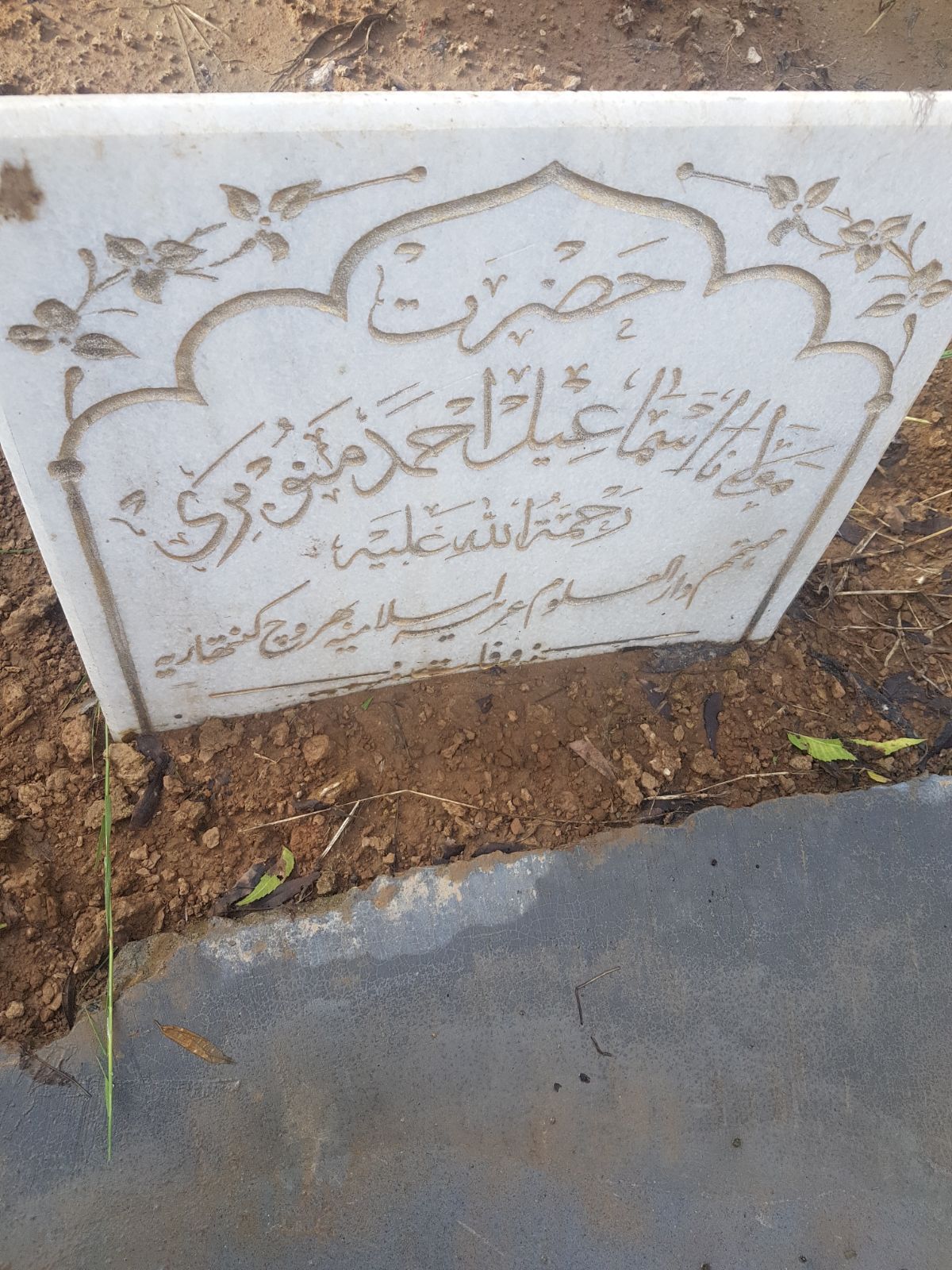
Obituary of Hadhrat Mawlana Ismail Manubari (Rahmatullahi Alayhi)

10th November 2014 / 17th Muharram 1436Grave hadhrat mawlana ismail saheb.jpg

“Hold on to your Salah and Uphold Good Character”

The Final Message of Hadhrat Mawlana Ismail Manubari Sahib (RA)

Hadhrat Mawlana Ismail Sahib (RA) was truly a great man who sacrificed much more than most of us will ever know about.

In one way or another, he has touched and positively benefited each of our lives. The Muslim community of United Kingdom and India specifically, and the wider world more generally, will be forever indebted to him.

Hadhrat Mawlana Sahib (RA) departed this world on Monday 10th November 2014 at approximately 9.25am, UK time, and 2.55pm local India time. The world is so much poorer in every sense today – the death of a scholar is a loss to the whole Universe.

Over the last few months, Hadhrat’s health had deteriorated. Last week, he insisted on returning to India. He left the UK on the morning of Sunday 2ndNovember, accompanied by his son Mufti Abdus-Samad Sahib.

He arrived at Darul Uloom Kantharia on Monday 3rd November and spent the final days of his life there. Hadhrat (RA) devoted his life to the Darul Uloom for several decades.

Despite his poor health, on Thursday 6th November he asked to visit Bachchon ka Ghar Amod, Darul Uloom Jambusar and then on to the village of Kavi where Hadhrat has established a Darul Uloom. It was a tradition of Hadhrat Mawlana Sahib (RA) that, whenever he would visit India, his first trip would be to the village of Kavi and then he would undertake all other journeys.

During his final 4 or 5 days, Hadhrat Mawlana (RA) continued to advise visitors and well-wishers with one of the most important objectives of the Prophet’s (saw) mission – to improve and uphold one’s character.

On Friday 7th November, he travelled to Manubar where Mawlana Ismail Bhuta visited him and asked for advice. Hadhrat Mawlana (RA) replied, “Read the Qur’aan – the whole of the Qur’aan is full of advice.” Mawlana Bhuta insisted that he adds something more. To which, Hadhrat Mawlana (RA) replied, “Uphold your character and conditions of the ummah, as a whole, will improve”. Then Hadhrat Mawlana Sahib (RA) gave examples of how those who were not Muslims were convinced of the truthfulness and merits of Islam as a result of the character of the Prophet (SAW) and his Companions (RA).

This was a consistent message that Hadhrat Mawlana Sahib (RA) relayed throughout his final days.

Hadhrat’s (RA) bed was in the guest room of Darul Uloom Kantharia. On Sunday 9th November, he asked for it to be moved in to the office where he spent countless days and nights as Principal.

On the morning of his last day (Monday 10thNovember), Hadhrat’s son Shafi Bhai and grandson Moulana Rizwan arrived from the UK. He raised his hand to acknowledge them.

At the time of Zuhr, Hadhrat (RA) advised his son Khalid bhai, and others gathered around him, to remain steadfast on Salaah. He instructed all of them to go and offer their Zuhr prayers with jama’at, as this was more important and fruitful than sitting in his company.

Hadhrat Umar (RA) would say, “Hold onto your Salah because if you lose that, you lose everything else.”

Mufti Abdus Samad Sahib described Hadhrat’s last moments as similar to the last moments of our beloved Prophet (SAW).

A few minutes before Hadhrat’s (RA) sad demise from this temporary world to his eternal abode; he asked for his limbs to be straightened and then asked his son Hafidh Sanaullah to turn his face towards the Qiblah. 5 minutes later, he departed from this world – (Innaalillaahi Wainnaailaihi Raaji’oon).

Hadhrat’s janaazah took place at Darul Uloom Kantharia after Isha (Monday 10th November 2014) and Hadhrat was placed to rest in Manubar next to his beloved brother and Founder of Darul Uloom Kantharia Hadhrat Mawlana Adam Sahib (RA). Hadhrat Mufti Ahmed Khanpuri Sahib (DB) insisted that Hadhrat’s son Mufti Abdus-Samad Sahib leads the Janaza prayer that was attended by approximately fifty thousand mourners.

How true are the noble words of the Prophet (SAW), ‘You will die as you lived and you will be resurrected on the Day of Judgment as you died’.

Hadhrat was truly a father figure to all. A most humble, dedicated, sincere, kind, loving, passionate, smiling … person. He always used to address even the youngest in a most respectful way. Very particular about practising the sunnahs of our beloved Prophet (SAW). May he remain happy and smiling forever.

In addition to the thousands of students and ‘Ulama who have graced the numerous institutions founded and overseen by Hadhrat (RA) , he leaves behind a wife, eight children and 99 grandchildren and great-grandchildren.

May Allah (SWT) reward him and his family, with the highest abode in Jannah. May He grant the family, particularly his loving wife Bibi Apa, who has also sacrificed everything for his mission, sabr jameel, and the whole ummah a ni’malbadal, Ameen.

So, his final message to the Muslim Ummah across the world sums up Hadhrat’s own life so well –remain steadfast on your salaah (fulfil the rights of Allah) and uphold good character (fulfil the rights of his creation). This final advice captures the essence of Islam. It is sufficient to reconnect all of us with our Lord, restore the love and respect for Islam and improve the conditions of humanity across the Globe.

To Allah we belong and to him we shall return.

Written by an Alim who wishes to remain anonymous.

Grave hadhrat mawlana ismail saheb.jpg

Categories
Personalities Shaykh Saleem Dhorat

My Beloved Teacher – Hadhrat Mawlānā Ismā’īl Wādī sāhib rahimahullāh

by Hadhrat Mawlānā Muhammad Saleem Dhorat Saheb (hafidhahullāh)

Once, ‘Umar radhiyallāhu ‘anhu asked those around him of a hadīth of the Prophet sallallāhu ‘alayhi wasallam with regards to the trials and tribulations which were to fall upon the Ummah. Hudhayfah ibn Al-Yamān radhiyallāhu ‘anhu, who knew the hadīth, remarked, “Why do you worry about such a fitnah, O Amīr-al-Mu’minīn, when there is a closed door between it and yourself?” When asked who this ‘door’ was, Hudhayfah radhiyallāhu ‘anhu replied, “Umar radhiyallāhu ‘anhu.”

The existence of pious and righteous servants of Allāh ta‘ālā amongst us is a barrier that stops the torrents of evil from emerging and causing havoc. Upon their demise, the doors to these evils are opened, and the people are tested by trials and tribulations. That is why, as time draws nearer to the Day of Judgement (during which trials and tribulations will increase), the passing away of pious servants of Allāh ta‘ālā become more frequent.

In November 2012, a pious and righteous servant from amongst this category, my most honourable and beloved teacher, Hadhrat Mawlānā Ismā‘īl Wādī sāhib rahimahullāh, of Blackburn, UK, passed away. I had studied the revered subjects of ‘aqīdah, hadīth and fiqh under his tutelage when I was studying at Dār-al-‘Ulūm Bury.

My Last Meeting

Alhamdulillāh, I was fortunate to have visited him the weekend prior to his demise, after having been kept informed of his condition during the week. This was despite the fact that I myself was not in the best of health, but Allāh ta‘ālā favoured me greatly by granting me the courage to undertake this very important journey, accompanied by my dear Mawlānā Ahmad Patel and Muftī Ismail Bhayat.

Upon reaching Blackburn, I was treated as always, with love and respect by the members of the household, and was immediately taken upstairs into the room where Hadhrat Mawlānā rahimahullāh was resting. I was grieved to see him lying unconscious on his bed, which was set so that his face was facing the Qiblah, as is the sunnah for the one in his last moments. I was given the opportunity to sit right next to the bed and I sat, holding his hand, reciting surah Yāsīn, and due to love for Hadhrat Mawlānā rahimahullāh, tears began to roll down my cheeks. After a while, Muftī Saalih sāhib, the son-in-law of Hadhrat Mawlānā rahimahullāh and the Imām of Masjid Noorul Islam Blackburn, who loves me dearly, tried to awaken Hadhrat Mawlānā rahimahullāh by informing him of my arrival, but he did not respond. I was informed that he had been in this condition since the morning, and that the doctors had said that he was in his last moments. All his organs had started failing, but the serenity was apparent on his face. The medical experts were unanimous that they had not seen a patient in this condition, who was without any sign of pain, hence he was not administered with morphine. I stayed in the room for at least half-an-hour, silently reciting surah Yāsīn, salāt and salām, dhikr and making du‘ā when we were all asked to leave the room for a little while so that necessary medical checks could be carried out.

When we went back inside, Muftī Saalih sāhib again attempted to inform Hadhrat Mawlānā rahimahullāh of my presence, and this time to my fortune he opened his eyes. Everyone present became delighted. I greeted him with salām, to which he replied. He was made to sit up, and taking this opportunity I placed his hand on my head and requested him to make du‘ā for me and all, to which he obliged. My happiness knew no bounds. I was sure Allāh ta‘ālā had been extremely merciful to me.

This was the highlight of this journey and I was extremely delighted to have had the honour of greeting him and gaining his du‘ā. Thereafter, I advised Muftī Saalih sāhib that the menfolk should leave the room so that the household womenfolk could have an opportunity to visit Hadhrat Mawlānā rahimahullāh also, whilst he was conscious. We went downstairs and sat with the male family members, discussing the life and salient characteristics of Hadhrat Mawlānā rahimahullāh.

Birth and Childhood

Hadhrat Mawlānā Ismā‘īl Wādī sāhib rahimahullāh was born on 28th Jumādā Al-’Ūlā 1339AH/7th February 1921, in Lājpūr, Gujarat, India. He started his elementary Islamic education at the age of 8, started memorising the Qur’ān at 10, and finished in two years at the age of 12, in his home town.

Higher Education

In Shawwāl 1353AH/January 1935, at the age of thirteen, he enrolled in the renowned madrasah Jāmi‘ah Islāmiyyah in Dabhel, India, where he started his ‘Ālimiyyah course. This is where he completed his studies in Sha‘bān 1364/July 1945, except for a year in between during which he studied in Jāmi‘ah Husayniyyah in Rander, India.

During his time in Dabhel, he was blessed to have great luminaries as his teachers. He studied the Sahīh of Imām Al-Bukhārī under Muftī Shafī‘ Al-‘Uthmānī sāhib rahimahullāh and Mawlānā Shams-al-Haqq Al-Afghānī sāhib rahimahullāh; At-Tirmidhī under Mawlānā Zafar Ahmad At-Thānwī sāhib rahimahullāh; and Mishkāt-al-Masābīh and Jalālayn under Mawlānā Badr-‘Ālam Mīrthī sāhib `rahimahullāh. He then went on to further enhance his education at Dār-al-‘Ulūm Deoband, where he studied Ṣaḥīḥ-al-Bukhārī again under Shaykh-al-Islām Mawlānā Husayn Ahmad Al-Madanī sāhib rahimahullāh. He then went to Lahore in Sha‘bān – Ramadān 1365AH/July 1946, studying tafsīr under Shaykh-at-Tafsīr Mawlānā Ahmad ‘Alī Al-Lāhorī sāhib rahimahullāh.

Religious Service

After finishing his education, he returned to his hometown, Lājpūr, and started as an imam in his local masjid. He then travelled to Madagascar in 1952 and settled there, serving the Dīn of Allāh ta‘ālā for 21 years, until he arrived in the UK in 1973. He served as the Imām in Masjid Noorul Islam in Blackburn until he retired in 1988 due to weakness and old age. He also taught at Dār-al-‘Ulūm Bury from 1978-1988, without any remuneration.

Status in Academics

He was both pious and knowledgeable. His level of knowledge can be gauged from the fact that after his graduation he spent many years without having had the opportunity to teach Higher Islamic sciences. As it is common knowledge that after graduation in any field, if a long span of time was to pass by without practicing in that field, the graduate somewhat loses touch with the sciences learnt. However, Hadhrat Mawlānā Ismā‘īl Wādī sāhib rahimahullāh, despite such a lengthy gap between graduation and the opportunity to teach, taught these difficult subjects and satisfied his students.

Khilāfah

Hadhrat Mawlānā Ismā‘īl Wādī sāhib rahimahullāh was in his nineties at the time of his demise, and Allāh ta‘ālā had blessed him with a life of unimaginable steadfastness and piety. He attained khilāfah (discipleship) from the esteemed late Shaykh Ghulām Habīb sāhib rahimahullāh during hajj in 1974, and from Hadhrat Mawlānā Abrār Ahmad Ad-Dhulyawī sāhib rahimahullāh, who was the khalīfah of Qārī Muḥammad Tayyib sāhib rahimahullāh.

His ‘Ibādah (worship)

He was an embodiment of steadfastness, a true and dedicated Muslim who was always connected to the masjid, had true love for the Qur’ān and for standing in ṣalāh for long durations. He was very punctual in Tahajjud, reciting 10-12 Juz’ daily, which he increased to 15 in the latter stages of his life. This meant that he would complete approximately one recitation of the Qur’ān every day, including the portions he would read in other nawāfil and otherwise.

In winter, he would go to the masjid before Zuhr and return after ‘Ishā! He would remain engaged in ‘ibādah. He would stand in qiyām for hours. I once went to the masjid after Maghrib salāh to meet him, where I found him alone, engaged in salāh. I waited for him for approximately an hour, but there was no sign of him going into rukū‘ and I had to leave without meeting him, because of prior commitments.

Salāh with Jamā‘ah

Whilst he was the Imām at the masjid, he did not miss a single ṣalāh during the fifteen years, and even after retiring in 1988, for a full twenty years before his illness in 2008 did not miss a single takbīr-at-tahrīmah (The first takbīr of salāh).

Once, during the period after 2008, he arrived late into the masjid and missed one rak‘ah. He stood in qiyām of that one rak‘ah for so long that the masjid emptied. When he finished, he was asked regarding his lengthy qiyām, to which he replied that today, I missed one rak‘ah, so recited two and a half juz’, and reprimanded the nafs saying, “Even at this old age, you still cannot arrive on time for salāh?” This was when he was approximately 80 years old.

Adherence to the Sunnah

Hadhrat Mawlānā rahimahullāh was also very particular with regards to sunan, mustahabbāt and ādāb. Once, while in hospital and very weak, he felt the need to relieve himself. With the assistance of his son, he made his way to the toilet, which was at quite a distance. Upon reaching the toilet, he realised that he had forgotten his topī (head gear). He insisted and his son had to make him sit at an appropriate place, retrieve the topī from his bedside and it was only then that he entered the toilet.

Humbleness

Despite such excellent qualities found in his life, he lived a simple life very much unknown by the general public, and would dislike being brought into the limelight.

Hadhrat rahimahullāh and the IDA

He had much love for this humble one, and would always enquire and ask about the Islamic Da‘wah Academy and its progress. Rather, I regard his blessed du‘ā to be one of the main catalysts for the success of the Islamic Da‘wah Academy.

In 1996, a few days after the purchase of the property where the Islāmic Da‘wah Academy is today, we were fortunate that Hadhrat Mawlānā rahimahullāh visited Leicester. Upon my request, he came into the former building and asked for some seating arrangements to be made. As the building had just been purchased, there was no carpet inside, hence a piece of carpet was brought and Hadhrat Mawlānā rahimahullāh, myself, and the rest of those present sat down. Hadhrat Mawlānā rahimahullāh asked someone to recite a portion of the Qur’ān and thereafter gave a few advices. After his short talk ended, he sat looking downwards, deep in thought. He then suddenly looked up and said to me, “Mawlānā! Make an intention to initiate a Dar-al-‘Ulūm here!”

I was taken aback by this instruction, as this area and building had just been bought, for the sole intention of expanding the IDA’s da‘wah activities and to cater for the evening classes which were taking place at the time in the premises of the IDA on 186 Melbourne Road. For this reason, I did not reply, as I felt that it would be incorrect to make such a promise when the intention was not there. However, Hadhrat Mawlānā rahimahullāh continued to insist. At this point, I thought to myself that inshā’allāh, it would be possible to teach three or four years of the ‘Ālimiyyah course in the future, and mentioned accordingly to Hadhrat Mawlānā rahimahullāh. He replied, “No! You must continue until Al-Bukhārī and you must teach [Sahīh-] Al-Bukhārī!” Upon this, I thought that a very pious person is insisting on a pure and good cause, therefore I should follow his instruction, and eventually I made the intention and requested Hadhrat Mawlānā rahimahullāh to make du‘ā. He was so serious regarding this instruction of his that after this, whenever I would meet him, he would ask with regards the progress of the Dār-al-‘Ulūm and further emphasise that I must continue running the madrasah up until the final year wherein Sahīh Al-Bukhārī is taught, and to teach it myself.

Demise and funeral

This very affectionate teacher of mine breathed his last on Monday, the 6th of Muharram, coinciding with the 19th of November 2012, when the adhān of Maghrib salāh was being called out. I was grieved with this sad news. An announcement was made at the IDA for du‘ā and īsāl-ath-thawāb for the respected Hadhrat Mawlānā rahimahullāh, and the following day I, along with approximately eight members from the staff of the IDA arrived before Zuhr ṣalāh at Masjid Noorul Islam. There, in the foyer was my beloved teacher, resting in peace after his hard work of ninety years. Before ‘Asr, the salāh-al-Janāzah was led by Hadhrat Mawlānā rahimahullāh’s son, Shaykh Qasim hafizahullāh, and was attended by hundreds of people, including leading personalities from all over the UK. Finally, he was laid to rest just before Maghrib ṣalāh in Blackburn cemetery.

May Allāh ta‘ālā forgive his shortcomings, fill his grave with nūr and make it a garden from the gardens of Jannah, and elevate his rank in the Hereafter. It is my fervent desire that each associate of mine perform whatever good he/she can and ask Allāh ta‘ālā to write its reward in his book of deeds. May Allāh ta‘ālā grant him all the good of the Hereafter and the company of the Ambiyā, the Siddīqūn, the Shuhadā and the Sālihūn in Jannah-al-Firdaws. Āmīn.

Courtesy: Riyādul Jannah, Vol 22 Issue 1 (January 2013/ Rabī‘ul Awwal 1434)

Categories
Shaykh Saleem Dhorat

‘Īd-ul-Fitr

By Hadrat Mawlānā Muhammad Saleem Dhorat hafizahullāh

The Night of ‘Īd
The nights of both ‘Īds are described in the hadīth as amongst the great and sacred nights in the Muslim calendar. To remain awake on the nights of ‘Īd and perform ‘ibādah is a source of great virtue and reward.

1. Abū ‘Umārah radhiyallāhu anhu relates that Rasūlullāh sallāllahu ‘alayhi wasallam said:

Whoever stays awake and performs ‘ibādah on the night of the two ‘Īds, with hope for abundant reward (from Allāh ta’ālā), his heart will not die on the day (i.e. Qiyāmah) when all hearts will be dead. (Targhīb)

2. Mu‘ādh Ibn Jabal radhiyallāhu anhu relates that Rasūlullāh sallāllahu ‘alayhi wasallam said:

Jannah is wājib (incumbent) for those who stay awake with the intention of making ‘ibādah on the following nights: 8th, 9th, 10th, of Dhul Hijjah, the night of ‘Īd-ul-Fitr and the night of the 15th of Sha‘bān. (Targhīb)

3. Imām Shafi‘ī rahimahullāh said: “Du‘ās are answered on the nights of Friday (the night between Thursday and Friday), the nights before the two ‘Īds and the 15th night of Sha‘bān.”

Sunnats of the Day of ‘Īd
1. To rise early.
2. To clean the teeth with miswāk.
3. To have a masnūn bath.
4. To dress in one’s best garments in an Islamic manner.
5. To use ‘itr (apply fragrance).
6. To eat dates or any other sweets before going for the ‘Īd-ul Fitr Salāh.
7. To go early for ‘Īd Salāh.
8. To go walking for ‘Īd Salāh.
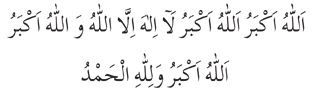
9. To read the Takbīrāt of Tashrīq in a low voice while going for the ‘Īd Salāh.


Allāhu akbar Allāhu akbar lā ilāha illallāhu wallāhu akbar
Allāhu akbar wa lillāhil hamd

10. To use different routes to and from the place of ‘Īd Salāh.
Mas’alah: It is harām to fast on the 10th, 11th, 12th, and 13th of Dhul Ḥijjah, (i.e. on ‘Īd-ul-Ad’hā and three days after) and the day of ‘Īd-ul-Fitr.

The Method of ‘Īd Salāh

1. Make niyyah (intention) of performing two raka‘āts wājib of ‘Īd-ul-Fitr behind the imām, with six wājib takbīr.
2. The first takbīr in the first rak‘ah is the takbīr tahrīmah which is followed by three wājib takbīr. Raise your hands to the ears in all four takbīr (saying the takbīr). However, after the first takbīr fold the hands under the navel and read thanā (sub’hānakallāhumma…). Thereafter, in the following two takbīr raise the hands up to the ears and drop them on the sides and after the fourth takbīr fold them again.

3. The imām will recite Sūrah-al-Fātihah and another sūrah and go into rukū‘ and sajdah etc. as usual.

4. In the second rak‘ah, after the recitation and before rukū‘ another three takbīr will be called. In all three takbīr raise the hands to the ears and drop them on the sides and go into rukū‘ when the fourth takbīr is called.

NOTE: Four takbīr are said together in each rak‘ah; at the beginning of the first rak‘ah and before going into rukū‘ in the second rak‘ah. The easy method of remembering when to drop the hands and when to fold is mentioned hereunder:

(a) Remember the following words: Fold, drop, drop, fold, for the first rak‘ah and drop, drop, drop, rukoo‘, for the second rak‘ah.
(b) Or keep the following general rule in mind: when there is something to be recited after a takbīr; the hands should be folded and when nothing is to be recited the hands are to be dropped to the sides.

Mas’alah: It is makrūh to offer any salāh in the masjid where the ‘Īd Salāh is to be performed, before or after the ‘Īd Salāh.

Mas’alah: It is also makrūh to perform any ṣalāh at home before the ‘Īd Salāh, but it is not makrūh after the ‘Īd Salāh. Hence, we should not perform nafl Salāh such as Ishrāq on ‘Īd day.

Mas’alah: If anyone missed the ‘Īd Salāh then he cannot offer it individually.

Mas’alah: Khutbah after the ‘Īd Salāh is sunnah. However, the listening of the khutbah is wājib.

Mas’alah: If anyone joins the ‘Īd Salāh after the imām has said the three takbīr in the first rak‘ah he should say his three takbīr immediately. If he joins while the imām is in rukū‘, then if he feels and has strong hope that he will say three takbīr and join the imām in rukū‘ then he should complete the takbīr before going into rukū‘. Otherwise he should join the imām in rukū‘ and say the three takbīr instead of the tasbīḥ of rukū‘.

NOTE: Whilst saying the takbīr in rukū‘, he should not raise his hands.

NOTE: If the imām rises from rukū‘ before one’s takbīr are completed, one should also rise with the imām and his takbīr will be remitted for him.

Mas’alah: If anyone missed the first rak‘ah and joined the imām in the second rak‘ah, he should say the three takbīr of the first rak‘ah after the recitation when he gets up to complete the missed rak‘ah. 

Mas’alah: If anyone joined the imām in the second rak‘ah after rukū‘, then he should perform two raka‘āts as mentioned above.

© Islāmic Da’wah Academy


• Please forward this message on to all your contacts

Categories
Ramadhan Shaykh Saleem Dhorat

When is Eid?

eid

This is a question on the tongues of many Muslims and in the minds of many already, as we near to the end of the holy month. Eid is a day of happiness and bliss. A festival ordained by Allah SWT, so much so, it is Haram to fast on the days of Eid (1st Shawwal, 10th, 11th, 12th, 13th Dhul Hijjah). But the question still remains brothers and sisters, “When is Eid?”

The answer to that is not one word or one day. One of the Salaf said, “My Eid is the day in which I do not commit a sin.” Further to this, I recently listened to a talk by his eminence, the honourable, Shaykh Muhammad Saleem Dhorat Saheb (Hafidhahullah) of Leicester, UK. He explained when the ‘true’ Eid is, it really changed my perspective on Eid and this temporary life we are passing through. Below are a few things I happened to remember:

We do not know when we will depart from this transient and fleeting world, neither you know neither I know. Life and death are not guaranteed, perhaps this is the last advice of mine you will hear (because I no longer remain or you don’t). I plead to you sincerely with advice, cut off from your life of sins. Leave the television, music, lustful glances at Haram, the love of wealth, following your desires, all of this will be left behind (once you die). We have all fasted the month of Ramadhan, Alhumdu Lillah! Don’t you feel proud of yourself? Of course you do! This is the difference between sins and obedience. When you sin, the happiness is temporary, just five or ten minutes. But in obedience it is long lasting e.g. 20 years later you will remember these fasts, the Qur’an you read, the one Subhan Allah you said in the Masjid. And you will feel joy in your heart, this joy is forever and ever.

This is only when you obey Allah SWT, then every hour and every minute is Eid for you.

The moment you die, then your soul is content and happy, ready to return to Allah SWT, this will be Eid for you.

The angels will descend to welcome you, this will be Eid for you.

The moment you are lowered into your grave, like a garden of Jannah, this will be Eid for you.

On the day of judgement, Allah will give you shade under His throne, this will be Eid for you.

When you are given your books of deeds in the right hand, this will be Eid for you.

Crossing the bridge of sirat at the speed of lightning, this will be Eid for you.

Then, your final abode, Jannah! Allah’s angels will great you, “Salam! Salam!” This will be Eid for you.

Just imagine the angels doing Salam, the ecstatic feeling in your heart…

“The Messenger of Allah recited this Verse: ‘For those who have done good is the best reward and even more.’

 Then he said: ‘When the people of Paradise enter Paradise, and the people of the Fire enter the Fire, a caller will cry out: “O people of Paradise! You have a covenant with Allah and He wants to fulfil it.” They will say: “What is it?” Has Allah not made the Balance (of our good deeds) heavy, and made our faces bright, and admitted us to Paradise and saved us from Hell?” Then the Veil will be lifted and they will look upon Him, and by Allah, Allah will not give them anything that is more beloved to them or delightful, than looking upon Him.'” (Ibn Majah)

This will be Eid!

The Prophet (ﷺ) said, “Allah will say to the people of Paradise, “O the people of Paradise!” They will say, ‘Labbaik, O our Lord, and Sa`daik, and all the good is in Your Hands!’ Allah will say, “Are you satisfied?’ They will say, ‘Why shouldn’t we be satisfied, O our Lord as You have given us what You have not given to any of Your created beings?’ He will say, ‘Shall I not give you something better than that?’ They will say, ‘O our Lord! What else could be better than that?’ He will say, ‘I bestow My Pleasure on you and will never be angry with you after that.’ “ (Bukhari)

This will be Eid!

The Eids in the world will come and go, that happiness will come and go. A new child is born it is temporary happiness, you children’s wedding, the happiness is temporary. But the real happiness is the happiness of obeying Allah, pleasing Allah, having the love of Allah and feeling His benevolence. This is when every day is Eid, every night is Eid, every hour is Eid, in hardship you will feel it is Eid and in ease you will find it is Eid.

O Allah! Accept from us our Fasting, Tilawah, Sadaqah, Zakah, Qiyam and Taraweeh.

O Allah! Make this Ramadhan such, that I become a Wali of yours.

O Allah! Free our necks from the fire of Hell and grant us Jannah.

O Allah! Make this Ramadhan a turning point in our lives, so we become closer to You.

O Allah! Make this Eid a true Eid for us, one in which we abstain from disobedience and keep us all steadfast.

Ameen.

eid lantern

Ismail Ibn Nazir Satia (One who is in dire need of Allah’s forgiveness, mercy and pleasure)

27th Ramadhan 1437


Categories
Shaykh Saleem Dhorat

A Perfect Muslim

By Hadrat Mawlānā Muhammad Saleem Dhorat hafizahullāh

The Prophet Muhammad sallallāhu ‘alayhi wasallam has stated:

A (complete and perfect) Muslim is one from whose tongue and hand people are safe. (An-Nasa‘ī)

To be a perfect Muslim it is necessary to fulfil all of the requirements of Islām. One of these is to ensure that one does not cause harm to another human being, Muslim or non-Muslim. This is an extremely important component of the teachings of Islām.

In the above hadīth, the Prophet sallallāhu ‘alayhi wasallam’s use of the word ‘tongue’ encompasses all forms of speech, whilst the word ‘hand’ represents all physical actions. It means therefore, that no one can be a perfect Muslim unless the rest of Allāh ta‘ālā’s  bondsmen are safe from any harm originating from him.

Someone who performs salāh, pays zakāh, observes fasts, recites the Qur’ān in abundance and gives plenty in sadaqah cannot be classed a perfect believer if at the same time he also causes people heartache through his words or actions.  A person who, without any valid reason, causes hurt to another human being is a Muslim, but not a perfect or complete Muslim.

The religion of Islām branches out into five major areas: ‘aqā’id (beliefs), ‘ibādāt(worship), akhlāq (morals and character), mu‘āmalāt (transactions) and mu‘āsharah(etiquettes of social life). The branch of mu‘āsharah, or social etiquettes, is based on the above-mentioned saying of the Prophet sallallāhu ‘alayhi wasallam. In today’s climate, there can be no more effective method of popularising Islām than the world’s Muslims embracing this branch of faith and living in accordance with it. If Muslims adopt the Islāmic etiquettes of social interaction, it will dispel the many misunderstandings created about Islām and Muslims, making it much easier for non-Muslims to understand and come closer to Islām.

Adopting the Islāmic way of dealing with people gives rise to occasions when a Muslim’s compassionate nature stands out. Intelligent people invariably pick up on such behaviour and become curious as to why, for example, a Muslim in a position to say or do something hurtful to another person does not do so. A time eventually comes when they enquire from the Muslim in question, presenting an opportunity for him to explain that he was only doing what the Prophet Muhammad sallallāhu ‘alayhi wasallam taught, and that it is a major principle of Islām that no human being should be caused undue distress.

This is an extract from the booklet ‘Islām: A Message of Mercy’ published by
the Islāmic Da’wah Academy.


• Please forward this message on to all your contacts