Islam has no priesthood. Yet amongst parts of the conservative Muslim community, particularly in South Africa, we have almost created one. I have seen ulama treated like rock stars. Feted, fawned over and placed on pedestals, with people behaving as though they are in the presence of someone almost beyond ordinary Muslims. Respect for knowledge is one thing.
Hero worship is another. It reminds me, in some ways, of the enormous power once exercised by the Catholic Church and its clergy. The institution became so powerful and its clergy so revered that questioning the priest could almost be treated as questioning the religion itself. At its worst, that kind of devotion could become almost cult-like. Islam was never supposed to work like that. We have no Pope, no priesthood and no religious caste standing between us and Allah SWT. Yet sometimes we behave as though we do.
BLIND FAITH KILLS ACCOUNTABILITY
Question the Maulana and suddenly you are a jahil. Your knowledge is questioned. Your intentions are questioned. Sometimes even your Islam is questioned. The man becomes bigger than the argument. We strongly reject the Shia belief in infallible Imams, yet some behave as though their own Maulana can never be wrong. They would never call him infallible, but look at the behaviour. His mistakes are explained away, his excesses defended and his insults excused. His followers rush to protect the man rather than examine what he actually said. That is not respect. That is blind following. And blind following destroys accountability.
RELIGIOUS CHAUVINISM
Then there is the religious chauvinism. A layperson asks a legitimate question. Instead of answering it, the response is: Who are you? What have you studied? How many years were you in madrasa? Of course scholarship matters. An alim has knowledge the layperson may not possess. But dismissing the person instead of answering the question reeks of arrogance, not scholarship. Being an alim does not mean everyone else must switch off their brains. If your argument is strong, answer the question.
LOOK AT WHAT WE HAVE NORMALISED
Some peddle hatred and constantly demonise and denigrate other Muslims and ulama with whom they disagree. The disagreement stops being about ideas and becomes personal. Vulgar language, insults, character attacks and labels. There is also a disturbing penchant for demeaning women. Women who fall foul of certain religious personalities can be subjected to disgusting language and even called prostitutes. This language is then excused because it came from an alim. It should be the opposite. An alim should be held to a higher standard of conduct, not a lower one. Then, of course, there is the visceral hatred of the Shia, pumped out over the airwaves and from lecture platforms. Theological disagreement is one thing. Constant hatred and demonisation is another. This is conduct unbecoming of an alim.
BRAVE AGAINST THE WEAK, QUIET BEFORE POWER
And here lies another contradiction. We can tear another Muslim apart over a theological disagreement but become strangely cautious around power, wealth and rulers. If your courage only works downwards, against people with less power than you, what kind of courage is that?
WHEN PEOPLE BECOME AFRAID
Then we come to something even more disturbing. There have been allegations of threats of violence from murids and followers against people who challenge powerful religious personalities. Mosques can be bullied and pressured into conformity. Critics are intimidated. People become afraid to speak. Many simply keep quiet because they know the abuse and intimidation that may follow. When Muslims are frightened to question an alim because they fear what his followers may do, something has gone terribly wrong. That is not healthy respect for scholarship. That is fear. When murids turn loyalty to a conservative scholar into unquestioning obedience, enforce conformity through intimidation and punish dissent, sometimes with the scholar’s nod and consent, devotion has crossed the line into a coercive cult.
THE COCOON
And perhaps this helps explain some of it. For decades, particularly during apartheid, parts of our religious establishment were comfortably ensconced within a Hanafi-Deoband cocoon. They knew that world, its debates, its language, its personalities and its boundaries. Then the world opened up. Suddenly they had to engage with a much bigger and more complicated world: politics, media, Islamophobia, war, international relations, Western governments, Muslims living as minorities, modern workplaces, social change, other Muslim traditions and people who simply do not share our worldview. Zionism. Hindutva. Christian nationalism. And sometimes they appear lost when forced to engage with that wider world. So what happens? Retreat to familiar territory. Attack the Shia. Attack another alim. Call the layperson a jaahil. Decide who is Ulama-ul-Haq and who has deviated. It becomes a deflection from the real problems facing the Ummah. The world is changing around us while we fight amongst ourselves over who has the right to wear the mantle of religious authority. That is not evidence of strength. It is symptomatic of weakness.
RESPECT IS NOT WORSHIP
Knowledge should bring humility, wisdom and restraint. A turban does not make vulgarity respectable. A title does not make arrogance Islamic. Years in a madrasah do not make a man infallible. And scholarship does not place anyone above accountability. Respect the ulama. Learn from the ulama. Honour the ulama. But do not turn them into rock stars. Do not fear them. Do not surrender your ability to think. And do not create a priesthood Islam never gave us. Because the moment the question changes from “Is he right?” to “How dare you question him?”, we have stopped defending scholarship. We have started defending power.
Those who have selected ta’līm as their occupation, they have been classed as the best of people by Nabī ﷺ.
خَيْرُكُمْ مَنْ تَعَلَّمَ الْقُرْآنَ وَعَلَّمَهُ
Abū Abdur-Rahmān as-Sulamī who narrated this hadīth to his students from Hadrat Uthman said that it is this hadīth which is the reason for me sitting here today. From the time of Hadrat ‘Uthmān to the time of Hajjāj bin Yūsuf, he continued teaching in one place, one Masjid – and it was due to this hadīth. Hence, those who teach are very valuable in the sight of Allāh.
The ‘Ulamā are the inheritors of the Anbiyā. What is their duty? Ta’līm and Tarbiyyah.
After Ibrāhīm AS made the house of Allāh with Ismā’īl AS, he didn’t stop there, but he made the above du’ā – he asked to send someone with these specific four qualities. The first three of these qualities are connected to ta’līm and the last one is connected to tarbiyyah.
If we summarise these missions, they come down to two things – Ta’līm and Tarbiyyah.
Nabī ﷺ has said,
إِنَّمَا بُعِثْتُ لِأُتَمِّمَ صَالِحَ الأَخْلاقِ
إِنَّمَا بُعِثْتُ مُعَلِّمًا
There is no one better than Nabī saw in this world – Allah gave him knowledge and did his tarbiyyah
So Allah gave Nabī ﷺ ta’līm, hence he was a muta’allim, and Allah did his tarbiyyah so he was murabba at that time. He then became the murabbī and mu’allim of this ummah. He did ta’līm and tarbiyyah of this ummah.
إِنَّ الْعُلَمَاءَ وَرَثَةُ الأَنْبِيَاءِ
This duty was then passed onto the people of knowledge. It is a great virtue and a tremendous ihsān from Allāh ﷻ upon those who take on this responsibility. Our job is Ta’līm and Tarbiyyah. Our responsibility is Ta’līm and Tarbiyyah. When we sit for 2–3 hours in a maktab, our purpose should always be Ta’līm and Tarbiyyah.
Take an example: if a man doesn’t know that his purpose is to go to town and buy a coat, he may go—but he won’t know which shop to enter or what to do. If he doesn’t know what he’s buying, he won’t know where to go. However, if a child knows his mother has given him money to buy chocolate, he will go to the right shop, in the right area, and buy the right thing. The point is: when you know the purpose of something, you won’t waste time—you’ll fulfil the duty.
The purpose of our teaching is Ta’līm and Tarbiyyah.
Our job is to teach both ‘Ilm and ‘Amal. It’s not enough to just say, “We should lower our gaze.” We must also teach how to do that. A weakness today is that we say what needs to be said, but we don’t forbid the wrong in practice. If someone is doing something wrong, it’s either due to a lack of knowledge or a lack of tazkiyah.
Tarbiyyah is not done through r’ub and khawf , but through shawq (desire) and muhabbah (love). A child should look forward to your class and your lessons. From the morning, they should be waiting eagerly for 5pm. If they develop love for you, they will want to come. That is how you do their Tarbiyyah—through muhabbah. The child’s progress in Ta’līm and Tarbiyyah is directly tied to your progress towards the ākhirah.
Story of Muhājir Umm Qays: Nabī ﷺ was giving Tarbiyyah. If a mistake was not corrected, the mistake would have continued.
There is a difference between parhāna (to lecture) and sikhāna (to teach practically). If you take a recipe book and explain the recipe of biryani in an excellent manner, the girls won’t be able to make biryani just from that. That is parhāna. But sikhāna is different—you have to teach practically too. You teach the knowledge, but you also teach how to implement it.
A young man once came to Nabī ﷺ and said he felt the urge to commit zina. If it was only about propagating, Nabī ﷺ would have just said, “It is harām.” But Nabī ﷺ knew the boy already had the knowledge—what he lacked was Tarbiyyah. So Nabī ﷺ began his Tarbiyyah: he asked the young man how he would feel if someone did this with his mother, daughter, or sister. The boy replied that he would dislike it. Nabī ﷺ explained that the woman he wishes to commit adultery with is also someone’s daughter, sister, or mother.
Notice—Nabī ﷺ did not shout at him. He did not say, “How dare you ask such a thing? Don’t you know zina is harām?” Instead, he gave Tarbiyyah. Then, he placed his hand on the young man’s chest and made du‘ā:
“O Allāh, forgive his sin, purify his heart, and protect his chastity.”
After this, the young man never even looked at a non-mahram. This was the extent to which Nabī ﷺ went in doing Tarbiyyah.
We really need to understand our purpose.
Before leaving the house, we should think: I am going to do Ta’līm and Tarbiyyah of my students. I must teach them knowledge and also how to practice it.
In the villages of India, even if a teacher wasn’t an ‘Ālim, he had concern (fikr) to see whether the students attended the masjid for ṣalāh.
A teacher should never be absent—not even once. Absence removes barakah. Be present physically, mentally, and wholeheartedly. The children’s time is an amānah. I go as far as saying that we shouldn’t even look at our mobile phones in class—that is khiyānah.
We should always feel the need for the suhbah of the buzurgs. When things succeed, we shouldn’t think it’s due to our own efforts, but rather the du‘ās of our teachers.
The entire time should be spent behind the students—even during exams, don’t read your own books. Help them revise. Ml Islām ul Haq would listen to us—he didn’t just say, “Revise with one another” whilst he sat observing. He would listen to us even during exam time. He didn’t even need to open the kitāb. He listened to sabak every day of every child, sometimes even correcting us firmly when needed.
If you’ve finished sabak earlier one day, still occupy the children’s time.
Qārī Raheem Baksh, a student of Qārī Panipatti, always arrived 5–10 minutes early and left 5–10 minutes late. If he had to travel abroad, even if his flight was at 2pm, he wouldn’t simply give a holiday. He would teach until he had to leave for the airport. And when he returned, if there was still time left in the day, he would first go to teach and only then return home.
Hadrat Qārī Siddīq Bandwi continued teaching even when his wife passed away. He was in great sorrow and wanted to cry—he would go to the toilet as an excuse to weep, then return to continue teaching. But he never left his Ta’līm.
If a madrasah is closed for a week due to issues in the building, how many teachers feel sad that the children are missing days of learning? Instead, many feel happy. This shows we don’t truly understand our purpose. If one madrasah has 50 days of holiday and another has 40, the second group should be happy for having ten extra days of Ta’līm, while the first should feel sad for having ten fewer—but today, it’s often the opposite.
We should note this and change our mindset. When school holidays began, my father would call students from the morning. Whether there was a wage or not, he would make them understand the value of using the holidays. He encouraged them to do a few extra ajzā’. He would take them with him to ẓuhr. If a child had not completed his lesson, he would keep him until he had finished—even if it was until 8pm because of just one student. It was not easy.
Once, my father slipped due to a frosty surface and broke his hand. We rushed him to hospital, and by the time we returned home, it was nearly ‘aṣr. He quickly prayed ẓuhr and told me: “Go tell the mosque secretary that I have fever and a broken hand, so I cannot come to the mosque—but send the children to my house instead.” My mother said, “Leave it for one day.” But he replied, “Sabak cannot be missed.”
There are countless stories like this from our pious predecessors. Qārī Siddīq Bandwi writes about his teacher, Qārī Abdul Haleem. When asked to teach sab‘a qirā’āt, he replied: “I don’t have time. But after ẓuhr, the class I teach hidāyah to take 7–8 minutes to organise their kitābs. If you come then, I can teach you in those 7–8 minutes.” Later, he added: “Come after ‘ishā’ as well.” After some time he said: “Even this won’t be enough to complete within a year. So come from tahajjud till fajr.” The students would sleep in his house, and after praying tahajjud, he would wake them up and teach them until fajr.
We should put effort not only on the bright students, but also on those who struggle. A teacher once said to me that he wanted to stop teaching maktab because his class that year wasn’t as bright as previous cohorts. I told him to continue—and at the end of the year, he felt a great sense of satisfaction.
There was a ḥifẓ teacher who complained to me about a student who could only learn three lines a day. I asked him: “What would you do if he was your own child?” The boy continued and eventually completed his ḥifẓ in seven years, later becoming an ‘Ālim. Due to the patience of his teacher, the child achieved so much.
Nabī ﷺ said: “I am to you like a father is to his son.” Imām Shāfi‘ī mentioned that as a child, being an orphan, he received less attention from his teachers. Burhān al-A’immah, when students came to him after fajr, would teach them until midday, and only then would he teach his own son. His son complained: “You teach them at the best time, but me at the hardest time (when people are sleepy).” His father explained: “The others come from far away, so they deserve priority.” Both father and son sacrificed. Whoever puts effort on other people’s children, Allāh ﷻ will not deprive their own.
A teacher has limited time, but it is his duty that if someone does not understand, he should teach them again in his free time. Imām Shāfi‘ī explained something 17 times to a student who still didn’t understand. Out of embarrassment, the student left. Imām Shāfi‘ī called him back and said: “I will explain again.”
Rabi‘ ibn Sulaymān, a beloved student of Imām Shāfi‘ī, once heard his teacher say: “If I could feed you knowledge, I would feed it all to you.”
Every father wants better for his child. A sincere (mukhlis) teacher also wishes the same—that his students’ rank surpasses his own. Qārī Raheem Baksh could not eat if a student had failed to deliver sabak. At night, he would turn restlessly and do istighfār, thinking the fault lay in his own shortcomings.
We should have immense love for our students. Ml Mamlūk ‘Alī Sāhib would check on every student. If he heard that one was ill, he would travel far to visit him.
At Jāmi‘ah Islāmiyyah (Fatehpur), there was a principal, Maulānā Zuhoorul Islām. Once, a student became ill and cried when Mawlānā visited him. Hadrat comforted him, then went to the masjid to pray two rak‘ahs. His khādim overheard him making du‘ā: “O Allāh, this child has come from far. If shifā’ is not written for him, and death is written for him, then I also have a son—‘Aṭiyyatullāh. Take him instead.” Shortly after, he received news that his son was gravely ill. Before he could reach home, ‘Aṭiyyatullāh had passed away, while the student had recovered.
Even maktab teachers should do mutāla‘ah. They should think: How can I explain this to a child of such-and-such age? Mufti Sa‘īd Ahmad Pālanpūri once advised: “The time you spent in mutāla‘ah during your student days, now spend that much time thinking about how to teach in a way that your students can grasp that information.”
We should have the following bātinī asbāb:
Reverence
We should regard the spreading of knowledge as something great in our hearts. Allāh ﷻ sent an angel to our beloved Nabī ﷺ and chose the month of Ramadān and such a blessed place (Makkah). We should have love and reverence for this knowledge. There is a noticeable difference between a teacher who has azmat for knowledge in his heart and one who does not.
Love
Have love in your heart—for Allāh, for the students, and for the knowledge itself.
Sincerity
One should be sincere. There is nothing wrong with taking a wage. However, there is a difference between teaching for Allāh ﷻ and accepting a wage for livelihood, and teaching purely for the wage. Do we come to the madrasah just for the wage? Do we switch to another madrasah solely because it pays better? Teaching without ikhlās is one of the worst things.
Taqwā
We should maintain taqwā in our hearts. Find a murabbī who can guide you—there are many shuyūkh around. Be serious and have concern for your own Tarbiyyah. How can we give Tarbiyyah to others if we lack it ourselves? We should be good examples for our students. Often, we instruct students to do something, yet we do not follow it ourselves—such as giving salam when entering the classroom or sitting appropriately. Our environments of madrasah should also be based on taqwa.
Hadrat Mawlānā Hashim, a very affectionate teacher of mine, once said that next to Jogwar Dārul ‘Ulūm, there is a vast piece of land. He suggested to Qari Siddeeq Sb that we should establish a Dārul ‘Ulūm for girls there and construct a large wall as a barrier between the two institutions. He also proposed that the holidays be arranged so that when the girls are going home, the boys are not present, and vice versa. For example, boys would have a holiday one day, and the girls would have their holiday the next day. Qari Siddeeq Sb listened to this proposal but responded thoughtfully:
“You may build a physical barrier between the two, but there is no barrier between thoughts and hearts. What wall can prevent thoughts like, ‘Such-and-such a girl from such a place is studying there’?”
I mention this because today we are familiar with all the rules and regulations, but as Mufti Shafi Sb said, “The biggest mufti is your heart.”
What is the meaning of parda? It means ensuring that thoughts of non-mahrams or inappropriate thoughts do not enter the heart. A niqab alone cannot achieve this. Someone once remarked that he found niqāb-clad women more of a fitna than women without a niqab. When I asked why, he explained that with a woman without a niqab, her reality is visible, but with a niqāb, the imagination of the nafs takes over. Our elders were extremely cautious about this. There should be taqwā in the madrasah: no casual messaging between genders, no unnecessary interactions. A mahram is a mahram, and a ghayr mahram is a ghayr mahram. Meetings shouldn’t take place with both genders in the same room, even with a niqāb.
In our madrasah, IDA, we currently combine lessons for girls and boys in Mishkāt and Daurah years. Insha’Allāh, we plan to make it fully independent in the future. During lessons, complete seriousness is maintained. Even sensitive hadiths, such as those about nāqisāt-‘aql, are never joked about. Besides one teacher, no one knows how many girls are studying or whose daughters are enrolled. Even I do not know how many girls are currently studying in Daurah Ḥadīth.
Before going to a lesson, when leaving your home, start by making du‘ā—for protection from Shayṭān and that you may fulfill the duty entrusted to you. Ask yourself: have I made enough preparations? After teaching, do shukr and istighfār. Ask yourself: did I teach the way I was supposed to?
Keep a connection with your elders—they have basīrah, and the nūr of ‘Ilm and Taqwā!
By Shaykhul-Hadith, Hadrat Mawlana Muhammad Saleem Dhorat damat barakatuhum
Virtues of Udhiyah
• Udhiyah is a practice commanded by Allah ta‘ala:
..So turn in prayer towards your Rabb and sacrifice (animals). (108:2)
• The son of Adam does not carry out on Yawmun-Nahr (10th Dhul- Hijjah) a deed more beloved to Allah than the animal sacrifice. The sacrificed animal shall come on the Day of Judgement with its horns, hair, and hooves (to be weighed). The sacrifice is accepted by Allah ta‘ala before the blood reaches the ground. Therefore, sacrifice with an open and happy heart. (At-Tirmidhi)
On Whom is Udhiyah Wajib?
• Udhiyah is wajib on every Muslim who is of sound mind, mature (who has reached the age of puberty), muqim (i.e. he is not a Shar‘i traveller) and possesses the amount of fifty two and half tolas of silver (612.36 grams) or wealth equivalent to that value which is in excess of one’s asli (basic) needs. It is not necessary that this amount be in one’s possession for a complete lunar year. It’s possession during the three days of udhiyah will make udhiyah obligatory. Udhiyah is not incumbent on a child or an insane person whether they own wealth equivalent to the amount above or not, nor is it wajib upon their guardians to perform it on their behalf. Similarly, it is not wajib on a Shar‘i traveller.
Note: A Shar‘i traveller is he who goes on a journey with an intention of travelling forty eight miles. He will be regarded a Shar‘i traveller as soon as he goes out of his town.
• It is also highly virtuous for one on whom udhiyah is not wajib to offer sacrifice for the Pleasure of Allah ta‘ala. He will be eligible for all the reward mentioned in the Ahadith.
• During the days of udhiyah, sadaqah (charity) cannot compensate for udhiyah nor fulfil the wajib. Udhiyah is a unique ‘ibadah. Just as zakah cannot compensate for hajj, or sawm (fasting) cannot compensate for salah, similarly sadaqah cannot compensate for udhiyah. However, if the days of udhiyah had passed and the udhiyah was not offered due to not knowing, negligence or for some other valid reason, then it becomes wajib to give in sadaqah the price of udhiyah animal or the animal itself to the poor.
• If a traveller returned home or a person acquired the required wealth on the 12th of Dhul-Hijjah before sunset, it will be wajib upon him to perform udhiyah.
• A traveller who makes intention of staying at a certain place for fifteen days or more, no longer remains a traveller. He must offer udhiyah if he possesses the prescribed amount.
Days of Udhiyah
• The days of udhiyah are the tenth, eleventh and twelfth of Dhul-Hijjah. The first day is better than the second, and the second better than the last.
Time for Udhiyah
• In towns and cities where Jumu‘ah and ‘Id are performed, the time for udhiyah is from after the ‘Id salah until before sunset of 12th Dhul Hijjah. If the udhiyah has been offered before the ‘Id salah, it will have to be repeated.
• It is permissible, but not preferable to perform udhiyah at night.
The Udhiyah Animal
• It is permissible to offer in sacrifice a goat or she-goat, sheep of all kinds, cow, bull, buffalo or camel.
• It is necessary that the goat is one (full) year old, whether male or female. A cow, bull or buffalo will have to be two years old, and a camel five years. Animals that are younger are not suitable for udhiyah.
• A sheep (of any kind) not less than six months old, so strong and fat that it appears to be one year old will suffice for udhiyah, otherwise it will have to be one (full) year old.
• A cow, bull, buffalo or camel will suffice for seven persons provided no one’s share is less than one seventh and the niyyah (intention) of all partners is to attain thawab (for udhiyah), and not merely to obtain meat.
• The udhiyah of only one person can be performed from a goat, sheep or ram.
• If an animal seller says that the animal has reached the required age, and outwardly there is no sign to disprove it, then it is permissible to rely on his statement.
• Animals that are castrated can be used for udhiyah. In fact, this type of animal is preferable.
• The following cannot be used for udhiyah:
-Animals that are blind, one-eyed or has lost one-third or more of its eyesight.
-Animals that have lost a third of the ear or the tail. Similarly, the animal which has no ear from its very birth.
-An animal whose horn has been broken off from the root.
-An animal which has one leg lame to the extent that it walks on three legs only and is unable to use the fourth leg.
-An animal so lean and thin that its bones have no marrow.
-An animal so weak that it cannot walk to the place of slaughtering on its own.
-An animal completely toothless or one that has lost most of its teeth.
• It is virtuous to purchase the animal for udhiyah a few days prior to slaughtering and care must be taken in feeding and nursing it.
Method of Sacrifice
• It is more virtuous to slaughter the animal with one’s own hands. If one does not know how to slaughter, it is preferred that he remain present while someone else is sacrificing the animal. It is not necessary to make the niyyah (intention) of udhiyah with the tongue, however it is necessary to say the Name of Allah, preferably Bismillahi Allahu Akbar when slaughtering.
• Use a sharp knife and slaughter the animal quickly so that it does not suffer.
• Do not sharpen the knife in front of the animal.
• After slaughtering, do not skin the animal before it becomes completely cold.
• Do not slaughter one animal in the presence of another.
• It is mustahabb (desirable) for the one intending to offer udhiyah to refrain from cutting hair or clipping nails from 1st Dhul-Hijjah until one’s udhiyah animal is sacrificed.
The Udhiyah Meat and Skin
• It is impermissible to sell the meat or skin of the udhiyah animal. However, they may be given away in charity or as a gift.
• It is permissible to eat the udhiyah meat. It can also be distributed to relatives and friends whether wealthy or poor, muslims or non-muslims. It is better to divide it into three parts. One for the family, one for relatives and friends and one for the poor and needy.
• The skin of the udhiyah animal can be kept for personal use, e.g. using it as a prayer-mat, water bag etc.
• If the meat or skin of the udhiyah animal is sold, then it is wajib to give that amount in sadaqah to the poor (i.e. those who are eligible for zakah).
• It is not permissible to give the meat, skin, fat, etc. of the sacrificed animal to the butcher as his wages.
• The meat of the animal slaughtered by partners should be shared by weight and not by estimation.
• The rope, cover, etc. of the animal should be given away as sadaqah.
Udhiyah on Behalf of the Deceased
If one has been favoured by Allah ta‘ala with wealth, then he should also perform udhiyah on behalf of Rasulullah sallallahu ‘alayhi wa sallam, the Ambiya ‘alayhis salam, the Sahabah radhiyallahu ‘anhum, the Ummah, and for his own living or deceased relatives, friends, mashayikh and teachers who have conveyed to him Dini knowledge.
One should always remember our Beloved Nabi sallallahu ‘alayhi wa sallam and perform udhiyah on his behalf. Sayyiduna ‘Ali radhiyallahu ‘anhu sacri?ced two rams for udhiyah; one on behalf of Rasulullah sallallahu ‘alayhi wa sallam and one for himself, and said, ‘Rasulullah sallallahu ‘alayhi wa sallam ordered me to offer udhiyah on his behalf, therefore I will always do so (for as long as I remain alive).’ (Al-Hakim)
Our Beloved Nabi sallallahu ‘alayhi wa sallam himself performed udhiyah on behalf of his ummah. Sayyiduna Abu Talhah radhiyallahu ‘anhu has related that Rasulullah sallallahu ‘alayhi wa sallam sacrificed one ram and while sacrificing the other he said, “This is on behalf of every one of my Ummah who believed in me and testified (to my prophethood).” (At-Tabarani)
It is a matter for deep thought and consideration that Rasulullah sallallahu ‘alayhi wa sallam kept his Ummah in his mind while offering the sacrifice; hence it would be inappropriate for the Ummah not to remember him and offer udhiyah on his behalf.
21st Dhul-Hijjah 1445 AH ~ Thursday 27th June 2024 Like the rest of the country, the UK’s Muslim community is also gearing up to vote on Thursday 4th July 2024. The political parties have been campaigning in earnest for some time, outlining their manifestos and stressing their commitments to the nation. During the days preceding polling day, Britain’s Muslims should be asking themselves what commitments they have made when it comes to casting their votes. Below is an article by Hadrat Mawlana Muhammad Saleem Dhorat damat barakatuhum, containing valuable advice for the Muslim voter.
Three Electoral Commitments Every Muslim Should Make
By Shaykhul-Hadith, Hadrat Mawlana Muhammad Saleem Dhorat damat barakatuhum
Reaping the Benefits of Progress Allah ta‘ala has placed the desire for progress, and the spirit of mutual competitiveness that accompanies it, into the very nature of man. It is natural for individuals and communities to strive to better themselves and achieve progress. As Muslims, we should open the pages of history to discover those factors which make a nation progressive and prosperous and adopt them, as long as they are consistent with the teachings of our Din. As a result, we too will reap the benefits of progress, insha’allah.Our study should commence with trying to ascertain the secret behind the success of the noble Sahabah radhiyallahu ‘anhum, for they are the ideal role models of a community that attracted success in its every endeavour. A thoughtful investigation will reveal three prominent qualities which can be attributed to their success. In this election season, every Muslim should commit him/herself to observing these three principles, regardless of their preferred party, in order to secure success and achievement, both on a personal and communal level.
Taqwa Abstention from sins is the essence of taqwa and through it Allah ta‘ala has promised relief from every difficulty. The Sahabah radhiyallahu ‘anhum shunned all disobedience to Allah ta‘ala; they neither had a habit of sinning nor were they inclined towards sins.In dealing with the election issue, we must not say or do anything that displeases Allah ta‘ala. Of all the sins to beware of, backbiting and slander are major sins which are a particular threat at such times. One inclined towards a particular party should not backbite or slander a supporter of another party, for in doing so the requirements of taqwa will be compromised; and Divine assistance and blessings cannot be expected in the absence of taqwa.
Ikhlas Every decision taken by the Sahabah radhiyallahu ‘anhum was only for the Pleasure of Allah ta‘ala. Whether standing for election, supporting a party or voting, a Muslim must be pure in his intentions. This intention should be to elect the candidate who will best serve humanity in general, including the Muslim community. If a Muslim has sincerity then his vote will go to the right candidate, for he will expend his energies in finding out who is the best candidate.
Unity Unity is a key factor for the success of any nation; a truly united community can withstand any competition. Individuals should have the courtesy of mutual respect despite their political rivalries. Sadly, the Muslim community is a divided one. Every individual has the right to his own opinion and his own preference, within Dini boundaries; but our mutual differences often transform into malice and enmity towards each other. We go to extremes: if we like something in a particular person, we praise him to the extreme, whereas if we disagree with someone on one issue, we become blind to all the good qualities he possesses. Our dealings are but a faint shadow of the Islamic concept of brotherhood, taught to us by our Beloved Nabi sallallahu ‘alayhi wasallam. True brotherhood demands that whatever our political stripe, we should be able to sit at a table and sacrifice our political allegiances for the sake of Allah ta‘ala and agree to support the candidate who is best for not only the Muslims, but all communities in general. All that is needed to achieve unity is a little sacrifice and the willingness to swallow one’s pride. We should be willing to marginalise our differences in order to progress in a common direction.It may be a good idea for the Muslims of each constituency to unite on a single platform and form a committee which is responsible for recommending the best candidate to Muslim voters. In this way, political parties will try to persuade such committees and as a result, seriously consider the needs of the Muslim community. May Allah ta‘ala grant us all the longing to strive for taqwa, ikhlas and unity. Amin.
Short and Beneficial Advice for Students Sitting Exams
By Shaykhul-Hadīth, Hadrat Mawlānā Muhammad Saleem Dhorat dāmat barakātuhum
1. Work hard to achieve the highest possible grades. You will not be able to reach great heights without putting effort into your studies.
2. Manage your time appropriately by making a timetable and a revision plan. Adequate time should be allocated for exam preparation and also for resting and eating, as the mind is not able to function efficiently without sufficient rest and food.
3. Whilst acknowledging that your efforts and preparations alone cannot guarantee success without the Help of Allāh ta‘ālā, turn to Him with utmost humility. Make du‘ā yourself and request your parents, the ‘Ulamā and pious to make du‘ā for you too.
4. Repent and abstain from every disobedience to Allāh ta‘ālā. This is the most important advice as any sort of disobedience will incur the Displeasure of Allāh ta‘ālā and close the doors of His Help.
5. Recite Sūrah Yāsīn in the morning of the exam. It has been narrated that Nabī sallallāhu ‘alayhi wa sallam said, ‘Whoever recites Sūrah Yāsīn in the morning, his needs will be fulfilled.’ (Sunanud-Dārimī)
6. Perform two raka‘āt of salāh before leaving for the exam. Allāh ta‘ālā says, ‘Seek help with salāh and patience.’ (2:45)
7. Give sadaqah (charity) according to your capacity, even it is as little as 10p, 20p or 50p.
8. Whenever the examinations make you worry, recite the following:
O The Most-Merciful of the merciful! O the Ever-Living! O the Sustainer (of all)! Only through Your Mercy do I seek help. Allāh is sufficient for us and He is the best one in Whom to trust.
9. Begin the exam paper with bismillāh and salāt ‘alan-Nabī. If you get stuck on any question during the exam, then before giving more thought to the question, recite two or three times a short formula of salāt ‘alan-Nabī such as sallallāhu ‘alayhi wa sallam or Allāhumma salli ‘alāMuhammad. Salāt ‘alan-Nabī creates ease and provides a solution for every problem.
10. Show gratitude to Allāh ta‘ālā for whatever you were able to write by performing two raka’āt after the exam.
11. If the exam does not go as well as you desired, then do not become despondent. Remain content with the Decree of Allāh ta‘ālā regarding your exam results and remember that He is the Most-Wise. Inshā’allāh, your efforts along with your obedience to Allāh ta‘ālā will, sooner or later, bring success.
I pray that Allāh grant all the students barakah in their studies, success in their examinations and make them true ambassadors of Islam. Āmīn.
By Shaykhul-Hadīth, Hadrat Mawlānā Muhammad Saleem Dhorat dāmat barakātuhum
Recently, I was approached by a concerned brother who had been facing some difficult times with regards to his provision and sustenance. This is something that many of us face at some time in our lives. Naturally, when we are in this situation, we begin to panic and look for ways out. Some bear the situation remaining within the laws of Sharī’ah and with patience make it through, whilst others fail in this test from Allāh ta’ālā and take to prohibited means to try to solve their problems.
So, when the brother asked the question, I pondered for a while and the following advice, all based on the Qur’ān and hadīth, came to mind:
1. At such difficult times it is paramount to adopt taqwā, which is to stay away from each and every sin. Remember, what is thought of to be a tough financial situation will differ from person to person, but in these circumstances, it is necessary that we stay compliant with the Commands of Allāh ta’ālā. Both the dos and don’ts commanded by Allāh ta’ālā have to be adopted. Salāh, Sawm, Zakāh, Hajj, and all farā’id must be performed. Similarly, we must refrain from all sinful activities. In return for this adoption of taqwā, Allāh ta’ālā has promised that He will see to our needs:
Whoever adopts taqwā, Allāh brings forth a way out for him and provides him (with what he needs) from where he does not even imagine. And whoever places his trust in Allāh, He is sufficient for him. Surely Allāh is to accomplish His purpose. (65:2)
If the people of the towns believed and adopted taqwā, We would have opened for them blessings from the heavens and the earth, but they disbelieved. So, We seized them because of what they used to earn for themselves. (7:96)
2. A second point to keep in mind is to make istighfār (seek forgiveness) abundantly. A person should look towards his own misdeeds and take them to be the reason for finding himself in the predicament he is in. He should turn to Allāh ta’ālā and repent. Sometimes, such circumstances are caused by Allāh ta’ālā in order to make His servant turn towards Him. Such is the Mercy of Allāh ta’ālā!
Pray to your Lord for your forgiveness. Indeed, He is Very-Forgiving; and He will cause the heavens to rain upon you in abundance, and will help you with riches and children, and will cause gardens to grow for you, and cause rivers to flow for you. (71:10-12)
O my people, seek forgiveness from your Lord, then turn to Him in repentance, and He will release the heavens pouring upon you, and will add strength to your strength, and do not turn away like sinners. (11:52)
The Prophet sallallāhu ‘alayhi wasallam has said:
He who holds firm to seeking forgiveness, Allāh will make an exit for him from every tight situation, will grant him relief from every trouble and will provide for him from where he does not even imagine. (Abū Dāwūd, Ibn Mājah, Ahmad)
3. Another point is to ensure that we keep our transactions free from sin. For this, we must consult the ‘Ulamā, learn from them in regards to what is halāl and what is harām and act accordingly. Any transaction which is contrary to the teachings of Allāh ta’ālā and His Messenger sallallāhu ‘alayhi wasallam will be devoid of barakah (blessings); therefore, no matter how great the profit or benefit seems, it will soon disappear. The Prophet sallallāhu ‘alayhi wasallam said:
The seller and the buyer have the right to keep or return the goods until they part. And if both parties spoke the truth and described the goods accurately, then they would be blessed in their transaction, and if they told lies or hid something, then the blessings of their transaction would be lost. (Al-Bukhārī)
Similarly, the Prophet sallallāhu ‘alayhi wasallam also says:
Taking (false) oaths improve the sales, but it eradicates the blessings. (Al-Bukhārī)
4. Nowadays, many people look for wazā’if (the recitation of certain verse(s), name(s) of Allāh ta’ālā etc. a certain number of times to fulfil a particular need) to solve their problems. Whereas, within the boundaries of Sharī’ah, this is permissible, there can be no better solutions than those shown by the Prophet sallallāhu ‘alayhi wasallam regarding whom Allāh ta’ālā says:
He does not speak out of (his own) desire. It is but revelation revealed (to him). (53:3-4)
• In a hadīth the Prophet sallallāhu ‘alayhi wasallam mentions that whoever recites the following 100 times between subh sādiq and Fajr salāh, wealth shall come to him unwillingly and humbled. (Ihyā)
Pure is Allāh and for Him is praise. Pure is Allāh, the Great. I seek forgiveness from Allāh.
• In another hadīth, the Prophet sallallāhu ‘alayhi wasallam passed by a person who was dishevelled and worried, at which the Prophet sallallāhu ‘alayhi wasallam told him to recite the following words through which his worry and poverty would go away. The words were:
I place my trust in the Ever Living who is not to die, Praise belongs to Allāh who has neither had a son, nor is there any partner to Him in His kingdom, nor is anyone (needed) to protect Him from (any) weakness. And proclaim His greatness, an open proclamation. (Abū Ya’lā, Ibnus-Sunnī)
5. Read Sūrah Al-Wāqi’ah every night:
Sayyidunā ‘Uthmān radhiyallāhu ‘anhu visited Sayyidunā ‘Abdullāh ibn Mas’ūd radhiyallāhu ‘anhu during the last stages of the latter’s life. Sayyidunā ‘Uthmān radhiyallāhu ‘anhu asked him, “What is your illness?” Sayyidunā ‘Abdullāh ibn Mas’ūd radhiyallāhu ‘anhu replied, “My sins.” He then asked him, “Is there anything you desire?” Sayyidunā ‘Abdullāh ibn Mas’ūd radhiyallāhu ‘anhu replied, “The Mercy of my Rabb.” Sayyidunā ‘Uthmān radhiyallāhu ‘anhu then asked if he would like him to re-issue the allowance that was allocated for him during his life that he had refused. When he declined, Sayyidunā ‘Uthmān radhiyallāhu ‘anhu said, “Let it be for your daughters for after your death.” Upon this, Sayyidunā ‘Abdullāh ibn Mas’ūd radhiyallāhu ‘anhu asked, “Do you fear poverty upon my daughters after my death? I have instructed them to recite Sūrah Al-Wāqi’ah every night; for I have heard the Prophet sallallāhu ‘alayhi wasallam say, ‘Whoever recites Sūrah Al-Wāqi’ah every night shall never be afflicted with poverty.'” (Al-Qurtubī)
6. Imām At-Tabarānī rahimahullāh has quoted a hadīth in which the Prophet sallallāhu ‘alayhi wasallam has said:
Washing hands, before and after food, safeguards against poverty.
7. We should constantly make du’ā to Allāh ta’ālā, for in du’ā lies the solution to all our problems. The Prophet sallallāhu ‘alayhi wasallam has said:
Indeed, du’ā is of benefit for those things that have descended and (also) for those things that have not yet descended. O servants of Allāh, hold fast to du’ā. (At-Tirmidhī)
One important point to ponder here is that to be afflicted with financial difficulties is not an everlasting problem, for tomorrow we may be relieved; either our problem may ease or we may not live for long. Why then do we have so much concern for this temporary issue? If a solution is guaranteed, we will be prepared to do anything. On the other hand, the life hereafter is inevitable and definite, but we do not have the same concern. How surprising it is that for something inevitable, we have no concern, yet that which is uncertain occupies our hearts and minds all the time. Surely, we have set our priorities incorrectly!
Sisters, your role in society is like the role of the archers in the battle of Uhud.
They were not at the forefront or in the thick of the action,
BUT they held the most important position. They guarded the army. If they moved, the whole army would be uncovered and defeated.
In the same way, if you leave your most important position, you leave the army-the Ummah uncovered.
You are the silent heroes,
You are the foundational structure of great generations,
You are the mothers who look after the family,
You are the first of the teachers of this Ummah,
You are the ones who teach the Muslim men courage, truthfulness, kindness, perseverance, and patience.
You are the carers of the men of this Ummah.
The success of this Ummah lies upon your shoulders. ﷲ͜عَزَّوَجَــــل states that a woman’s primary abode is her home. This does not mean she plays no role in society. She is like the engine of a car hidden in the bonnet. Everything in the car is meaningless without the engine.
The engine being concealed does not mean it is insignificant. In fact, being concealed reveals its real value.
A woman is like a live wire tucked away.
If it is exposed it will shock people. It is concealed yet provides the current for electricity.
A woman is like the battery in a mobile phone.
All the features of the mobile phone mean nothing if the battery is not there. It is concealed but provides the main function. Being concealed and doing what ﷲ͜عَزَّوَجَــــل wants you to do reveals the real value of women.
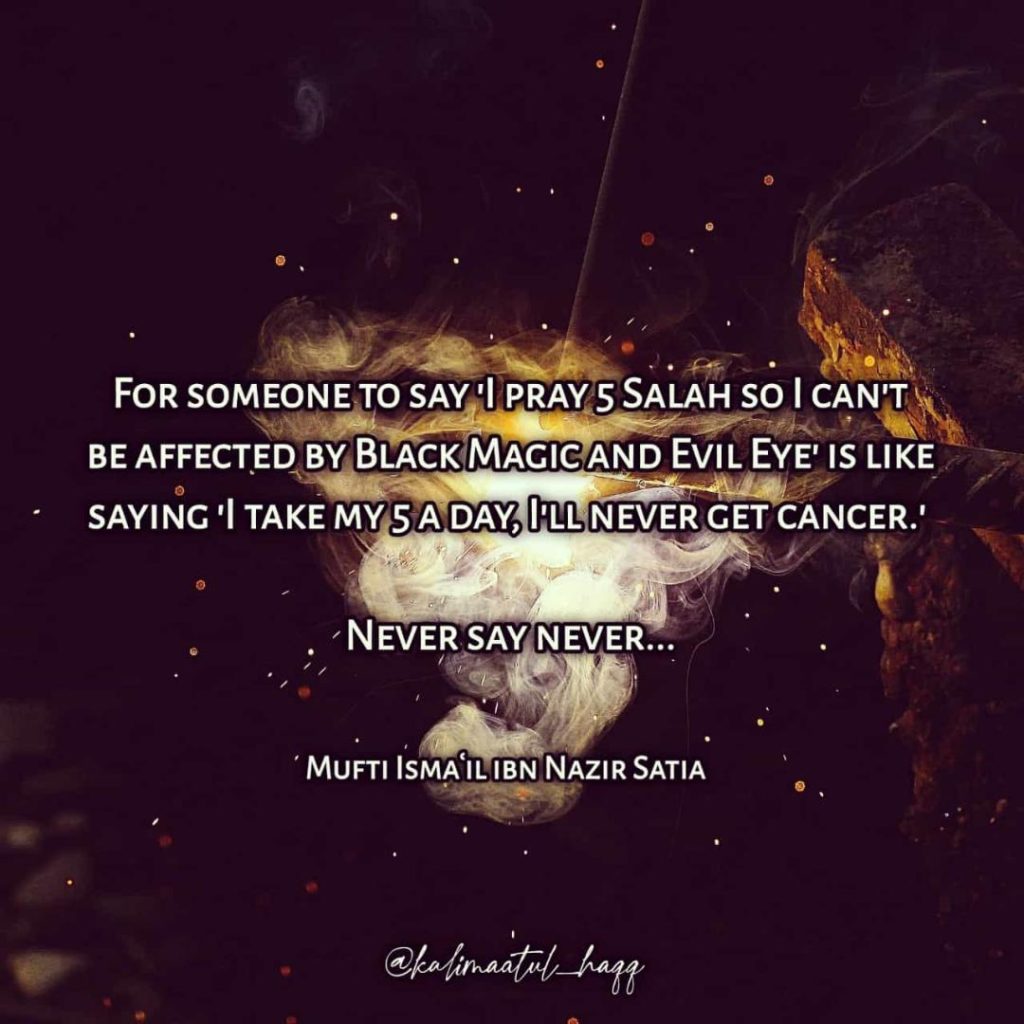
1. “I pray my Salah and Manzil, then trust Allah. Nothing can harm me! Why would I need Ruqya?”
A simple answer for such people is that the Prophet PBUH also prayed Salah and read the Qur’an, rather the Qur’an was revealed upon him. Despite such noble piety, He PBUH was still affected by jinn/jadoo for six months and wasn’t aware (some scholars say even longer). Salah and Qur’an/Manzil are the best forms of protection, they do help, but a person can still be affected by nazar and jinn etc.
NB: We do not stop anyone from reading Manzil and general Qur’an as this does help immensely if someone casts evil eye on you despite your Salah and Qur’an it will only affect you 20%-30%, because you have a certain amount of protection.
2. “I went for Ruqya once it didn’t make a difference, black magic never really goes away.”
This is a statement we hear often because people have unrealistic expectations from Raqis. They want us to fix all their life problems, marriage, kids, work, house and maybe get us that fancy new car too?? And when those expectations are not met it leads to disappointment and frustration.
Secondly, Ruqya is never a one-time fix, this is the biggest mistake people make because most people need a few sessions.
Thirdly, patience is needed. It takes time for these things to heal. A person can have black magic for 10 years and expects it to go in a day or a week? Even medical doctors can’t cure cancer in a week.
You don’t change GPs every week, in a like manner don’t go to one Raqi today, another one next week, then try Taweez in India, by February you’re on Chinese herbal medicine and then back to anti-depressants. Stick to one method for at least 6 months, if it doesn’t work go to someone else, but do regular treatment.
3. “Ruqya is soo expensive and they tell you to drink Zamzam regularly also expensive, and buy Ajwa dates even more expensive! Ruqya is a rip-off!!”
Money means a lot to us all, we all value and love our money, but do we love our health? Mental and physical health… that’s what it boils down to. If you value your health, you will spend the money you spend all your life earning to save that health. But not everyone does, and nobody admits it.
Dear brother and dear sister, have you ever contemplated the amount of money you spend on takeaways/restaurants. The amount brothers spend on cigarettes and shisha. The amount sisters spend on make-up and handbags? Shoes? None of the above save your health! Cut down on these and save £20 for Zamzam/Ajwa… I’m not an accountant, but you can do the maths, we happily spend on futile things because shaytan loves to mislead us.
Ruqya is expensive and the reason is the nature of the field and the risks we take to do this job. It’s not easy and it’s not ABC, don’t compare us to a dentist or optician who opens at 9 am and closes at 5 pm. Raqis have to do so many things in the background to protect themselves to treat you, it also affects their family and house. Not to mention the backlash from doing Ruqya which comes in many forms.
But we must apply the ‘common sense rule’. If someone is charging in the 100s, then Shariah says use your Aqal and run, as you run from a lion. Don’t get conned!
Look for those who have decent and reasonable prices, bearing in mind those who run from clinics have rent to pay (costs add up). I’m only explaining, not justifying.
Again, I will say, I rarely hear people complain about dentists and opticians who have high rates! Private health care rips your wallet, arm, and leg off…
4. “I’ve heard these guys are all bogus, they make stories up. And it’s all money-making!”
Nobody likes stereotypes. Nobody. But we all get angry and emotional at some point in our lives and blurt a few things hidden in our minds, because of our bad experiences. You are allowed to have bad experiences and even talk about them, just don’t generalise. The word ‘all’ is dangerous, especially when it’s due to the actions of a few individuals.
The police are meant to protect us and uphold the law, often they break the law. There are corrupt police officers, does that mean all coppers are bent? #LoD
Teachers are meant to educate our children in school and madrasah, many teachers abuse our children, physically and sexually. Do you still send your children to school or do you generalise?
Doctors are meant to save our lives, but many doctors have killed their patients. Have you stopped going to the hospital?
My point is every sector has a few rotten apples, but you can’t say that everyone is the same. You get genuine people in the world and corrupt people, we need to look for genuine Raqis.
I have never denied the fact that there are fake healers, even in the Taweez/Aamil world. Don’t look at social media and YouTube, everyone looks good on there! Sisters particularly need to be careful as these predators often target vulnerable women. Always go with a mahram and ask questions if you have doubts about their diagnosis, don’t be bamboozled.
5. “Isn’t there a Hadith to the nearest effect, 70,000 people will enter Jannah without accountability on Qiyamah. One group is those who don’t seek Ruqya.”
The Hadith is correct, but like with most Hadith they need interpretation and commentary, they shouldn’t be taken literally, otherwise, it can cause confusion (generally speaking not just for Ruqya). There are Hadith that the Prophet PBUH urinated standing up? Do we follow such Hadith?
The different meanings of the “one who did not seek ruqya.”
1. There are certain pious individuals who have 100% reliance on Allah SWT and they never turn to the creation for help, like the Prophets AS and the Sahabah RA and even in the general public we have the Saints of Allah, they shouldn’t seek Ruqya as it goes against their tawakkul.
2. They do not ask anyone for Ruqya until the affliction happens, some individuals who panic seek Ruqya before the affliction, this is incorrect.
3. They believe Allah cures not the Raqi, so their belief is correct.
4. They refrain from shirk in their Ruqya, like the Ruqya in pre-Islamic times.
5. They try Ruqya or treatment themselves first then seek it from others. Self-Ruqya is important, to learn and teach it to others.
These are the answers given by Shaykh Khalid Hibshi, KSA
6. “I believe my issues are mental health or even medical. I don’t need Ruqya, because I don’t believe in jinn/jadoo.”
An increasing issue, especially in Europe and the West, where Mental Health issues are accepted and Jinn/Jadoo issues are rejected, denied and marginalized. So where is the balance and correlation between them all? We, as Muslims should believe in Mental Health, it’s a growing reality. Our lifestyle, our diet, and the fast-moving technology are usually the causes.
As for believing in Ruqya and Jinn/Jadoo, be careful before you get your defense shield up. Ruqya is reciting verses of the Qur’an and the treatment is everything mentioned in the Hadith. There is a Surah in the Qur’an called ‘Surah Jinn’. The Prophet PBUH and many of the Sahabah RA were affected by Black Magic. To deny the above is a major sin, and we need to watch our words before we deny them haphazardly.
It is mainly men who deny these things and even some scholars are negative towards jinn/jadoo issues (wait for day 10 and the reality of Ulama/Imams).
To believe in one thing you don’t need to deny another, to believe in mental health (because you suffered) doesn’t mean you deny jinn/Jadoo. But I’ll be honest, I do feel mental health is overrated, everything is mental health nowadays! Especially with the millennial kids and millennial parents, they don’t believe in jinn/Jadoo as much. The reason is the secular society we live in, the NHS and Media promote Mental Health massively. Well, my answer is My Nabi and My Allah promote jinn/Jadoo issues far more, it is endorsed in the Qur’an and Hadith. We do believe in mental health but mental health doesn’t believe in us.
Many people suffering from jinn/jadoo will suffer mental health issues and vice versa, jinn/jadoo can be a contributing factor in mental health and medical issues. Ruqya has helped people who suffer from Anxiety, Depression, Severe Migraines, even in cases of Cancer Ruqya has helped. Some were given ‘all clear’ and others said Ruqya helped with (the pain of) Chemo. That doesn’t mean we deny medical issues, it just endorses what Allah SWT has said, “The Quran is Shifa.” If doctors and medical experts know everything and cure all, why are soo many people still suffering day and night pills after pills;
CT scan = Clear.
MRI = Clear.
X-ray = Clear.
But they are still in pain and agony? Please do explain.
7. “I’ve had soo much Ruqya done, been to a dozen Raqis. Why am I not getting better? Why doesn’t it go away?”
Some people don’t get better and don’t see major improvements, there are reasons for this: i) People don’t act upon the advice we give them. They don’t pray salah and manzil, let alone surah baqarah (which is long). Men don’t go to the masjid, sisters don’t want to cover up and wear hijab, how on earth will you get better? Apart from a miracle…
ii) Sihr/Jadoo can be repeated. Just like Covid-19, you can get it once and you can get it twice (some have had it thrice). You can also get jadoo again, because the people doing it repeat it. Hence, I say never give up Manzil and Surah Baqarah, keep drinking Ruqya water, and use olive oil regularly. Most people become complacent once they see signs of improvement.
iii) The one doing Black Magic is close to you. Nobody likes to hear that, but often true. I don’t suggest accusing people, but the worst cases for us are when the perpetrators of Sihr are family members. Hence they keep feeding you and you lose all spirituality and religiosity.
Food is the strongest source of Black Magic, they feed you by mixing it in your food (usually sweet things, cakes, biscuits, or tea). The food enters your body, flows through your blood, eventually, you are fully ‘jadoofied’. A man’s whole personality can change, good men/women can become bitter and evil, harsh and arrogant.
If you find the concept hard why a family member would do jadoo, father on his own son? Wife on her own husband? One word: control. Control is what everyone craves, but not everyone gets it. Black Magic will give you that control (temporarily), and hellfire (permanently).
8. “You treated my brother who got better instantly, but I am not seeing results despite praying manzil regularly and reading surah baqarah etc.”
Yaqeen and conviction is an important aspect of Islam, it makes all the difference in treatment (medical or spiritual). Even if you take a paracetamol your belief should be Allah SWT cures, not the tablet. If you come for Ruqya you need to believe Allah SWT cures, not the Raqi. The higher the level of Yaqeen the quicker the ilaaj.
Two people can come for Ruqya with different mind-sets and see different results. Many come to ‘test’ us and see if it works. Totally wrong mindset, such people need to stick to MOT testing and not test the words of Allah SWT. If you are cured, Allah SWT cured you and if you weren’t cured there is a deficiency somewhere.
One of the greatest things I have learnt from Ruqya is trust in Allah SWT, hope in Him, and being optimistic about Allah SWT in all situations. It’s a real test of your Imaan. “I am as my servants think of me” (Hadith Qudsi). Think good of Allah SWT and the results are amazing!
One of the best clips on Husne Dhann with Allah SWT for Arabic listeners.
A line from the clip, “One of the pious predecessors used to say, even if Allah SWT enters me into the Hellfire, I will still tell the people of Hell: I love Allah SWT!”
Subhan Allah! Despite being entered into Hell, to still say I love Allah (because He is fair) is real love and optimism. Allah grant us a share of it. Ameen.
9. “I have heard Raqis don’t like Aamils and people who do Taweez, is this true? Because they say all Taweez are shirk!”
There is a hadith that states ‘amulets/taweez are shirk’, but there is also a hadith (which nobody quotes) that states ‘Ruqya is shirk’. As always, Hadith need interpretation and commentary. The answer to both Hadith is that those amulets which contain the words of Shirk and associating partners with Allah SWT are Shirk. The same applies to Ruqya of jahiliyya/pre-Islam which contains Shirk is not allowed.
Taweez is a grey area though and we need to be careful what sort of taweez we use. If it is clear and legible, then good, if it is a Qur’an ayah you know, then okay. But if you don’t know what it says in the taweez, avoid it like the plague. Why risk it?
Many taweez have been opened to find hair and blood inside. Others had the names of Shaytan and pictures of Shaytan. Hence, we always promote Ruqya which is clear and Qur’anic, it makes sense. The method of treatment is found in the Sunnah. Why have cotton when you can have silk?
As for the hatred, Taweez vs. Ruqya, I have never been intimidated by anyone who does Taweez, Alhumdu Lillah. But I am not sure about the other way round. I have heard many Aamils who spread all sorts of rumours about Raqis, it’s like we are stepping on their toes! If what they do is “kosher” why do they panic when someone starts Ruqya?
Why the use of such adjectives like “dodgy mawlana” or “Magician molsab”? Carry on with what you do silently… but ruqya does damage for some of them, because their works are far, far from kosher. It is the work of Shaytan! Black magic comes from somewhere…
And often that somewhere are Peers and Mawlanas who sell Taweez containing shirk and black magic. People who do Black Magic don’t sit in a castle dressed in black with a cat and cauldron, that’s Harry Potter! In real life, they are our own scholars making millions of dollars. Be warned!
The truth is always bitter, but bitter medicine has always proven to cure faster than any other. And remember half these stories you get from Aamils are absolutely bogus, many claim to keep jinns for info, even that is questionable whether their jinns exist? But people love to hear their fascinating stories!
10. “I recently went to a counsellor with my husband, the counsellor is also an Alim. We talked about jinn/jadoo issues to which he replied, “shut that topic down, no such thing! 99% of these jinn/jadoo issues are just mental health!”
The best to the last… Ulama and jinn/jadoo issues! First and foremost, we need to understand scholars are scholars, not God! They study in Darul Uloom for 6/7 years to give them “training” in Qur’an/Hadith.
I choose my words carefully, ‘training’, they don’t qualify to know everything. Then they’re told to further their studies on their own or specialise in specific fields. But the majority don’t, many don’t even know Qur’an and Hadith properly let alone specialise in something, let alone know about Mental Health and Jinn/Jadoo issues. Just like this scholar mentioned above. When I put on my trench coat and glasses, I realised he also works in a school? Imagine how many people he is misleading because of his arrogance! You know I will always challenge these molvis… so I called him and gave a plethora of evidence, hadhrat jee put the phone down! I apologised for hurting his ego.
For years, I wondered and wandered through different avenues to work out why soo many Ulama are against Ruqya and negative towards jinn/jadoo issues.
Once I listened to a talk relating the story of Imam Ahmad ibn Hanbal RH, in his time someone came and said, “O Imam! Fulan ibn Fulan denies the issue of jinn!” Imam Ahmad RH: “This is the Shaytan talking on his tongue.” This meaning shaytan will target ulama/imams and misguide them, to mislead the masses, there is plenty of evidence for this. It is important for ulama to have protection against sihr/jinn.
We will always reach out to Ulama who are wrong and correct them, there is no harm. It is better than gheebat-ing, especially in a dars of hadith. That’s right, even senior scholars can be corrected. Recently, our intel told us a senior Shaykhul Hadith sat in a lesson of Bukhari blasting Ruqya and blasting me! What was my sin? Educating people on Black Magic and Ruqya.
Subhan Allah! It’s a shame ulama don’t have the courage to ring me or tell me to my face, especially when I’m not doing anything wrong… these are the elders we are told to respect since we were small. I wonder if they are elders or oldies?
Ismail ibn Nazir Satia (one who is in dire need of Allah’s forgiveness, mercy and pleasure).
26th Jumādal-Ākhirah 1442 AH ~ Monday 8th February 2021
True Appreciation of Rajab
By Shaykhul-Hadīth, Hadrat Mawlānā Muhammad Saleem Dhorat hafizahullāh
With the advent of Rajab, the seventh month of the Islamic calendar, Muslims remember the great miracle of the Beloved Nabī of Allāh ta‘ālā, the Mi‘rāj, which is commonly believed to have taken place in this month.During this miracle, Rasūlullāh sallallāhu ‘alayhi wasallam travelled with his body and soul from Makkah Mukarramah to Baytul-Maqdis, and from there to the seven heavens and beyond and returnedall in a split second.
The first part of the journey, from Makkah Mukarramah to Al-Masjidul-Aqsā, is called the Isrā and is mentioned in the Glorious Qur’ān. The second part of the journey, from Al-Masjidul-Aqsā to the heavens and beyond, is known as the Mi‘rāj. The great Mufassir ‘Allāmah Ibn Kathīr rahimahullāh has enumerated twenty-five Sahābah radhiyallāhu ‘anhum who have narrated this second part of the journey from Rasūlullāh sallallāhu ‘alayhi wasallam.
With regards to Mi‘rāj and the month of Rajab, let us keep the following points in mind:
• Auspicious nights such as Laylatul-Qadr, Laylatul-Barā’ah and Laylatul-Jumu‘ah are full of virtue and blessing, but the difference between them and the night of Mi‘rāj is that this night was prominent in blessings only on the particular night when Nabī sallallāhu ‘alayhi wasallam made this blessed journey. The blessedness and prominence does not return every year. Therefore, to make special arrangements of any sort or to engage in ‘ibādah during this night, assuming it to be blessed, is baseless. There is no record of Rasūlullāh sallallāhu ‘alayhi wasallam or the Sahābah radhiyallāhu ‘anhum celebrating the night of Mi‘rāj.
• This great miracle is commonly believed to have taken place on the 27th night of the Islamic month of Rajab. However, the ‘Ulamā hold differing opinions about the exact date.
Hāfiz Ibn Hajar Al-‘Asqalānī rahimahullāh, the commentator of Sahīhul-Bukhārī, has quoted more than ten different opinions for the possible date of Mi‘rāj. If this night was meant to be observed and spent in ‘ibādah, there would have been no difference amongst the Sahābah radhiyallāhu ‘anhum, for their ‘ibādah would have clearly defined the time of occurrence.
• The incident of Mi‘rāj is truly an extraordinary event and a blessing not bestowed upon any other prophet, angel or other creation of Allāh ta‘ālā, neither before nor after. The correct way of truly celebrating and appreciating this great event is to remember the very precious gift that Allāh ta‘ālā sent for us on that night i.e. salāh. The performance of the five daily salāh is the Mi‘rāj for the believers, as through ṣalāh they receive the honour of conversing with Allāh ta‘ālā. Rasūlullāh sallallāhu ‘alayhi wasallam said:
A faithful believer, while in salāh, converses privately with his Rabb… (Al-Bukhārī)
Allāh ta‘ālā says in a Al-Hadīthul-Qudsī:
‘I have divided the salāh (Sūratul-Fātihah) into two halves between Me and My slave; half is for Me and half is for My slave, and My slave will receive whatever he asks for.’ Rasūlullāh sallallāhu ‘alayhi wasallam said: Read (Sūratul-Fātihah)! (Because when) the slave says: ‘All Praise is for Allāh, the Rabb of all the worlds,’ Allāh ta‘ālā says: ‘My slave has praised Me.’ He (the slave) says: ‘The Most-Beneficent, the Most-Merciful,’ Allāh ta‘ālā says: ‘My slave has lauded Me.’ The slave says: ‘Owner of the Day of Recompense,’ Allāh ta‘ālā says: ‘My slave has glorified Me, and this coming verse is between Me and My slave.’ The slave says: ‘You (Alone) do we worship and from You (Alone) do we seek help,’ Allāh says: ‘This is between Me and My slave, and My slave will receive whatever he asks for.’ The slave says: ‘Guide us to the Straight Path, the path of those whom You have favoured, not of those who have incurred Your Displeasure nor of those who have gone astray,’ Allāh ta‘ālā says: ‘These are for My slave, and My slave will receive whatever he asks for.’ (Abū Dāwūd)
By understanding the position of salāh in Islām, one can conclude that only that person who values the gift of Mi‘rāj can truly claim to have understood Mi‘rāj.
When the month of Rajab would arrive, Rasūlullāh sallallāhu ‘alayhi wasallam used to make the following du‘ā:
Allāhumma barik lana fī rajabin wa sha’bān, wa balighnā Ramadān.
O Allāh! Grant us barakah in the months of Rajab and Sha‘bān and make us reach the month of Ramadān. (Al-Mu‘jamul-Awsat)
Therefore, it is desirable to recite this du‘ā on the advent of Rajab. Upon the commencement of Rajab, everyone should focus their attention on making preparations for the blessed month of Ramadān. This preparation is a spiritual one and entails fulfilling one’s duties to Allāh ta‘ālā, especially in areas where one is lacking.
Preparing for Ramadān from the month of Rajab is just like getting into a car and putting it in first gear. Begin to observe the compulsory and obligatory acts from now so that by the time Ramadān sets in, you are in fifth gear practising many optional acts of worship as well.
May Allāh ta‘ālā give us the tawfīq to practise upon His entire Dīn according to the teachings of our Beloved Nabī sallallāhu ‘alayhi wasallam, and may He enable us to start making preparations for the month of Ramadān from now. Āmīn.