بسم الله الرحمن الرحيم
I am a Muslim. I am British.

Heart breaking! Allah help the people of Ghouta and all around the world who are being oppressed make dua for them and give to trusted reliable charity
?please be aware the following text is very upsetting – an account from a Doctor in Ghouta, Syria – Allah have mercy on them and all the oppressed and may He grant them ease soon and may He protect us all
?
Please, please take a few minutes to read what Doctor Housam Adnan wrote from #EasternGhouta yesterday:
From the womb of the dead
For more than twenty years, the scalpel was my companion
Dancing between my fingers, while I do my work very quietly
At the end of each day I whisper to it:
You did very well, and we saved many together
But everything changed now
The scalpel wasn’t what it used to be, lately
My fingers can’t handle it anymore
As if a part of my soul was taken into its teeth, and it can’t bear the wounds it witnesses anymore
Children without parts
Without eyes
Without faces
Women and families covered by sheets full of soil from the home land, with more of her children’s blood
The smell of gunpowder and its abhorred black color hangs over those hungry, withered faces
The screams of children, the wailing of women, the oppression of men, the impotence of doctors, reached my dead scalpel, creating a spirit of the misery inside it, that it stopped working after what it witnessed, but those cries did not reach the hearts of the world to awake it
Today, all those who came to us are slim skinny bodies that haven’t tasted food for days. Buried with their children under the rubble of those barrels that do not distinguish between stones and human.
Today from under the rubble of our homeland they brought to me a mother in her seventh month of pregnancy, with two of her children.
If I told you that the misery of the world came together in the eyes of those children, I wouldn’t be describing enough,
The first child without a right leg and has a broken arm. The other has lost his eye and shrapnel entered his chest, and the mother is struggling to survive. The shrapnel has broken all of her slim body sending to our hands to witness her last breath.
I see her struggling for survival, her eyes are fixed on her little ones being in that situation
The father left them, dead, a few months ago
They brought them to me in one cover, because we lost our Patient stretchers, we used them as beds, because beds are full
I beg you to imagine with me, just for a moment that scene and that torn, torn blanket that carried the four lives: the mother, her fetus and her two children.
A colleague whispered in my ear
Maybe we can save her baby
For the first time, I sat down thinking with my head down
“do we save him, or leave him happy with his mother without seeing the ugliness of this world,
Do I let him go with her
No.. no
My mission is to save him
I looked around
Her torn children
Her soul that’s leaving her body
The noise of planes and exploding barrels
Children’s crying that burns the heart
And my colleague whispering:
What are you waiting for
Come on
There’s a life we should get out
I looked at my scalpel and friend
To what life will you get him out?
The world of barrels, fire and disappointment?
The world of orphanhood, oppression and hunger?
Who will breastfeed him?
Who will change his pampers?
Who will rock him?
Who will hear his weeping?
Yes, he has a god that won’t give up on him, but I became unable, along with my scalpel, to even think
My colleague’s voice awoke me from my fantasies
“her heart stopped”
I’ll take him out now, with her dead
And for the first time in my life, I couldn’t do it, my scalpel stopped me. I put it on the table, and left in silence.
My colleague continued his work, his eyes full of tears, while looking at me in surprise
All that incident took only a few minutes, but it marked a years-long wound, a wound made of defeat and impotence. I didn’t imagine I’d read in the stories of Tatars’ massacres, inquisition stories, or even the pharaoh’s tales.
World, leaders and kings of the world:
Your silence over these massacres affecting hundreds of thousands of innocent civilians, who did nothing except being on a land called “Al Ghouta of Damascus” is a shame
I’m not going to ask you to save #Ghouta, but to save your humanity
Save your people
Your children
And be sure, this baby coming out of his martyr mother is your responsibility
Feed him
Keep him warm
Give him his right in living a decent life
Stop these sky monsters with the barrels of death
Come and join the children of Ghouta
Touch their faces, listen to their hungry stomach’s noises
Aren’t they humans?
Announce that you care about all humans, not only your blood like, this would save what’s left of god’s spirit in you
#SaveGhouta
#Save Syria

Enjoy yours…If wealth is the secret to happiness, then the rich should be dancing on the streets .

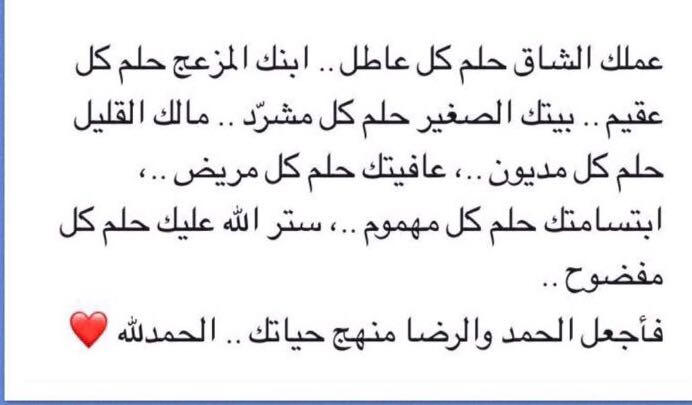
“Your difficult job is the dream of every unemployed, your annoying child is the dream of every infertile, your small home is the dream of every homeless, your little money is the dream of every debtor, your health is the dream of every ill, your smile is the dream of every sad. Allah concealing your sins is the dream of every exposed. So, let gratitude and contentment be your methodology of life.” Alhumdu Lillah!


“I am not perfect. Let’s both assume that the other is doing the best she can.”
Weddings are usually such happy occasions, full of love and hope for the future of the bride and groom. As wonderful as it can be, it can also mean mother-in-law problems. Something happens the moment a bride says, “I accept him.” Not only does she get a husband, but in most cases, a mother-in-law as well.
But far too many women describe this relationship as fragile, tense, and even competitive.
It’s no secret that in-laws are the subject of many marital arguments. The rivalry between wives and their mothers-in-law is a major source of tension in many marriages. You may find it interesting that many new brides get along very well with their husband’s parents at first; it isn’t until later—sometimes years later—that friction develops.
Time-after-time, daughters-in-law say things like, “My husband’s parents welcomed me into their family immediately and treated me as their own daughter.” Likewise, “My own in-laws showered me with gifts and included me in everything”. It’s not uncommon for young women to be very fond of their husband’s family, and vice versa… in the beginning.
Later on down the marriage, dealing with in-laws can be an overwhelming challenge—whether you are dealing with an overbearing mother-in-law who believes her opinions are superior to yours—or someone who tries to make you feel guilty whenever your needs conflict with hers. It may be tempting to gossip, hold silent grudges, or cut off all communication with troublesome in-laws – but that often just adds to the problem.
Mother-in-law problems can be one of the biggest issues in an engaged or married couple’s life. In some cases, they’re really more like out-laws. Some mother-in-laws have a way of letting everyone know their displeasure with the new family member over issues big and small – and yet seem to forget their own son or daughter can think or speak for themselves, and in most cases, should.
Why is it that the mother-in-law relationship can be so difficult? When you think about it, it really shouldn’t be. You have so many meaningful things in common: love for the same person, wanting what’s best for that person, and for them to be happy. For some though, it’s these same things that make for fast adversaries.
Some mother-in-law problems arise out of a competition for the attention of the adult child. Because they are now spending all of their time with their new spouse, there may not seem to be room enough for mum, which can be seen as not loving them as much anymore. When they visit mum, of course your spouse is going to take you with them – you’re now a package deal. Mother-in-law’s can be very resentful of having to share time and space with someone else.
Who would know what’s best for their kids better than a mother? As adults, however, we know what’s best for ourselves, not our mum. Some mothers, however, feel that they should reign supreme over our lives – even when we’re 45-years-old. It can be a hard habit for parents to break and some never feel compelled to stop parenting, even adult children. What makes that more difficult is that some of us don’t know how to let our mothers know that we are now adults who think for ourselves.
No one wants or needs their mother-in-law (or future one) telling them what’s best for their partner or worse, guilt-tripping them because of some imaginary slight or that they don’t measure up to her expectations. Big or small, whatever the issue may be, if she can’t refrain from commenting or speaking out inappropriately, it’s up to our spouse to talk to her. This can be difficult for our partners since for some it can seem unthinkable to speak out “against” their mother and be independent.

Advice for mother-in-laws:
A good mother-in-law doesn’t make the wife feel like she doesn’t measure up, or give the impression that she wishes her son would have made a ‘better’ choice. A good mother-in-law encourages, accepts, and loves unconditionally. Allow your daughter-in-law to disagree and know that it isn’t something personal. Don’t be offended if a daughter-in-law does not share your tastes, dreams, and values. Tell her about decisions you faced as a mother of infants, toddlers, teenagers, young adults, etc. Talk about more than superficial things. Get to know her for the person Allah created her to be. Then, come alongside her to mentor, encourage, and build a relationship so that if/when you need to give loving input or direction, it is not taken as meddling. Express your gratitude towards her: “You truly are the wind beneath my son’s sails and I really appreciate and love you. You understand my son far better than I do, and I thank Allah for you.” “I’ve got the best daughter-in-law God could give. I am so blessed.” Finally, offer to take care of the grandkids so your daughter-in-law can have a day to herself.
Okay, mothers-in-law, there’s the list. What are we going to do about it?

The second year of my son’s marriage, he and his wife had Thanksgiving with us. My daughter-in-law made a delicious sweet potato casserole. My mother and I complemented her on it and asked for the recipe. “It’s a family recipe,” my daughter-in-law said. “So I don’t give it out.” —Anonymous mother-in-law
Whoa! I had thought that daughters-in-law were the ones with the in-law stories. Well, apparently mothers-in-law have their share of stories, too.
One mother-in-law wrote something that brought back memories. “That little boy that brought me dandelions and messy hugs,” she said, “is now a grown man with a family of his own. I need to fully release him so he is allowed to change and adapt to his wife and adult life. I don’t want to be a parent who says or does things that grate in the mind of my daughter-in-law. She is the one who knows my son best now.”
Yes, a mom relinquishes her title of “first lady” in her son’s life on his wedding day. Perhaps that’s why some have described the relationship between a mother- and daughter-in-law as fragile or tense. Allah certainly didn’t intend it to be that way.
Advice for daughter-in-laws:
Some mothers- and daughters-in-law form close friendships very quickly. For others, this may take years. But most mothers- and daughters-in-law do want to connect with each other. They want to find common ground. They want to know each other as individual women with feelings, beliefs, and ideas. Do not fight your mother-in-law over your husband and same to the mother-in-law over your son. If the daughter-in-law cooks something or buys something for her husband, please do not compete with her for praises.

REFERENCE: https://haq2012.wordpress.com/2013/03/25/imam-ibn-taymiyyahs-stance-on-the-usage-of-weak-ahaadith/

All praise for Allah, may peace and blessings be upon our noble master Mohammed sallalaho alayhi wasallam, upon his pure family his noble companions and all those who follow them until the day of judgement.
Respected readers, what I would like to discuss here inshallah is an issue which causes a lot of controversy, that is the issue of usage of weak ahaadith. We have some people who go the extreme of saying that weak ahaadith should be rejected entirely. I will state the obvious here, and mention that other that the sahihayn (Bukhari and Muslim) every other book of hadith, be it the sunan of Imam Tirmidhi, Imam Abu Dawud, Nasai, Ibn Majah, Bayhaqi, the mustadrak of Imam Haakim, musannaf of Imam ibn Abi shaybah and others all contain some weak as well as sahih ahaadith.
What we must understand is that there is a difference between a weak and a fabricated hadith but unfortunately and sadly we have certain ignorant people who don’t differentiate between the two. They treat a weak hadith like a fabricated hadith and totally disregard it. I am not saying for a second that fabricated ahaadith should be entertained, we all know the severity of attributing a lie to the messenger of Allah sallalaho alayhi wasallam who himself said ‘whoever attributes a lie to me has reserved his space in the fire of hell’ (Bukhari).
Some people who are even regarded as scholars have this attitude that weak ahaadith should not be used at all, and if this approach was adopted then the majority of the books of hadith would be rendered useless and only Bukhari and Muslim could be applied thus making life extremely difficult.
The majority view of the ulema is that a WEAK hadith is permissible for usage in non-fiqh issues. The following are some great scholars who hold this view : Imam Nawawi, Ibn Salah, Sufyan Thawri, Ahmed bin Hanbal, Ibn uyaynah, Ibn Mubarak, Ibn mahdi, ibn ma’een, khateeb Baghdadi, Bukhari, mullah Ali Qari, ibn Hajr al Asqalani, ibn Taymiyah, ibn Qayim, imam Sakhawi, abu Dawud.
Even Imam Bukhari RA himself has compiled weak narrations in his book ‘Al Adab Al Mufrad’ which shows that he accepted weak narrations in regards to virtues of good deeds, so we can see here that the majority of muhaditheen accepted the usage of weak ahaadith and did not have this attitude that the salafis of today have.
I will now present work from none other than imam Ibn Taymiyah RA from his famous book ‘al qaedah jaleelah fit tawassul wal waseelah.’ The reason I chose to use Ibn Taymiyah RA on this occasion is because those people today who like to reject weak ahaadith and condemn others for using them are those who use Ibn Taymiyah RA as a reference and would always accept any ruling of his without hesitation.
The imam states:
“But Ahmad ibn Hanbal and other scholars permitted the narration [of hadith] regarding the virtues of good what is not sure as long as it is not known that it is a lie.” [laakinna Ahmad ibn Hanbal wa ghayruh min al-‘ulama jawwazu an yurwa fee fada’il al-‘aamal maa lam yu’lam annahu thaabit idha lam yu’lam annahu kadhib.]
Ibn Taymiyya goes into a full chapter of discussion of this subject from here, Chapter 8 of “al-qaida al-jaleela fit-tawwasuli wal-waseela“, where he presents the views of the majority of the ‘ulama of Islam and he presents his own views of the subject. And here we will examine this in detail.
To continue, Ibn Taymiyyah RH says, in para 478:
“and that is the action which is known to be lawful with a shari’ah evidence, and there has been narrated in its virtue hadith that is not known to be a lie, it is possible that the reward will be true and none of the Imams have said that it is permissible to consider something required [waajib] or recommended [mustahabb] by way of a weak hadith, and whoever said so differed from the consensus [ijma’a].”
So here we see that Ibn Taymiyah RA is explaining that if there is a hadith, even though it has not been judged to be authentic, if it encourages what is known as a good deed in Islamic shari’ah, something of virtue, a praiseworthy action, or idea, then it is fully acceptable to refer to such a hadith as an encouragement for that deed.
And here also, Ibn Taymiyah RA refers to the ijma’a, the consensus, which is a clear reference to the concept of ijma’a of scholars of Islam as being a fully accepted concept and one which *he* accepts. And this is a clear proof that Ibn Taymiyah RA, though he considered himself a mujtahid mutlaq, capable of independent reasoning, nevertheless depended on the consensus [ijma’a] of scholars as a proof for the opinions he considered acceptable. And this is the position of Ahl as-Sunnah wal-Jama’at.
Then he continues in para 479:
“And just like it is not permissible to forbid something without a shari’ah evidence, [daleel shar’ee] but if it something is known to be forbidden and a hadith has been narrated in warning the one who commits such an action, and it is not known that it is a lie, it is permissible to narrate it. And it is permissible to narrate it in the manner of encouraging and discouraging [at-tarheeb wat-targheeb] what is not known that it is a lie. but in what is known that Allah has encouraged or discouraged with another evidence besides this [weak] hadith whose authenticity is unknown [majhoul haaluh].”
So from this we see that Ibn Taymiyah RA is using the weak hadith [ahadith da’eef], to discourage people from doing an evil deed, as long as this deed is known to be forbidden in the shari’ah. If the deed is forbidden in the shari’ah, it is acceptable to use a hadith whose authenticity is unknown, as long as the hadith is known not to have been an actual lie. This principle is acceptable, in anything that it is known that Allah expressed its forbiddance. Ibn Taymiyah RA continues to explain this concept in para 480:
“This is like the [situation] of the Isra’iliyyaat [stories related by the Jews]. It is permissible to be narrated as long as we know that it is not a lie, for encouraging or discouraging in what we know that Allah has ordered in our law [shar‘] or forbade in our law [shar‘].”
Here we see that Ibn Taymiyah RA is not only accepting that the weak are acceptable in the case of encouraging good deeds and discouraging evil ones, but he is showing clearly that he accepted the use of Isra’iliyyaat, stories related from the Jews, which many Salafis reject today as unacceptable. And this is verified in the hadith of the Prophet (saws), “narrate from the hadith of Bani Isra’il and there is no harm in doing it.”
So respected brothers and sisters, we see from the above evidences that Imam Ibn Taymiyah RA himself accepted the usage of weak ahaadith, I ask those salafi brothers who love to insult the likes of hazrat Moulana Zakariyyah RA because of his usage of weak ahaadith, will you now refute and condemn your own imam on the same grounds?
May Allah give us all the ability to understand the deen in its entirety, Ameen.
I have a question regarding the text Faza’il – e – A’maal by
Shaikhul Hadith Maulana Muhammad Zakariyya Kaandhlawi. From many I’ve heard that this text contains many weak hadiths and should not be read for the hadiths all are not saheeh. Is this correct? If so, please explain if this text would be appropriate to read and are the hadiths with strong chains?
Assalamu alaykum
In the name of Allah most Gracious Most Merciful.
Along with many sahih hadiths, Fada’il A’mal is also known to contain a number of weak hadiths. In fact many of the great hadith collections contain weak hadiths. This is the case with Sunan al-Tirmidhi, Ibn Maja, al-Bayhaqi, al-Mustadrak of Imam Hakim, Mishkat al-Masabih, al-Tarqhib wa al-tarhib, etc. Besides these, popular works such as the Ihya ‘ulum al-din of Imam Ghazali is one in which Allama ‘Iraqi has judged many hadiths to be weak. However, these works have been overwhelmingly accepted by the majority of traditional scholars of Islam throughout the centuries. Furthermore, despite the rigorous authentication of the Sahih of Imam Bukhari, his other works such as al-Adab al-Mufrad and Juz’ al-qira’a khalf al-imam contains many weak narrations.
What we understand from this is that it is not a crime to relate weak hadiths, as some like to advocate. Individuals have risen in the last century who have attempted to “purify” the books of the pious predecessors by sifting the weak hadiths from the authentic (many a time with great injustice) and have published the classical collection under new titles such as Sahih Sunan al-Tirmidhi, Sahih Sunan Ibn Maja, etc.
The approach of the classical scholars was not such. It was accepted among them that works on the subject of virtues and fada’il did not have to meet the same levels of authenticity as was needed in discussions on the belief system of Islam or the laws and rulings of the lawful and unlawful.
Great hadith experts such as Imam Ahmad ibn Hanbal, Ibn al-Mahdi, ‘Abdullah ibn al-Mubarak said, “When we narrate in regards to the lawful [halal] and unlawful [haram] we exercise extreme strictness and when we narrate in regards to virtuous and the like (stories and narratives) then we are more lenient.” (See Suyuti’s Tadrib al-rawi).
We learn from this statement that the scholars were more relaxed in the case of using weak hadith in virtues, but were very strict when it came to aspects of belief or fiqhi rulings. There were also other conditions for accepting weak hadith. For instance, the weakness should not be extreme that it is bordering on fabrication or the hadith should not be a spurious one. Likewise the weak hadith should not contradict an established principle of Shari’a or go against the spirit of the teachings of Islam (See Tadrib al-rawi).
If one takes the approach of shunning every book that contains weak hadiths would be left with very few books to benefit from. This would create great difficulty in regard to the din. Imam Tirmidhi has demonstrated in his Sunan as to how so many fiqhi rulings have been based on not-so-strong narrations.
The Fada’il A’mal is not a book of juristic laws. it is a book of virtues and as such there is no doubt that one can read it and practice on the virtues mentioned therein, even if they are from weak hadiths. Allah has granted this book such a widespread popularity that it is difficult in many countries to find a masjid without a copy. Many have benefited and softened their hearts for the remembrance of Allah and other such virtuous acts by reading it and the Fada’il Sadaqat by the same author.
The author Shaykh Zakariya Khandelwi taught the Sahih al-Bukhari for numerous years and spent his entire life in the service of the hadith of the Messenger (upon him be peace). His works include the editing of the Badhl al-Majhud (Arabic commentary of Sunan Abi Dawud), al-Hall al-Mufhim (Arabic commentary of Sahih Muslim), and al-La’ali al-Dirari (Arabic commentary of Sahih al-Bukhari); then the Awjaz al-Masalik is his Arabic commentary of the Muwatta of Imam Malik (Dar al-Fikr, Syria edition over twenty volumes), and the Khasa’il al-Nabawi, his Urdu commentary of the al-Shama’il al-Muhammadiya of Imam Tirmidhi. Besides these he has authored numerous other works in Urdu. He passed away in Madina Munawwara on Monday the 1st of Sha’ban 1402 corresponding to 24th May 1982.
Wassalam
(Mufti) AbdurRahman ibn Yusuf Mangera (hafidhahullah)


A woman whose hand was paralysed entered upon ‘Aa’ishah (radiyallahu ‘anha). She said, “O Mother of the Believers, I went to sleep yesterday and my hand was healthy and I woke up and it was paralysed.
‘Aa’ishah said, “How is that?”
She replied, “I had wealthy parents and my father used to pay zakah, host guests and give to beggars and he did not see any good except that he would do it.
As for my mother, she was stingy and did nothing good with my father’s wealth. Then my father died and my mother died only two months after him.
So I saw my father in a dream last night and he was wearing two yellow garments and in front of him was a flowing river.
I said, “Father, what is this?’
He said, “Whoever does good in this life will see it, this is what Allah has given me.”
I asked him, “What has happened to my mother?” He asked, “ Your Mother died?”
I said, “Yes”
He said, “She has been turned away from me, so look for her on your left”
So I turned to my left and I saw my mother standing naked, covering her lower half with a rag and in her hand was a piece of fat.
She was calling out, “My sadness, my thirst.’
When she became tired she would rub the fat with her hand and then lick it, while in front of her was a flowing river.
I said, ‘O mother, why are you crying out of thirst and there is a flowing river in front of you?’
She said, ‘I am not allowed to drink from it.’
I said, ‘Can I give u some of the water?’
She said, ‘I wish u would do that.’ So I filled my hand with water and let her drink and when she swallowed it I heard a voice on my right, ‘Whoever has given this woman water, may his hand be paralysed and they repeated it twice.
Then I awoke and my hand was paralysed and I am not able to do anything with it.
‘Aa’ishah (radiyallahu ‘anha) asked: ‘Did you recognise the rag she was wearing?’
I said, ‘Yes, O Mother of the Believers, it was exactly the same one I saw her wearing, for I had never seen my mother give anything as charity, except that one day my Father slaughtered a bull. So a beggar came to ask for some, so my mother gave him a bone that had some fat on it. And I saw one day that a beggar asked her for charity, so she gave him that exact rag.’
‘Aa’ishah (radiyallahu ‘anha) said, ‘Allah is the Most Great! Allah has told the truth and the Messenger (sallallahu ‘alayhi wasallam) has delivered the message.
فَمَن يَعْمَلْ مِثْقَالَ ذَرَّةٍ خَيْرًا يَرَهُ
وَمَن يَعْمَلْ مِثْقَالَ ذَرَّةٍ شَرًّا يَرَهُ
“So whoever does an atom’s weight of good will see it,
And whoever does an atom’s weight of evil will see it”
(Surah Zilzal, verses 7-8)
Hafiz Ibn Rajab Al-Hambaly (rahimahullah) references it to Kitabut Targhib wat Tarhib of Imam Abu Musa Al-Madini (rahimahullah) with a sound (hasan) chain.
(Al-Kalamu ‘alal Hadith: yatba’ul mayyita thalath; see Majmu’ Rasail Ibn Rajab, vol.2 pg.430)
Imam Abu Bakr ibn Abid Dunya (rahimahullah) has also recorded a variant of this incident with two weak chains, that support each other adequately.
(Kitabu Mujabid Da’wah, number: 71 & 72)
This incident may be quoted.
﷽

Ismail ibn Nazir Satia (one who is in dire need of Allah’s forgiveness, mercy and pleasure)
12 Rabiul Thani 1439
HOW TO START A NEW YEAR: https://mylittlebreathingspace.wordpress.com/2015/02/25/the-new-year/