Categories
Shaykh Saleem Dhorat

Naseehah for Madrasah Teachers

Naseehah (Principal Forum Conference)

Shaykh Muhammad Saleem Dhorat (hafidhahullāh)

1st September 2025

Those who have selected ta’līm as their occupation, they have been classed as the best of people by  Nabī ﷺ. 

خَيْرُكُمْ مَنْ تَعَلَّمَ الْقُرْآنَ وَعَلَّمَهُ

Abū Abdur-Rahmān as-Sulamī who narrated this hadīth to his students from Hadrat Uthman said that it is this hadīth which is the reason for me sitting here today. From the time of Hadrat ‘Uthmān to the time of Hajjāj bin Yūsuf, he continued teaching in one place, one Masjid – and it was due to this hadīth. Hence, those who teach are very valuable in the sight of Allāh. 

The ‘Ulamā are the inheritors of the Anbiyā. What is their duty? Ta’līm and Tarbiyyah.

لَقَدْ مَنَّ ٱللَّهُ عَلَى ٱلْمُؤْمِنِينَ إِذْ بَعَثَ فِيهِمْ رَسُولًۭا مِّنْ أَنفُسِهِمْ يَتْلُوا۟ عَلَيْهِمْ ءَايَـٰتِهِۦ وَيُزَكِّيهِمْ وَيُعَلِّمُهُمُ ٱلْكِتَـٰبَ وَٱلْحِكْمَةَ

What was the mission of Rasūlullãh ﷺ?

  1. Tilāwah – teach them the words of the Qur’ān
  2. Tazkiyah – purify their hearts from shirk, spiritual illnesses etc.
  3. Tafsīr of Qur’ān – teach them the explanation of the Qur’ān alongside the words
  4. Sunnah 

رَبَّنَا وَابْعَثْ فِيهِمْ رَسُولًا مِّنْهُمْ يَتْلُو عَلَيْهِمْ آيَاتِكَ وَيُعَلِّمُهُمُ الْكِتَابَ وَالْحِكْمَةَ وَيُزَكِّيهِمْ ۚ إِنَّكَ أَنتَ الْعَزِيزُ الْحَكِيمُ

After Ibrāhīm AS made the house of Allāh with Ismā’īl AS, he didn’t stop there, but he made the above du’ā – he asked to send someone with these specific four qualities. The first three of these qualities are connected to ta’līm and the last one is connected to tarbiyyah. 

If we summarise these missions, they come down to two things – Ta’līm and Tarbiyyah.

Nabī ﷺ has said,

إِنَّمَا بُعِثْتُ لِأُتَمِّمَ صَالِحَ الأَخْلاقِ

إِنَّمَا بُعِثْتُ مُعَلِّمًا

There is no one better than Nabī saw in this world – Allah gave him knowledge and did his tarbiyyah

وَعَلَّمَكَ مَا لَمۡ تَكُن تَعۡلَمُۚ وَكَانَ فَضۡلُ ٱللَّهِ عَلَيۡكَ عَظِيمٗا

Nabī ﷺ has said,

أدبني ربي فأحسن تأدیبي

So Allah gave Nabī ﷺ ta’līm, hence he was a muta’allim, and Allah did his tarbiyyah so he was murabba at that time. He then became the murabbī and mu’allim of this ummah. He did ta’līm and tarbiyyah of this ummah.

إِنَّ الْعُلَمَاءَ وَرَثَةُ الأَنْبِيَاءِ

This duty was then passed onto the people of knowledge. It is a great virtue and a tremendous ihsān from Allāh ﷻ upon those who take on this responsibility. Our job is Ta’līm and Tarbiyyah. Our responsibility is Ta’līm and Tarbiyyah. When we sit for 2–3 hours in a maktab, our purpose should always be Ta’līm and Tarbiyyah.

Take an example: if a man doesn’t know that his purpose is to go to town and buy a coat, he may go—but he won’t know which shop to enter or what to do. If he doesn’t know what he’s buying, he won’t know where to go. However, if a child knows his mother has given him money to buy chocolate, he will go to the right shop, in the right area, and buy the right thing. The point is: when you know the purpose of something, you won’t waste time—you’ll fulfil the duty.

The purpose of our teaching is Ta’līm and Tarbiyyah.

Our job is to teach both ‘Ilm and ‘Amal. It’s not enough to just say, “We should lower our gaze.” We must also teach how to do that. A weakness today is that we say what needs to be said, but we don’t forbid the wrong in practice. If someone is doing something wrong, it’s either due to a lack of knowledge or a lack of tazkiyah.

Tarbiyyah is not done through r’ub and khawf , but through shawq (desire) and muhabbah (love). A child should look forward to your class and your lessons. From the morning, they should be waiting eagerly for 5pm. If they develop love for you, they will want to come. That is how you do their Tarbiyyah—through muhabbah. The child’s progress in Ta’līm and Tarbiyyah is directly tied to your progress towards the ākhirah.

Story of Muhājir Umm Qays: Nabī ﷺ was giving Tarbiyyah. If a mistake was not corrected, the mistake would have continued.

There is a difference between parhāna (to lecture) and sikhāna (to teach practically). If you take a recipe book and explain the recipe of biryani in an excellent manner, the girls won’t be able to make biryani just from that. That is parhāna. But sikhāna is different—you have to teach practically too. You teach the knowledge, but you also teach how to implement it.

A young man once came to Nabī ﷺ and said he felt the urge to commit zina. If it was only about propagating, Nabī ﷺ would have just said, “It is harām.” But Nabī ﷺ knew the boy already had the knowledge—what he lacked was Tarbiyyah. So Nabī ﷺ began his Tarbiyyah: he asked the young man how he would feel if someone did this with his mother, daughter, or sister. The boy replied that he would dislike it. Nabī ﷺ explained that the woman he wishes to commit adultery with is also someone’s daughter, sister, or mother.

Notice—Nabī ﷺ did not shout at him. He did not say, “How dare you ask such a thing? Don’t you know zina is harām?” Instead, he gave Tarbiyyah. Then, he placed his hand on the young man’s chest and made du‘ā:

‎اللَّهُمَّ اغْفِرْ ذَنْبَهُ، وَطَهِّرْ قَلْبَهُ، وَحَصِّنْ فَرْجَهُ

“O Allāh, forgive his sin, purify his heart, and protect his chastity.”

After this, the young man never even looked at a non-mahram. This was the extent to which Nabī ﷺ went in doing Tarbiyyah.

We really need to understand our purpose.

Before leaving the house, we should think: I am going to do Ta’līm and Tarbiyyah of my students. I must teach them knowledge and also how to practice it.

In the villages of India, even if a teacher wasn’t an ‘Ālim, he had concern (fikr) to see whether the students attended the masjid for ṣalāh.

A teacher should never be absent—not even once. Absence removes barakah. Be present physically, mentally, and wholeheartedly. The children’s time is an amānah. I go as far as saying that we shouldn’t even look at our mobile phones in class—that is khiyānah.

We should always feel the need for the suhbah of the buzurgs. When things succeed, we shouldn’t think it’s due to our own efforts, but rather the du‘ās of our teachers. 

The entire time should be spent behind the students—even during exams, don’t read your own books. Help them revise. Ml Islām ul Haq would listen to us—he didn’t just say, “Revise with one another” whilst he sat observing. He would listen to us even during exam time. He didn’t even need to open the kitāb. He listened to sabak every day of every child, sometimes even correcting us firmly when needed.

If you’ve finished sabak earlier one day, still occupy the children’s time. 

Qārī Raheem Baksh, a student of Qārī Panipatti, always arrived 5–10 minutes early and left 5–10 minutes late. If he had to travel abroad, even if his flight was at 2pm, he wouldn’t simply give a holiday. He would teach until he had to leave for the airport. And when he returned, if there was still time left in the day, he would first go to teach and only then return home.

Hadrat Qārī Siddīq Bandwi continued teaching even when his wife passed away. He was in great sorrow and wanted to cry—he would go to the toilet as an excuse to weep, then return to continue teaching. But he never left his Ta’līm.

If a madrasah is closed for a week due to issues in the building, how many teachers feel sad that the children are missing days of learning? Instead, many feel happy. This shows we don’t truly understand our purpose. If one madrasah has 50 days of holiday and another has 40, the second group should be happy for having ten extra days of Ta’līm, while the first should feel sad for having ten fewer—but today, it’s often the opposite.

We should note this and change our mindset. When school holidays began, my father would call students from the morning. Whether there was a wage or not, he would make them understand the value of using the holidays. He encouraged them to do a few extra ajzā’. He would take them with him to ẓuhr. If a child had not completed his lesson, he would keep him until he had finished—even if it was until 8pm because of just one student. It was not easy. 

Once, my father slipped due to a frosty surface and broke his hand. We rushed him to hospital, and by the time we returned home, it was nearly ‘aṣr. He quickly prayed ẓuhr and told me: “Go tell the mosque secretary that I have fever and a broken hand, so I cannot come to the mosque—but send the children to my house instead.” My mother said, “Leave it for one day.” But he replied, “Sabak cannot be missed.”

There are countless stories like this from our pious predecessors. Qārī Siddīq Bandwi writes about his teacher, Qārī Abdul Haleem. When asked to teach sab‘a qirā’āt, he replied: “I don’t have time. But after ẓuhr, the class I teach hidāyah to take 7–8 minutes to organise their kitābs. If you come then, I can teach you in those 7–8 minutes.” Later, he added: “Come after ‘ishā’ as well.” After some time he said: “Even this won’t be enough to complete within a year. So come from tahajjud till fajr.” The students would sleep in his house, and after praying tahajjud, he would wake them up and teach them until fajr.

We should put effort not only on the bright students, but also on those who struggle. A teacher once said to me that he wanted to stop teaching maktab because his class that year wasn’t as bright as previous cohorts. I told him to continue—and at the end of the year, he felt a great sense of satisfaction.

There was a ḥifẓ teacher who complained to me about a student who could only learn three lines a day. I asked him: “What would you do if he was your own child?” The boy continued and eventually completed his ḥifẓ in seven years, later becoming an ‘Ālim. Due to the patience of his teacher, the child achieved so much.

Nabī ﷺ said: “I am to you like a father is to his son.” Imām Shāfi‘ī mentioned that as a child, being an orphan, he received less attention from his teachers. Burhān al-A’immah, when students came to him after fajr, would teach them until midday, and only then would he teach his own son. His son complained: “You teach them at the best time, but me at the hardest time (when people are sleepy).” His father explained: “The others come from far away, so they deserve priority.” Both father and son sacrificed. Whoever puts effort on other people’s children, Allāh ﷻ will not deprive their own.

A teacher has limited time, but it is his duty that if someone does not understand, he should teach them again in his free time. Imām Shāfi‘ī explained something 17 times to a student who still didn’t understand. Out of embarrassment, the student left. Imām Shāfi‘ī called him back and said: “I will explain again.”

Rabi‘ ibn Sulaymān, a beloved student of Imām Shāfi‘ī, once heard his teacher say: “If I could feed you knowledge, I would feed it all to you.”

Every father wants better for his child. A sincere (mukhlis) teacher also wishes the same—that his students’ rank surpasses his own. Qārī Raheem Baksh could not eat if a student had failed to deliver sabak. At night, he would turn restlessly and do istighfār, thinking the fault lay in his own shortcomings.

We should have immense love for our students. Ml Mamlūk ‘Alī Sāhib would check on every student. If he heard that one was ill, he would travel far to visit him.

At Jāmi‘ah Islāmiyyah (Fatehpur), there was a principal, Maulānā Zuhoorul Islām. Once, a student became ill and cried when Mawlānā visited him. Hadrat comforted him, then went to the masjid to pray two rak‘ahs. His khādim overheard him making du‘ā: “O Allāh, this child has come from far. If shifā’ is not written for him, and death is written for him, then I also have a son—‘Aṭiyyatullāh. Take him instead.” Shortly after, he received news that his son was gravely ill. Before he could reach home, ‘Aṭiyyatullāh had passed away, while the student had recovered.

Even maktab teachers should do mutāla‘ah. They should think: How can I explain this to a child of such-and-such age? Mufti Sa‘īd Ahmad Pālanpūri once advised: “The time you spent in mutāla‘ah during your student days, now spend that much time thinking about how to teach in a way that your students can grasp that information.”

We should have the following bātinī asbāb:

  1. Reverence

We should regard the spreading of knowledge as something great in our hearts. Allāh ﷻ sent an angel to our beloved Nabī ﷺ and chose the month of Ramadān and such a blessed place (Makkah). We should have love and reverence for this knowledge. There is a noticeable difference between a teacher who has azmat for knowledge in his heart and one who does not.

  1. Love

Have love in your heart—for Allāh, for the students, and for the knowledge itself.

  1. Sincerity

One should be sincere. There is nothing wrong with taking a wage. However, there is a difference between teaching for Allāh ﷻ and accepting a wage for livelihood, and teaching purely for the wage. Do we come to the madrasah just for the wage? Do we switch to another madrasah solely because it pays better? Teaching without ikhlās is one of the worst things. 

  1. Taqwā

We should maintain taqwā in our hearts. Find a murabbī who can guide you—there are many shuyūkh around. Be serious and have concern for your own Tarbiyyah. How can we give Tarbiyyah to others if we lack it ourselves? We should be good examples for our students. Often, we instruct students to do something, yet we do not follow it ourselves—such as giving salam when entering the classroom or sitting appropriately. Our environments of madrasah should also be based on taqwa.

Hadrat Mawlānā Hashim, a very affectionate teacher of mine, once said that next to Jogwar Dārul ‘Ulūm, there is a vast piece of land. He suggested to Qari Siddeeq Sb that we should establish a Dārul ‘Ulūm for girls there and construct a large wall as a barrier between the two institutions. He also proposed that the holidays be arranged so that when the girls are going home, the boys are not present, and vice versa. For example, boys would have a holiday one day, and the girls would have their holiday the next day. Qari Siddeeq Sb listened to this proposal but responded thoughtfully:

“You may build a physical barrier between the two, but there is no barrier between thoughts and hearts. What wall can prevent thoughts like, ‘Such-and-such a girl from such a place is studying there’?”

I mention this because today we are familiar with all the rules and regulations, but as Mufti Shafi Sb said, “The biggest mufti is your heart.”

What is the meaning of parda? It means ensuring that thoughts of non-mahrams or inappropriate thoughts do not enter the heart. A niqab alone cannot achieve this. Someone once remarked that he found niqāb-clad women more of a fitna than women without a niqab. When I asked why, he explained that with a woman without a niqab, her reality is visible, but with a niqāb, the imagination of the nafs takes over. Our elders were extremely cautious about this. There should be taqwā in the madrasah: no casual messaging between genders, no unnecessary interactions. A mahram is a mahram, and a ghayr mahram is a ghayr mahram. Meetings shouldn’t take place with both genders in the same room, even with a niqāb.

In our madrasah, IDA, we currently combine lessons for girls and boys in Mishkāt and Daurah years. Insha’Allāh, we plan to make it fully independent in the future. During lessons, complete seriousness is maintained. Even sensitive hadiths, such as those about nāqisāt-‘aql, are never joked about. Besides one teacher, no one knows how many girls are studying or whose daughters are enrolled. Even I do not know how many girls are currently studying in Daurah Ḥadīth.

Before going to a lesson, when leaving your home, start by making du‘ā—for protection from Shayṭān and that you may fulfill the duty entrusted to you. Ask yourself: have I made enough preparations? After teaching, do shukr and istighfār. Ask yourself: did I teach the way I was supposed to?

Keep a connection with your elders—they have basīrah, and the nūr of ‘Ilm and Taqwā!

Categories
Shaykh Saleem Dhorat

Hajj – a Lesson in Submission

By Shaykhul-Hadith, Hadrat Mawlana Muhammad Saleem Dhorat damat barakatuhum

On 6th Dhul Hijjah 1426 after the jumu‘ah salah, we arrived at Dhul-Hulayfah, outside Madinah, and made preparations to enter into ihram. Dhul-Hulayfah was chosen because it is where Rasulullah sallallahu ‘alayhi wasallam and his Companions radhiyallahu ‘anhum had entered the state of ihram. It was our desire to begin the hajj by observing this sunnah of Rasulullah sallallahu ‘alayhi wasallam. The thought persisted in my mind that the Beloved of Allah sallallahu ‘alayhi wasallam performed only one hajj during his lifetime, and Allah ta‘ala had chosen this place for him to enter into ihram. Thus, there could not have been a better place for this act.

After making all the preparations, attired in only two sheets, we performed two raka‘at, made the intention for hajj and recited the talbiyah:

Labbayk, allahumma labbayk. Labbayk, la sharika-laka labbayk. Innal-hamda wan-ni‘mata laka wal-mulk. La sharika-lak.

Here I am (at Your service), O Allah, here I am. Here I am, no partner do You have, here I am. Truly, the Praise and the Favour is Yours, and the Sovereignty. No partner do You have. (Al-Bukhari)

It is impossible to express how I felt at that moment. Tears trickled down my cheeks wetting my beard. In my mind echoed the thought: ‘You are so careless regarding the Din of Allah ta‘ala. You are not worthy of being invited by Allah ta‘ala to His Blessed House. How Merciful and Kind is your Creator that despite all your negligence and shortcomings, He has listed you amongst the hujjaj of 1426.’

We were now in the state of ihram and many things had now become prohibited, including the use of ‘itr (perfume) and covering the head, both of which are sunnah at other times.

On 8th Dhul Hijjah, we arrived in Mina. According to the sunnah practice, we were to spend the whole day and perform all our salah there. On this day, being present in the Haram for us pilgrims was less rewarding than remaining in Mina.

On the next day, 9th Dhul Hijjah, we moved to ‘Arafah. Those who performed the Zuhr salah in Masjid Namirah behind the Imam of hajj combined the ‘Asr salah with it before its prescribed time. We remained in ‘Arafah until sunset, after which we left, delaying the Maghrib salah until we combined it with the ‘Isha salah in Muzdalifah, as this is the sunnah of Nabi sallallahu ‘alayhi wasallam.

I came across hundreds of hujjaj from all walks of life, young and old, men and women, and masha’allah, not a single person questioned any of the above. Each individual carried out what had been commanded without raising any objection whatsoever. No one was concerned that covering the head and applying perfume, both prophetic practices, were forbidden. No remarks were to be heard regarding the reward of salah in the Haram during the stay in Mina. The performance of ‘Asr salah in ‘Arafah before its appointed time did not raise any questions, nor did delaying the Maghrib salah. Every single haji was an embodiment of Islam, submitting his/her will to the Will of the Creator, unquestioningly carrying out all the Commands of Allah ta‘ala.

Alhamdulillah, throughout my journey, amidst the thousands of hujjaj who had come from all corners of the world, I witnessed nothing but Islam i.e. submission to the Will and Command of Allah ta‘ala. This made me think that the greatest lesson of hajj is that Allah ta‘ala is telling His bondsmen: ‘If you are able to submit totally to my commands without any hesitation during these five days, surely you have the ability to do the same after hajj. Islam is not difficult, as long as you resolve to follow it.’

Once this lesson has been learnt, the haji resolves to submit himself to his Creator. By pelting the Jamarat and sacrificing an animal he practically begins his battle against those two things that prevent a person from fully submitting to Allah ta‘ala: Shaytan and the nafs. The act of pelting is an open declaration of enmity towards Shaytan, whilst sacrificing an animal is a vow to sacrifice the desires of the nafs. Once these two, Shaytan and the nafs, are under control, submission is no longer difficult. Allah ta‘ala and His Rasul sallallahu ‘alayhi wasallam have warned us against both these obstacles:

O believers, enter into Islam completely and do not follow the footsteps of Shaytan; surely, he is your open enemy. (2:208)

As for the one who feared to stand before his Rabb and restrained his nafs from (evil) desire, Jannah will be his abode. (79:40-41)

The clever one is he who subjugates his nafs and works for what is to come after death… (At-Tirmidhi)

If the haji returns with a resolution to submit wholeheartedly to his Creator, then definitely his life will change. And this change is a sign that he has performed al-hajjul-mabrur (accepted hajj) and the reward for al-hajjul-mabrur is nothing other than Jannah.

Taken  from ‘Inspirations’ (Volume 1) published by Islamic Da’wah Academy

© Islamic Da’wah Academy

Categories
Shaykh Saleem Dhorat

Short and Beneficial Advice for Students Sitting Exams

Short and Beneficial Advice for Students Sitting Exams

By Shaykhul-Hadīth, Hadrat Mawlānā Muhammad Saleem Dhorat dāmat barakātuhum

1. Work hard to achieve the highest possible grades. You will not be able to reach great heights without putting effort into your studies.

2. Manage your time appropriately by making a timetable and a revision plan. Adequate time should be allocated for exam preparation and also for resting and eating, as the mind is not able to function efficiently without sufficient rest and food.

3. Whilst acknowledging that your efforts and preparations alone cannot guarantee success without the Help of Allāh ta‘ālā, turn to Him with utmost humility. Make du‘ā yourself and request your parents, the ‘Ulamā and pious to make du‘ā for you too.

4. Repent and abstain from every disobedience to Allāh ta‘ālā. This is the most important advice as any sort of disobedience will incur the Displeasure of Allāh ta‘ālā and close the doors of His Help.

5. Recite Sūrah Yāsīn in the morning of the exam. It has been narrated that Nabī sallallāhu ‘alayhi wa sallam said, ‘Whoever recites Sūrah Yāsīn in the morning, his needs will be fulfilled.’ (Sunanud-Dārimī)

6. Perform two raka‘āt of salāh before leaving for the exam. Allāh ta‘ālā says, ‘Seek help with salāh and patience.’ (2:45)

7. Give sadaqah (charity) according to your capacity, even it is as little as 10p, 20p or 50p.

8. Whenever the examinations make you worry, recite the following:

 يَا أَرْحَمَ الرَّاحِمِيْنَ، يَا حَيُّ يَا قَيُّوْمُ بِرَحْمَتِكَ أَسْتَغِيْثُ،

 حَسْبُنَا اللهُ وَنِعْمَ الْوَكِيْلُ 

O The Most-Merciful of the merciful! O the Ever-Living! O the Sustainer (of all)! Only through Your Mercy do I seek help. Allāh is sufficient for us and He is the best one in Whom to trust.

9. Begin the exam paper with bismillāh and salāt ‘alan-Nabī. If you get stuck on any question during the exam, then before giving more thought to the question, recite two or three times a short formula of salāt ‘alan-Nabī such as sallallāhu ‘alayhi wa sallam or Allāhumma salli ‘alā Muhammad. Salāt ‘alan-Nabī creates ease and provides a solution for every problem.

10. Show gratitude to Allāh ta‘ālā for whatever you were able to write by performing two raka’āt after the exam.

11. If the exam does not go as well as you desired, then do not become despondent. Remain content with the Decree of Allāh ta‘ālā regarding your exam results and remember that He is the Most-Wise. Inshā’allāh, your efforts along with your obedience to Allāh ta‘ālā will, sooner or later, bring success.

I pray that Allāh grant all the students barakah in their studies, success in their examinations and make them true ambassadors of Islam. Āmīn.

Categories
Du'aas

PDF Books

Munajaat Maqbool

Hizbul Azam

Muawwadhaat

Istighfaar Book

Forty Durood

Manzil-jadeed-1-1

Wird Sikran – Protection from enemies

Categories
Shaykh Saleem Dhorat

Guidelines and Advices Relating to Janāzah

بسم الله الرحمن الرحيم


14th Jumādal-Ākhirah 1441 AH ~ Saturday 8th February 2020

By Shaykhul-Hadīth, Hadrat Mawlānā Muhammad Saleem Dhorat hafizahullāh 

Recently two close members of my family departed to meet the Creator (this article was written in April 2018): my aunt being my father’s first cousin; and my nephew, who unexpectedly departed at the age of 44. May Allāh ta‘ālā forgive them and grant them entry into Jannatul-Firdaws, Āmīn.

During moments of both joy and grief, we have been provided with guidelines by our beloved Nabī sallallāhu ‘alayhi wasallam which we need to follow, in order to be rewarded by Allāh ta‘ālā. On the occasion of a bereavement, we need to pay attention to certain points related to bathing, shrouding and burying the deceased:

•  The injunction of hijāb should be observed by every Muslim male and female. It should be observed in one’s lifetime and also when someone passes away, from the moment of death, during the bathing and shrouding and until after the burial. Non-mahrams of the deceased should not view the deceased.

•  It is more virtuous and better to give ghusl to the deceased as soon as possible.  It is common practice to first fix the time of the burial and thereafter give ghusl as per our convenience. The practice which needs to be adopted is that the custodians of the deceased should focus on bathing and shrouding the deceased as soon as the person passes away, whilst simultaneously making arrangements for the burial.

•  Before giving ghusl, those giving ghusl should go through the procedure of giving ghusl to the deceased and not rely on their own knowledge. It is not every day that we give ghusl to the deceased, so many a time even those who regularly give ghusl also become habituated to adopting an incorrect method which afterwards becomes their norm, assuming that it is correct. Similarly, the ‘Ulamā only get the opportunity to give ghusl once in a while as well and so can also be prone to mistakes. Therefore, everybody should refer to simple books of fiqh and go through the method of giving ghusl; thereafter, give ghusl according to the correct method trying utmost to carry out as many sunnah and mustahabb as possible. (Inshā’allāh the IDA will soon publish a leaflet, detailing the method of how to bathe the deceased.)

•  When giving ghusl to the deceased, the cloth used to cover the body of the deceased should be dark in colour like black, brown or blue, so the body of the deceased does not become visible even after the cloth becomes wet.

•  It is sunnah to apply perfume to the deceased. The method for this is to apply camphor upon those limbs and parts of the body which touch the ground during Salāh in prostration. ‘Itr (perfume) will be applied to the beard and the hair of the head for males and only to the hair of the head for females.

•  When lifting the deceased people normally recite Shahādah loudly and some people encourage others to do so as well. This is makrūh. One should remain engaged in silent dhikr of their preference and ponder over the situation which the deceased is to face soon and make du‘ā accordingly. 

•  In the presence of the deceased, the Glorious Qur’ān can be recited silently or audibly if the ghusl has taken place. However, if the ghusl is yet to take place, it will be permissible to recite the Qur’ān audibly near the deceased if the body is totally covered from head to toe, or if one recites at a distance from the deceased. If the body is not fully covered, the Qur’ān may be recited silently near the deceased. However, the Qur’ān should not be recited if any impurities are upon or around the deceased. Similarly, Qur’ān should not be recited whilst in the bathing area whilst the ghusl is taking place.

•  The viewing of the face of the deceased before the Janāzah Salāh is contrary to Islamic teachings if it leads to a delay in the performance of Janāzah Salāh, resulting in a delay in the burial. From this it is concluded that it is also contrary to Islamic teachings to view the face of the deceased after the Janāzah Salāh, as this will definitely lead to a delay in the burial. Some ‘Ulamā are of the opinion that this practice should be discarded completely as it can lead to other wrongs, such as people taking photos of the deceased.

•  Sometimes close relatives, such as a son, hold on to the Janāzah throughout. This is against the Sunnah method. Similarly, it is preferred to walk behind the Janāzah; it is ok for a few people to be slightly ahead of the Janāzah. Moreover, for the majority to proceed ahead of the Janāzah is makrūh.

•  Those who are going to participate in the Janāzah Salāh, should go through the method of performing Janāzah Salāh and in particular understand the necessary requisites of Janāzah Salāh. (Inshā’allāh a leaflet will soon be available from the IDA.)

•  The followers should say the takbīrāt during the Janāzah Salāh softly.

•  Those who participate in Janāzah Salāh should go with sincerity, only for the Pleasure of Allāh ta‘ālā and with the aim to acquire the reward that He has promised. Participating in Janāzah Salāh and burial only to show one’s presence is contrary to the teachings of Islām.

•  Dignity should be maintained before and after the Janāzah Salāh, whilst the burial is taking place and after the burial. People should not make noise and talk about worldly matters; they should avoid meeting and greeting each other; complete focus should be on the success of the deceased in the grave. Everyone should continue to busy themselves in dhikrullāh and recitation of the Glorious Qur’ān, passing its reward to the deceased and continually asking Allāh ta‘ālā to forgive the deceased.

•  It is preferable to bury the deceased without a coffin; not to benefit from this facility where it is available and to bury the deceased in a coffin is lamentable. However, in conditions where there is excessive moisture in the soil, a coffin may be used.

•  The whole body of the deceased should be turned towards the Qiblah, not only the face. The body should be turned to its right, and if possible, supported against the wall of the grave towards the Qiblah side. If required, soil can be placed to support the back of the deceased.

•  Many a time, the filling of the grave is done by using a digger. Those present should wholeheartedly participate and fill the grave with their hands or by using spades.

•  After the burial it is mustahabb to recite the beginning verses of Sūrah Al-Baqarah at the head and the final verses of Sūrah Al-Baqarah at the feet of the grave, as was the practice of Sayyidunā Ibn ‘Umar radhiyallāhu ‘anhu. However, this practice should be left out now and then, so that people do not deem it to be necessary. The Glorious Qur’ān is recited to attract the Mercy of Allāh ta‘ālā through which it is hoped that the deceased will be saved from punishment of the grave. Similarly, the recitation of the Qur’ān is a means of solace and comfort for the deceased, along with its reward being a blessing for him. For these reasons, the gathering can recite any portion of the Qur’ān. Furthermore, after the burial all forms of adhkār and du‘ā are permissible; to deem a certain form of dhikr or portion of the Qur’ān to be necessary is incorrect.

•  As mentioned above, the recitation of Sūrah Al-Baqarah, or any other portion of the Glorious Qur’ān, is for the benefit of the deceased and not for the gathering. Therefore, it is not necessary for the recitation to be so loud that it reaches the whole gathering.  Some ‘Ulamā are of the opinion that these verses should be recited silently.  From this it can be understood that microphones are not required for this purpose; rather it is better to discard the use of microphones.

•  Congregational du‘ā after the burial is permissible, but not necessary. This practice should also be left out at times. Similarly, there is no need for du‘ā after the burial of a child, as it is sinless.

•  After the burial, people pay a lot of attention to bettering the grave and others busy themselves comforting the near and dear ones; as a result they become negligent of the deceased. It is desirable after the burial, for the near and dear ones to stand around the grave for a while and recite the Qur’ān or engage in adhkār and du‘ā for the deceased. Mullā ‘Alī Al-Qārī rahimahullāh has stated that each person should try to recite Sūrah Yāsīn after the burial.

•  Sprinkling water over the grave after the burial to settle the soil is mustahabb. To deem it necessary is incorrect.

•  The cost of the burial is the responsibility of the deceased, and so will be taken from his estate, except in case of a wife, for whom the burial costs are borne by the husband. However, the relatives and well-wishers who come for the funeral are not the guests of the deceased and are not his responsibility. The cost of the food for the guests can only be paid from the estate of the deceased, if all the inheritors are bāligh (mature) and they wholeheartedly give permission.

•  Those attending the burial should try to make their own arrangements for food, as on such occasions we should not become a burden on those who are grieving.

•  It is mustahabb for the relatives and the near and dear ones to feed the family of the deceased for one day, and according to some ‘Ulamā, a maximum of three days. However, it is a matter of concern that this beautiful sunnah of assisting and helping those in grief sometimes takes the form of a feast, where 50 to 100 people are invited and many times it goes beyond Shar‘ī limits too.

•  The leaflet, “Ta‘ziyah: The Sunnah Method of Consoling the Bereaved”, and the booklet, “Inheritance in Islām”, both published by the Islāmic Da‘wah Academy (www.idauk.org), should be read by every individual.

May Allah ta‘ālā grant us all the ability to practice. Āmīn.

© Riyādul Jannah (Vol. 27 No. 3)


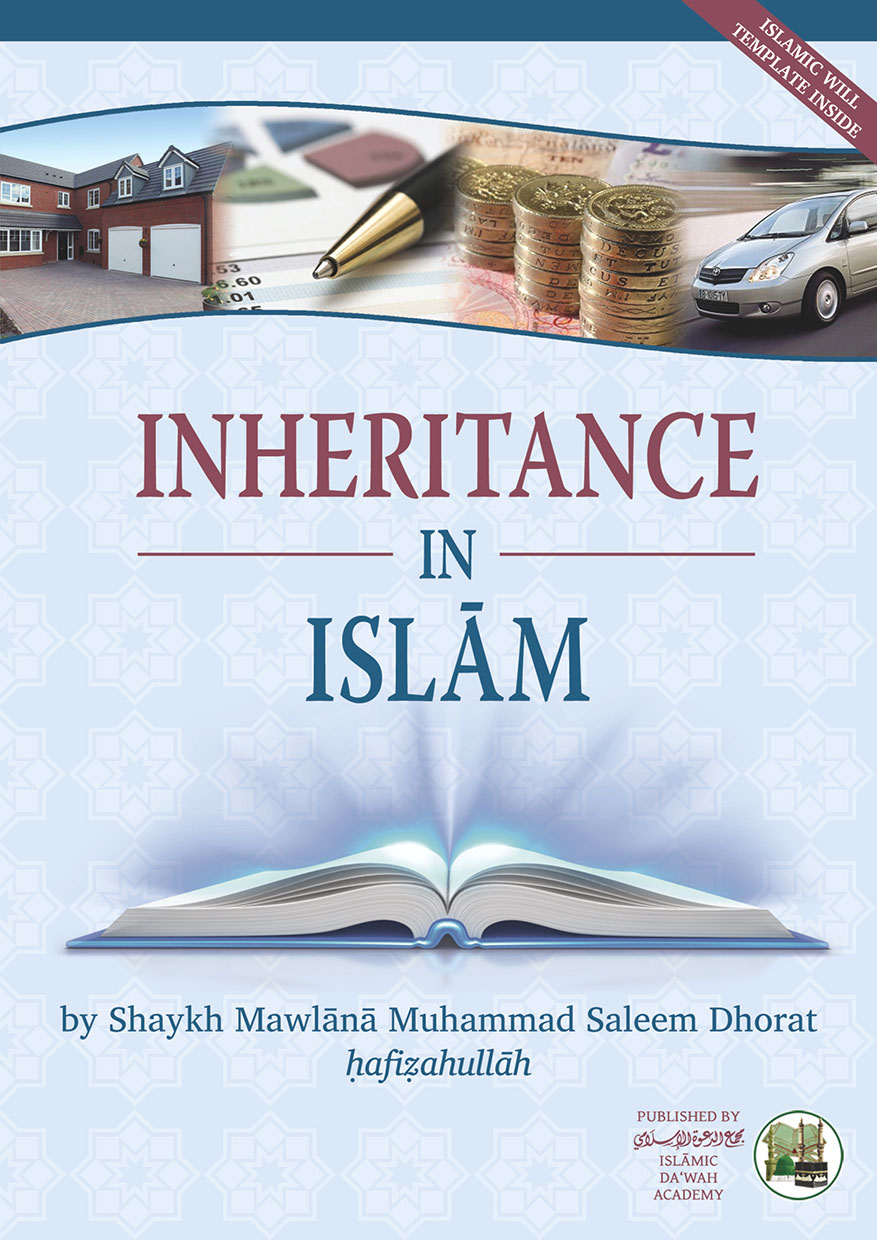
We are witnessing an era where Islām, in spite of its vastness and applicability in every sphere of the human life, has been confined to mere beliefs and a handful of rituals. As with some other important obligations of Islām, the obligation of ensuring the correct procedures in the field of inheritance has also been subjected to gross disregard and outright neglect. In fact, this section of Dīn can be said to be the most neglected one among all. Seeing such state of affairs, the respected Shaykh hafizahullāh embarked on the task of acquainting the Muslims on the importance of this vital duty. The lectures delivered proved to be highly informative and beneficial, but only to a limited audience. In order to extend the benefits to a larger part of the Ummah, it was decided that two of these lectures be selected and published in booklet form. (34 pages p/b + Islamic will template) £1.00A few topics mentioned in the booklet are as follows:• Equality in inheritance
• What can be drawn from the estate
• The importance of drawing up a will
• Causes of incorrect wills
• Criteria for wasiyyah (bequest)
• What to do following a death
• Common errors and customs
To order the above book or for details of our other publications, please email  info@idauk.org or call 0116 262 5440.

• Please forward this message on to all your contacts •

Categories
Shaykh Saleem Dhorat

Understanding Tazkiyah

بسم الله الرحمن الرحيم

By Shaykh-ul-Hadīth, Hadrat Mawlānā Muhammad Saleem Dhorat hafizahullāh

The Four Parts of Dīn

The sole objective of our lives is to acquire the Pleasure of Allāh ta‘ālā, which can only be achieved by following the whole Dīn. The whole Dīn can be categorised into four parts:

1.   External actions, which comprise of:

a.  Performing good actions e.g. Salāh;

b.  Refraining from sinful actions e.g. backbiting.

2.   Internal qualities, which comprise of:

a.  Purifying the heart from debasing qualities e.g. pride;

b.  Adorning the heart with praiseworthy traits e.g. humbleness.

Allāh ta‘ālā has laid down commands relating to both the external and the internal aspects of Dīn. In both, there are Do’s and Don’ts. For example, performing Salāh, giving Zakāh, fasting and performing Hajj are external actions which must be carried out; whilst causing physical harm, stealing and consuming harām are external actions which must be avoided. Similarly, jealousy, malice and pride are debasing qualities of the heart which are prohibited; whilst Shukr (being grateful to Allāh ta‘ālā) and Sabr (patience) and humbleness are praiseworthy qualities with which every Muslim should strive to adorn his heart.

We can therefore conclude that our duties as Muslims are: to carry out good actions; to refrain from sinful actions; to purify the heart from debasing qualities; and to adorn the heart with praiseworthy qualities. All four are termed as Al-A‘māl As-Sālihah (good deeds) and our success lies in carrying them out. Allāh ta‘ālā states:

Verily those who believe and do good deeds, for them shall be gardens beneath which rivers flow. That is the great success. (85:11)

Tazkiyah and its Importance

The process of removing the debasing qualities from the heart and adorning it with the praiseworthy qualities is known as Tazkiyah (soul purification). Through Tazkiyah a person first begins to recognise the shortcomings in his inner traits, such as the existence of pride and miserliness. As a result, he is able to exert effort and replace them with praiseworthy qualities such as humbleness and generosity. Allāh ta‘ālā has emphasised the importance of Tazkiyah in the Glorious Qur’ān by taking oath of seven different things before stating:

Undoubtedly, the one who purified it (the soul) has succeeded and the one who soiled it (through kufr, shirk, sin) has certainly failed. (91:9-10)

‘Ilm and Tazkiy

In order to understand the Commands of Allāh ta‘ālā and to carry them out, it is necessary to acquire ‘ilm. Through ‘ilm, we will be able to understand what we are required to do in every situation. Regarding the external actions for example, ‘ilm is required to understand the pre-requisites of Salāh as well as all the necessary aspects within Salāh. Similar is the case for the inner qualities; a person will require ‘ilm to understand which qualities are prohibited and the consequences of having such qualities. For example, our beloved Nabī sallallāhu ‘alayhi wasallam has informed us that a person with pride equivalent to a mustard seed in his heart will not enter Jannah (without first going in Jahannam). (Abū Dāwūd, At-Tirmidhī, Ibn Mājah).

However, without Tazkiyah ‘ilm is not beneficial, as we find that a person has ‘ilm but is unable to practice according to it despite having the desire to do so. For example, a person is aware that offering Fajr Salāh is compulsory, but is unable to leave his bed and go to the masjid.  Similarly, despite being aware that sinful glances are not permissible, he is unable to control the gaze from lustful glances. The reason for this is a lack of spiritual stamina to carry out the Commands of Allāh ta‘ālā. Through the process of Tazkiyah, a person purifies his heart from debasing qualities and as a result gains the spiritual stamina required to fulfil all the external actions Commands of Allāh ta‘ālā.

External Actions Hold No Value without Tazkiyah

Another important point to understand is that without purifying the heart, despite carrying out the external actions of Dīn, they may not be accepted in the Court of Allāh ta‘ālā. This is because a corrupt heart could lead to a person performing deeds with the wrong intention. For example, if a person performs a good action with the intention of acquiring fame, he will gain no reward whatsoever, rather he will be answerable in the Court of Allāh ta‘ālā. Even though outwardly his action may appear perfect and in accordance with the Commands of Allāh ta‘ālā and the Sunnah of Nabī sallallāhu ‘alayhi wasallam, due to his insincerity his action will yield no benefit.

The importance of a purified heart has been explained by Nabī sallallāhu ‘alayhi wasallam in a hadīth:

Indeed there is a piece of flesh in the body; if it is sound, then the whole body will be sound and if it is corrupt then the whole body will be corrupt. Indeed it is the heart. (Al-Bukhārī)

Tazkiyah: The Key to Practising the Whole Dīn

From the above, it is clear that Tazkiyah is the path that leads to the reformation of the heart, providing the spiritual stamina required for external actions; and making them perfect and worthy of acceptance.  Having understood the importance of Tazkiyah, the question arises as to how it can be achieved. For this, read and study ‘The Path to Purification’, published by At-Tazkiyah. 

Let us recognise the importance of Tazkiyah and exert effort towards its acquisition, so that we may practice the whole Dīn and acquire the eternal bliss of the Hereafter.

© Riyādul Jannah (Vol. 26 No. 11/12, Nov/Dec 2017)


We are witnessing an era where Islām, in spite of its vastness and applicability in every sphere of the human life, has been confined to mere beliefs and a handful of rituals. As with some other important obligations of Islām, the obligation of ensuring the correct procedures in the field of inheritance has also been subjected to gross disregard and outright neglect. In fact, this section of Dīn can be said to be the most neglected one among all. Seeing such state of affairs, the respected Shaykh hafizahullāh embarked on the task of acquainting the Muslims on the importance of this vital duty. The lectures delivered proved to be highly informative and beneficial, but only to a limited audience. In order to extend the benefits to a larger part of the Ummah, it was decided that two of these lectures be selected and published in booklet form.

A few topics mentioned in the booklet are as follows:

• Equality in inheritance
• What can be drawn from the estate
• The importance of drawing up a will
• Causes of incorrect wills
• Criteria for wasiyyah (bequest)
• What to do following a death
• Common errors and customs

To order the above book or for details of our other publications, please email info@idauk.org or call 0116 262 5440.


• Please forward this message on to all your contacts

Categories
Shaykh Saleem Dhorat

Valuing the Last Ten Days of Ramadān

بسم الله الرحمن الرحيم

By Shaykh-ul-Hadīth, Hadrat Mawlānā Muhammad Saleem Dhorat hafizahullāh

The month of Ramadān is full of blessings. Rasūlullāh sallallāhu ‘alayhi wasallam said:

And it is a month the first part [first ten days] of which is mercy, the middle part [middle ten days] is forgiveness and the last part [last ten days] is emancipation from the Fire (of Jahannam). (Ibn Khuzaymah)

Having passed through the first ten days of ‘mercy’, we find ourselves in the second ten days of ‘forgiveness’ and approaching the last ten days, wherein Allāh ta‘ālā emancipates His servants from the Fire of Jahannam. Now, we will find people with different mind-sets; some will count down the days in eager anticipation of ‘Īd after which they will not have to stay hungry and thirsty for long hours anymore; some will have spent the major part of Ramadān exerting much effort in devotion to Allāh ta‘ālā and thus feel that they can now relax in the last ten days as they have, in their opinion, carried out much ‘ibādah already; and some will not have done anything of note until now and feel that there is no point of doing anything in these remaining days.

All these mind-sets are incorrect, as the last ten days of Ramadān hold great significance and virtue over the first twenty days of Ramadān. One only needs to examine the conduct of Nabī sallallāhu ‘alayhi wasallam during the last ten days to understand their virtue.

The Conduct of Nabī sallallāhu ‘alayhi wasallam during the Last Ten Days

Sayyidah ‘Ā’ishah radhiyallāhu ‘anhā reports that when the last ten days of Ramadān would enter, Nabī sallallāhu ‘alayhi wasallam would tighten his waist belt, stay awake at night and awaken his family. (Al-Bukhārī)

In this hadīth, Sayyidah ‘Ā’ishah radhiyallāhu ‘anhā has mentioned three things:

1.  Nabī sallallāhu ‘alayhi wasallam would tighten his waist belt, which refers to preparation for exerting himself in ‘ibādah.

2.  Nabī sallallāhu ‘alayhi wasallam would stay awake throughout the nights of the last ten days of Ramadān and worship Allāh ta‘ālā.

3.  Nabī sallallāhu ‘alayhi wasallam would awaken his family also for ‘ibādah and tahajjud so that they too can acquire the blessings of the blessed nights.

The fact that Nabī sallallāhu ‘alayhi wasallam would especially exert much effort in devotion during the last ten days of Ramadān, shows the virtue and significance of these last ten days. And why would Nabī sallallāhu ‘alayhi wasallam not exert effort during these last ten days, when they have been specified for the Night of Qadr. Nabī sallallāhu ‘alayhi wasallam said,

Seek Laylat-ul-Qadr during the last ten days of Ramadān. (At-Tirmidhī)

The Virtues of Laylat-ul-Qadr

Laylat-ul-Qadr is a night full of blessings and goodness. ‘Ibādah carried out on Laylat-ul-Qadr is better than ‘ibadah carried out continuously for a thousand months (83 years and four months). Allāh ta‘ālā says:

Verily! We revealed it (the Qur’ān) during the Night of Qadr (from Al-Lawh Al-Mahfūz to the first heaven). Do you know what is the Night of Qadr? The Night of Qadr is much better than a thousand months. The angels and the Rūh (Sayyidunā Jibra’īl ‘alayhis salām) descend in it by the Command of their Rabb with every decision. It (this night) is full of peace. And (all of this) remains (from sunset) until the break of dawn. (97:1-5)

Nabī sallallāhu ‘alayhi wasallam said:

During the Night of Qadr, Jibra’īl ‘alayhis salām descends with a group of angels and they make du‘ā of mercy for every servant who stands or sits remembering Allāh ta‘ālā (engaged in worship). (Al-Bayhaqī)

Nabī sallallāhu ‘alayhi wasallam also said:

Whoever stands in worship during the Night of Qadr with Īmān and hope of reward, all his previous sins will be forgiven. (Al-Bukhārī)

If we understood the virtues and the blessings of this great night, we too would exert great effort towards acquiring these blessings just as our pious predecessors did. It is reported regarding Qatādah rahimahullāh that he would complete the entire Qur’ān every three nights during the first twenty days of Ramadān and every night during the last ten days. In order to become deserving of the virtues of Laylat-ul-Qadr, one must exert every effort and do everything he can. One easy way of becoming deserving of the blessings of the Night of Qadr is to observe the i‘tikāf of the last ten days of Ramadān. Sayyidunā Abu Sa‘īd Al-Khudrī radhiyallāhu ‘anhu narrates that Nabī sallallāhu ‘alayhi wasallam said,

Verily, in search of Laylat-ul-Qadr I performed i‘tikāf of the first ten days and then extended it to the next ten days for the same purpose; then I was told that this night is in the last ten days; so those who are performing i‘tikāf with me should perform the i‘tikāf of the last ten days. (Al-Bukhārī, Muslim)

The Importance and Virtue of I‘tikāf

We learn from the Sīrah of our beloved Nabī sallallāhu ‘alayhi wasallam that the i‘tikāf of the last ten days of Ramadān was a practice that he sallallāhu ‘alayhi wasallam would not miss. Sayyidah ‘Ā’ishah radhiyallāhu ‘anhā said that Nabī sallallāhu ‘alayhi wasallam would observe i‘tikāf in the last ten days of Ramadān until he passed away. (Al-Bukhārī, Muslim)

Sayyidunā Anas radhiyallāhu ‘anhu said that Rasūlullāh sallallāhu ‘alayhi wasallam observed i‘tikāf during the last ten days of Ramadān. One year he could not observe the i‘tikāf, so the following year he observed i‘tikāf for twenty days. (At-Tirmidhī)

Mentioning the virtues of i‘tikāf, Sayyidunā Ibn ‘Abbās radhiyallāhu ‘anhu says that Nabī sallallāhu ‘alayhi wasallam said,

He (the one observing i‘tikāf) refrains from sins (as he confines himself to the boundary of the masjid) and is rewarded for all good deeds (that he cannot do due to being in i‘tikāf e.g. visiting the sick or participating in janāzah salāh) like that person who carries out good deeds. (Ibn Mājah)

The one performing i‘tikāf, through the blessing of staying within the confines of the masjid, is able to refrain from sins which he may have committed outside of the masjid. Along with this, he is able to engage in so many worships e.g. salāh, dhikr, tilāwat, du‘ā. Moreover, every moment of his is a means of reward as i‘tikāf in itself is also a worship; hence the one performing i‘tikāf gains the reward of i‘tikāf even whilst eating and sleeping.

I‘tikāf: A Fortune

The one observing i‘tikāf is extremely fortunate for he disassociates himself from everything and throws himself into the Court of His Lord and Creator. He remembers Him, praises Him, glorifies Him and sincerely seeks His Forgiveness; he cries over his past mistakes and beseeches His Creator for His Mercy and seeks nothing but His Pleasure. His days and nights are spent only in this pursuit. The author of Marāqī-Al-Falāh states that if i‘tikāf is observed with sincerity, then it is amongst the most virtuous deeds.

Our Task in Hand

So if one is able to perform i‘tikāf during the last ten days, he should most definitely do so. The ladies should also perform i‘tikāf at home. If one is not able to perform i‘tikāf for all of the last ten days, he should perform i‘tikāf for however many days he is able to. And if one is so busy that he cannot spend even one day in i‘tikāf then the least he should do is value each and every moment of the last ten days, especially the nights. He should refrain from every minor and major disobedience to Allāh ta‘ālā carry out actions which please Him to acquire Divine Pleasure.

May Allāh ta‘ālā grant us the tawfīq to value the remaining days of Ramadān, especially the last ten days. May He bless us with the virtue of Laylat-ul-Qadr. May He accept those who have intended to carry out the Sunnah i‘tikāf and may Allāh ta‘ālā make this Ramadān a turning point in our lives and enable us to live a life of obedience until we depart from this world. Āmīn.

© Riyādul Jannah (Vol. 27 No. 5/6, May/June 2018)


• Please forward this message on to all your contacts

Categories
Shaykh Saleem Dhorat

Advice for Teachers – 08/04/2018

بسم الله الرحمن الرحيم

Notes from Khatme Bukhari Jalsah of Shaykhul Hadith Hadhrat Mawlana Muhammad Saleem Dhorat Saheb (Hafidhahullah)IMG-20170609-WA0080.jpg

Sacrifice


Asad ibn Furat RH was a student of Imam Muhammad RH. He says that Imam Muhammad RH would teach some students extra lessons at night time. So I also requested to be taught at night, he granted me permission. One night, I knocked on the door of my teacher’s house. Imam Muhammad RH opened the door with a book in one hand and a jug of water in the other. As the lesson started, I felt sleepy, when Imam Muhammad caught sight of this he would sprinkle the water from the jug on my face. I would awaken immediately. Once again, if I fell sleepy he would repeat the same action.

Shaykh mentioned this story and stated, “Brothers! This deen did not come to us with ease, there was great sacrifice behind this.”

Imam Shafiee RH

Imam Shafiee RH states, “A teacher should pick out the brighter students and make extra effort on them, so they can advance and excel.” Which does not mean we leave out the weaker students, also focus on them to improve.

Patience and Mercy

Rabee ibn Sulayman RH narrates, “Once Imam Shafiee RH explained a mas’alah in class, I did not understand so he repeated the mas’alah. Imam Shafiee kept asking me if I understood, until he repeated it FORTY times. After which he asked me if I understood. Out of sheer embarrassment I walked out of class, because I didn’t want my fellow colleagues to lose out on the lesson. After class my ustadh called me and kept explaining and explaining until I understood! By Allah! He would not leave his place until I did. He would say the following to me: If I could empty my chest and make you drink this knowledge I would (literally) make you drink it.”

Shaykh mentioned that we should think of these children as a plantation for our hereafter. Have Marcy upon them if they lack understanding.

Another similar incident is mentioned regarding Hasan ibn Ziyad RH, he mentions, “I used to attend the classes of Imam Zufar RH, occasionally I would question Imam Zufar on issues I didn’t understand. He would answer the first time, politely. If I asked the same question again, he would answer with a slight harsh and annoyed tone. The third time he would get very angry at me for repeating the same question. Then I referred to Imam Abu Yusuf RH. I would ask him the same question, once, twice, thrice… He would answer each time with the same forbearance and tolerance, saying…’لو استطيعُ انْ ٓاطٓعمكٓ الْعلم لاطعمتُهُ'”

Fearing Criticism

We must continue to do the work of Deen and not fear what people will say. The critics of Imam Shafi’ee RH said about him, “He is worse than Iblees!” The enemies of Imam Abu Hanifah RH said, “Killing Imam Abu Hanifah is better than doing Jihad 70 times.

Keep focused on your purpose, do not look around at what people are doing.

Importance of Qiyamul Layl

A man came to study by Imam Ahmad ibn Hanbal RH, after a few days Imam Ahmad RH noticed that he does not wake up for Tahajjud. Imam Ahmad RH commented, “This man is seeking knowledge, but does not awaken at night for prayer?”

We should be punctual in Tahajjud and pray for our students as well.

Continue Seeking Knowledge

After graduation, continue to seek knowledge. Our knowledge should keep increasing and increasing. Also, remember to act upon the knowledge we learn. As well as all this, you should endeavour to spread this knowledge to the four corners of the world. We should have worry and concern that how we can reach this knowledge to every person of the Ummah. To acquire this, we need to ask Allah for help, make constant Dua and meet and greet people with good manners and etiquette. Deal with them in a soft and gentle manner.

Forgiveness

Forgive your students, ask forgiveness from them as well. Students should also ask forgiveness regularly from their teachers.

Wealth and Money

Do not run after the world/dunya. What is written for you in Taqdeer will alway come to you. Do not make this your purpose. We want you students to make Ilm/knowledge your life, your eating, breathing, sleeping etc. We want you to die seeking this Ilm.

The Ummah is thirsty, they are on the brink of Apostasy. My dear children, it is your duty to save them with the knowledge Allah has blessed you with. Allah will fulfil your financial, spiritual and physical needs in sha Allah. Allah make you a great Sadaqah Jariyah for your parents.

Categories
Shaykh Saleem Dhorat

How to Acquire Husn-ul-Khatimah

By Shaykh-ul-Hadīth, Hadrat Mawlānā Muhammad Saleem Dhorat hafizahullāh

If we study the lives of the pious servants of Allāh ta‘ālā, i.e. the Ambiyā, Sahābah Radhiyallāhu ‘anhum, the Muhaddithūn, Fuqahā, Awliyā, we will find one common factor in their lives, and that is their concern for securing Husn-ul-Khātimah so that they are successful in the Court of Allāh ta‘ālā. Despite their lives being full of virtue, they would worry and pray for death in the state of īmān and Islām. 

Allāh ta‘ālā quotes the du‘ā of Yūsuf ‘alayhis salām in the Glorious Qur’ān:

…O Creator of the heavens and the Earth, You are my guardian in this world and the Hereafter. Make me die a Muslim and make me join the righteous. (12:102)

This is because a single word of disbelief at the time of death can erase the benefits of a lifetime of virtue and obedience. On the other hand, a person may live a life of sin and vice, and then be granted the blessing of īmān in the final moments of his life, thereby securing the success of both this world and the Hereafter. Through His infinite Grace and Mercy, Allāh ta‘ālā inspired me with six points, which will secure Husn-ul-Khātimah and a good death for ourselves, which in turn will result in a good outcome in the Hereafter, Inshā’allāh.

1. Adopt Taqwā (fear of Allāh ta‘ālā). Taqwā holds the power to repel all the forces which weaken one’s īmān and at times snatch it away. This can be understood from the verses wherein Allāh commands the believers to adopt Taqwā. We understand from them that once a person becomes a believer, the method of safeguarding that belief is adopting Taqwā. And Taqwā simply means to create a barrier between disobedience to Allāh and ourselves. Another name for this Taqwā is Istiqāmah (steadfastness), because when a person, after accepting īmān, remains steadfast upon the Commands of Allāh, he will not disobey Him. Allāh ta‘ālā mentions:

Surely, those who have declared: ‘Our Lord is Allāh’, then remained steadfast, on them the angels will descend, saying, ‘Do not fear, and do not grieve; and be happy with the good news of Jannah (Paradise) that you had been promised. We have been your friends in the worldly life, and (will remain as such) in the Hereafter. And for you here is whatever your souls desire, and for you here is whatever you call for.’ (41:30)

So when one accepts īmān by saying, “My Lord is Allāh”, and thereafter safeguards this īmān by remaining steadfast in carrying out the Commands of Allāh and staying away from every disobedience, then Allāh will reward him with a good death, as is indicated in the verse above, that the angels will descend with special mercy at the time of his death. The commentators of the Qur’ān have mentioned that the angels of mercy are always with those who are steadfast on Dīn; however, the special indication given in this verse is that at the time of their death, the angels become visible to them, who give them the glad tidings of Jannah from their Lord.

2. Love the pious and spend time in their company. The pious people are the people of Taqwā. The effect of loving them will create in one the desire to spend time in their company, and in doing so the effect of their taqwā will rub onto one’s self. Allāh ta‘ālāmentions: 

O you who believe, adopt taqwā, and be in the company of the truthful. (9:119)

We need to firstly accept īmān, which alhamdulillāh we all do, and thereafter safeguard our īmān by adopting Taqwā, which can be acquired by staying in the company of those who already have it. The term ‘The Truthful’ used here is another name for those who have Taqwā, as mentioned in another place in the Qur’ān:

…Those are the ones who are truthful, and those are the God-fearing. (2:177)

Similarly the Prophet sallallāhu ‘alayhi wasallam states in a hadīth:

On the Day of Judgement, a person will be with whom he loved. (At-Tirmidhī)

If a person entertains love for the pious, he will be with them in the Hereafter, and the pious people will be granted entry into Jannah, for which īmān is a prerequisite. Thus, we can deduce that such a person will die in the state of īmān.

3. Giving in charity. Spending in the path of Allāh ta‘ālā cools the Anger of Allāh. If Allāh ta‘ālā is angry with a person, what chance is there for him to have a good death? Therefore, charity paves the way for one to die in the state of īmān, as indicated by the Prophet sallallāhu ‘alayhi wasallam: 

Sadaqah (charity) extinguishes the anger of the Lord and prevents an unpleasant death. (At-Tirmidhī)

An unpleasant death could either mean death without īmān or death in an undesirable state, i.e. as a victim of a tsunami, hurricane, or earthquake. Inshā’allāh, a person will be saved from both types of death.

4. Carrying out acts upon which the intercession of the Prophet sallallāhu ‘alayhi wasallam is guaranteed. In various narrations, the Prophet sallallāhu ‘alayhi wasallamhas encouraged carrying out certain good acts, the virtue of which is that the intercession of the Prophet sallallāhu ‘alayhi wasallam will become incumbent for the doer. One should inquire about and learn such acts from reliable, authentic sources and act upon them. The intercession of the Prophet sallallāhu ‘alayhi wasallam is of two types. The first being that on the Day of Judgement, when every human will be gathered in the Plain of Resurrection, every soul will be in a state of extreme worry and fear regarding its fate in the court of Allāh ta‘ālā. At this tense moment, the Prophet sallallāhu ‘alayhi wasallam will intercede on behalf of the whole humankind and request Allāh ta‘ālā to begin the reckoning. The reckoning will thus begin, and this is known as the ‘general intercession’. Thereafter, once the process of reckoning begins, the Prophet sallallāhu ‘alayhi wasallam will specifically intercede on behalf of many individuals of his ummah, with the permission of Allāh. Only a person who dies in the state of īmān will be worthy of receiving this ‘special intercession’ of the Prophet sallallāhu ‘alayhi wasallam. The glad tidings of intercession upon various good actions is this ‘special intercession’ which is exclusively for people with īmān. It can be therefore understood that those carrying out these good acts will die with īmān, as only they will be worthy of this ‘special intercession’. One example of such an act is reciting the du‘ā after the adhān.

5. Repeatedly thank Allāh ta‘ālā for the great bounty of īmān, for Allāh ta‘ālāpromises: 

If you express gratitude, I shall certainly give you more. (14:7) 

It should be kept in mind that gratitude should be expressed in 3 ways:

  • By acknowledging and contemplating over this great bounty in one’s heart and mind that Allāh has granted this to me through His Grace only without my deserving it.
  •  By verbally expressing one’s gratitude.
  • By fulfilling the Commands of Allāh in regards to this bounty.

If we acknowledge the bounty of īmān with our heart and mind, express praise for Allāh verbally and carry out the demands of this ni‘mah (blessing), i.e. adopt Taqwā, then Allāh will increase this ni‘mah of ours inshā’allāh.

6. Make du‘ā for a good death and for a pleasant abode in the Hereafter. You may do this in your own words or by using supplications from the Qur’ān and ahādīth, for example: 

O Allāh, forgive our living and our dead, those present from among us and those absent, our young and our old, our males and our females, O Allāh whoever you keep alive from among us, keep him alive on Islām, and whoever you give death to, give him death upon īmān. (Ahmad)

Allāh ta‘ālā mentions the supplication of the knowledgeable people: “Our Lord, do not let our hearts deviate from the right path after You have given us guidance, and bestow upon us mercy from your own.” (2:8)

If we strive to do the above and ask Allāh ta‘ālā sincerely, then inshā’allāh, He will grant us this great bounty of death in the state of īmān.

May Allāh ta‘ālā grant us the true understanding of the reality of the Hereafter and grant us the tawfīq to adequately prepare for it. Āmīn.

Categories
Shaykh Saleem Dhorat

Quenching the Thirst of Others


By Shaykh-ul-Hadīth, Hadrat Mawlānā Muhammad Saleem Dhorat hafizahullāh

Imām Al-Bukhārī rahimahullāh has narrated a hadīth on the authority of Sayyidunā Abū Hurayrah radhiyallāhu ‘anhu that Rasūlullāh sallallāhu ‘alayhi wasallam said, “A person, whilst on a journey, experienced extreme thirst. [Along the way, he came across a well so] he climbed down this well and drank from it. He then climbed out of the well and saw a dog panting and licking the moist soil due to [extreme] thirst. This person said [to himself], ‘Indeed this dog has faced the same dilemma [of thirst] that I faced.’ [So he climbed down the well again and] filled his leather sock with water. He then climbed out whilst holding his sock with his teeth and quenched the thirst of the dog. Allāh ta‘ālā appreciated his deed and forgave his sins. The Sahābah radhiyallāhu ‘anhum asked, ‘Is there reward for us in [being kind to] animals?’ Rasūlullāh sallallāhu ‘alayhi wasallam replied, ‘There is reward in [being kind to] every living creature’.”

Many lessons can be derived from this hadīth, but I wish to draw your attention to a specific lesson, that of providing water for the creation of Allāh ta‘ālā. It is evident that the deed that attracted the Mercy of Allāh ta‘ālā was quenching the thirst of a dog.

Water – A Gift from Allāh

Water is an essential need of a human; a person can survive weeks without food, but only days without water. The body’s function is dependent on water and all its essential organs need a constant supply. As the body cannot make its own water, a person needs to supply the body with water. This important need of humans is provided by Allāh ta‘ālā himself in the form of rain, streams, rivers, lakes, seas and oceans. Allāh ta‘ālā states:

…and We have sent down pure water from the sky. (25:48)

And We caused the earth to burst with springs… (54:12)

Water – A Medium to Gain Great Reward

Due to its importance and necessity, Allāh ta‘ālā has also promised great reward for those who provide water to the creation of Allāh ta‘ālā. In the above ḥadīth, we already learnt that it attracts the forgiveness of Allāh ta‘ālā. Many other ahādīth also mention further benefits:

• Rasūlullāh sallallāhu ‘alayhi wasallam has stated, “There is no sadaqah more rewarding than [providing] water.” (Al-Bayhaqī)

• Upon being asked regarding the most virtuous form of sadaqah, Rasūlullāh sallallāhu ‘alayhi wasallam replied, “[Providing] water.” (Abū Dāwūd)

• Rasūlullāh sallallāhu ‘alayhi wasallam stated, “Whichever Muslim quenches the thirst of another Muslim, Allāh will grant him drink from Ar-Rahīq Al-Makhtūm.” (Abū Dāwūd)

Ar-Rahīq Al-Makhtūm is a special wine of Jannah which has been promised for the special servants – the Abrār (the righteous). Allāh ta‘ālā says,

Verily the Abrār will be in bounties, upon couches looking on. You will recognise the radiance of bounties in their faces. They will be given pure sealed wine to drink, the seal of which is musk. It is for this that the competitors should compete. (83:22-26)

Water – A Means of Continuous Reward

Sadaqah is of two types:

1. Sadaqah: where the reward is confined to the action and the reward is a single entry. For example, when someone feeds another person, a one-off reward is written for him; and

2. As-Sadaqah Al-Jāriyah: when the reward is continuous. In fact, it also continues after one’s demise. For example, authoring a book from which people benefit; for as long as people benefit from this knowledge, the author will continue to reap its reward.

After one’s demise, the avenues to gain further reward by any action inevitably cease. A person finding himself in a bad state in the afterlife cannot carry out any deed to change his situation. Similarly, if he finds himself in a good state and he wishes to enhance his condition further, he is unable to carry out any deed to achieve this. At this juncture, a deceased person has two possibilities of earning reward:

1. Īsāl-uth-Thawāb: someone performing a good deed and sending him its reward; and

2. As-Sadaqah Al-Jāriyah: as explained above, a deed he carried out during his lifetime which is still generating reward for him.

Nabī sallallāhu ‘alayhi wasallam said,

When a person dies, [reward for] his deeds are cut off from him except three [types]: [reward for] As-Sadaqah Al-Jāriyah, knowledge from which benefit is derived [by others]; and righteous children who pray for him. (Muslim) 

There are many forms of As-Sadaqah Al-Jāriyah a person can carry out. In one narration Rasūlullāh sallallāhu ‘alayhi wasallam listed seven and from amongst them he mentioned, “.…a stream which he causes to flow….” (Ibn Mājah)

In another narration we find that Rasūlullāh sallallāhu ‘alayhi wasallam also advised providing water as a form of Īsāl-uth-Thawāb. After the demise of his mother, Sayyidunā Sa‘d Ibn ‘Ubādah radhiyallāhu ‘anhu asked Rasūlullāh sallallāhu ‘alayhi wasallam which sadaqah would be most meritorious and rewarding. Rasūlullāh sallallāhu ‘alayhi wasallam replied, “Providing water.” Sayyidunā Sa‘d radhiyallāhu ‘anhu then got a well dug and dedicated its reward for his mother. (Abū Dāwūd)

‘Allāmah Al-‘Aynī rahimahullāh has mentioned a hadīth wherein Rasūlullāh sallallāhu ‘alayhi wasallam visited a person who was in his last moments. Rasūlullāh sallallāhu ‘alayhi wasallam asked him what he was observing [of the next world]. He explained, “I see two angels distancing themselves from me and two snakes coming closer; and I see evil increasing and goodness weakening.” The person sought help from Rasūlullāh sallallāhu ‘alayhi wasallam by requesting him to make du‘ā. Rasūlullāh sallallāhu ‘alayhi wasallam supplicated, “O Allāh! Accept little [he has done] and forgive the large quantity [of evil deeds he has committed].” Rasūlullāh sallallāhu ‘alayhi wasallam then asked him what he was seeing now. He replied, “The two angels are coming closer and the two snakes are going away; and I see goodness increasing and evil weakening.” Rasūlullāh sallallāhu ‘alayhi wasallam asked him which of his actions he found most rewarding. He said, “Providing water.” (‘Umdah-al-Qārī)

Sayyidunā Anas radhiyallāhu ‘anhu narrates that Rasūlullāh sallallāhu ‘alayhi wasallam said, “On the Day of Judgement, the people going to Jannah will be lined up in rows. A person destined for Jahannam [whilst passing by these rows] will come across a person [to whom he had provided water in this worldly life]. He will say to him, ‘Do you remember that day when you asked for water and I gave you water to drink.’ The person will [remember this favour and] intercede for him.” (Ibn Mājah)

Warning on Not Sharing Water

It is the sheer Grace of Allāh ta‘ālā that he has provided this necessity for survival in much abundance and in principle, it is for all people. Therefore, it would be extremely inhuman to deprive someone of water at the time of his need, especially when one has the means to provide it. Consequently, a grave warning has been cited for such wretched people whose hearts do not soften upon seeing others suffering thirst. Rasūlullāh sallallāhu ‘alayhi wasallam has stated:

There are three types of people; Allāh will neither talk to them, nor look towards them, nor purify them, and for them will be a painful punishment: One who has excess water in the path [along a route] and he prevents a traveller [passing by] from [using] it…. (Al-Bukhārī)

Benefit in this World

Providing water not only benefits a person in the hereafter, but it also has worldly benefits. A person once came to ‘Abdullāh ibn Al-Mubārak rahimahullāh complaining about a wound in a knee which was not healing for the past seven years, despite referring to doctors and treating it with various methods of treatment. ‘Abdullāh ibn Al-Mubārak rahimahullāh advised him to find a place where people are in need of water and provide water by digging a well. The person located a place and dug a well and Allāh ta‘ālā cured him. (Al-Bayhaqī)

Imām Al-Bayhaqī rahimahullāh narrates that my teacher Imām Al-Hākim had a wound on his face. Despite many types of treatment, it could not be cured for a period of one year. He requested Abū ‘Uthmān Sābūnī rahimahullāh to make du‘ā for him in his weekly majlis on Friday. Abū ‘Uthmān rahimahullāh made du‘ā for him. The people who attended earnestly beseeched Allāh ta‘ālā saying āmīn to the du‘ā of the shaykh.

The following Friday, a woman who had attended the previous week, sent a note to Imām Abū ‘Uthmān rahimahullāh. In the note she narrated that, after the previous majlis, she went home and earnestly prayed for Imām Al-Hākim rahimahullāh that night. She mentioned that she saw Rasūlullāh sallallāhu ‘alayhi wasallam in her dream as if he was advising her to tell Imām Al-Hākim rahimahullāh that he should provide water for the Muslims in abundance. When this note reached Imām Al-Hākim rahimahullāh, he ordered a siqāyah [a place where water is provided] to be constructed outside his home. When the construction was completed, it was filled with sweet water. Ice was also placed in it and people began drinking. Not even a week passed and he was cured and his face turned beautiful again. (Al-Bayhaqī)

Providing Water to Others

It is a great Mercy of Allāh ta‘ālā that we in England do not experience a shortage of water. Clean and abundant water is available at all times. We should be thankful to Allāh ta‘ālā for this great gift. There are so many people throughout the world who have to travel far distances to bring clean water for their homes. The short supply obliges them to get every family member to walk the long distance in order to obtain as much water as possible, including young children.

Those of us who are fortunate to have water in abundance and sufficient wealth, should resolve to provide water to the less fortunate ones according to our means. This could be through:

• arranging for wells to be dug;

• providing water pumps;

• providing water coolers; and

• setting up drinking fountains.

In whatever way possible, we should seek to quench the thirst of people and animals. Providing water to the general public on a hot summer day in this country or elsewhere, will also be a deed that will be greatly recompensed by Allāh ta‘ālā. Along with that, the wider community will be able to appreciate the beautiful teachings of the saviour of humanity, our beloved Nabī sallallāhu ‘alayhi wasallam, who was sent as mercy for the world.

May Allāh ta‘ālā grant us the ability to engage in this meritorious act as much as possible, in order to secure His Mercy in this life and in the hereafter. Āmīn. 

© Riyādul Jannah (Vol. 26 No. 3, March 2017)


• Please forward this message on to all your contacts