Categories
Current Affairs articles

In the Shadow of Saints: My Journey from Blackburn to Baghdad

From Blackburn to Baghdad
Alhumdu Lillah, we have just spent seven days in Iraq. It was a profound sacred journey into the heartland of Islamic heritage, many Prophets ﷺ, revered Sahabah RA, Ahle Bayt, knowledgeable Imams and pious Saints graced these very lands. I will share a few notes and thoughts from the visit to Baghdad, Najaf and Karbala. Before I do that, I want to remind everyone when you think of Iraq in modern times, what do you think of? Who do you remember?

No doubt, you will remember the war also referred to as the Second Gulf War from 2003 – 2011. USA invaded Iraq, the primary rationale for the invasion centered around false claims that Iraq possessed weapons of mass destruction. But no WMD stockpiles were found in Iraq. Thanks to the likes of Jack Straw the then Blackburn MP, aka the architect of the Iraq War, the war led to over a million deaths, young girls being raped and the abuse in Abu Ghraib prison. Some of you may remember the letters that came out of these prisons…
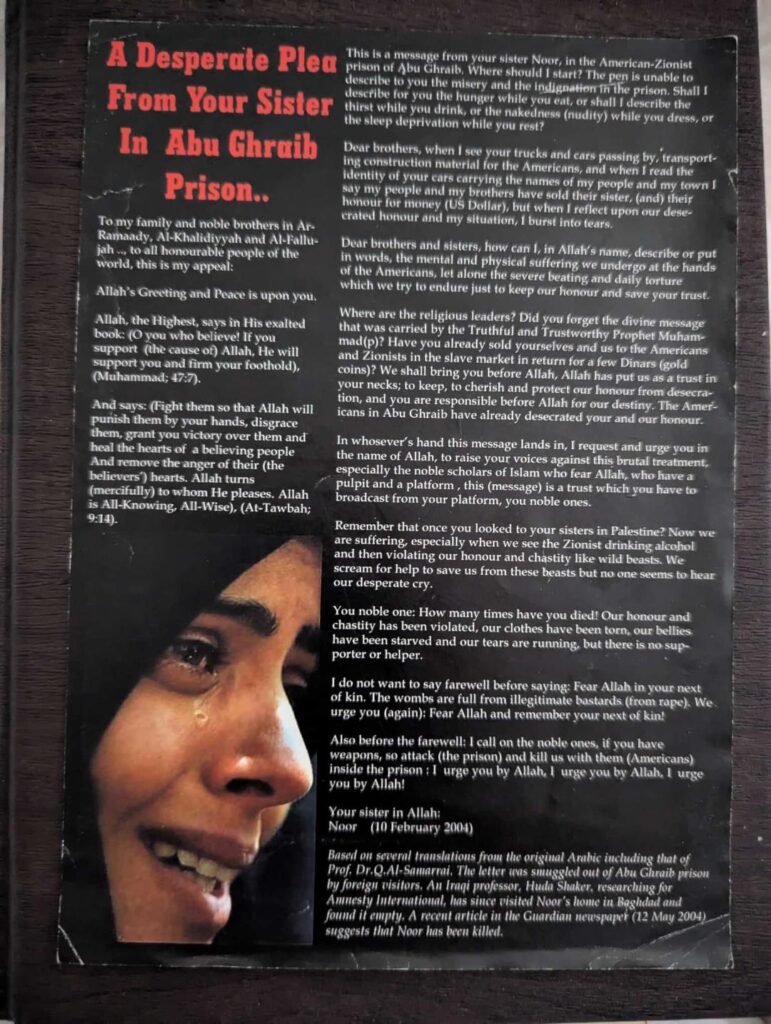
From 2004
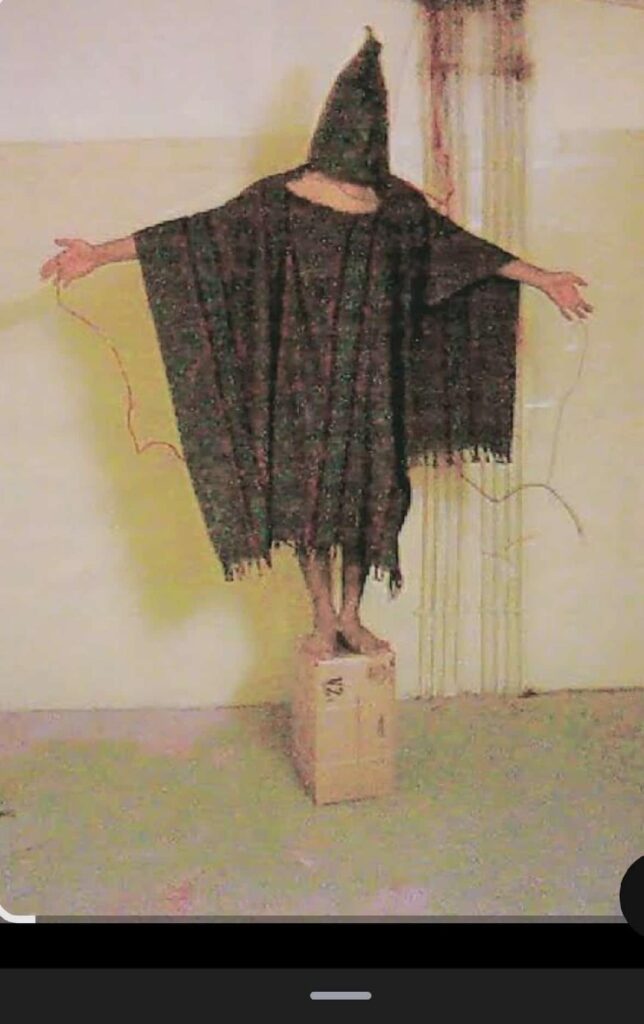
Prisoner abuse at Abu Ghraib prison. Photograph of a hooded prisoner who was forced by US military to stand on a box while attached to wires. The prisoner was led to believe that stepping off the box would result in electrocution.
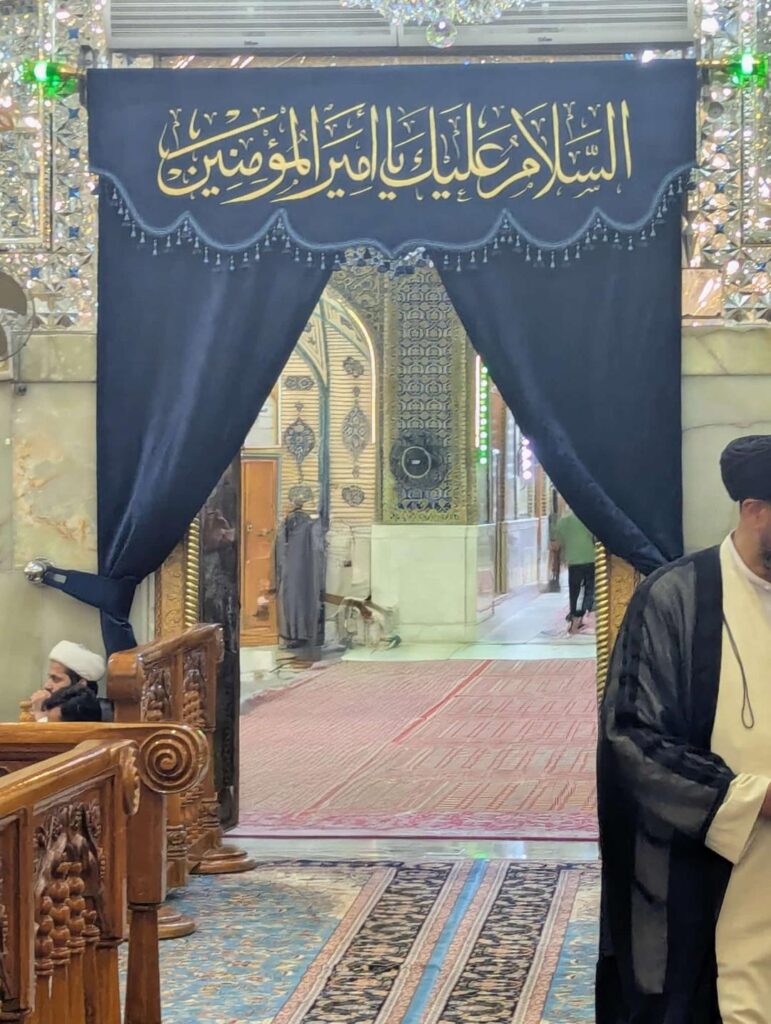
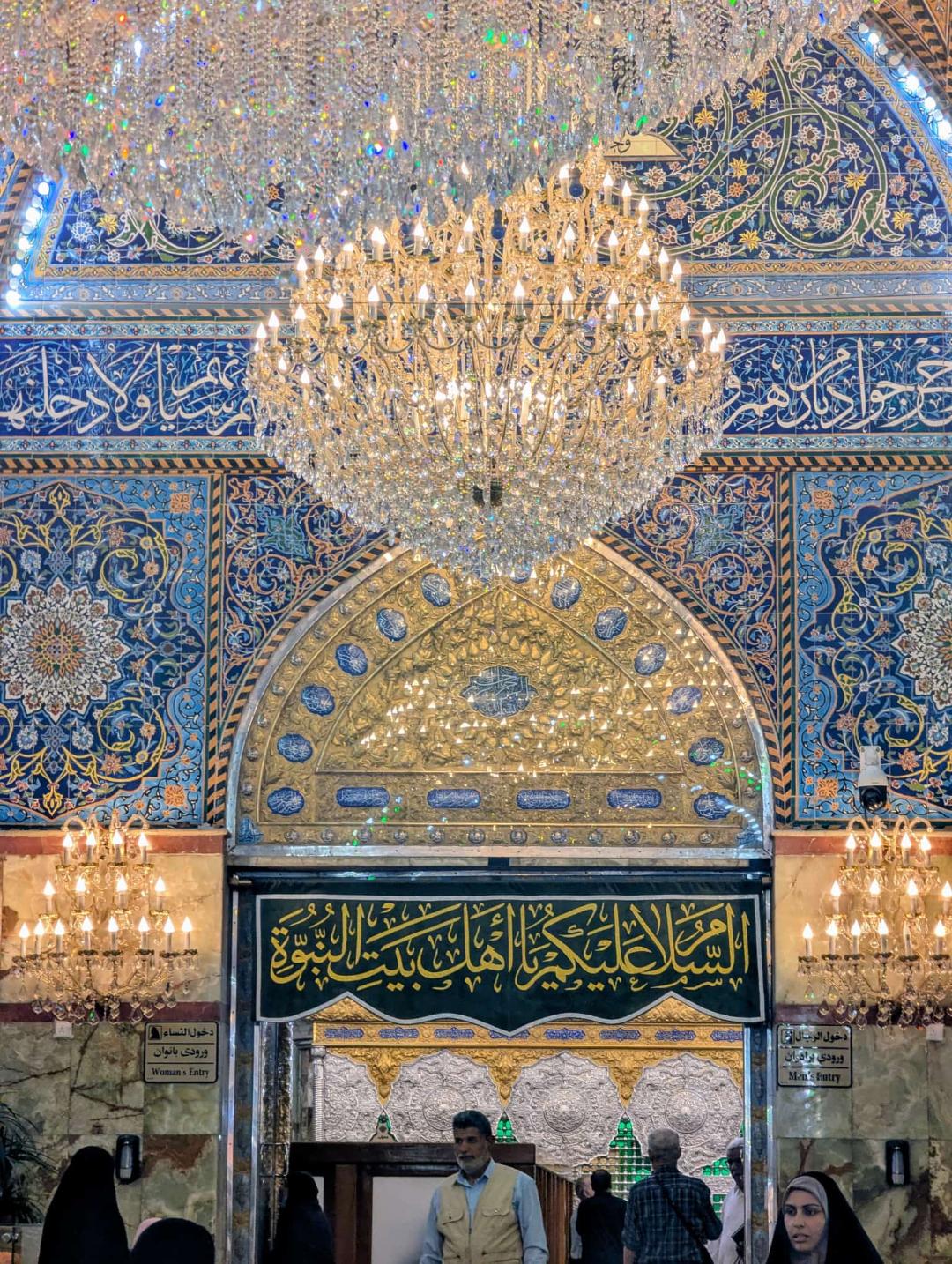
The mausoleum of Sultanul Awliya Shaykh Abdul Qadir Jilani RH in Baghdad, showcasing intricate architectural details and a serene atmosphere.
Day 1
The intention when going to these places is Ziyarat/visiting/learning. You cannot make an intention for thawab/reward: Narrated Abu Huraira: The Prophet ﷺ said,
"Do not set out on a journey except for three Mosques ie Al-Masjid-Al-Haram, the Mosque of Allah's Messenger ﷺ , and the Mosque of Al-Aqsa."

Alhumdu Lillah, on our first day in Baghdad we visited the mausoleum of Sultanul Awliya Shaykh Abdul Qadir Jilani RH. Shaykh was born in Gilan, Iran in 470 A.H. Shaykh was an Arab by descent, being the tenth descendant of Hassan ibn Ali RA. He came to Baghdad in 488 A.H. at the age of 18. After completing his education of religious sciences, he turned to Mysticism/Sufism. Shaykh later became one of the Imams of tasawwuf and Allāh SWT endowed him with many karamaat (miracles).

There is an account narrated about Shaykh Abdul-Qadir Jilani, Allah have mercy on him, that when he set out away from home for the purpose of his education, his noble mother sewed his share of eighty coins into the underarm of his shirt and advised him: ‘Son, do not lie.’ When Shaykh Abdul-Qadir RH departed, on the first day of his journey he passed through a jungle that was inhabited by a large band of thieves and robbers. A party of robbers confronted and apprehended him. The robbers asked: ‘What have you in your possession?’ Shaykh Abdul-Qadir thought to himself that he was being tested in the first stage of his journey; he reflected over his mother’s advice and said:‘I have eighty coins which my noble mother has sewn into the underarm of my shirt.’ The robbers were extremely surprised on hearing this and said: ‘What is this dervish saying! We have never seen such a righteous man!’ They took him and putting him before their chief, related the entire story. When the chief questioned him, Shaykh Abdul-Qadir gave the same response. Finally, when his shirt was torn at the place that he had described, it turned out that there were indeed eighty coins sewn into his shirt. All the robbers were astonished and the chief asked why Shaykh Abdul-Qadir had told them the truth. At this, Shaykh Abdul-Qadir mentioned the advice that his mother had given him...He said: ‘I have set out as a student of religion. If I had told a lie at the very first stage of my journey, what could I ex- pect to attain? And so, I chose to stand by the truth.’ When Shaykh Abdul-Qadir said these words, the chief burst into tears, fell at his feet and repented for his sins. It is said that this chief was the first follower of Shaykh Abdul-Qadir.

In short, truth is a thing that delivers a person in even the most trying and difficult of times.
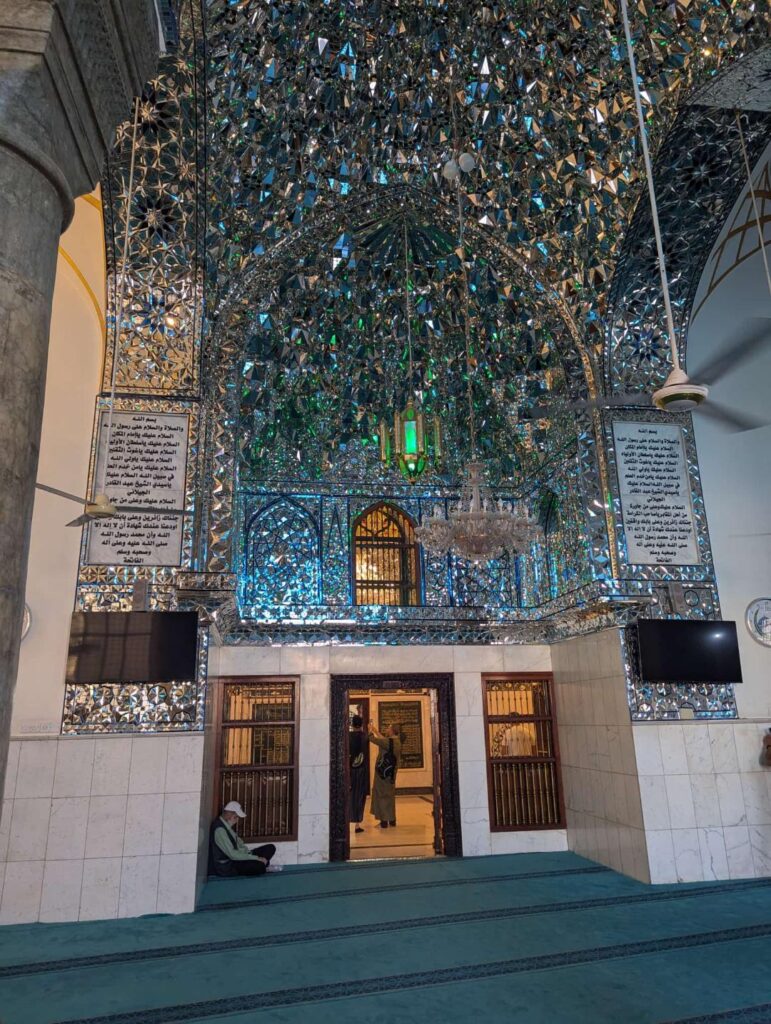
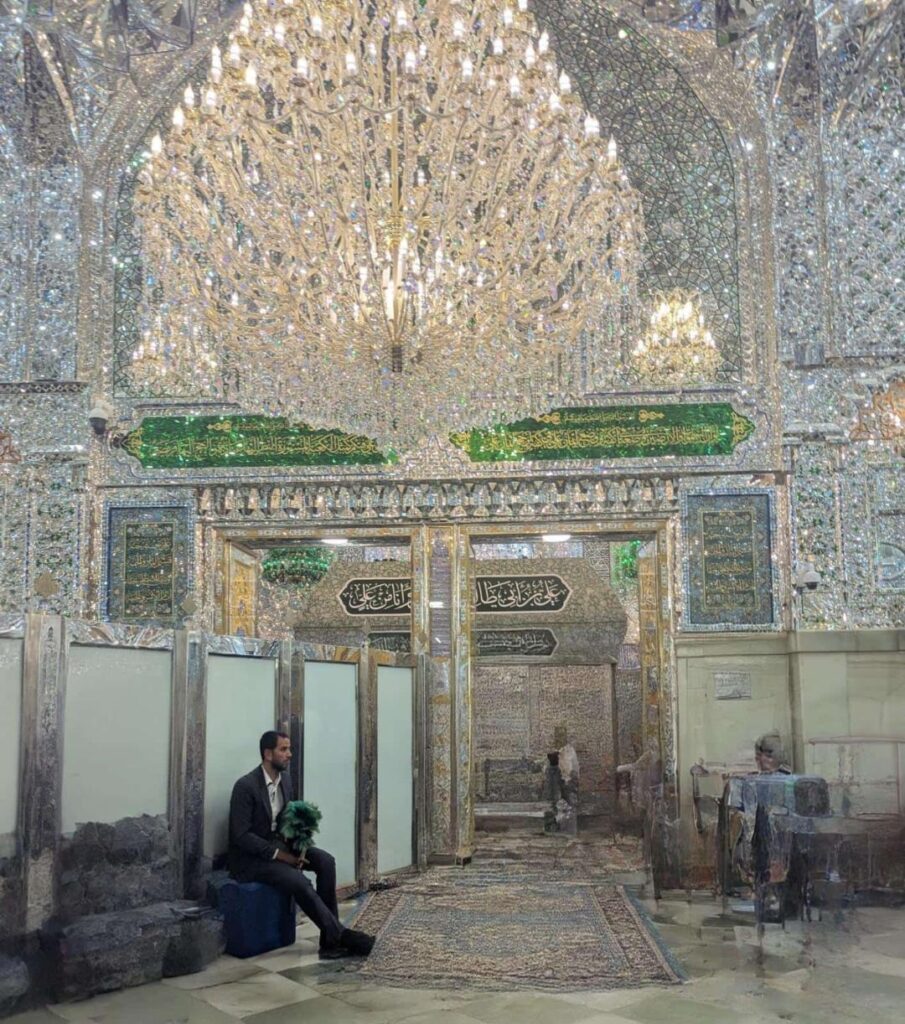
Interior view of the Masjid of Sultanul Awliya Shaykh Abdul Qadir Jilani RH, the whole masjid is studded with diamonds and decorated with chandeliers.
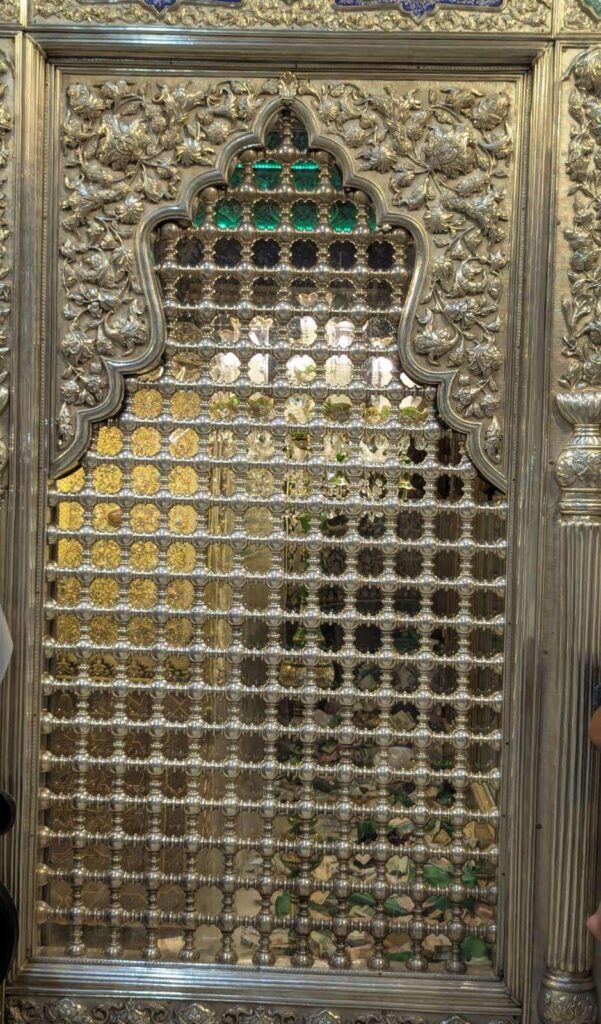
The grave of Shaykh Abdul Qadir Jilani RH in Baghdad.
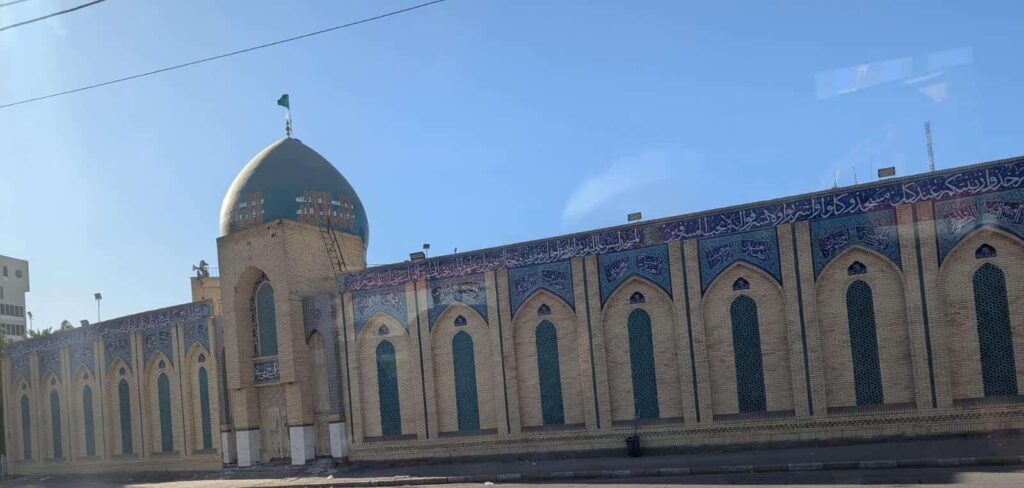
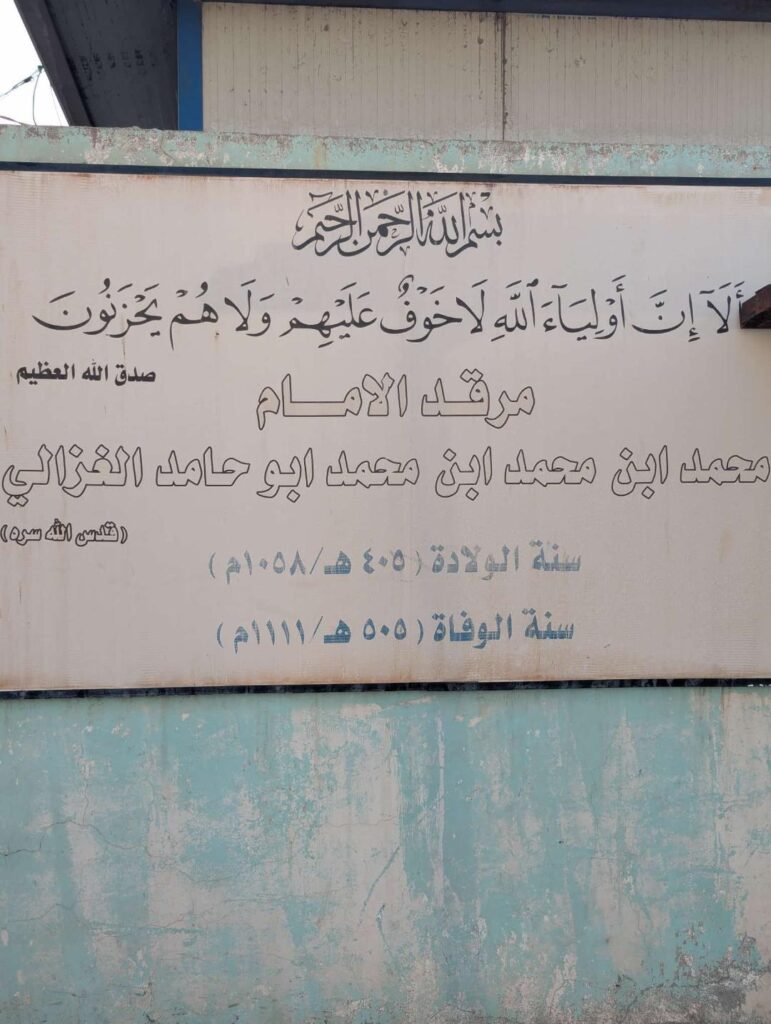
The Mausoleum of Imam Ghazali (Allah elevate his status)


We visited the grave of Abu Hamid Muhammad Ibn Muhammad Al-Tusi al-Ghazali, born 1058-1111, Tus, Iran. Imam Ghazali RH is one of the great jurists and mystics of the 12th century. He wrote on a wide range of topics including Jurisprudence, Theology, Mysticism and philosophy. He was titled the Intellectual Proof of Islam and the Bane of the Philosophers. From childhood Imam Ghazali's inquisitiveness and unquenchable thirst for comprehension of reality was unmatched.Imam Ghazali RH was often scolded by teachers for asking too many questions and engaging in debate. His passion for knowledge is shown from the story below:
Having completed his studies, Imam Ghazali was en route back home. On the way the caravan in which he was traveling was waylaid by robbers. Together with his co-travellers, Imam Ghazali was dispossessed of all his goods. Amongst his possessions were the carefully written notes of the lectures delivered by his ustads. These notes were also taken by the robbers. Imam Ghazali sought out the leader of the band of robbers and pleaded with him...“Your men have taken all my possessions except for the clothes I wear. You may keep the extra clothes and other valuables – I do not lament their loss. However, please ask your men to return the papers they have taken.”
The leader of the band of robbers was amazed at this unusual request. This young man was not worried about clothes and valuables, but he was asking for some pieces of paper to be returned!
Very curious, he asked: “What papers are these?”
Imam Ghazali explained: “I am a student returning home after completing my studies. When my teaWhen my teachers used to lecture, I used to make notes. These are those very pages of ‘ilm that I am requesting to be returned to me.” The leader of the robbers said: “What you have just said fills me with great sorrow and regret. Young lad! Is your ‘ilm on pieces of paper when it should have been in your heart? Papers can get lost. Papers can be destroyed by fire, become parched by the sun, get eaten by moths, become damaged with damp, etc., etc. You are dependent on papers? It fills me with great pity. Your ‘ilm should be in your heart! Be that as it may, your papers will be returned.” He summoned one of his men and ordered him: “Give back to this boy his papers.”The notes were retrieved and returned to Imam Ghazali.
Imam Ghazali was of noble character. He was, moreover, a dedicated student. The words of the gang-leader were like a knife piercing his heart. On reaching home, he lost no time in memorizing all his notes.
These were the scholars of the past who sacrificed everything for knowledge, their dedication is admirable and their zeal for the truth is commendable. This is what shapes history and inspires generations, Allah grant us similar qualities, Ameen.
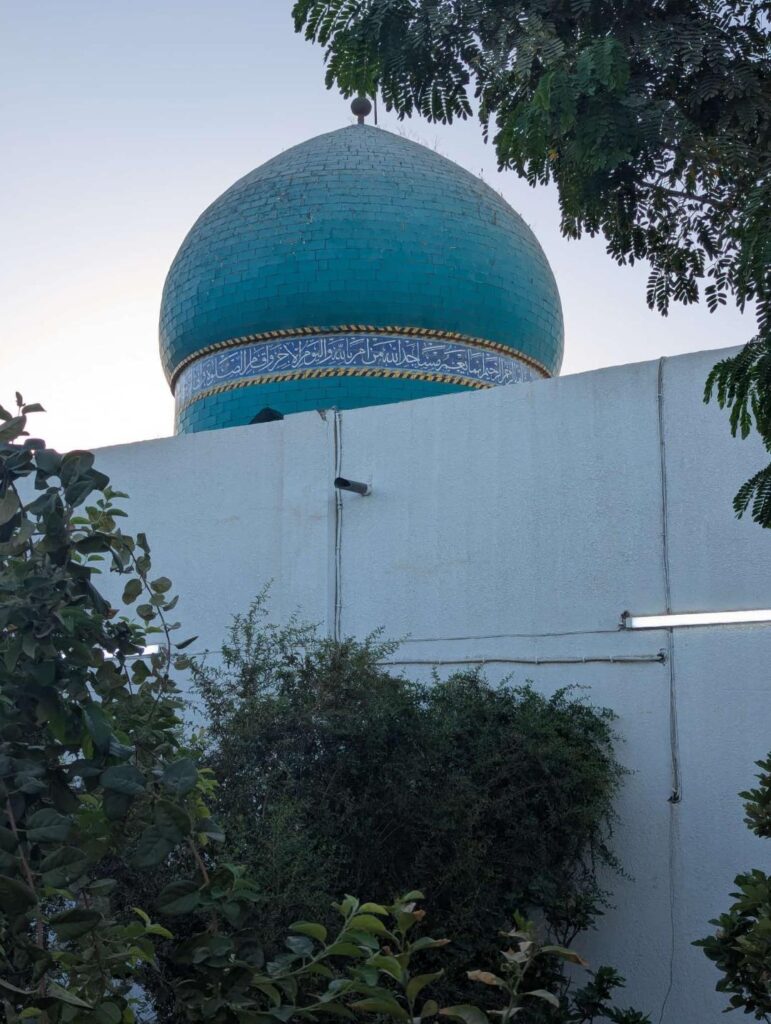
Hujjatul Islam (Proof of Islam)
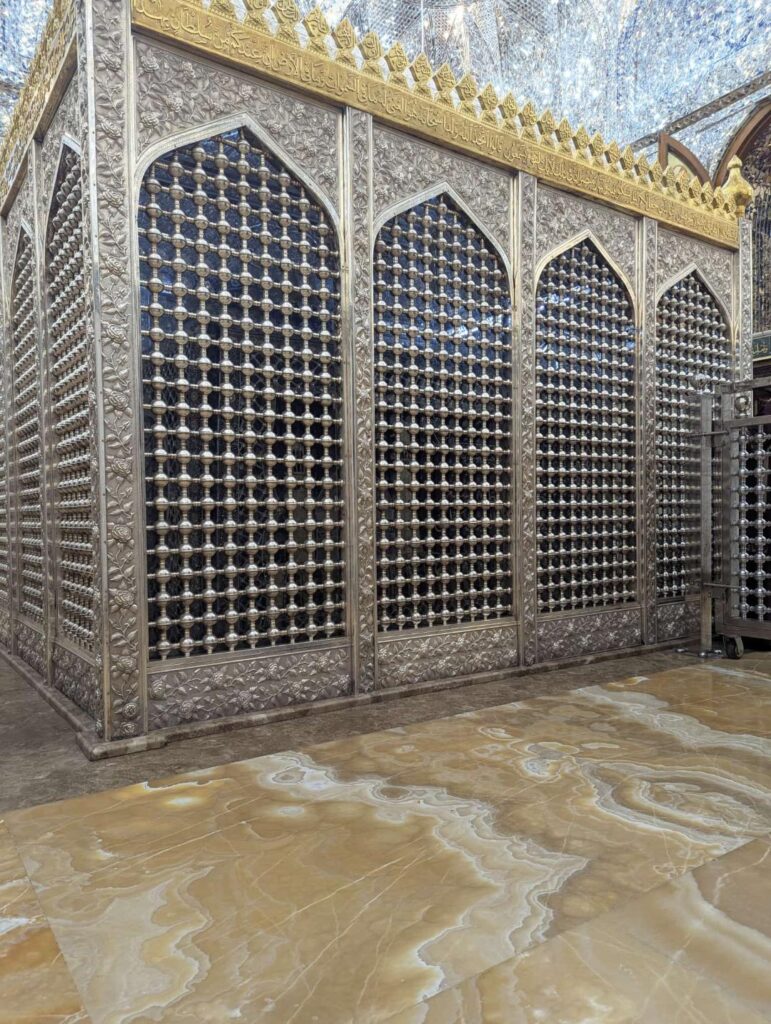
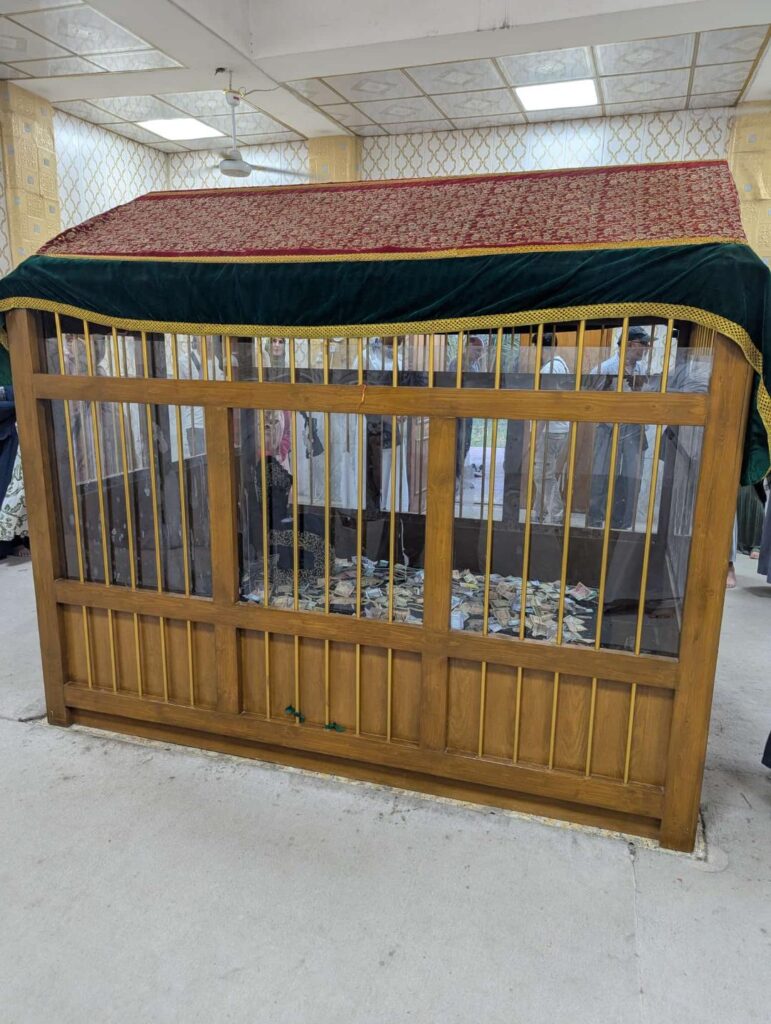
The Grave of Imam Ghazali (Allah sanctify his secret)
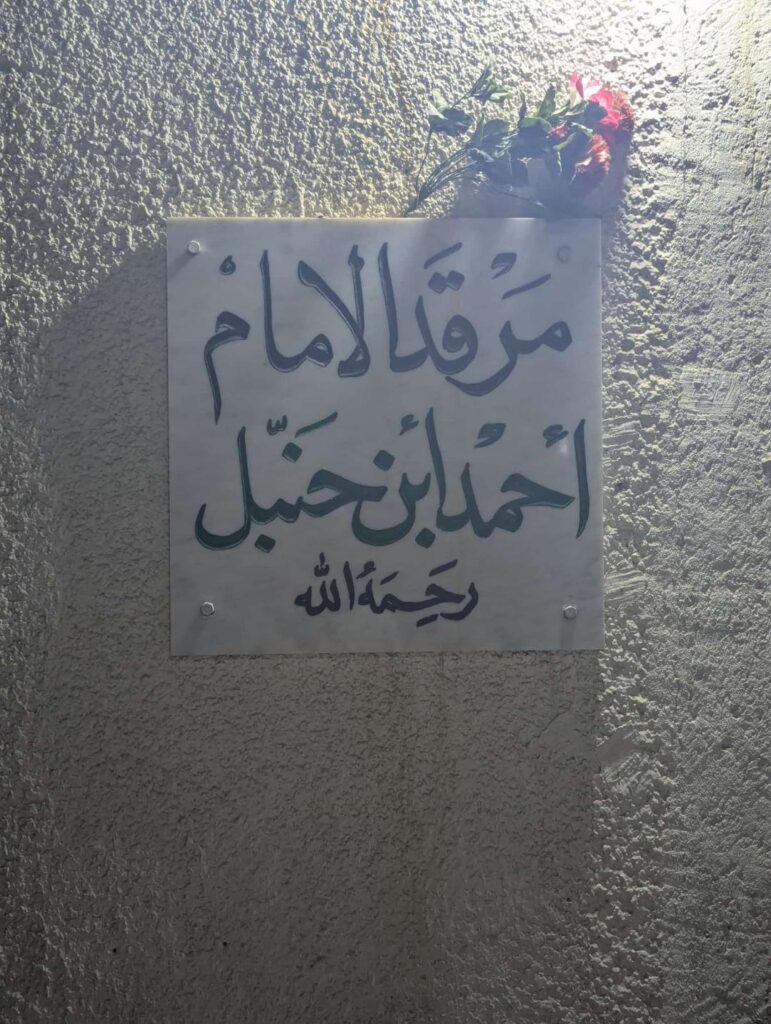
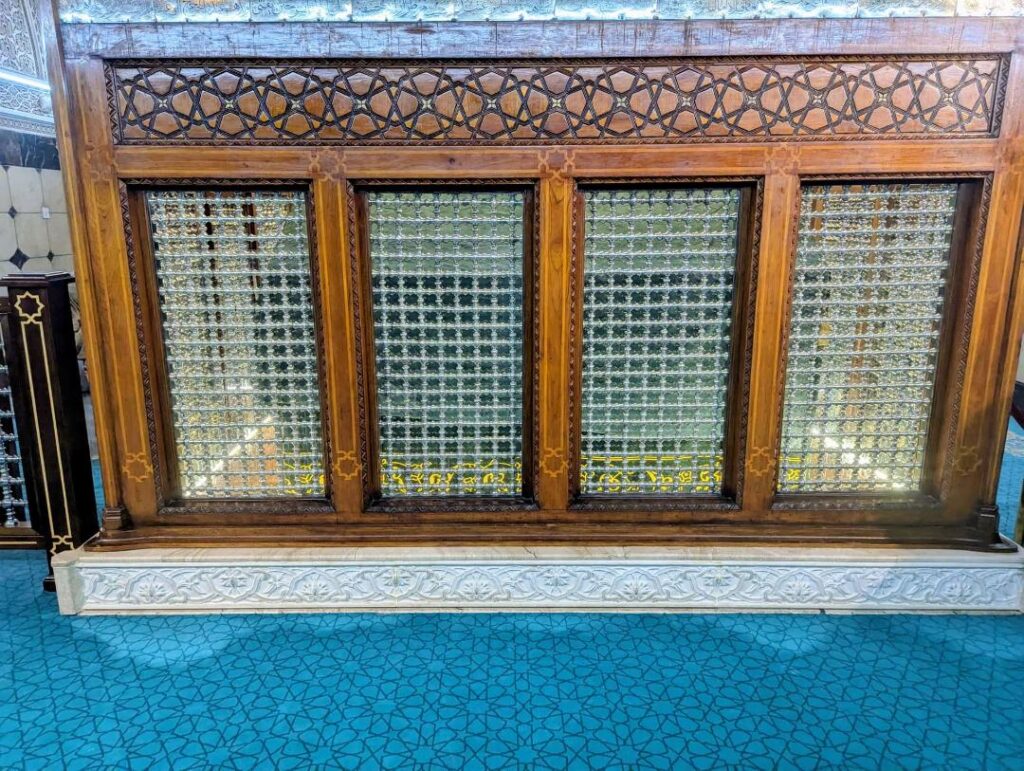
The Mausoleum of Imam Ahmad ibn Hanbal (Allah elevate his status)
I pray Allah SWT sends someone to refurbish the whole area
One of the greatest disappointments of this journey was the grave and house of Imam Ahmad RH had not been looked after. Most tombs in Iraq were well looked after as you saw yesterday and the day before, some with gold plated doors and chandeliers on the ceiling. In the following pages you will see how well and preserved the Shia sites are. Imam Ahmad RH was one of the greatest Sunni Imams, his largest following is in Saudi Arabia and they should fund the upkeep of his tomb. 
In the earlier part of the second century, an ideology called Itizaal creeped into the Ummah. The people following this ideology were know as Mutazilah. This group were regarded as rationalists and philosophers. They would try and justify Islamic teachings and beliefs through ration and intellect. Their centre of focus were mainly issues like the attributes of Allah Ta’ala, seeing Allah in Jannah, predestination, free will, and the nature of the words of Allah, Ta’ala.
They gave preference to intellect, ration, and philosophy over the Divine revelation sent by Allah Ta’ala and over the words of his Prophet ﷺ.This ideology gained popularity during the reign of Mamun Rashid, so much so that it turned into a state religion, and their views were imposed upon the people, and the masses were forced to accept them.
The issue of the nature of the words of Allah Ta’ala, the Quran, became a major tenet of this school of thought and it was considered a criteria for determining ones adherance to the Mutazili school of thought. The Mutazilis held that the Quran (The words of Allah) are a creation of Allah, whilst the Ahlul Sunnah Wal Jamaat maintained that the words of Allah are an attribute (sifat) of Allah and not a creation of Allah.The Mutazilis would punish and torture those who wouldn’t accept their views. Mamun Rashid once summoned all the big Ulama of the time to question them with regard to their beleifs about the nature of the words of Allah Ta’ala. Some of those scholars accepted the views of the Mutazilis, out of fear, whilst other scholars stayed firm on the belief of the Ahlul Sunnah. Out of them, some such as Ishaq Ibn Ibrahim, Bishr ibnul Walid, and Ibrahim al-Mahdi were executed, and many were thrown into prison.
After some time, Imam Ahmad RH was brought before the governor in Baghdad. He was tied with four chains fastening his legs and was told to submit tHe was then brought in front of the Caliph. The Caliph ordered that Imam Ahmad RH should be given 34 lashes. After each whip, Imam Ahmad would say, “Give me some proof from the Quran or Sunnah, then I could accept your view. Imam Ahmad RH was imprisoned and tortured for 28 months. People who felt for him, would visit him and narrated the Hadith to him, that in such a situation one is allowed to even utter words of Kufr to save ones life. Imam Ahmad RH would reply, “But what do you say of the Hadith of Khabbab which says that there were people who were slaughtered into two, but they did not give up their faith.” Subhan Allah!
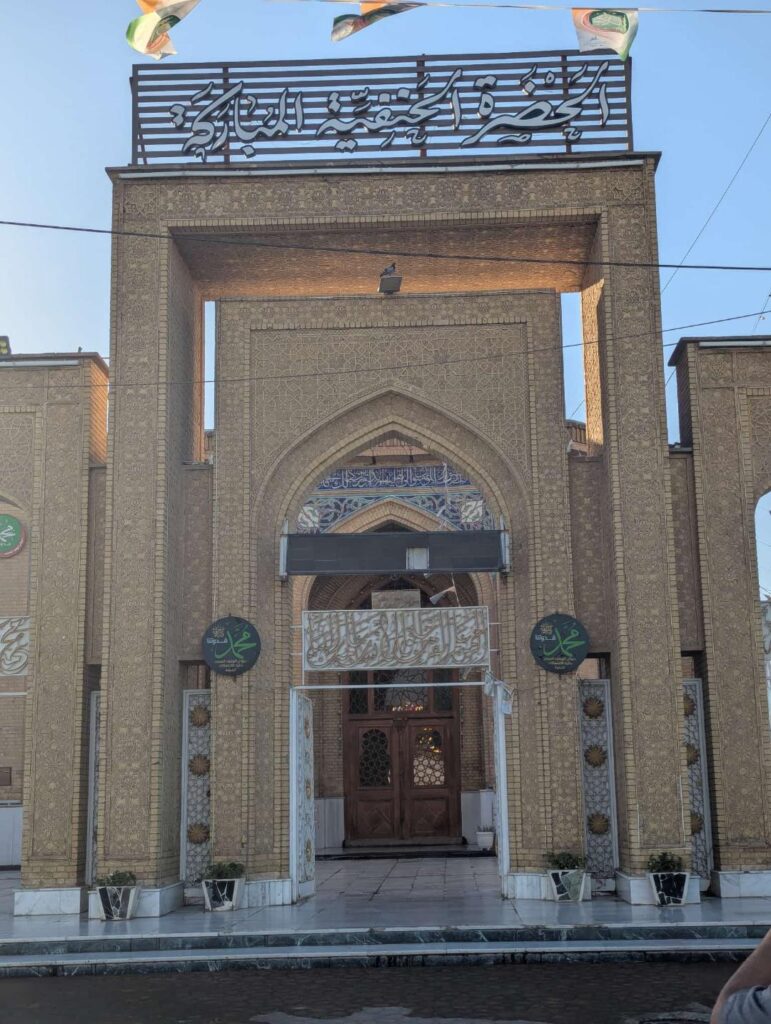
Yahya ibn Ma’een RH: “The people wanted us to be like Ahmad ibn Hanbal. No, by Allah! We are not as strong as Ahmad and we are not strong enough to follow the way of Ahmad “
Mausoleum of Imam Abu Hanifah (Allah be pleased with him)
Day 2
Imam Abu Hanifa's RH full name was Numan ibn Thabit. Imam Abu Hanifa RH was born in Kufa in the year 80 and passed away in 150 after hijrah. Imam Abu Hanifa RH is the first of the four Imams of the different schools of thought. It is the Sunnah of Allah SWT that He executes His will through some natural means which serves to strengthen the faith of those who examine these signs and ponder over them. History reveals that in Islam's darkest times this religion was safeguarded through beacons of light in the form of the righteous individuals who upheld Islam.
Imam Abu Hanifa: The Juggernaut of Jurisprudence
Abu Huraira RA narrates the Prophet ﷺ said: "If deen was suspended from the Thurayya star (Pleiades) and the Arabs are unable to reach it, then a man from the sons of Persia will be able to reach it." (Saheeh Muslim). 
Allamah Suyuti RH mentions that this hadith refers to Imam Abu Hanifa RH. The reason being there was nobody equivalent to that level of knowledge during his time.One of Imam Abu Hanifa’s first areas of focus was the subject of Aqidah. Aqidah is the study of Islamic theology, which was threatened by the deviant ideologies festering in Kufa at the time. Imam Abu Hanifa RH would champion the field, debating against the figures of the aberrant creeds. One of the most noteworthy stories of Imam Abu Hanifa RH that highlighted his knowledge was his confrontation with an orator from the Romeo-Christian land. The man posed three questions: Where is Allah (SWT) facing, what was before Allah (SWT), and what is Allah (SWT) doing right now?In his response to the first question, Imam Abu Hanifa RH lit a candle and asked the man where the light of the candle was facing. He declared, similar to how the light of the candle was not directed one way and filled up the room, the same was true of the nur (blessed light) of Allah SWT. On the next question, Imam Abu Hanifa RH had the questioner count back from ten. He encouraged the questioner to continue after number one and the questioner responded that he could not. Abu Hanifa said in the same way, we do not entertain a “before” to Allah SWT because it is out of our comprehension. Before answering the last question, Imam Abu Hanifa RH requested to give his answer from a high placeThe questioner obliged and Imam Abu Hanifa RH responded to the last question saying Allah SWT had disgraced the questioner by giving the higher physical state to the one who protected his Deen.
Allah grant Imam Saheb coolness in his grave and a lofty status in Jannah, may we follow in his footsteps, Ameen.
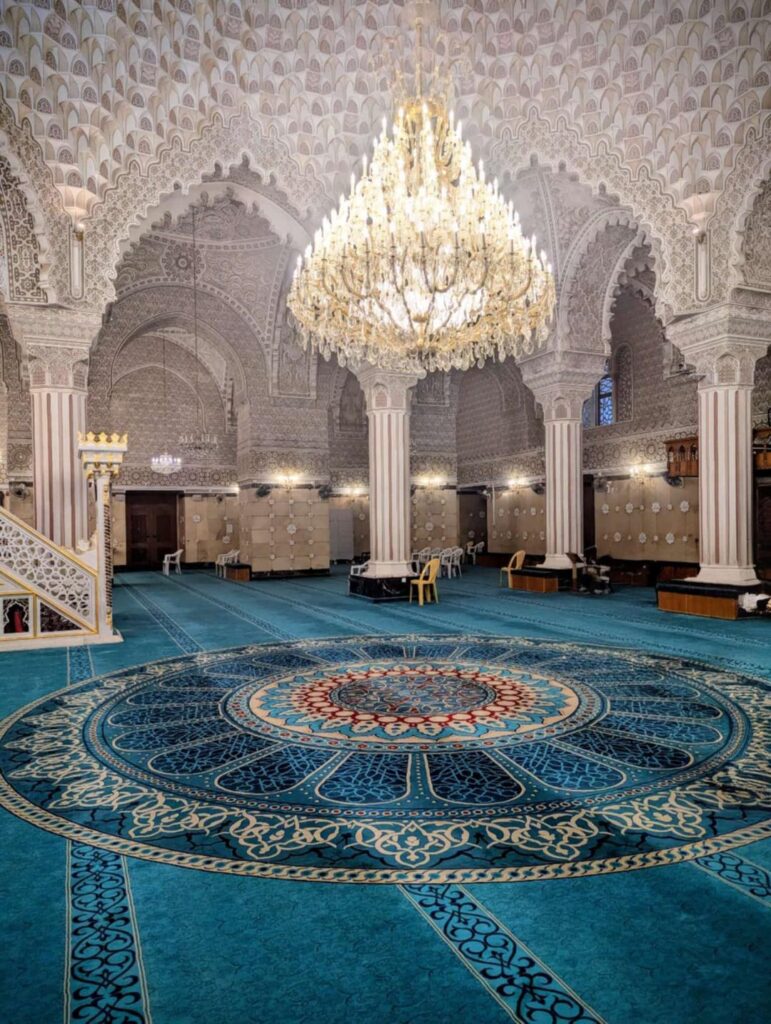
The Masjid of Imam Abu Hanifah RH
The grave of Imam Abu Hanifah RH
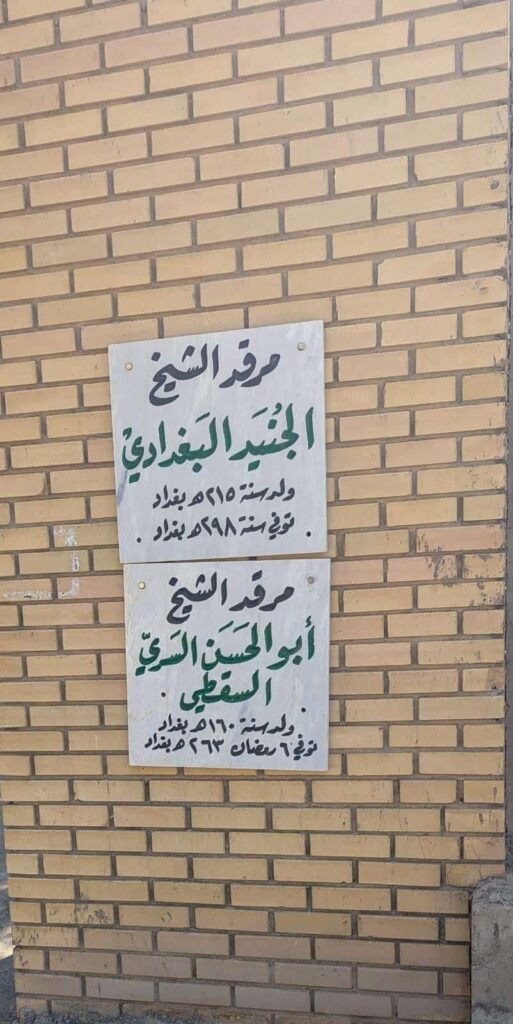
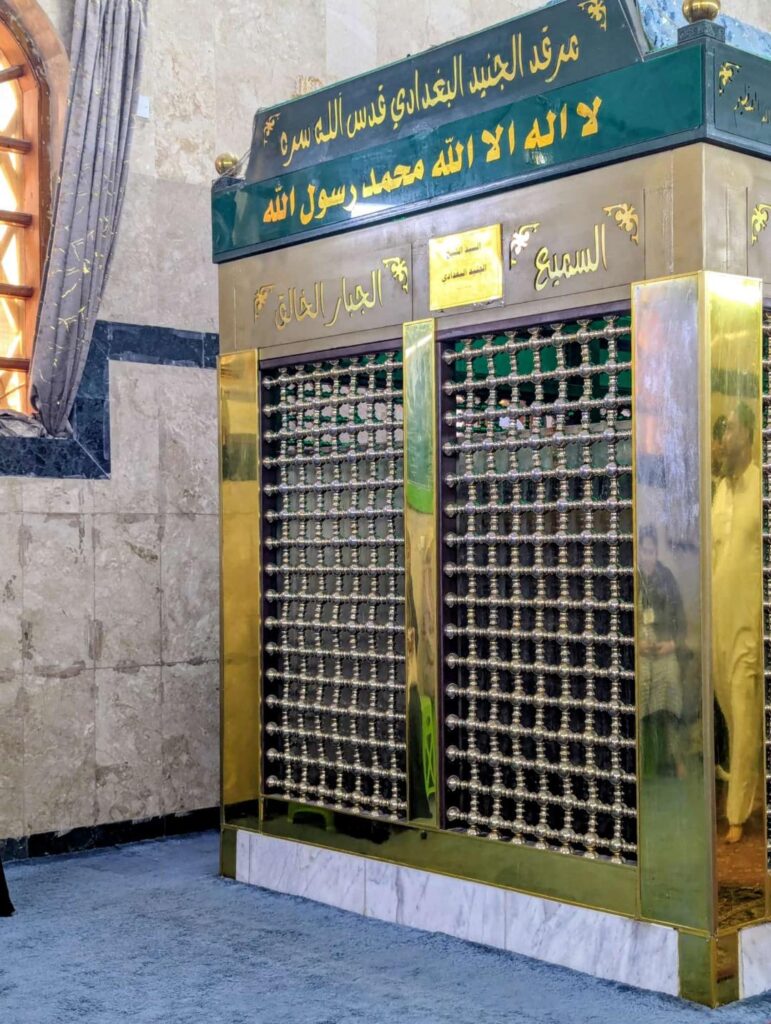
The Mausoleum of Shaykh Junaid Baghdadi and Shaykh Sarri Saqti (Allah have mercy on them)
Junayd al-Baghdādī’s efforts were instrumental in bridging the gap between taṣawwuf and the scholars of fiqh, reconciling their perspectives and earning him broad recognition within Ṣūfī circles. For his commitment to engaging with society and guiding the people without retreating into isolation, he was honoured with the title Sayyid al-Ṭāʾifah (Master of the Ṣūfī Order). In the following, we take a brief glimpse into the eventful life and legacy of Imām Junayd al-Baghdādī RH.
Prior to sainthood, Junaid Baghdadi RH was a skilled warrior and an undefeated world-renowned wrestling champion. One day the King of Baghdad issued a challenge, “Today, if any man defeats Junaid, I will give him whatever he asks.”
A man came forth and accepted the challenge. The crowd gasped in shock for the man was feeble and weak. So weak that his skin was hanging off his bones. The King remarked “It seems that death is calling him. How will he beat Junaid? He won’t withstand a slap.” The man remained firm in his call, he wanted to fight. The fight became official and Junaid entered the arena. Just before the fight took place, the man whispered into Junaid's ear. He said “Everyone is right, I cannot withstand your strike but I have no choice. I have two daughters who are ready for marriage but I own nothing. In my shame, I wish to die. I either jump into the ocean or die by your hands.”
Junaid replied, “If you need wealth, go ask the King and he will help.” The man responded “I cannot ask anyone for anything. I am from the offspring of the Prophet ﷺ, a Sayyid, it is forbidden for me to ask. Now, you can lose and sacrifice your honour of the world but you will gain honour in theJunaid pondered over the offer. If he lost, he would lose his fame and reputation. If he won, with what face would he face the Prophet ﷺ? The whistle blew and the fight commenced. To avoid suspicion, Junaid displayed some finesse in his manoeuvres but allowed himself to be pinned. The man mounted his chest and was victorious.
After succumbing to his first loss, the people disowned Junaid. When he arrived home, he began crying but his heart was content. That night, the Prophet ﷺ came to him in a dream and said, “O Junaid! You sacrificed your honour and kept the dignity of one of my sons. As of today, your name is raised amongst the Awliya.”The next day, the King summoned Junaid and said, “O Junaid, we know you. No man can compete with you and yet yesterday you hardly fought. Tell me this, why did you fall and let the man beat you?”
Junaid responded, “I am not Shimr who stands on the chest of the offspring of the Prophet ﷺ. The man was a Sayyid so how could I stand upon his chest? Yes, I sacrificed my honour for the sake of the Prophet ﷺ and from today I need not wrestle. From today, I shall spend my life in the love of the Prophet ﷺ.”
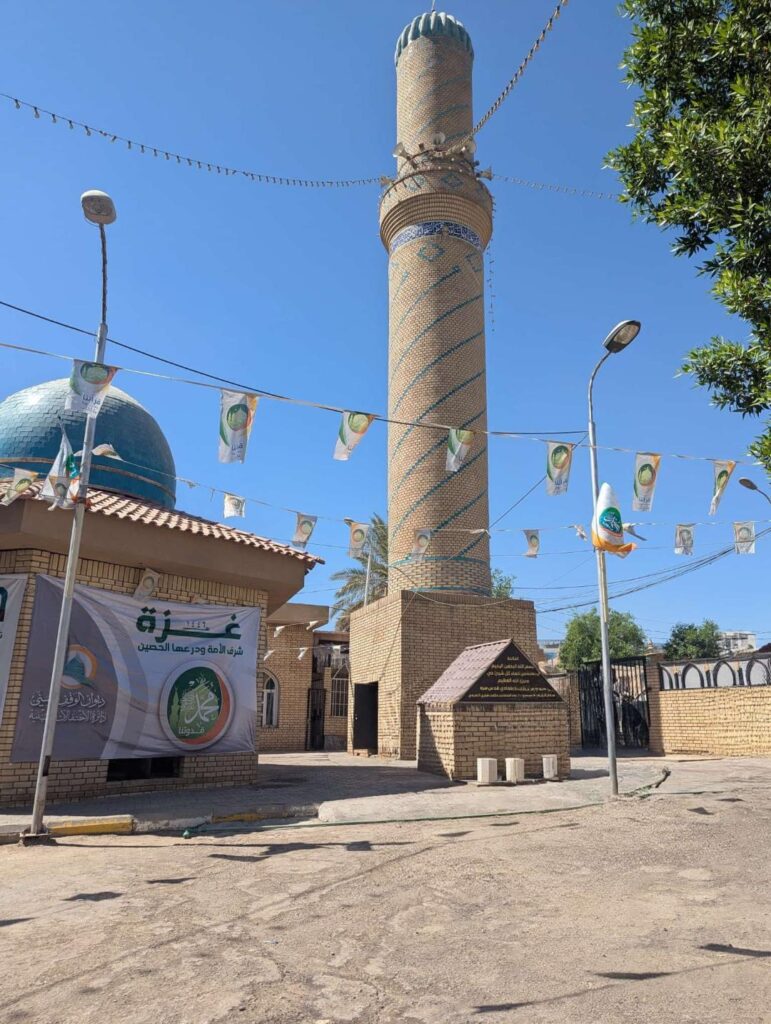
The Pioneer of Islamic Mysticism
Grave of Shaykh Junaid Baghdadi (Allah sanctify his secret)
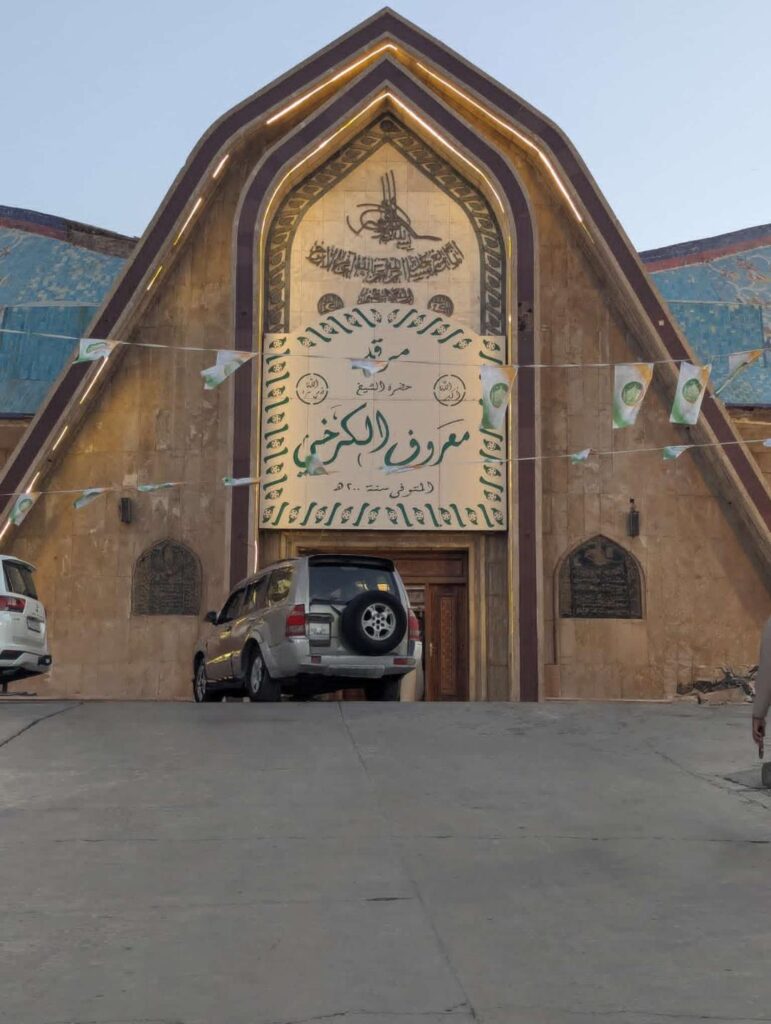
The Mausoleum of Shaykh Maroof Karkhi (Allah have mercy on him)


His full name was Abu Mahfuz Ma’ruf b. Firuz al-Karkhi. Shaykh Ma’ruf al-Karkhi RH was born to Christian parents but, from an early age, he rejected it, even when beaten for it at school, the whole doctrine of the Trinity and declared his conviction that God is One. Eventually, according to the same authority he ran away from home and his parents pined for him. They said in his absence that, so long as he came back to them, they would surely approve and accept whatever religion he chose for himself. Some years later, he did call at their door. He announced himself by name adding that he was now a Muslim. His parents promptly converted to Islam at his hands.

Once one of Ma‘ruf Al-Karkhi RH friends asked him the following, “What is it that has caused you to abstain from the world and from the creation of God, and remain in seclusion, remembering Almighty God? Is it the fear of Death and the grave, or the fear of Hell, or the enthusiasm of attaining Paradise?” Ma‘ruf Al-Karkhi RH said, “O My Friend! You discuss such minor things. What are all these worth in front of the creator Almighty God? All these are but humble subjects of Almighty God. Once you taste the pleasure of his closeness, then you will not think of any of the other things (you have mentioned).”

Shaykh Maroof Karkhi RH is well known for his high ranking in Tasawwuf. His calibre is evident from his students:
Shaykh Junaid Baghdadi RH 
Shaykh Sarri Saqti RH 
Shaykh Bishr Haafi RH 
Shaykh Shibli RH
Even Shaykh Abdul Qadir Jilani would visit his grave for meditation (they were 200 years apart).
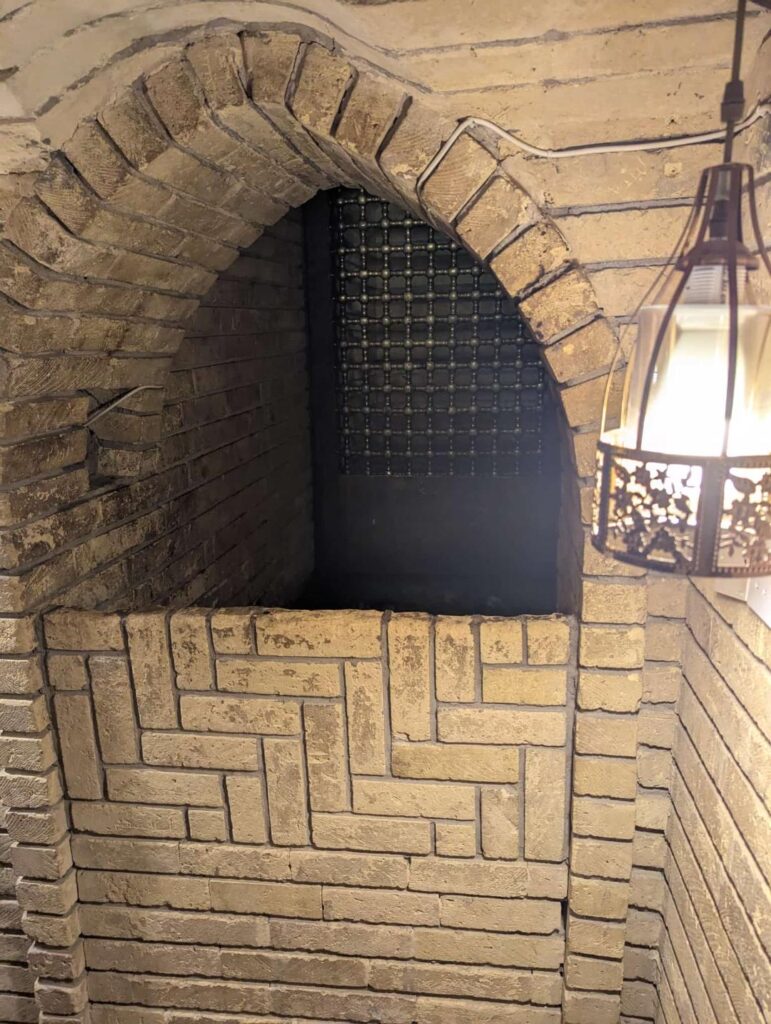
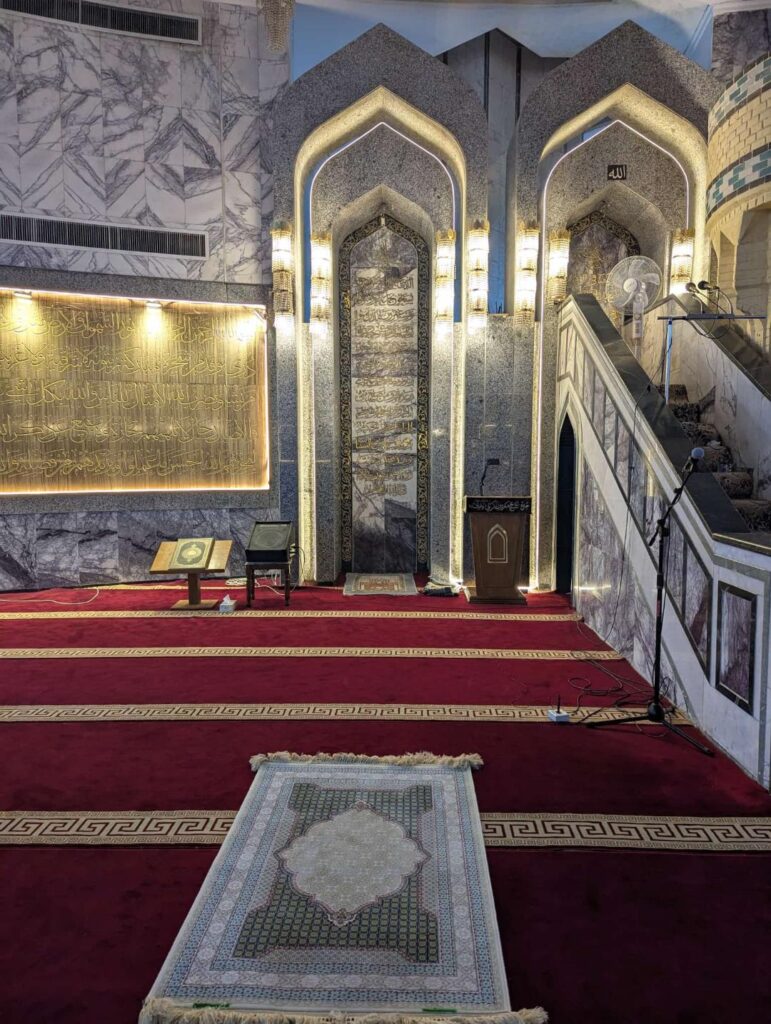
Grave of Maroof Karkhi (Allah have mercy on him)
Masjid of Maroof Karkhi
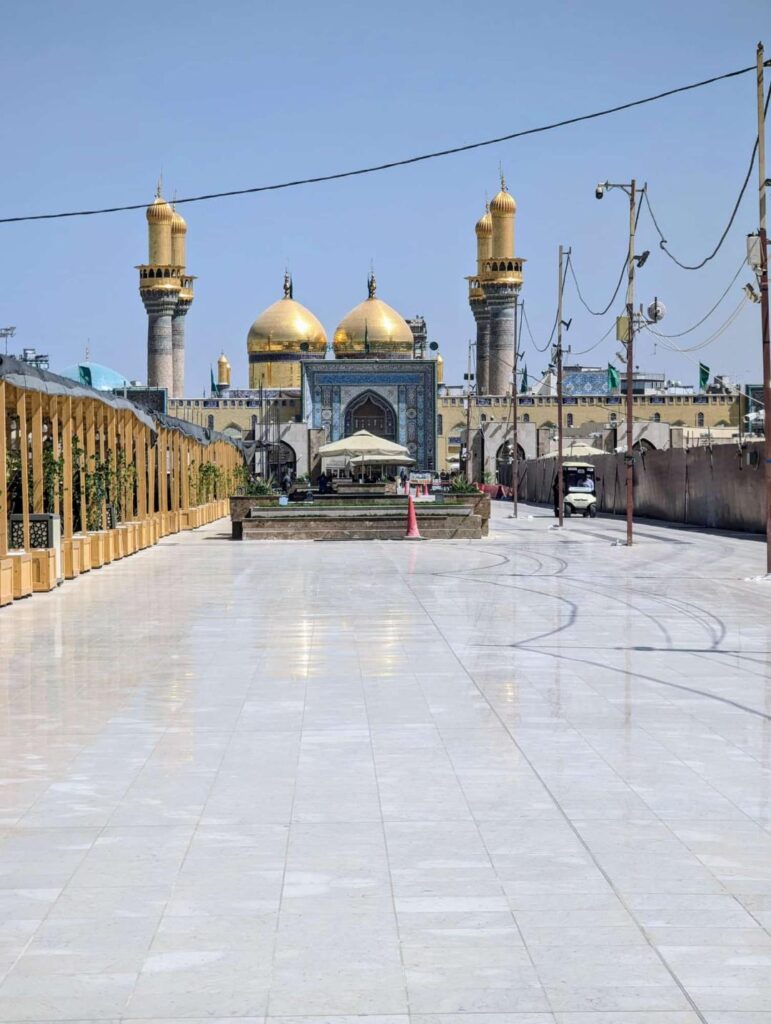
The Mausoleum of Musa Kazim (Allah have mercy upon him)


Musa ibn Jafar al-Kazim (Allah have mercy on him) was the great grandson of Hussain RA. He was born in 745 in Madiha Munawwarah, his father was Jafar al-Sadiq RH.
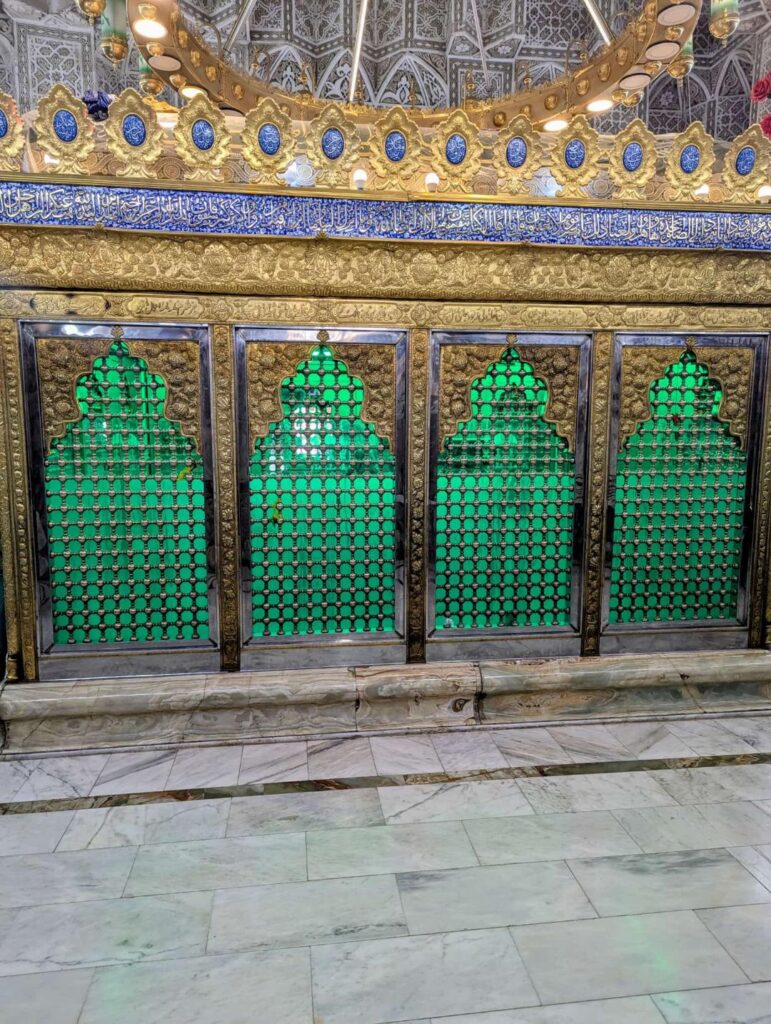
The Twelver Shias class Musa Kazim RH as the seventh Imam. Therefore you will see the tomb decorated with elegance.
The grave of Musa Kazim (Allah have mercy upon him)
The Mausoleum of Imam Abu Yusuf (Allah have mercy upon him)
Imam Abu Yusuf Yaqub ibn Ibrahim (113-182) was the foremost student of Imam Abu Hanifah and the first chief judge in Muslim history, he was also a Hafidh of Hadith.
During the day he would listen to cases and give fatwas, during the night he would teach hadith and fiqh.
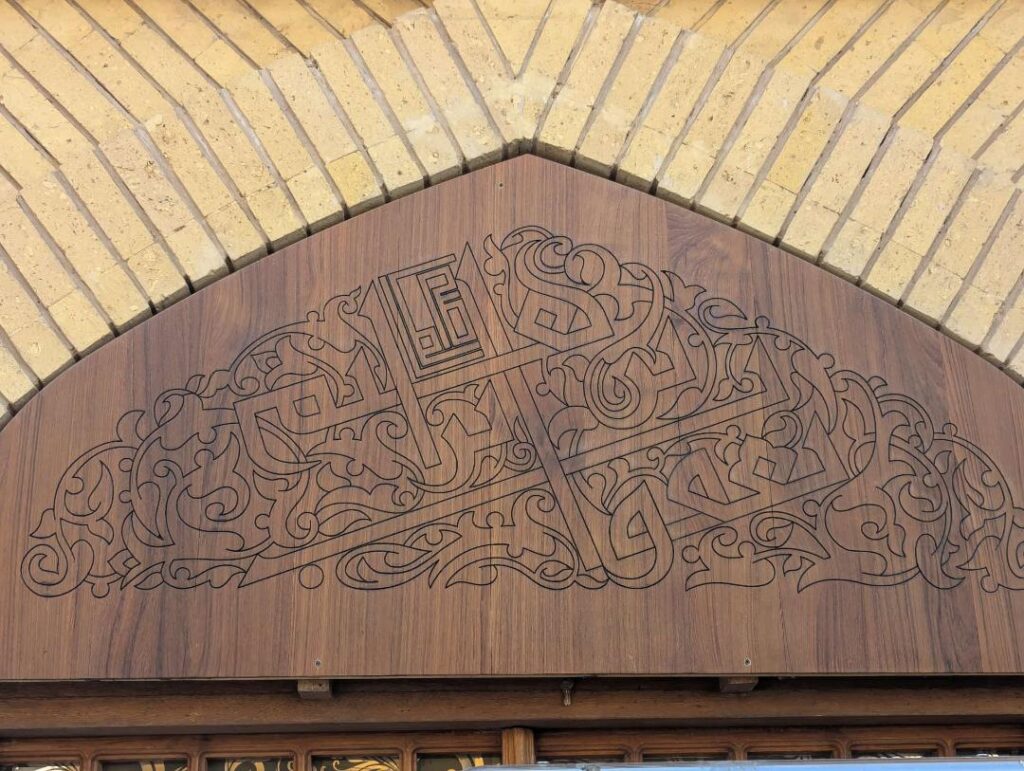
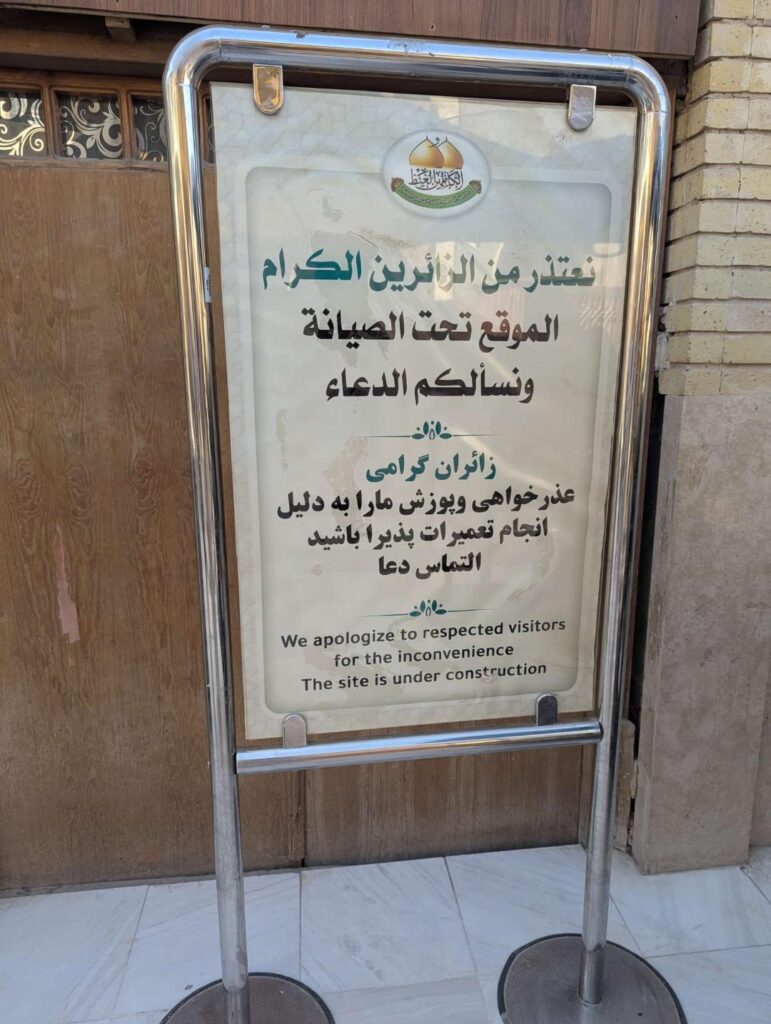
Behind the grave of Musa Kazim RH is the grave of Imam Abu Yusuf RH (tomb is under construction so we weren’t allowed inside)
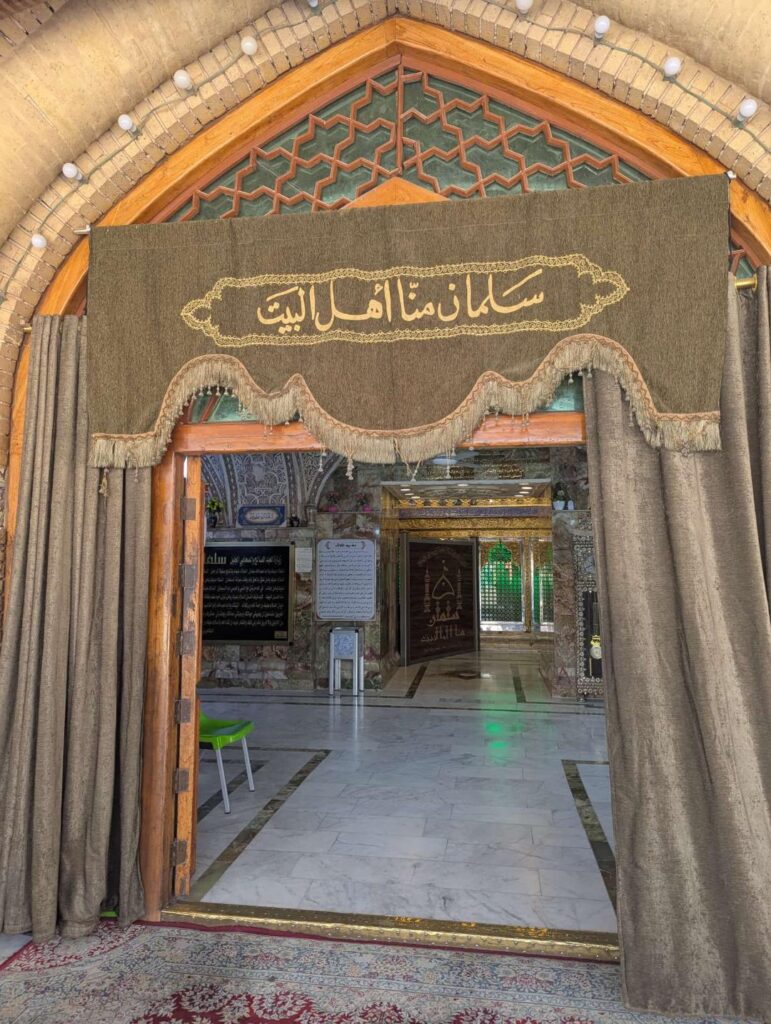
The Mausoleum of Salman Farsi (Allah be pleased with him), Madain
The Grave of Salman Farsi (Allah be pleased with him), Madain
The Prophet ﷺ said: "Salman is one of us - the people of the household." (Mustadrak Hakim)
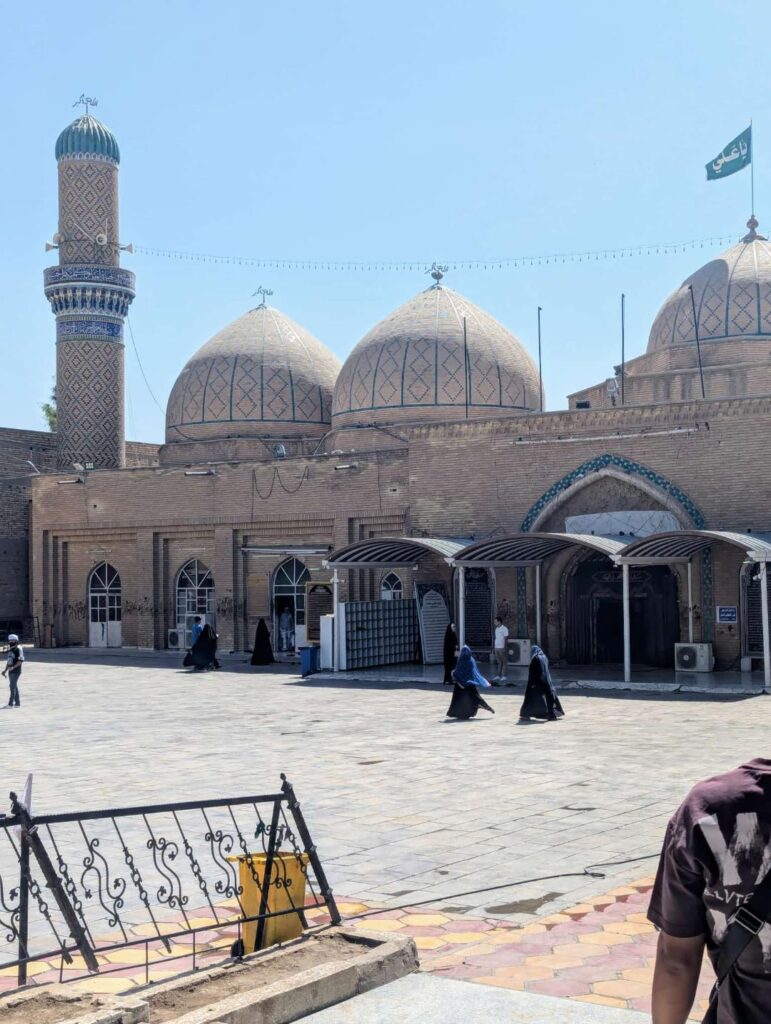
Salman Farsi (Allah be pleased with him), also known as Salman the Persian was a companion of the Prophet Mohammad ﷺ and the first Persian who converted to Islam. Salman Farsi RA was born in Isfahan, Iran, and was originally named Ruzbih. According to traditions, his father, Khushfudan, was an Iranian landholder who practiced the Zoroastrian religion. However, the family later converted to Christianity.
As Salman Al Farsi RA grew up in his hometown in Iran, his father’s love for learning about the new religion encouraged him to send his son to Syria to study under leading Christian scholars. However, Salman Al Farsi RA had other plans. He was eager to learn more about the religion of Ibrahim AS, and he used his travel plan to Syria as an escape in search of the Prophet ﷺ in the land of Arabs.
On his way to Hijaz, Salman Farsi RA was enslaved and sold to a man in the Banu Qurayza tribe in Madinah, an influential Jewish tribe. The event occurred around the same time the Holy Prophet ﷺ had recently migrated to the city from Makkah. Since both Salman Farsi and the Holy Prophet ﷺ were both in Madinah, Salman Farsi RA quickly learned about the presence of a prophet who recently migrated from Makkah.

When Salman Farsi RA first met the Holy Prophet ﷺ in Masjid e Quba in Madinah, he shared some food as a present which the Prophet (P.B.U.H.) accepted, but he didn't accept Sadaqah. Salman RA saw the seal of Prophethood and recognised that Islam's teachings aligned with the religion of Abraham.
After a few more interactions in and outside the masjid, Salman Farsi RA decided to convert to Islam solely inspired by the Prophet’s ﷺ character.
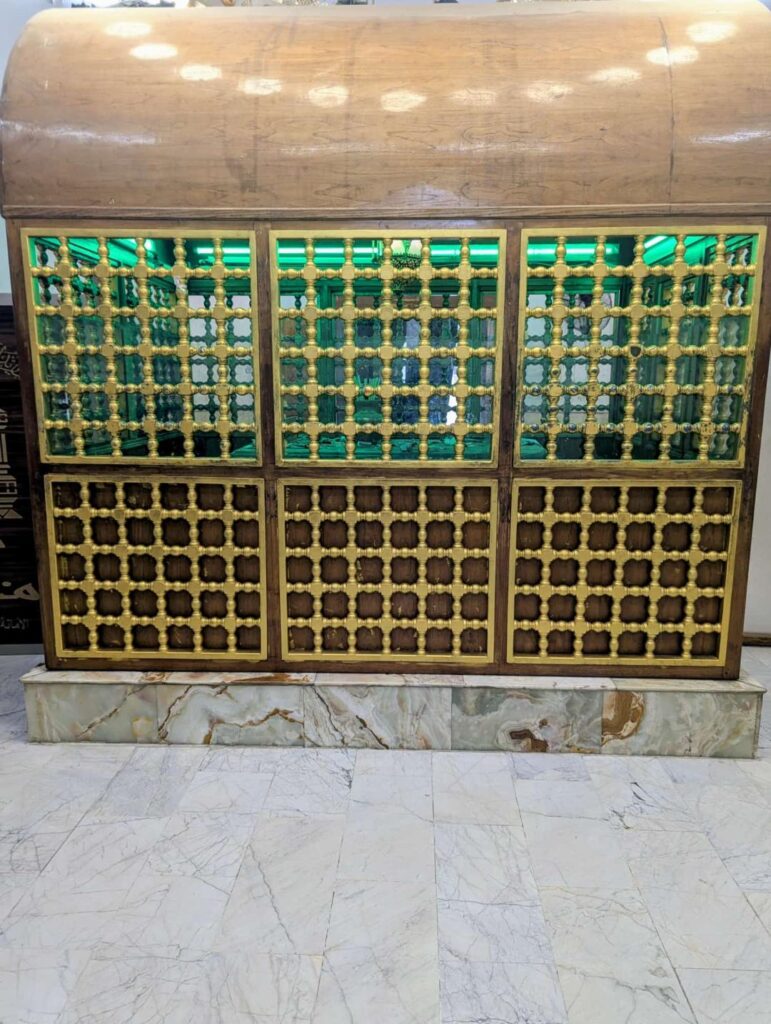
The Grave of Hudhayfah bin Yamaan (Allah be pleased with him)
"If you wish you may consider yourself among the Muhajirin or, if you wish, you may consider yourself one of the Ansar. Choose whichever is dearer to you." With these words, the Prophet ﷺ addressed Hudhayfah ibn al-Yaman when he met him for the first time in Makkah. How did Hudhayfah RA come to have this choice'?
His father, al-Yaman was a Makkan from the tribe of Abs. He had killed someone and had been forced to leave Makkah. He had settled down in Yathrib, becoming an ally (halif) of the Banu al-Ash-hal and marrying into the tribe. A son named Hudhayfah was born to him. The restrictions on his returning to Makkah were eventually lifted.

The gravest problems the Muslims of Madinah had to face was the existence in their midst of hypocrites particularly from among the Jews. Although many of them had declared acceptance of Islam, the change was only superficial, they continued to plot and intrigue against the Prophet and Muslims. Because of Hudhayfah's ability to keep a secret, the Prophet ﷺ confided in him the names of the munafiqin. It was a weighty secret which the Prophet didn't disclose to any other companions. He gave Hudhayfah RA the task of watching the movements of munafiqin, following their activities, and shielding the Muslims from their sinister actions.
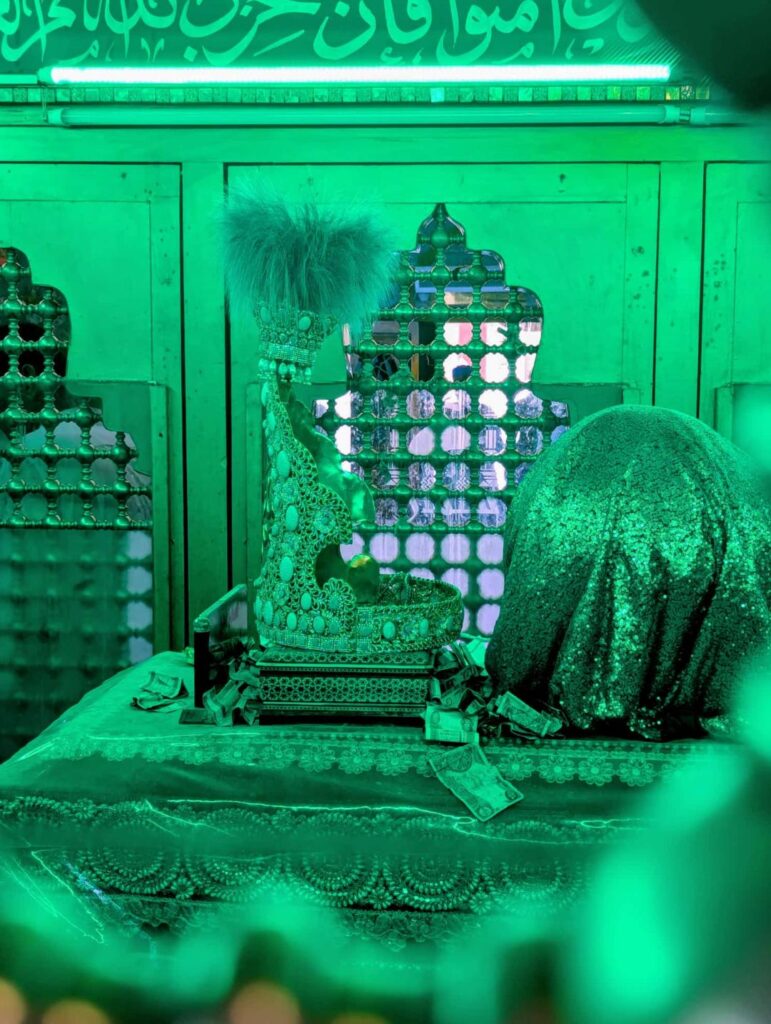
The Keeper of the Secrets (Allah shower his mercy on all the companions of the Prophet SAW)
Karbala – A Story of Pain and Sorrow

The Battle of Karbala took place on the 10th of Muharram in the year 61 A.H., approximately 50 years after the death of the Prophet Muhammad ﷺ. At this time, the Muslim rulership had been transferred to Yazid, son of Muawiyah RA. Yazid’s rulership was filled with corruption and violence, and Hussein RA son of Ali ibn Abu Talib RA and grandson of the Holy Prophet ﷺ took a stand against it. Yazid was hated for his violence, and knew Hussein RA was respected by society.

Thus, in order to validate his methods, Yazid went to force Hussein RA for his pledge of allegiance towards him. Hussein RA was raised in the Household of the Prophet ﷺ and was raised on the principles of truth and justiceAfter refusing to give allegiance to Yazid, Hussein RA took the ultimate stance for justice on Ashura, where he and his 72 companions, outnumbered by Yazid’s army of 33,000 men, were massacred.

The Battle began after the afternoon prayers – with Yazid’s army leading the attack on Hussein RA and his companions. Despite having a limited number on their side, the companions of Hussein RA fought valiantly. Eventually, Hussein RA was killed, and the bodies of the martyrs were trampled upon. This revolutionary act for Justice and to save the Truth of Islam sparks spiritual, physical, emotional, social, cultural, and political revolutions to this day.
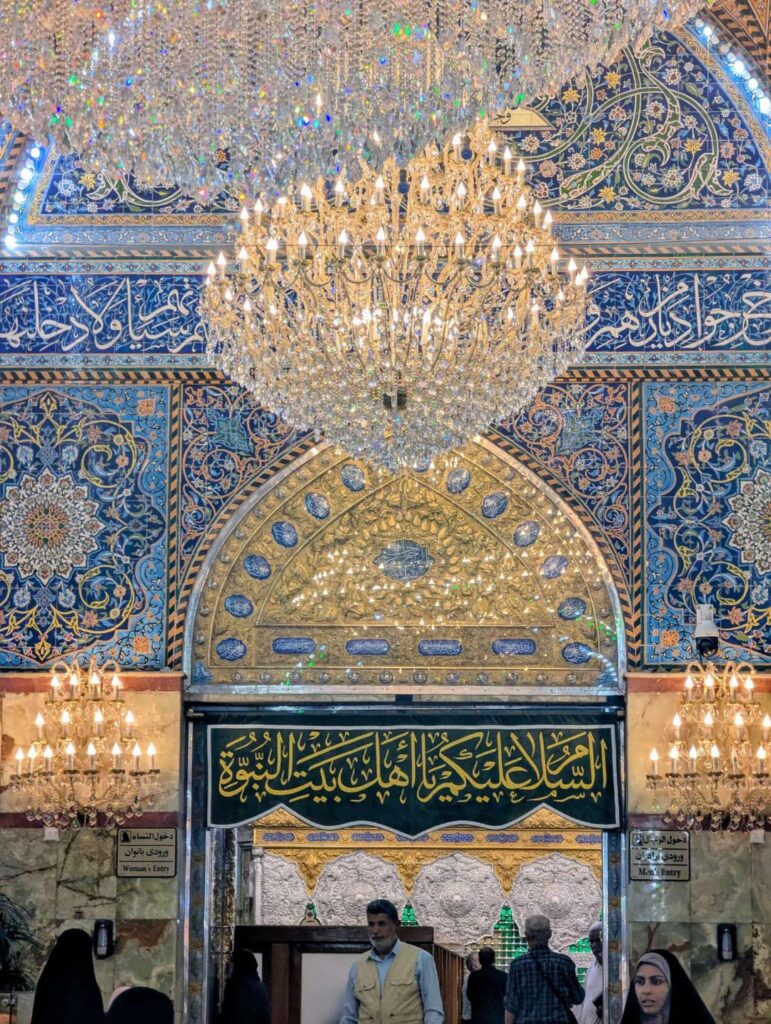
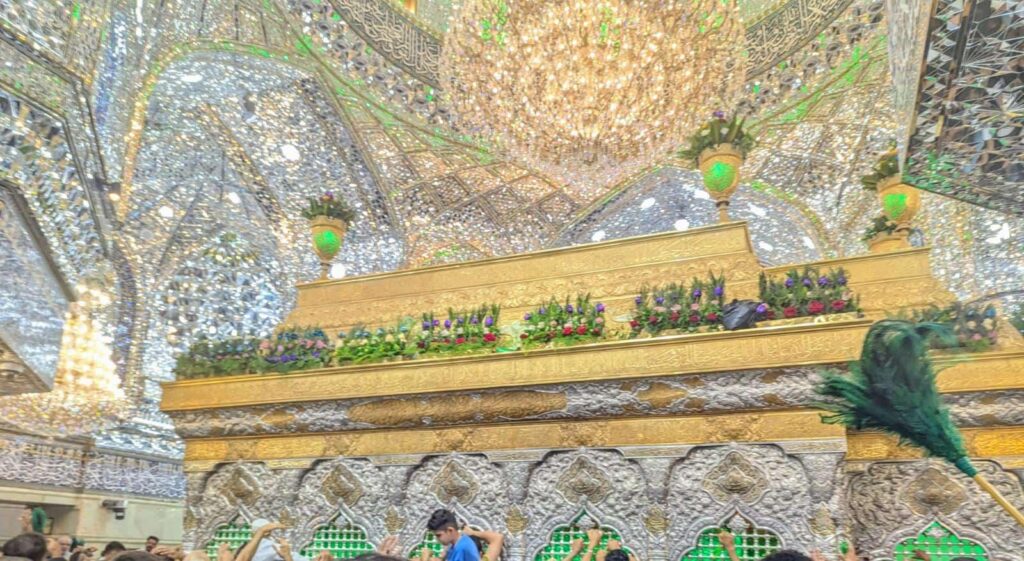
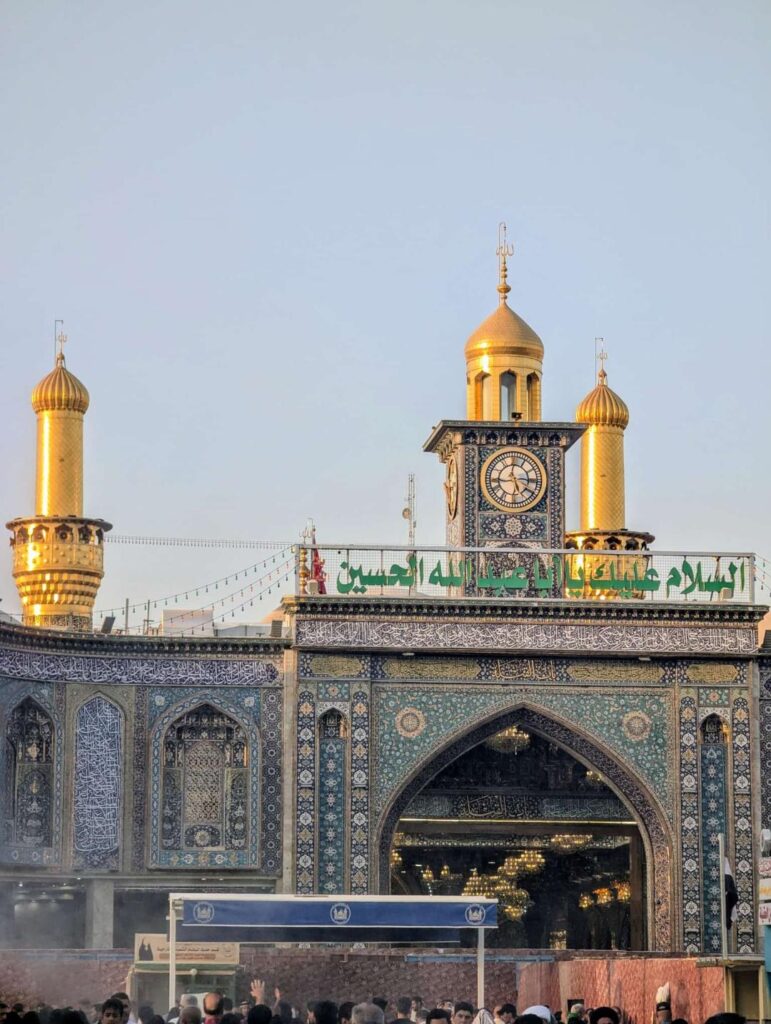
The Mausoleum of Hussain ibn Ali (Allah be pleased with him)
The grave of one of the greatest martyrs of Islam – Hussain ibn Ali (Allah be pleased with them)
Now, we will touch upon Shias and their beliefs in brief:
There are three major branches of Shia Islam, Twelvers, Ismaili, Zaidi. 
The Twelvers are the largest branch, they believe in a line of twelve divinely ordained Imams. Starting with Ali RA and ending with Imam Mahdi. Ismailis started from the sixth Imam Jafar al-Sadiq RA. Zaidis have a lot in common with Sunnis and do not believe in the concept of a hidden Imam.
The Twelvers are the largest group within mainstream Shiaism and they are the group that disrespect and curse Abu Bakr, Umar and Uthman RA due to the belief that they opposed the rising of Ali RA to be caliph.

They also disrespect the mother of believers Aisha RA. They highly respect the companions who supported Ali RA, as the is their first Imam. We have extremists in every sect, some extreme Shias even believe that Prophethood should not have been given to Muhammad ﷺ, rather it should have gone to Ali RA.

The majority of Iran are Twelvers, 95% (80 million). I have to mention this today, for the British youth who have praised Iran and Shias tremendously in the last two years (since Oct 7th) for their so-called support to Gaza. Don't be deceived by what you see online. Who killed Dr Ismail Haniyeh, the leader of Hamas last year in Tehran? Who planted the bombs six months beforehand? (Quoted by Mufti Taqi Uthmani Saheb). When the ceasefire was announced I don't recall any Gazans thanking Iran for their support? Qatar is one of the largest financial donors to Gaza and so is Turkey and there will be many Saudi citizens donating too.

Another notable group are the Alawites, mostly in Syria. They believe in the divinity of Ali RA, or even a trinity of God, Muhammad SAW and Ali. These are the Shias that killed thousands of Sunnis in the Syrian civil war and raped Sunni women in the masjid, with the microphones on, letting the whole town hear the screams of Sunni women getting raped. Think twice before you support them and praise Shia randomly because of some TikTok video you saw. Bashar Al Assad is also an Alawite, the damage he did is unforgivable.There's a lot more I can say on Shias and their hatred and oppression towards Sunnis, even in Iraq, after Saddam Hussain RH was martyred, America have put mainly Shia in charge of the government. Many of the Shia oppress Sunnis, to the point Sunnis are hiding their Sunnism and show that they are Shia. Regardless of whatever I have said above, we mustn't let our differences and hostility blind our hearts from feeling a level of humility, respect and pain when visiting these blessed places as they are the immediate family members of Nabi ﷺ.
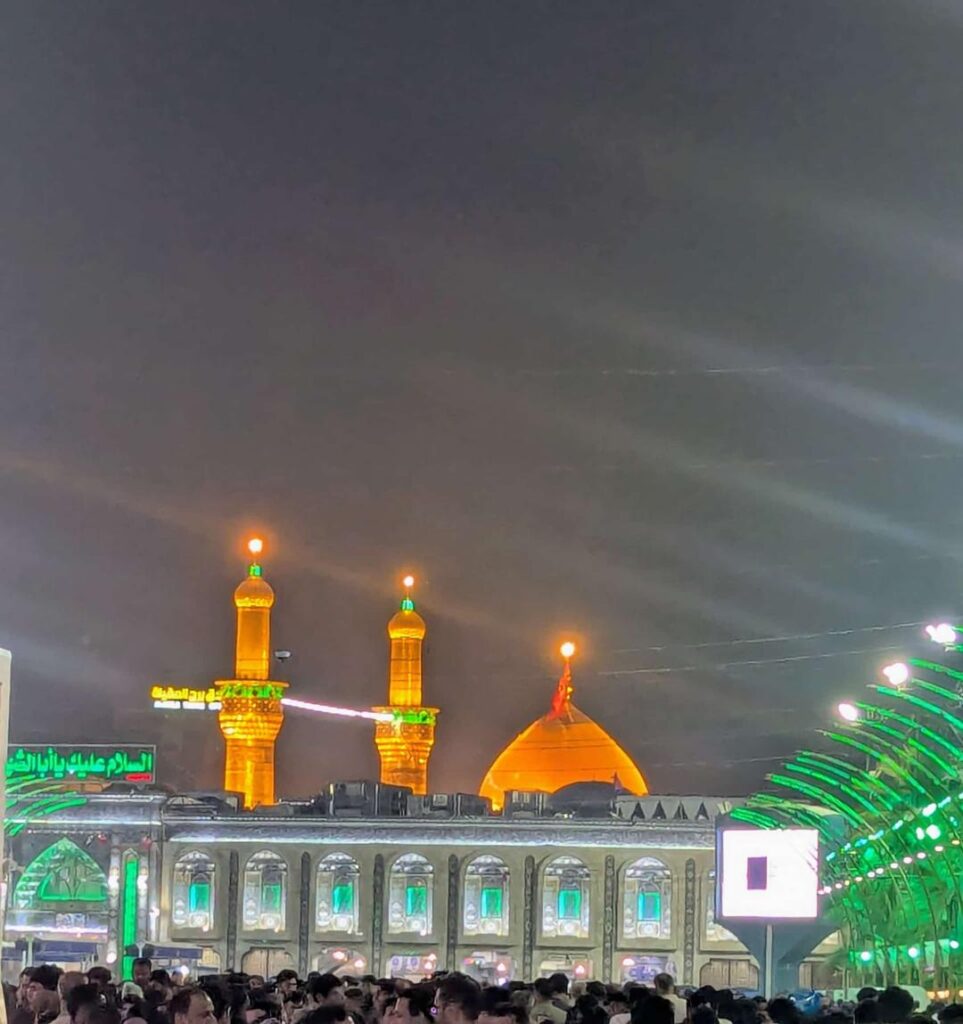
The Mausoleum of Abbas ibn Ali (Allah be pleased with him), Karbala
Abbas bin Ali was the son of Ali and Umm ul Banin RA. Abbas was born on 4th Shabaan 26AH. He was known for his bravery, courage, and loyalty to his family and his faith.
Ali ibn Abi Talib RA married Umm ul Banin after the death of his wife, Fatima bint Muhammad ﷺ. Ali RA was specifically looking to marry a woman who could be the perfect mother figure for his children and birth him a brave and valiant son. Ali RA instructed his brother Aqil RA to find a woman fulfilling these criteria. Aqil RA identified Umm ul-Banin. After some time, Ali proposed to Umm ul Banin RA and married her.
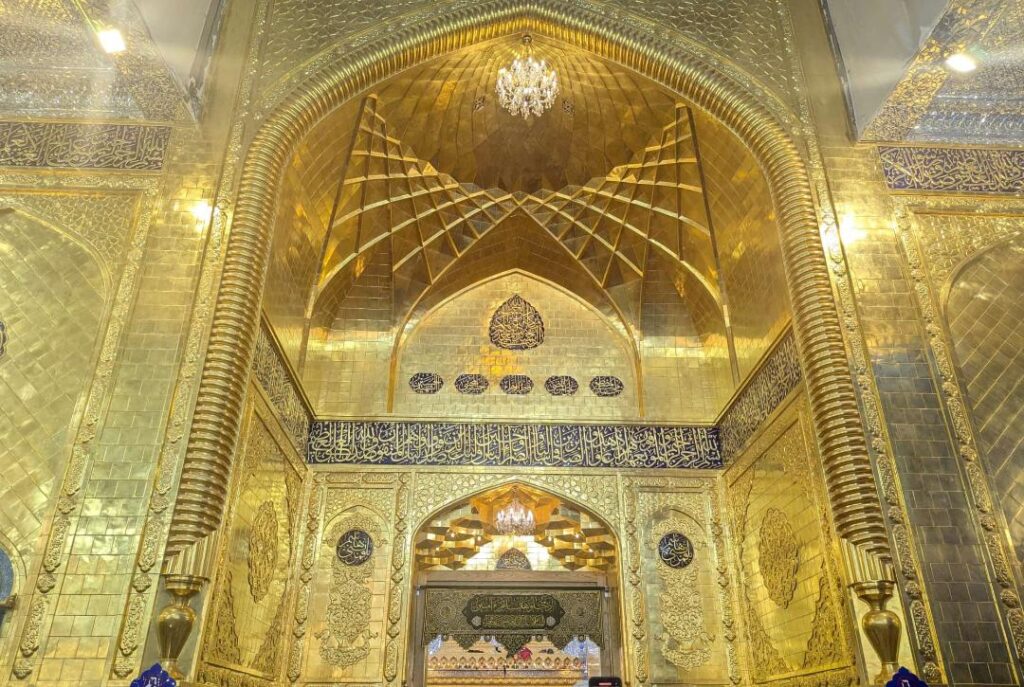
If you wanted to see loyalty, courage, bravery, and piety epitomised in one person, you wouldn’t have to look much further than Abbas bin Ali RA.


The story of Abbas’s quest to fetch water for the women and children at Karbala displayed all his good qualities in one go – none more so than his bravery. The enemies of Hussain RA had taken control of the water supply and denied Hussain RA and his camp access to water. 

On the day of the battle, Hussain RA and his army fought in the unforgiving heat of Arabia whilst not having drunk a sip of water for three days. At one point during the battle, Abbas RA could no longer see the children and women of Hussain’s RA camp suffering from thirst. He decided to take action and fetch water from the Euphrates river, which was located nearby.

Abbas RA reached the river and found that the enemy army had stationed itself around it and was guarding the access to the water. Abbas RA was undeterred and bravely charged towards the enemy, wielding his sword, and managed to break through their ranks and reach the river.

He then filled a bag with water and started to make his way back to the camp. The fact that he did not drink water despite being thirsty and preferred the woman and children to drink first says a lot about his character. On the way back, he was soon surrounded by enemy soldiers who attacked him with swords and arrows. Despite being outnumbered and under attack, Abbas continued to fight fiercely, using his shield to protect the bag of water. In the midst of the fighting, Abbas was struck by an arrow that pierced his eye and had both arms chopped off. He subsequently fell to the ground, called out to Hussain RA and died in his lap.
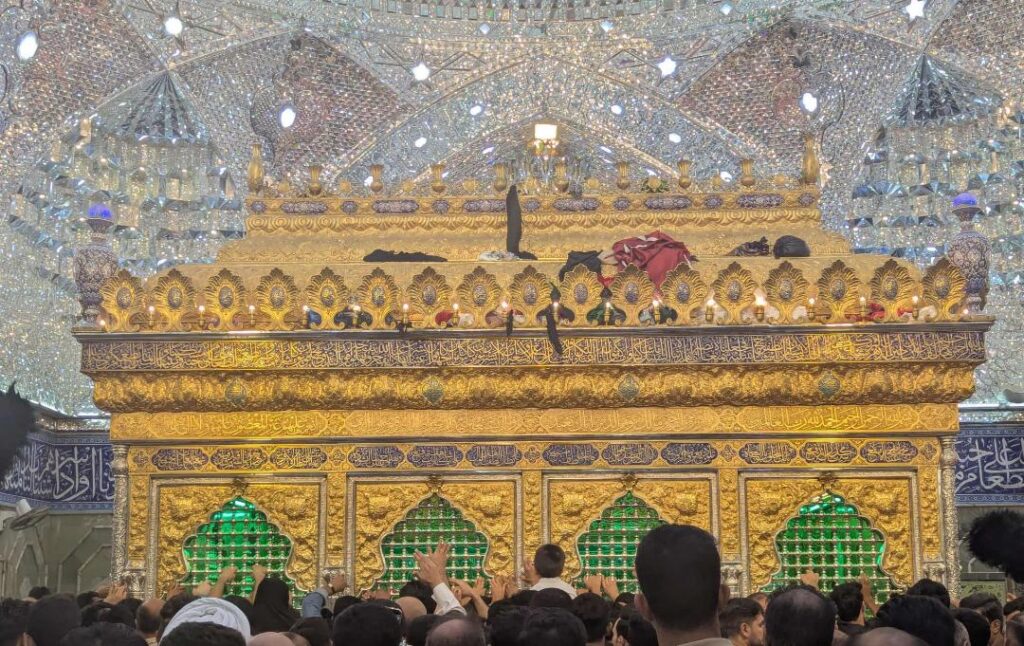
The grave of Abbas ibn Ali (Allah be pleased with him)
Ali ibn Abi Talib RA was the first cousin and son in law of the Prophet ﷺ, the fourth of the four rightly guided caliphs. The period of the Caliphate of Ali RA from 656 until 661 was the most tumultuous in his life. He was accused of failing to pursue the murderers of Uthman RA, foremost among his opponents was Muawiyah RA, the governor of Syria and a relative of Uthman. This led to the battle of Siffeen, which was prophecised in hadith.
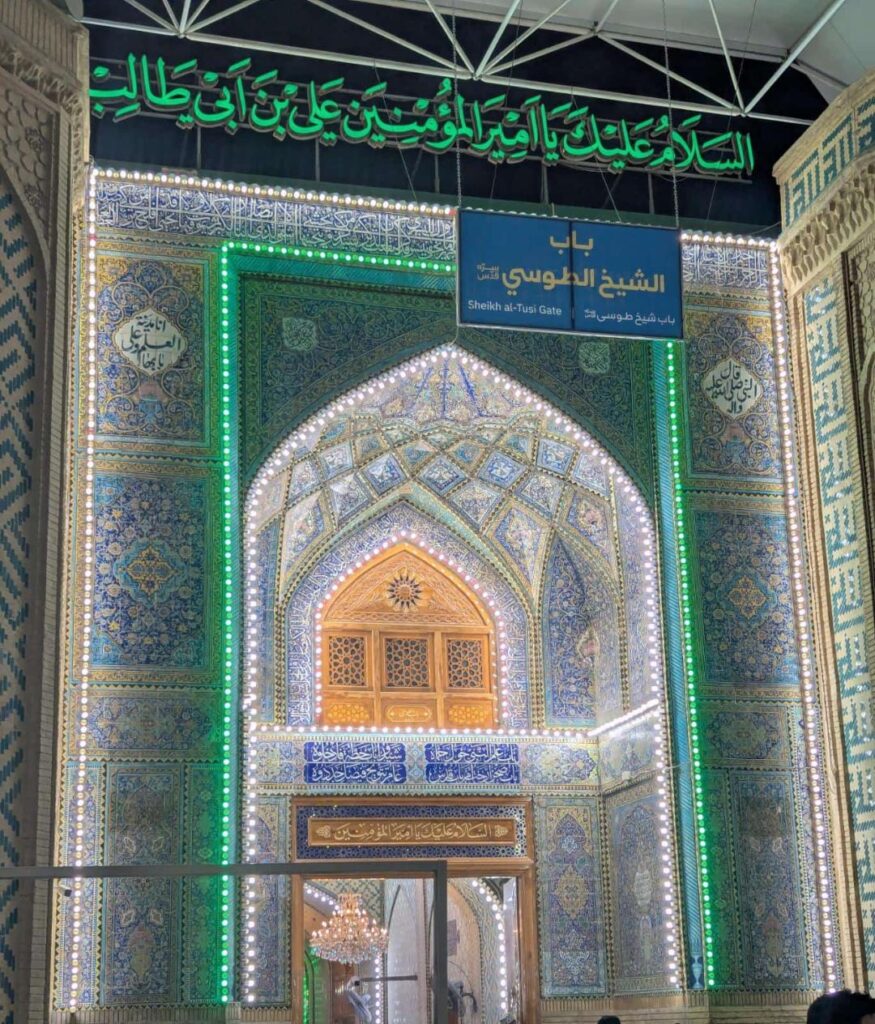
The Mausoleum of “Shere Khuda” Ali ibn Abi Talib (Allah be pleased with him)
كرٌم اللّه وجْهه Allah honour his face
The Grave of Ali (Allah be pleased with him)
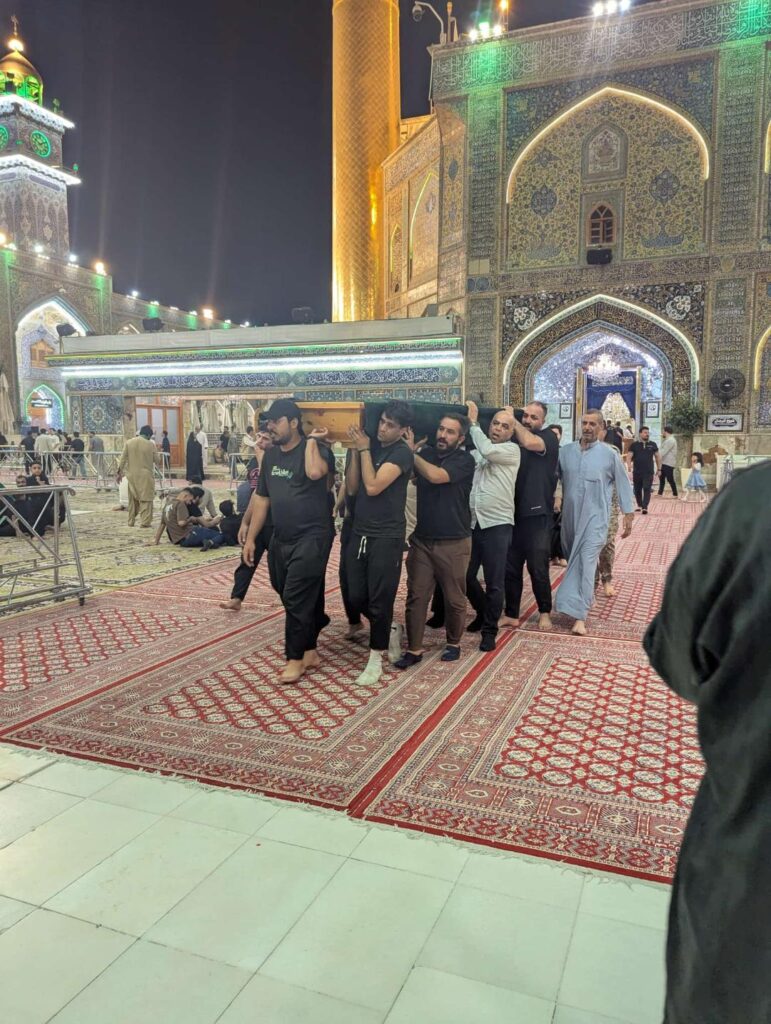
Every 10-15 minutes there are Janazahs, the deceased are mainly Shia Muslims from all over Iraq and Iran, they request to be buried next to Ali RA in Wadee Salam
Wadee Salam, Najaf
https://youtube.com/shorts/QC0sFYPzzyE?si=7XDdDLccCkMbUI8j

The world's largest cemetery, 6 million people are buried there. Every Janazah that comes into the Masjid of Ali RA does a tawaaf of the grave of Ali RA then gets buried in Wadee Salam.
The cemetery has 6 million bodies buried there, due to the fact anyone can get buried in the cemetery, Sunni or Shia from anywhere in the world, to gain the closeness to Ali (Allah be pleased with him).
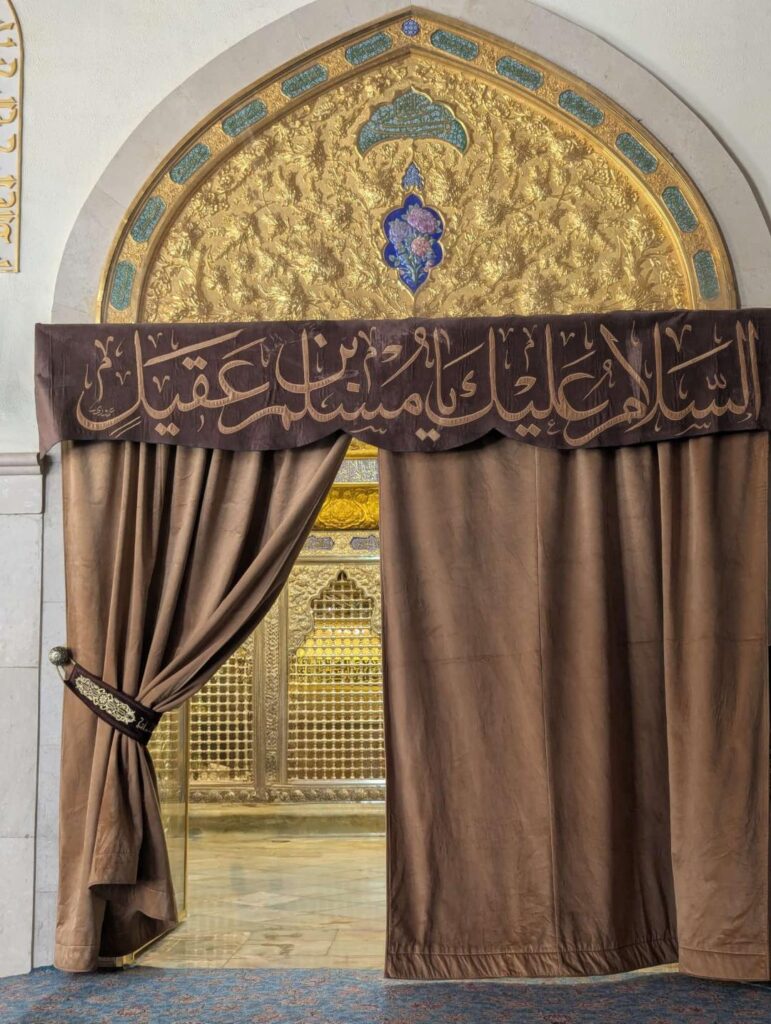
Muslim ibn Aqeel (Allah be pleased with him)
The Grave of Muslim ibn Aqeel (Allah be pleased with him)

Muslim ibn Aqeel RA was the relative of the Prophet ﷺ and the son of Aqil ibn Abi Talib. Muslim ibn Aqeel RA is remembered for his bravery and moral uprightness. The Kufans welcomed Muslim and overwhelmingly pledged to support Hussain RA against the Umayyad rule. Therefore Muslim RA wrote a letter to Hussain RA and urged him to come to Kufa, thus Hussain RA left Makkah. In the meantime Muslim was executed whilst Hussain was unaware.
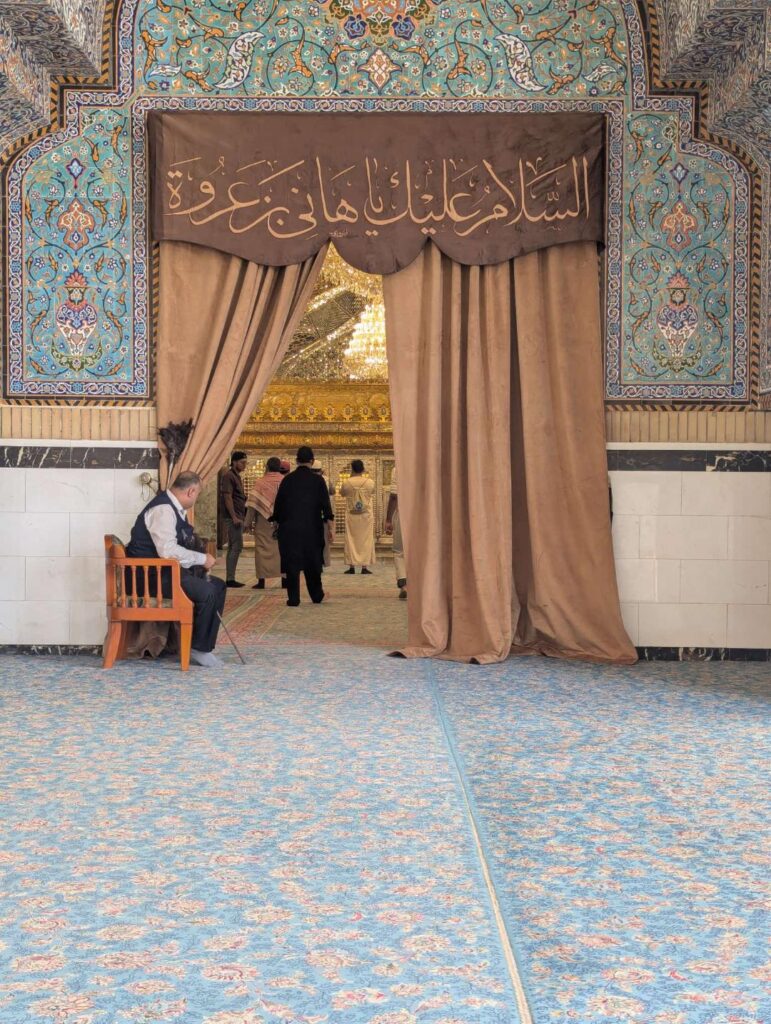
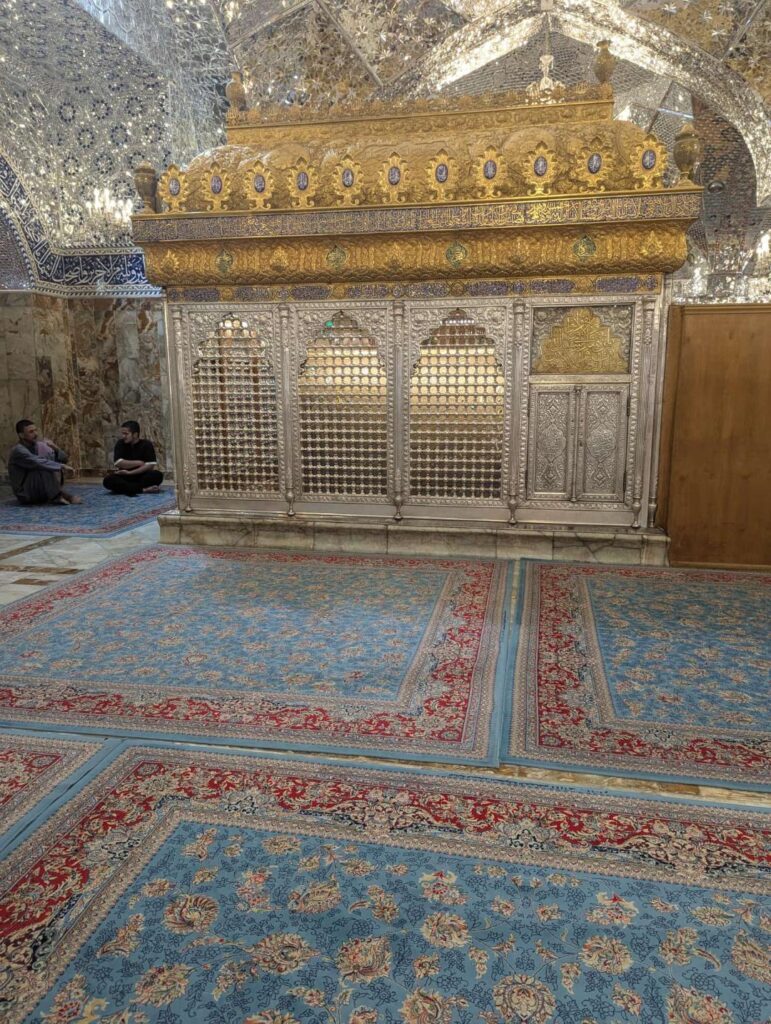
Hani ibn Urwaah (Allah be pleased with him)
The Grave of Hani ibn Urwaah
Who is Hani ibn Urwaah RA?
A Kufan leader who hosted Muslim ibn Aqeel RA. He was later killed by Ubayd Allah ibn Ziyaad, the governor of Kufa.

Why was Hani killed? Yazeed asked Hani, is Hussain on Haqq or me? Hani RA said: "Without doubt, Hussain RA is on the truth!" Yazeed ordered for him to be killed. This is the price you pay for standing on truth and principles. You may lose in this world, but the hereafter is yours.

Ismail ibn Nazir Satia (one who is in dire need of Allah’s forgiveness, mercy and pleasure)

10 Rabiul Thani 1447

Categories
Poems

O Companions of the Prophet ﷺ!

IMG_9149O Companions (R) of the Prophet ﷺ!

To him, you were so beloved

How did it feel to address my Nabi (S) directly?

And listen to him answering so calmly?

O Companions (R) of the Prophet ﷺ!

To him, you were so beloved

How did it feel to take the Shahadah for the very first time?

After the message was revealed and Hira he did climb?

O Companions (R) of the Prophet ﷺ!

To him, you were so beloved

How was it to proclaim, “I bear witness that there is no God but Allah and YOU are his slave and Messenger?”

You were the first believers and your Imaan was so strong despite you being fewer

O Companions (R) of the Prophet ﷺ!

To him, you were so beloved

How did it feel to steal a glance at his shining face?

What did you feel when reached for an embrace?

O Companions (R) of the Prophet ﷺ!

To him, you were so beloved

When Jibreel descended, did you see his blessed forehead perspire?

With words from above, which then did us inspire

O Companions (R) of the Prophet ﷺ!

To him, you were so beloved

How was my Nabi’s ﷺ smile when he was pleased with you?

Did you see his eyes glow? Did his teeth show?

O Companions (R) of the Prophet ﷺ!

To him, you were so beloved

How was his beloved face when he didn’t approve?

Did his eyes show his displeasure? Did his face redden?

O Companions (R) of the Prophet ﷺ!

To him, you were so beloved

Where were you when you heard the tragic news?

Did you fall to your knees? Did you think it was true?

O Companions (R) of the Prophet ﷺ!

To him, you were so beloved

How was Madinah after his death?

When you lay him in his grave to rest?

O Companions (R) of the Prophet ﷺ!

To him, you were so beloved

He spent his days and nights praying for us all

We pray to be united with him in the Hereafter

Zainab Bint Husain

Categories
Personalities

Asim Ibn Thabit (Allah be pleased with him)

بسم الله الرحمن الرحيم

IMG_0395
Asim ibn Thabit (Allah be pleased with him) Arabic: عاصم بن ثابت‎‎) was one of the Ansar, a person belonging to one of the first generations of Muslims and who helped Muhammad after his migration to Medina.
Asim ibn Thabit (Allah be pleased with him) in the Battle of Badr. Rasulullah ﷺ’s forces included Sayidina Abu Bakr (Allah be pleased with him) , Sayidina Umar Ibn Al Khattab (Allah be pleased with him) Sayidina Ali Ibn Abi Talib (Allah be pleased with him), Sayidina Hamzah Ibn Abdul Muttalib (Allah be pleased with him), Sayidina Mus`ab ibn `Umair (Allah be pleased with him), Sayidina Az-Zubair bin Al-‘Awam (Allah be pleased with him), Sayidina Ammar ibn Yasir (Allah be pleased with him) and Sayidina Abu Dhār al-Ghifari (Allah be pleased with him).
The Muslims also brought seventy camels and two horses, meaning that they either had to walk or fit three to four men per camel. However, many early Muslim sources indicate that no serious fighting was expected, and the future Saiyidina Othman Ibn Affan (Allah be pleased with him) stayed behind to care for his sick wife Ruqayyah (Allah be pleased with her) the daughter of Rasulullah ﷺ. Salman Al Farisi (Allah be pleased with him) could not join the battle, as he was still not a free man.
Asim ibn Thabit (Allah be pleased with him) also participated in the Invasion of Hamra al-Assad, after staying at Hamra al-Assad for three days, Rasulullah ﷺ returned to Madinah. Asim ibn Thabit (Allah be pleased with him) Abu Azzah al-Jumahi as prisoner. Abu Azzah had previously been one of the prisoners of Badr. Abu Azzah Amr bin Abd Allah al-Jumahi had been treated kindly by Rasulullah ﷺ after the Battle of Badr, being a poor man with daughters, he had no means to pay ransom, he was released after Battle of Badr, on the condition that he would not take up arms against Muslims again. But he had broken his promise and participated in Battle of Uhud. Abu Azzah al-Jumahi pleaded for mercy again, but Rasulullah ﷺ ordered him to be killed. Az-Zubair (Allah be pleased with him) him, and in another version, Asim ibn Thabit(Allah be pleased with him).
The father of one of Umar’s wives, Umm Kulthum bint Asim (Allah be pleased with her) was Asim ibn Thabit (Allah be pleased with him) is not clear if that person is the same person as the subject of this article is with regards to Saiyidina Asim ibn Thabit (Allah be pleased with him).
Hadith about Asim Ibn Thabit (Allah be pleased with him) narrated by Abu Hurairah (Allah be pleased with him)…
A narration attributed to Abu Hurayrah (Allah be pleased with him) :
Rasulullah ﷺ sent out ten men on a scouting expedition and put ‘Asim ibn Thabit al-Ansari RA in command of them. They proceeded until they reached Had ‘a, which is between ‘Usfan and Makkah.
This during the Expedition of Al Raji. In 625 some men requested that Rasulullah ﷺ send instructors to teach them Islam, but the men were bribed by the two tribes of Khuzaymah who wanted revenge for the assassination of Khalid bin Sufian by Rasulullah ﷺ’s followers and they killed the Muslims.
Their presence was reported to a branch of Hudhayl called the Banu Lihyan. About a hundred men, who were all archers, set out after them. They followed their tracks. When Asim Ibn Thabit (Allah be pleased with him) and his companions perceived them, they took cover. The people surrounded them and said, ‘Come down and give your selves up! You have protection and assurance that we will not kill any of you!’
Asim ibn Thabit RA said, ‘O people! As for me, I will not come down into the protection of an unbeliever! O Allah, inform Your Prophet about us!’ They shot at them with arrows and killed Asim Ibn Thabit RA. A group of three came down, accepting the offer of protection and security. They included Khubayb al-Ansari (Allah be pleased with him), Zayd ibn Dathina (Allah be pleased with him) and another man,
Rasulullah ﷺ informed his Companions about them on the day they fell. When they were informed that Asim ibn Thabit RA had been killed, some of the unbelievers of Quraish were sent to bring part of him that could be recognized. He had killed one of their great men on the Day of Badr. After killing Asim ibn Thabit RA, Hudhayl wanted to sell his head.
Allah SWT sent over Asim ibn Thabit RA a swarm of bees like a cloud and it protected him from their messengers and they could not cut off any part of him.”
A brief story on why the hatred and revengefulness of the unbelievers to Saiyidina Asim Ibn Thabit RA, and this took place after the “Battle of Uhud”
Ever despaired in your Du’as?
Ever thought that they are not answered or that Allah Azza Wa Jal doesn’t respond?
Then, let me narrate to you of another the story of ‘Asim Ibn Thabit RA.
During the Battle of Uhud, when the Muslims purportedly faced defeat though not reliably authenticated of the fact, the Quraish celebrated with their revenge but this was not enough for the ladies of their tribes. Hind, the woman who slaughtered the body of Saiyidina Hamzah RA, together with other women started to go out on the battlefield and started to dance and desecrate the dead bodies of the Mujahideen. Astagfirullah!
Narrations say that in the passionate desire for revenge, these women slit up the belies of the Mujahideen, gouged out their eyes and cut off their noses and their ears. One woman among them shaped an anklet of the nose of a Mujahideen and put it on her feet and started dancing joyfully amidst the dead bodies.
Astagfirullah!
But then came out Salafah Bint Sa’ad, who was very different from the other women, she was anxious about her family, so she started to look for them, she search high and low until she found the body of her husband soaked in his own blood, and near him were her sons, Mustafa, Kalab and Jalas who was breathing his last
On this Salafah asked who killed them, and Jalas said it was ‘Asim Ibn Thabit (Allah be pleased with him).Hearing this Salafah started to scream and swore by the false gods ‘Uzza and Lat that her rage could not die down until she had taken revenge on ‘Asim ibn Thabit (Allah be pleased with him) and drank wine from his skull.
After this, she indeed proclaimed that she would give any amount for the person who can bring her the head of ‘Asim ibn Thabit, and this spread like fire amongst the Quraish. So one by one they started to search for ‘Asim ibn Thabit.
After the Battle of Uhud, Rasulullah ﷺ sent  the Sahabah RA  on a special mission with ‘Asim Ibn Thabit (Allah be pleased with him) its  leader.
They were a few distance from Makkah when a group of Banu Hudhayl pursued them and ambushed them. The people tried to bribe the Sahabah (Allah be pleased with them) told them that they won’t be killed as long as they lay down their weapons.
Asim Ibn Thabit (Allah be pleased with him) all his courage said “I will not lay down my weapons before the Mushrikeen!”
Then, he remembered the swearing of Salafah and he prayed:
“O Allah! I protect and defend your faith and, have Mercy on me and protect my flesh and my bones; please do not allow them to fall into the hands of the enemy.”
After this Asim Ibn Thabit (Allah be pleased with him) the enemy with two of his companions, they fought fiercely until they were martyred one by one. The three other surrendered and were killed, one committed suicide and the other 2 killed by the Banu Hudhayl.
Now, this is where the power of du’a comes. After few hours of the martyrdom of Asim Ibn Thabit RA, the Quraish learnt of the where about of his body which was lying in the area inhabited by the Banu Hudhayl..
So, with the hungry bellies of the Quraish for money, they started to give a lot of money to their messengers so that they could succeed in getting the head of Asim Ibn Thabit RA.
When they succeeded, some men of the Banu Hudhayl went to the place where the body Asim Ibn Thabit (Allah be pleased with him) lying; when they were near it to cut off his head they found a whole lot of bees, wasps and hornets surrounding the body and head of Asim Ibn Thabit (Allah be pleased with him).Whenever they attempted to cut it these bees and wasps would attack them so they couldn’t do anything but give up and wait for the nightfall.
The sun had not yet set when suddenly dark dense of clouds appeared on the sky, the very air seemed to tremble with the thunder and heavy rains had fallen.
Soon the streets and roads took on the appearance of streams, low-lying areas were filled, and there was water everywhere. It rained heavily the whole night and the Banu Hudhayl went back to their homes.
Next morning they came out to get the head of Asim Ibn Thabit (Allah be pleased with him) as they went towards the field the body was nowhere to be found. The flood washed it away to some unknown place; they searched high and low but the body of Asim Ibn Thabit (Allah be pleased with him) disappeared like dust in the wind.
Subhan’Allah. Look how Allah Azza Wa Jall responded to the du’a of His faithful servant Asim Ibn Thabit (Allah be pleased with him). Allah SWT sent down wasps and bees to cover his body as protection to these people who had the intention to use his limbs and whatever is left of him into devilish and sinful act of drinking wine. Allah SWT  sent down heavy rain so that his body won’t be found and away from the Mushrikeen.
Allah Azza Wa Jal will never allow the Mushrikeen to triumph over the Mu’mineen and this is how he protects His faithful servants. Similarly in Palestine, the Kuffar may plan anything against the Mu’mineen, but the Divine Plan overcomes all other plans.
Indeed, the story of Asim Ibn Thabit truly reminds us of the one of the famous “Ayat of the Qur’an” where Allah Azza Wa Jall says:
“Call upon me and I will respond to you.” 40:60
So never despair of His Mercy and never underestimate the power of your du’a. Remember Allah Azza Wa Jall knows what you are about to ask Him even if you haven’t uttered them, He is within You, Your heart itself, calls upon Allah Azza Wa Jall with every beat.
“Rabb. Rabb. Rabb. La Hawla wala Quwwata illa billah.”
May you all benefit from the story of Asim Ibn Thabit (Allah be pleased with him)
Amin Ya Rabb
Categories
Spirituality

The Story of Abu Dujanah RA

بسم الله الرحمن الرحيم

dates
Abu Dajanah (Allah be pleased with him) always used to pray behind the Prophet (Sallalahu Alayhi Wasallam).
But as soon as he finishes his prayer, he comes out of the Masjid quickly.
This caught the eyes of the Prophet (Sallalahu Alayhi Wasallam) and one day he stopped him and asked him:
“O Abu Dajanah, don’t you need anything from Allah?”
Abu Dajanah (Allah be pleased with him) said:
“O Messenger of Allah, Yes I do. I can’t live without Allah even with a blink of an eye.”
The Prophet (Sallalahu Alayhi Wasallam) said:
“So why don’t you stay with us after prayers and ask Allah what you need?”
Abu Dajana (Allah be pleased with him) said:
“The reason is that I have a Jewish neighbor who has a date palm tree, and its branches are in the courtyard of my house.
 So when the wind blows at night, the dates fall into my courtyard.
 That is why you see me coming out of the Masjid quickly, so as I can go and collect the dates and return them to the owner, before my kids wake up. Because once they wake up, they will eat them as they are hungry.
 I swear to you, O Messenger of Allah, that one day I saw one of my children chewing the date, and I put my finger in his throat and took it out before he could swallow it.
 When my son cried, I said to him:
‘Aren’t you ashamed of standing in front of Allah as a thief?”
When Abubakr (Allah be pleased with him) heard what Abu Dajanah (Allah be pleased with him) said, he went to the Jewish and bought the date palm tree, and gave it to Abu Dajanah (Allah be pleased with him) and his children.
When the Jewish learned the truth of the matter, he quickly collected his children and his family and went to the Prophet (Sallalahu Alayhi Wasallam). and announcing their entry into Islam.
This is how they made people enter Islam because of their stand and their actions.
They were advocates of their deep-rooted faith, and their actions is a reflection of their faith.
(Nuzhatul Majalis, pg. 247-248)
Share please, JzkAllah
Categories
Current Affairs articles

Keeping Warm in Winter

Sulaym ibn Aamir RH narrates that when winter would come, Sayyiduna Umar ibn al-Khattab (Radhiallahu Anhu) would be extra mindful of them and write to them, advising: “Winter, which is an enemy, has come, so prepare for it with wool, leathers socks, and socks. Use wool as your under-clothing and outer-clothing, because the cold is an enemy that enters quickly but leaves slowly.”
winter
Ibn al-Rajab al-Hanbal (Rahimahullah) comments that Sayyiduna Umar (Radhiallahu Anhu) would write this advice to the people of Shaam when it was conquered in his era, as he was worried that the Companions RA and others who had not previously experienced such cold would be harmed by the cold of Shaam. This was out of his complete well-wishing, graceful vigilance, compassion and safeguarding of his subjects. May Allah be pleased with him. (Lataa’if al-Ma’aarif).
Following in the footsteps of Sayyiduna Umar (Radhiallahu Rnhu), the following is some important advice on what we can do to protect ourselves against the cold and stay warm this winter:
Wear warm clothes
The best way to protect against cold and stay warm is to wear warm clothes, especially when going outdoors into the cold.
Allah mentions warm clothing amongst His many favours: “And the grazing livestock He has created for you; in them is warmth [i.e., warm clothes] and [numerous] benefits” (Qur’an, 16:5). He also said, “And from their wool, fur and hair is furnishing and enjoyment for a time” (Qur’an, 16:80).
Wearing a number of thin layers, especially clothes made of cotton, wool and fleecy fibre, helps to keep the body warm. Keeping the feet warm and dry is particularly important, not forgetting footwear with good grips during icy/snowy periods.
Even if you are going out into the cold for a few minutes, to put the bins out perhaps or to get something out of the car, wrap up warm; a few moments of being exposed to the cold is enough to make a person ill.
Keeping your head warm with a scarf or hat is important, as a lot of body heat is lost through the head.
Eating Properly
Good nutrition is vital to keep the body warm. Hot meals (soups in particular) and hot drinks will help you stay warm throughout the day. Wholegrain, legumes (lentils, peas, chickpeas, beans) root vegetables (potatoes, carrots, turnips etc.), vegetables in general, citrus fruits, spices (in moderation!) and herbs (especially ginger), almonds, walnuts, pistachio and other nuts, dried fruits (especially dates and figs) are excellent choices to boost our health during winter.
Keep the House Warm
Cold and damp houses negatively affect our health, so keeping the house warm is a must for staying healthy during winter. We sometimes overlook the most obvious things which make our houses cold, such as unnecessarily opening windows and not attending to draughts under doors, so think about ways to minimise heat escaping from the house; this will also help to reduce heating costs.
Taking Care of Others
As Muslims, it is our duty to be concerned about the welfare of others and not just be concerned about ourselves. Allah’s Messenger ﷺ said, “None of you truly believes until he loves for others what he loves for himself.” (Bukhari, Muslim).
We should be checking on relatives, elderly neighbours or anyone who is more vulnerable during the cold, ensuring they have what they need to stay warm and safe, especially during the night. If we can save an elderly person the trouble of going out in the cold and do their shopping for them, or run other errands for them, we should do so and earn immense reward from Allah.
And let us not forgot the spirit of Sayyiduna Umar ibn al-Khattab (Radhiallahu Anhu) towards the people of Shaam, who are currently enduring extreme hardship and struggle, with many of them battling against the bitterness of winter without ample clothing, food and shelter.
There are a number of reliable charities that are providing much-needed provisions to our brothers and sisters in Shaam, and other parts of the world. Each Muslim home should aim to provide for at least one family this winter and help alleviate the suffering Allah, out of His Mercy, has saved us from.
May Allah keep us all in His protection, and make us all a means of blessings, comfort, guidance and happiness for others.
Ameen Ya Rabb!
29 Safar 1439
Categories
Personalities

The War on Error

War on Error
What if I told you there were soldiers outside who despised who you and I,
Ready to take us dead or alive, with guns pointed at your pride,
And you had the option to just lie and denounce what you hold inside,
Would you go run and hide, or would you get ready to die,
See the problem with you and I, is we would say anything to stay alive
Multiplied by the drive that we have to survive
Most would rather compromise, than be chastised
So we don’t even try, but I dare to ask why
Homeland security, is only trying to secure me
In these tiny little rooms, where I could barely breathe
Maybe it’s the way that I’m dressed in the land of the free
No khamis, I should have just wore jeans and a T
And I know it’s hard to believe, but I aint a refugee,
Actually, I was born in a hospital right down the street
So tell me what’s the beef; is it the beard or attire?
Or is it my last name; you could just call me Michael
Are you comfortable, am I moderate enough for your liking
I don’t wanna any trouble, I’ll be good, man I promise
I’m honest, only liars need to preach to a choir
Holding onto this deen is like holding onto fire,
But I still smile, aint sure if this is still worth your while
You say you wanna believe than you will be put on trial
Tested, but blessed are those who remain steadfast and pray
Because what are we but slaves, just looking for a raise
Anyways, everyday’s another chance at being saved
Cause even a broken clock is right two times a day
But I’d be lying if I didn’t say,
We look like lions without manes
Trying to impress these creatures who just came from mud and clay
Why don’t you beautify your grave, Iqra, proclaim
Who will testify for you when your Lord calls your name?
Work for your spot in the shade on the day when their will only be his shade
The things you love today, they will all fade away
Remember the story of the cave, even though they were afraid
The youth knew the truth so they still remained brave
The same goes today, cause even rain goes away
And after the clouds the sun comes out to play
So expect brighter days, and declare all praise
To the one with no son, in need of no aid
Isn’t it strange how the strangers are starting to feel strange?
I guess sometimes Guantanamo bay is just the price you gotta pay,
Allah does not place a burden on a soul more than it can handle
And the bruises from sujood will light your way just like a candle
And we follow the example of the best of examples
I don’t stand for flags and or bow to your bourgeois
I pledge allegiance to La elhalla il allah
Say it now, Say it loud, be proud of your Muslim names
Uthman, Umar, Ali, Khadija, Aisha, Summayah
If only you knew the sacrifice these people made
So tell airport security, I’m sorry if we all look the same
But there’s a reason why Muhammed is the world’s most popular name
And you can call us funny names, and draw cartoons in his name
But there will come a day when your Lord will decide who goes and who stays
So go ahead and tease, after hardship comes ease,
And gardens with rivers that flow underneath
This poem is for every hijabie who got made fun of in school
Or the brothers too scared to rock a beard, cause facial hair isn’t cool
If Allah didn’t love you, then he wouldn’t test you
So prepare for victory, coming to a soul near you

Heroes

My heroes never wore tights or appeared on carton channels
They had long beards and kept clothes above the ankles
No combing the streets, like beasts at night looking for thieves
My heroes fought their egos, and narrated ahadith
And some of my heroes were once bag guys too
Baby killers and highway robbers, if you only knew what they knew
Cause you gotta know a lie in order to recognize the truth
And what the point of knowing truth if you can’t back it up with proof
And to prove my heroes were united by a single point of view
Why else would they choose to go against what their fathers used to do?
Unless they knew, that paradise was worth being abused
The best of views, if only you could walk a mile in their shoes,
Oh what I wouldn’t do to kick it with Abduallah Ibn Musuud,
Listen to him recite the Quran, sad to go into ruku
Yeah that would be cool, but me and Hamza, we would kick it old school
Joke about the Jahilliya, silly things they used to do
If I could pick my own crew, Salman Al Farsi would have to be in it,
An honest seeker of truth, may Allah bless his spirit,
Have Tea with Julilibib, Coffee with Anas Ibn Malik
Anything to pick their brains and gain a better understanding
Could you imagine taking a class with Abduallah Ibn Abbas
A scholar by the age of 10, just a boy amongst the men
And if I had one friend, it would be Abu Baker as Saddique,
Someone to hold you down and to really represent,
When Sumayya held her chin to her killers, did she think?
We would name our little girls after her to teach them strength
And who cares about these rappers, we got Hassan Ibn Thabit,
Dude was sick with the flow, can’t believe you didn’t know,
That Zaid was a slave who became one of praise
Lived the American dream, when America was Cree
Umar Bin Khattab was G, held it down for this deen
A real superman, made the devils cross the street
And if I ever had beef, I would call up Khalid Bin Walid
He was a ride or die homie, amongst the Salaf as Saliheen,
And if I close my eyes, man, I could almost see
Bilal amongst the cold morning breeze, Allahu Akbar
Cause surely salah is much better than sleep
Like Abu Sufyan after he embraced the deen
On this earth Talha, was a walking shaheed
And Jafar gave his life for our Ummahs victory
May Allah be pleased and grant them all the highest levels of heaven
Like Uthman ibn Affan, who even the angles were shy in front of
Aisha was a genius, ever word was like a thesis
Mother to all believers, pure like that of Isa’s
Khadija held the fetus of Fatima, who was the teacher
Of Hassan and Hussein, sons of Ali who were slain
Man you gotta know these names, cause these people paved the way
It’s a shame, we know more about them monkeys on BET
This is our history, all the sacrifices that they made for me
Gave to me, a legacy that I could be proud to keep
Said: Be! It was decreed, that at Badr we were only 300 deep
But with the angels on our side, who could even compete?
Although he was a man of peace who preached speech before the sword
He raged a war against error, the worship of fake Lords
Came to restore the deen that Ibrahim laid before
Extreme in his need to feed miskeen and the poor
Yeah, he was hardcore with his face to the floor
Off praying so long that his feet became sore
Uhhhh, yeah he got down like that
And told all the rich they should pay the zakat
And make the salah, and spread the salaam
And declare Ashdu-la-ilah, Ha-il-allah,
Muhammed a rasooul Allah, Sallau alahe wsalaam,
Was the difference between Jannah and Jahennim,
Like the mailman just delivering a message
Who else do you know with a swagger that’s blessed?
The best and perfected, corrected the method
Madina state of mind, coming from the hood of Mecca
Champion companions, homeboys were go-getters
Did it bigger and better, had followers before twitter
The leader of leaders, amir to believers
Enjoined all the good and forbade all the evil
My hero taught people that we were all equal
The best of examples outlined what is legal
Forever I’m grateful for all that he came for
May blessings and peace always reach to my mentor
My teacher, my brother, my hero, my prophet
Muhammed, Sallau alahe wsalaam
And that’s how it goes, so tell everyone you know
That this party don’t stop till the son of Mary come home
I am pleased with my Lord and Islam as my deen,
May we die on these words, Allahuma, ameen

Categories
Miscellaneous

Feeling Quotatious!

dont

Time is a Precious Commodity

نِعْمَتَانِ مَغبونٌ فيهما كَثيرٌ مِنَ النَّاسِ  الصِّحَّةُ ، وَالفَرَاغُ

The two most undervalued assets by people are good health and leisure time.

The Prophet Muḥammad (peace and blessings be upon him)

[Bukhārī 5933, Tirmidhī 2226, Ibn Mājah 4160, Aḥmad 2224, 3038, Dārimī 2591, Riyad al-Saliheen #97]

                  ———————————

attitude

The Fault is in Us, Not in Time

نَعِيبُ زَمَانَنَا وَ العَيبُ فِينَا

وَ مَا لِزَمَانِنَا عَيبٌ سِوَانَا

“We blame time and the fault is in us,

There is no fault in time except us.”

— Imām al-Shāfi‘ī RH [d. 204H/820CE]

(Read on pg 39, Dr. Gohar Mushtaq, The Intelligent Heart, The Pure Heart. Ta-Ha Publishers. London: 2006.)

————————————————-

“Losing time is worse than death, as losing time keeps you away from Allah and the Hereafter, while death keeps you away from the worldly life and people.”

– Ibn al-Qayyim RHyou are

Today is All You Have

إن بلاءنا أننا نعجز عن حاضرنا و نشتغل بماضينا ،  نهمل قصورنا الجميلة ، و نندب الأطلال البالية . . . الريح تتجه إلى الأمام ، و الماء ينحدر إلى الأمام ، و القافلة تسير إلى الأمام ، فلا تخالف سنة الحياة

Our tragedy is that we are incapable of dealing with the present. Neglecting our beautiful castles, we wail over dilapidated buildings. Everything on earth marches forward, preparing for a new season—and so should you.

—‘Āiḍ al-Qarnī, Don’t Be Sad. International Islamic Publishing House. 2002hela

Beware of Three

Beware of Allah’s anger with regards to three:

  1. Beware that you fall into shortcomings concerning what He has commanded you.
  2. Beware that He sees you while you are feeling discontent concerning the provision He has granted you.
  3. Beware of feeling dismay at your Lord if you seek a provision of this life, but cannot acquire it.

—’Sufyān al-Thawrī RH [161H/778CE]

(Read on pg 24, Abdul-Malik bin Muhammad ibn Abdul Rahman Al-Qasim, Life is a Fading Shadow. Darussalam Publishers. Riyadh:1999.)ismailsatia

Remedy for the Heart

There are two main things you have to do. The first is to move your heart from dwelling on the things of this world and move it to dwell on the Hereafter, then focus all your heart on the Qur’an and ponder its meanings and why it was revealed. Try to understand something from every aayah and apply it to the disease of your heart. These aayaat were revealed (to treat) the disease of the heart, so you will be healed, by the permission of Allah.

—Ibn al-Qayyim RH [d. 751H/1350CE] on curing one’s heart

(Read on pg 57, Shaikh Muhammad Salih al-Munajjid, Weakness of Iman. Dar us-Sunnah Publisher. Birmingham:2003.)

koran

Satan’s 3 Wishes

Iblis (satan) said, “If I win three things from the son of Adam, I will have earned what I wanted from him: if he forgets his sins, thinks high of his actions, and becomes fond of his opinion.”

—Dirar b. Murrah RH

Sifatus-Safwah vol. 3, p. 116

(Read on pg 39, Abdul-Malik bin Muhammad ibn Abdul Rahman Al-Qasim, Life is a Fading Shadow. Darussalam Publishers. Riyadh:1999.)

lessons

Its not the land that make anyone Holy . . .

The Companion Abu’l-Dardā’ RA who was living in the land of al-Shām (present day Syria/Palestine) once invited his colleague Salmān al-Farsī RA to come and live with him in the Holy Land. Salmān RA wrote back to him:

إِنَّ الأَرْضَ لا تُقَدِّسُ أَحَدًا ، وَإِنَّمَا يُقَدِّسُ الإِنْسَانَ عَمَلُهُ

It is not the land that makes anyone holy, but one’s deeds.

—Salmān al-Farsī RA [d. 35/644]

[Muwaṭṭa’ Mālik]

patirn

You Are Everything Today but MUSLIM!

Lament that in the world, Muslims are descending

We say this in reply that you are condescending

With alien ways and culture you are not transcending

Are you Muslim still, what message are you sending

You are Syed, you are Mirza, Afghan in origin

Everything you are, but ARE YOU MUSLIM in religion?

—The timeless poet Muḥammad Iqbāl RH [d 1357/1938]

[from Rhymed Translations of Selected Ghazals by Khwaja Tariq Mahmood]


أفضل الأعمال ما أكرهت عليه النفوس

Imam Abu Bakr ibn Abid Dunya (rahimahullah) has recorded this as the statement of ‘Umar ibn ‘Abdil ‘Aziz (rahimahullah). (Muhasabatun Nafs, Hadith: 113)

Translation

“The best actions are those which the nafs is forced to carry out/dislikes doing.”

Categories
Shaykh Saleem Dhorat

The New Year


 The New Year
by Shaykh Mawlānā Muhammad Saleem Dhorat hafizahullāh

Having just completed the year, the ‘New Year’ is seen and heard all around us. However, the question remains as to what should be a Muslim’s take on these events.

Upon the passing of a year, the common trend is to celebrate; people have birthday parties, wedding anniversaries etc. However, in certain spheres this is not the case; take the example of a businessman who at the end of the (financial) year will first take stock of the past year. He will meticulously go through the accounts of the past year taking into account every single penny. He will check to see if he made a profit, and if so then how can he make more in the coming year. He will check his expenses: where did he spend his money? Can he make further savings? All of this is done so that he can make the coming year more profitable than the one that has passed.
This should be the case at the end of the year in every Muslim’s life for we too have been sent to this world as businessmen with the commodity of time; which is life. We will have to one day give account for every second in the Court of Allāh ta‘ālā, when our books of deeds shall be presented.

We will bring forth a book for him that he will find wide open, (and We will say to him) ‘Read your book. Enough are you today to take your own account.’ (17:13-14)

‘Umar radhiyallāhu ‘anhu, emphasising the same, says:

Take stock of your own lives before Allāh ta‘ālā reckons you. And assess yourself before you are assessed by Allāh. And prepare yourselves for the great summoning.

It is our belief that on the Day of Judgement Allāh ta‘ālā will reckon us for everything that we did in the world.

On the day when everybody shall find present before him whatever good he did and whatever evil he did, he will wish there would have been a wide space between him and that (day). (3:30)

No matter how minute or trivial an act we did, we will find that it is present in our book of deeds.

So, whoever does any good act (even) to the weight of a particle will see it. And whoever does evil (even) to the weight of a particle will see it. (99:7-8)

This will be to the extent that in awe people will say:

‘Woe to us! What a book is this! It has missed nothing, minor or major, but has taken it into account.’ Thus they will find whatever they did present before them, and your Lord will not wrong anyone. (18:49)

We need to keep this reality in mind and spend our lives with regular reflection on our actions with Murāqabah and Muhāsabah. Murāqabah means to supervise and oversee oneself to ensure that he/she stays away from disobediences of Allāh ta‘ālā and spends every moment seeking the Pleasure of Allāh ta‘ālā. Muhāsabah means taking account of one’s activities at the end of the day, week and year; and thanking Allāh ta‘ālā for the ability to have performed any good actions and seeking forgiveness for any sins one may have committed. Inshā’allāh, if this is adhered to, then we will see a great change in our lives. We will find ourselves spending every second of our lives with great care.

The end of a year is a time to reflect and say to yourself, ‘Another year from my precious life has passed. Who knows how many more years, if any, I have remaining?’ Let us spend them in those avenues that bring the pleasure of Allāh ta‘ālā and stay away from those things that bring His displeasure, so that we can meet Allāh ta‘ālā in a state that He is pleased with us.

© Riyādul Jannah