Categories
Dhulm/Oppression

Bharuchism Vs. Surtism

I have walked into churches and nobody called me a “paki.”

I have visited synagogues and nobody called me a “radical.”

I have seen the Hindu temple and nobody called me a “terrorist.”

It is only when you attend a Gujarati Masjid you get told:

“This is our turf”

“Surtis not welcome”

“What you lot doing here?”

Welcome to racist Blackburn!

Bharuchi racism is common and Surti racism is common, my rules are fair. I’ve also written about a Surti mufti who contaminated the mimbar once with his racist bile. But today’s message is for those who say I am not welcome to the bharuchi masjids, you remind me of the incident when Bilal (Allah be pleased with him) gave Adhan on the Kabah:

“Thank God that my father died before this happened, and he did not have to see this bad day. Harith Ibn Hisham remarked: Could Muhammad not find anyone better than this black crow to sound the adhan in the Sacred Mosque!”

“The Quraysh were angered upon seeing a black Ethiopian slave give Adhan on the Kabah. Just like members of the bharuchi community were angered upon seeing me in their masjid. The Prophet ﷺ remarked on hearing these comments: these are traits of ignorance and arrogance.

Bharuchism Vs. Surtism

There is no doubt every community has their praiseworthy traits and every community has their weaknesses, but some people only focus on the praise, which naturally feeds their egos. Anyone living in Batley/Dewsbury/Leicester will agree many from the Bharuchi and Surti community love to criticise others, but failed to look in the mirror and focus on their own faults. I’ve had many messages and calls yesterday from people around the country who agree that racism from these two communities is deep, destructive, it’s vile, it’s vulgar.

The Iron Dome

When you are reading these messages, remember it’s 40 years of racism I am talking about, from BOTH communities. Hence, some bharuchis and some surtis can’t fathom what I am talking about, because you don’t face this level of racism, we do. Over the years, I have fired a few missiles and rockets back at the racists, only to realise they didn’t accept a WORD of criticism. But they were happy to criticise others? Hence we give the example of the iron dome, some of you have this iron dome above your heads where the rockets are only fired one way. We have eyes, we will criticise you too! People in glass houses shouldn’t throw stones.

Fairness and Justice⚖️ 

I also receive a lot of love and respect from the Bharuchi and Surti communities, like those who accepted the fact Tauheedul Islam Masjid and the community at large need to work on their egos and arrogance. Too many of your ulama are defensive, never accept facts, hence Allah doesn’t guide them, Allah doesn’t guide the arrogant. There’s a lot of good in these communities but your people spoil it by having this baseball bat attitude. I’m not just talking about the Imam, don’t assume things, your young ulama are very egotistic too!

The good is also unforgettable, the ones who replied to me yesterday from Bicknell are the ones I knew would accept facts. There are many Bharuchis who stand for truth and justice, without any bias. The Surti community needs to take a leaf out of their book, too many passive and apathetic in the Surti community, very few speak out. In same breath, I will remind the bharuchi community just because you speak haqq – I speak haqq too, alhumdu lillah – don’t get over confident where your arrogance takes over. No doubt that’s a reminder for me too.

Equally, there’s a lot of good in the Surti community which bharuchis can learn from, their humility and softness. Surti masjids thrive because of this quality, they have disagreements too, minus the baseball bat! Allah loves humility, and the bharuchis need to learn from them, lower yourselves and swallow your pride. At the same time the greatest weakness of the Surti community is you need to be more open and honest. Other communities dislike you for this one quality which destroys all good you do. This is sincere advice and it is upon the individuals to accept, I have accepted your criticism for decades.

A Sign from Allah SWT

Alhumdu Lillah, our prayers have been answered by Allah SWT through the voice of Mufti Taqi Uthmani Saheb.

Last night in Tayyabah Masjid, Bolton.

Coincidence or Godincidence?

The Fish Rots From The Head

When it comes to deep levels of racism, it starts from the cream of the crop, the Ulama. If you are that naive individual who still believes that all Ulama are infallible and angels – skip this ad – Ulama are human and far from perfect. One of the reasons we have so much racism in society is the Ulama, those that teach in schools and madrasah are the ones who take the lion’s share of the blame. They are the ones who spread hatred from the mimbar, which could have been used to spread love.

Imam Ghazali (Allah have mercy on him) writes, “You will seldom find a man who is racist and intelligent. You will rarely find a man full of malice and intelligent.” A profound message for our racist friends. Unity is key, we are a minority in this country and we need to remember when the far right attack you they will not ask, are you Bharuchi or Surti? Only Muslims ask that! Wallahi there are many that ring me for my services and ask, are you Surti or Bharuchi? That’s just racist, please use people from your own village if that’s how much it means to you.

This concept is hard for many in Blackburn to digest, hence the community will never accept that Ulama can be racist, until they are victims themselves. Which is really selfish.

“Verily, before Qiyamah people will only greet those that they know.”(Musnad Ahmad)

One of the best remedies for racism in the Masajid is to start doing Salam with each other. The hadith above is apt in today’s day and age. 

Considering tomorrow is Jumuah, every Indian should do Salam to every Pakistani and vice versa, no hugs, no kisses, just salam … calm down. We see Muslims meet each other everywhere, even in the Masjid, but we only do Salam to those who we know, this is a disease of the heart.

Ismail ibn Nazir Satia (one who is in dire need of Allah’s forgiveness, mercy and pleasure)
Categories
Personalities

Mufti Ebrahim Desai Saheb (Allah have mercy upon him)

Mufti Ebrahim Desai Saheb (Allah have mercy upon him)

askimam.com


Mufti Ebrahim Desai Saheb RH was born in Richmond, Natal. He completed his Qurān Memorization (Hifdh) by the renowned Hafiz Abdur Rahman Mia Saheb Rahimahullah at Waterval Islamic Institute (Miā’s Farm) South Africa. Thereafter, he pursued his ῾Ālim Course in Jamia Islamia, Dhabel for 7 years and passed with distinction every year. Mufti Ebrahim Desai completed his Mufti Course (Iftā) at Jamia Islāmia, Dhabel, India under Hazrat Mufti Ahmad Khanpuri Saheb of Dabhel for 2 years. After he completed his  Iftaa in Dabhel, he went to  Deoband to spend time with his Shaykh, the Grand Mufti of India and famous reformer and saint of the time, Mufti Mahmood Hasan Gangohi Rahmatullah Alayh for Islaah and increase in spirituality. Mufti Saheb is the Khalifah of Mufti Mahmood Saheb Gangohi Rahimahullah.In 2011, Mufti Ebrahim Desai Saheb moved to Durban permanently and laid the foundation for Darul Iftaa Mahmudiyyah, Sherwood, Durban. He is currently the Ameer of the Darul Iftaa Mahmudiyyah where students enrol to study the Iftaa course. The Darul Iftaa caters for many facilities under the supervision of Mufti Sahib. Ulama who study under him to become Muftis, qualify from local Darul Ulooms, UK, US, Canada, and many parts of Africa. Many of Mufti Sahebs students have established Darul Iftaas in many parts of the world and have their own fatwa websites that are affiliated to Darul Iftaa Mahmudiyyah. Further information can be accessed at http://www.daruliftaa.net. 

POSTS:
Current Executive member of KZN Jamiatul Ulama (The Council Of Muslim Theologians)
Current Head of the Fatwa Department of KZN Jamiatul Ulama (The Council Of Muslim Theologians) for 25 years. Mufti Saheb was appointed at that position by Moulana Yunus Patel Rahimahullah and Moulana Abdul Haq Omarjee Rahimahullah.
Current Head of the Judicial Committee of KZN Jamiatul Ulama (The Council Of Muslim Theologians).
Mufti Saheb was a senior lecturer of Hadith at Madrasah In’aamiyyah, Camperdown for 10 years.
Mufti Saheb taught Fiqh, Principles of Fiqh, Tafsīr, Hadīth at Madrasah Ta῾leemuddeen, Isipingo Beach, South Africa for 10 years.
Senior Teacher at Madrasah Nu῾māniyyah, (Chatsworth, Durban) as well as Madrassah Hamidiyyah. Mufti Saheb has been teaching Bukhari Shareef for over 20 years.
Mufti Saheb is the guest of the world-renowned Askimam.org website which serves over 123 countries in the world. The Askimam.org site hosts approximately over 40,000 rulings with approximately 80,000 hits daily.
A Sharī῾ah Compliant Business Campaign, which was also initiated by Mufti Saheb in 2002 provides a conference to tackle contemporary business matters in Islamic Commerce and Finance.
Official Arbitrator of commercial and marital mediations/arbitrations.
Mufti Saheb has extensively travelled viz. United States, Canada, UK, China, Zambia, Malawi, and other countries for almost 15 Years and delivered talks and lectures on various topics in Masājids, Universities, and various institutes and has been included in 500 Most Influential Muslims in the world for many years.
Mufti Saheb also holds Majaalis on Islaah and Tasawwuf every Thursday night after Esha Salaah at Masjid-e-Saaliheen, Sherwood.
 PUBLICATIONS: Mufti Saheb has published numerous articles and kitaabs. He recently compiled Contemporary Fatawa comprising of three volumes and also published a detailed commentary on the Qaseedah Burdah which is available at the Darul Iftaa. Mufti Saheb has also authored two books, “Introduction to Hadīth: A general introduction to Hadīth and its sciences” and Madkhal al-Buyoo’ (Introductions to Islamic Commerce). His fatawa have been compiled in a 2-volume book titled “Al-Mahmood”. Another compilation of his talks at the Shariah Compliant Business Campaign is also available titled “Shariah Compliant Business Campaign”. The latest compilation of contemporary verdicts is also available in 3 volumes titled “Contemporary Fatawa”. Mufti Saheb has been issuing Fatwās in various fields for more than 25 years.

Glad Tidings in a Dream about Shaikh ul Hadeeth Mufti Ebrahim Desai Saheb Rahimahullah.
(Aapa Umme Yusuf) The Ahliyah of Moulana Muhammad Ashraf Hansrot Hafizahullah saw Hadhrat Mufti Saheb in a dream Last Night.
They were a very lengthy discussion. Mufti Saheb had a lot of Noor on him. There were a lot of Questions and Answers as was the norm with Hadhrat Mufti Saheb Rahimahullahs Majalis.
The questioner then asked Hadhrat Mufti Saheb Rahimahullah who is your “Parosi” neighbour in Jannah. Mufti Rahimahullah says that “Woh to Ho Gayaa, Koi Khaas Hai” meaning “That’s done already, It is Someone Very Special” 
(This was a very unique way of talking where Hadhrat Mufti Saheb Rahimahullah would now and then add Urdu words into his conversation)
Then Hadhrat Mufti Saheb Rahimahullah mentions that my neighbour in Jannah is Rasulullah Sallallahu Alaihi Wasallam.
May Allah Ta’ala make this dream a reality and grant this lofty position to our Hadhrat Mufti Ebrahim Desai Saheb Rahimahullah. Ameen
Moulana Muhammad Ashraf Saheb and his family had a very long-established Ta’alluq with Hadhrat Mufti Saheb Rahimahullah as Hadhrat Mufti Saheb Rahimahullah would spend the blessed month of Ramadhan in London with them for years and they were all very sad upon the demise and passing away of Hadhrat Mufti Ebrahim Desai Saheb Rahimahullah.
This is Allah Ta’alas way of consoling them upon this great loss.

Mawlana Imraan Desai on His Beloved Father Mufti Ibrahim Desai Rahimahullah


My fathers 3 outstanding qualities:


1) Husne Dhann – He used to make excuses for people who had done the worst of things to him & to us children. ‘Maybe this is what happened..’  & make excuses for them. He disliked ugliness between himself & anyone & disliked it for others too.
2) Love for Hadith, Fatawa & anyone in all the different services of Deen. He taught Bukhari Shareef for 30 years & his love for Bukhari Shareef cant be explained in words. Only if you sat in his class, you would know. I was lucky enough to be his student also.
3) Generosity – Many people think of generosity as giving wealth, whilst he felt pity for every single beggar who asked of him, he was generous with his time to the public & his love for his students. Those who know him will recognise & realise this deep, inner generosity he had. 
Once, he wanted to give to a beggar & he gave a long, sad story. He listened & didn’t interrupt him. I said, he is conning you (referring to the beggar) & he told me that Allah is so merciful & loving, Allah sent the beggar to HIM, so he could deposit some Sadaqah into his Aakhirah.
‘Dont look at WHO you are giving, look at where it is going’ (Your Akhirah)
If kindness, love & generosity were to be personified, it would be my father’s smiling face.

Categories
Current Affairs articles

Suicide: Hate the Sin, Not the Sinner!

https://www.youtube.com/watch?v=TV8r4HC2BPs&t=739s

If you are a Barelwi and you always stick up for Barewlis, understand this isn’t Islam.
If you are a Deobandi and you always stick up for Deobandis, understand this isn’t Islam.
If you are a Salafi and always stick up for Salafis, understand this isn’t Islam.
This is called following your ego, and we have many “ego bhais” in ALL societies. 

The same applies to Indians and Pakistanis who stick up for their own… follow Islam and don’t get so so defensive!

If Ulama showed a bit of humility then I wouldn’t need to take to such platforms, we always believe in telling people privately, unfortunately, they don’t always listen. Shame on some Pakistanis and Pakistani Ulama who showed a lack of sympathy towards the poor girl who committed suicide, Ayesha Banu, from India (Allah have mercy upon her).


We all know suicide is Haram. The video of Mufti Tariq Masood saheb where he says, “don’t have mercy upon her” further he make jokes about suicide was TOTALLY insensitive. We all know Mufti Tariq Saheb is very humorous, but so is Mufti Ismail Menk. But the video of Mufti Ismail Menk was far more sensitive and considerate and heartfelt. Defensive Pakistanis said that Mufti Tariq Saheb is humourous, I am sorry Mufti Ismail Menk is far more humorous? He didn’t laugh, nor make jokes, he didn’t even smile. He said we need to look at Ayesha’s background and what led to her suicide. Mufti Tariq didn’t do this, he didn’t even know if the story was true? (A quick google search would have helped mufti saheb). As Ulama, before we do a lecture on ANY topic we are told to do research and motala. Something as sensitive as suicide needed background information on the girl and her story. If you don’t have time, don’t do a bayan.


I have followed Mufti Tariq Masood for years, he is a good speaker. But the reason I’ve had to point this out is due to Pakistanis and Pakistani ulama who are pure and plain defensive. They can’t accept a word against their ‘pukstani ulama’. That’s not following Islam, that is following your ego. I actually don’t follow Mufti Ismail Menk, but we give credit where it’s due, Alhumdu Lillah!

The second category of people I want to call out are the narrowminded Deobandis. They have totally dismissed Mufti Menk’s video, you know why? “He’s not one of us….” Astagh firullah! Disgusting…

“Accept the truth even, if it is from a child.” Fudhayl ibn Ayadh RH.


I am also Deobandi, but we cannot be so narrowminded. Our true akabir and pious predecessors did not ignore the truth when it reached them, they were humble and accepted, even if they were wrong (naturally, they also made mistakes).
A girl lost her life due to domestic violence and long-suffering. And all Pakistani ulama can do is massage their ego? “We are right…” I just hope it’s not because she was “Indian.” Pakistanis pipe up very quickly against Gujaratis and Gujarati racism… we accept that there is racism in Gujaratis. But dear Pakistanis, you also need to accept this maxim, “if you want to criticise others, learn to accept criticism.”

Ismail ibn Nazir Satia (one who is in dire need of Allah’s forgiveness, mercy and pleasure).

29 Rajab 1442

Categories
Miscellaneous

Christmas and Turkey

On Saturday, 19 January 2019, 10:43:43 GMT, imraan <admin@daruliftaa.net> wrote:

Question:

Salams Mawlana,

I would like to ask, as we live in England and Christmas is creeping up slowly, many Muslims decide to have a feast on Christmas day with the family. They specifically cook Turkey, imitating the non-Muslims.

They say it is the only day the family can get together (as Xmas day is a bank holiday). But I usually tell them Boxing Day is also a Bank HOliday, cook it on the 26th December?

Is cooking a Turkey on Xmas day permissible, in light of the Hadith, “Whoever imitates a nation is from them.”

Ismail, Blackburn

Answer:

In the Name of Allah, the Most Gracious, the Most Merciful.

As-salāmu ‘alaykum wa-rahmatullāhi wa-barakātuh.

Cooking turkey and eating it on Christmas Day is a custom of the Christians.[1]

King Henry VIII was the first English king to eat turkey on Christmas Day. The tradition of eating turkey at Christmas spread throughout England in the 17th century. It also became common to serve goose which remained the predominant roast until the Victorian era. [2]

In the 1900s, turkey became a popular Christmas dish where it became more accessible and affordable.[3]

The Fuqaha (jurists) have ruled that it is impermissible to offer gifts or perform another action that is conducted by the non-Muslims on their sacred days.[4] Consider the following warnings issued by the Fuqaha on such conduct:

Imam Qadhi Khan (rahimahullah) mentions:

وعن الإمام أبي جعفر الكبير رحمه الله تعالى: اذا عبد الرجل خمسين سنة، ثم جاء يوم النيروز وأهدى الى بعض المشركين بيضة يريد به تعظيم يوم النيروز فقد كفر بالله وحبط عمله[5]

“It is narrated from Imam Abu Ja’far Al Kabir (rahimahullah Ta’āla) that if a man worshipped Allah for fifty years, then on the day of Nayruz, he gifted an egg in respect of Nayruz, then he has disbelieved in Allah and all his (good) deeds have been lost.”

Nayruz (also known as Nowruz) is the Zoroastrian New Year’s day. It is celebrated by the Zoroastrians (followers of Zoroastrianism).[6]  

It appears that there is nothing wrong in gifting an egg. However, such an act will be analysed in the context of the sacred day of the Zoroastrians. They exchange gifts on that day in reverence of that day. When a Muslim offers another a gift, it resembles the action of the Zoroastrians respecting that day, hence, it is impermissible.

Imam Burhan ad Deen al Bukhari (rahimahullah) has mentioned:

المسلم اذا أهدى يوم النيروز الى مسلم آخر شيئا ولم يرد به تعظيم اليوم ولكن جرى على ما اعتاده بعض الناس لا يكفر، ولكن ينبغي ان لا يفعل ذلك في ذلك اليوم خاصة، ويفعله قبله أو بعده كيلا يكون شبيها بأولئك القوم وقد قال النبي عليه الصلاة والسلام: (من تشبه بقوم فهو منهم)[7]

“If a Muslim gives a gift to another Muslim and he does not intend glorifying that day but it is the habit of some people, he will not have committed kufr. However, he should not do that on that specific day. He should do it before it or after it so as to not imitate those people for verily Nabi (sallallahu alayhi wasallam) has said, “Whosoever imitates a group of people is amongst them.”

Shaikh Zadah Efindi (rahimahullah) mentions:

ويكفر بوضع قلنسوة المجوس على رأسه على الصحيح إلا لتخليص الأسير أو لضرورة دفع الحر والبرد عند البعض وقيل إن قصد به التشبيه يكفر[8]

“According the most correct opinion, that person has committed kufr if he wears the headwear of a Magian except, according to some, to free a prisoner of war or for a need (such as) to keep away the cold and heat. It has been said that if he intended imitation by it, then he has committed kufr.”

Rasulullah (sallallahu alayhi wasallam) is reported to have said:

مَن تَشَبَّه بقومٍ فَهُوَ مِنْهُم[9]

“Whosoever imitates a group of people is amongst them.” (Abu Dawood: 4031)

Therefore, Muslims should not cook turkey on Christmas day and eat it.

And Allah Ta’āla Knows Best

Mizanur Rahman

Student, Darul Iftaa

UK

Checked and Approved by,
Mufti Ebrahim Desai.


[1] British Turkey. 2018. Christmas Day Meal Stats. [ONLINE] Available at: http://www.britishturkey.co.uk/facts-and-figures/christmas-day-meal-stats.html.

The Fact Site. Why Do We Eat Turkey on Christmas Day?. [ONLINE] Available at: https://www.thefactsite.com/2012/12/why-do-we-eat-turkey-on-christmas-day.html.

[2] Wikipedia. 2018. Christmas dinner. [ONLINE] Available at: https://en.wikipedia.org/wiki/Christmas_dinner.

[3] British Turkey. 2018. Christmas Day Meal Stats. [ONLINE] Available at: http://www.britishturkey.co.uk/facts-and-figures/christmas-day-meal-stats.html.

[4] البحر الرائق شرح كنز الدقائق ومنحة الخالق وتكملة الطوري، زين الدين بن إبراهيم المعروف بابن نجيم المصري (المتوفى: 970هـ)، دار الكتاب الإسلامي، القاهرة، مصر (5/ 133)

وبخروجه إلى نيروز المجوس والموافقة معهم فيما يفعلون في ذلك اليوم وبشرائه يوم النيروز شيئا لم يكن يشتريه قبل ذلك تعظيما للنيروز لا للأكل والشرب وبإهدائه ذلك اليوم للمشركين ولو بيضة تعظيما لذلك اليوم

حاشية رد المحتار على الدر المختار: شرح تنوير الأبصار، محمد أمين الشهير بابن عابدين (المتوفى: 1252هـ)، ايچ أيم سعيد كمبني، كراتشي، باكستان (6/ 755-754)

(والإعطاء باسم النيروز والمهرجان لا يجوز) أي الهدايا باسم هذين اليومين حرام (وإن قصد تعظيمه) كما يعظمه المشركون (يكفر) قال أبو حفص الكبير: لو أن رجلا عبد الله خمسين سنة ثم أهدى لمشرك يوم النيروز بيضة يريد تعظيم اليوم فقد كفر وحبط عمله اهـ ولو أهدى لمسلم ولم يرد تعظيم اليوم بل جرى على عادة الناس لا يكفر وينبغي أن يفعله قبله أو بعده نفيا للشبهة ولو شرى فيه ما لم يشتره قبل إن أراد تعظيمه كفر وإن أراد الأكل كالشرب والتنعيم لا يكفر زيلعي.

[5] فتاوى قاضيخان، فخر الدين ابو المحاسن حسن بن منصور المعروف بقاضيخان الأوزجندي (المتوفى: 592هـ)، دار الكتب العلمية (3/519)

وعن الإمام أبي جعفر الكبير رحمه الله تعالى: اذا عبد الرجل خمسين سنة، ثم جاء يوم النيروز وأهدى الى بعض المشركين بيضة يريد به تعظيم يوم اليروز فقد كفر بالله وحبط عمله

[6] Heritage Institute. Nowruz. [ONLINE] Available at: https://www.heritageinstitute.com/zoroastrianism/nowruz/index.htm.

Encyclopædia Britannica. 2013. Nōrūz. [ONLINE] Available at: https://www.britannica.com/topic/Noruz.

[7]  المحيط البرهاني، برهان الدين محمود بت صدر الشريعة ابن مازة البخاري (المتوفى:616هـ )، ادارة القرآن والعلوم اسلامية، كراشي باكستان – المجلس العلمي، جوهانسبرغ، جنوبي أفريقية

9287- قال في الجامع الأصغر: رجل اشترى يوم النيروز شيئا لم يكن يشتريه قبل ذلك، ان أراد به تعظيم النيروز كما يظمه المشركون يكفر، وان أراد به الأكل والشرب والنعمة لم يكفر. 9288- قال صاحب الجامع الأصغر المسلم اذا أهدى يوم النيروز الى مسلم آخر شيئا ولم يرد به تعظيم اليوم ولكن جرى على ما اعتاده بعض الناس لا يكفر، ولكن ينبغي ان لا يفعل ذلك في ذلك اليوم خاصة، ويفعله قبله أو بعده كيلا يكون شبيها بأولئك القوم وقد قال النبي عليه الصلاة والسلام: (من تشبه بقوم فهو منهم).

[8] مجمع الأنهر في شرح ملتقى الأبحر ومعه الدر المنتقى في شرح الملتقى، الشيخ زاده المعروف بداماد أفندي (متوفى:1077هـ)، دار الكتب العلمية، بيروت، لبنان (2/ 513)

ويكفر بوضع قلنسوة المجوس على رأسه على الصحيح إلا لتخليص الأسير أو لضرورة دفع الحر والبرد عند البعض وقيل إن قصد به التشبيه يكفر

[9]  سنن أبي داود ت الأرنؤوط، أبو داود سليمان بن الأشعث الأزدي السِّجِسْتاني (المتوفى: 275هـ)، دار الرسالة العالمية، بيروت، لبنان (6/ 144)

حدثنا عثمان بن أبي شيبة، حدثنا أبو النضر، حدثنا عبد الرحمن ابن ثابت، حدثنا حسان بن عطيه، عن أبي منيب الجرشي عن ابن عمر، قال: قال رسول الله – صلى الله عليه وسلم -:، من تشبه بقوم فهو منهم”

مرقاة المفاتيح شرح مشكاة المصابيح، علي بن (سلطان) محمد أبو الحسن نور الدين الملا الهروي القاري (المتوفى: 1014هـ)، دار الفكر، بيروت، لبنان – الطبعة الأولى: 2002م (7/ 2782)

 (وعنه) : أي عن ابن عمر (قال: قال رسول الله – صلى الله عليه وسلم – (من تشبه بقوم) : أي من شبه نفسه بالكفار مثلا في اللباس وغيره، أو بالفساق أو الفجار أو بأهل التصوف

Categories
Personalities

40 years… رحمهم الله

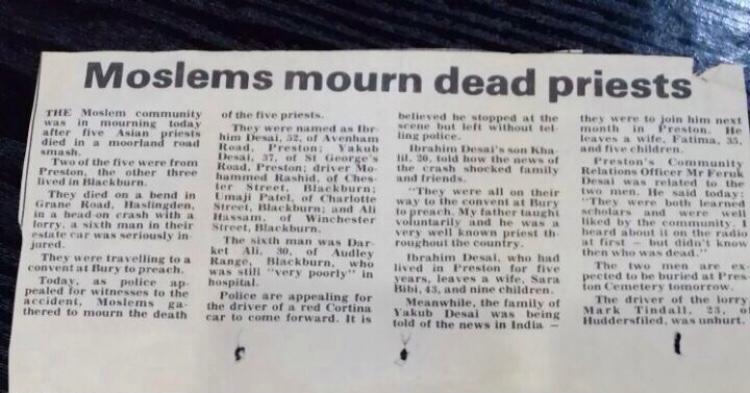
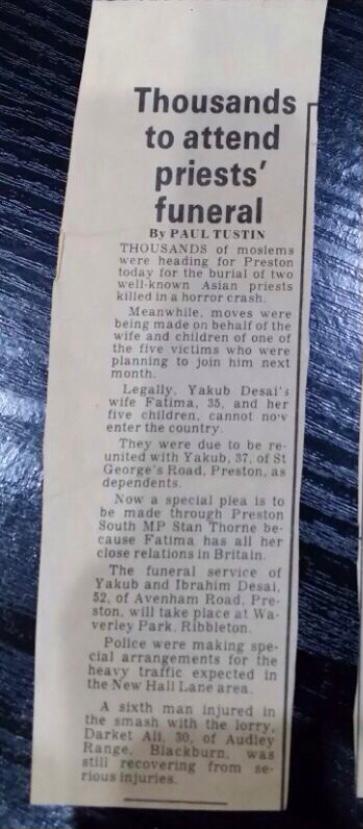
25th November 1980, five Ulama became Shaheed in a fatal car accident:

Mawlana Ibrahim Desai Saheb RH

Mawlana Yakoob Desai Saheb RH

Mawlana Ali Hassan Saheb RH

Mawlana Umarjee Saheb RH

Abdul Rashid Bhai (Driver) RH

Bayaan (Urdu) in Darul Uloom Chatam, Ontario, Canada.

Wednesday 25th July 2018, by Sheikhul Hadith Hadhrat Mawlana Yusuf Motala Saheb (RH)

Yaqoob Desai, who is a Mishkat student at this Darul Uloom [Chatam, Ontario Canada], and his paternal grandfather and other teachers used to travel from Preston to Darul-Uloom [Bury] daily in a car […] their arrival time used to be 9am, and at times they would either arrive five minutes early or five minutes late.


[One day] they didn’t arrive on time and we [Sheikhul Hadith Hadhrat Mawlana Yusuf Motala Saheb (db)] grew worried as to ‘what has happened?’ We rang their home but they didn’t have any clear explanation. However; after one and a half hours we were made aware of the tragic news that the car had been involved in an accident – all the passengers in the car, including the Ulama, the teachers and also the driver, had ALL been martyred!


His [Yaqoob Desai’s] paternal grandfather Mawlana Mohammed Yaqoob Saheb (ra), who was my true friend, also achieved martyrdom. […] 
After the accident and when the Janazah of his paternal grandfather was lifted and taken to the graveyard, firstly, the Janazah of Hadhrat Mawlana Ibrahim Desai Saheb was placed and behind it Moulana Yaqoob Saheb’s Janazah was placed (Janazah Salah led by Hadhrat Mawlana Qari Tayyab Saheb RH).


After the burial, a young man who was from the Kazi Family approached me and spoke, “When the two Janazah was placed on the ground I see [a spiritual vision] that Hadhrat Mawlana Ibrahim Desai Saheb moved the lid of his coffin, opened the lid and placed the lid back on the coffin and he then sat down on top of it.” 


He [young man] is seeing all this whilst awake, and all around there are thousands of Muslim people, who participated in the burial, yet none of these people see anything – he; however, is witnessing this!
[He young man continued] “I then see Mawlana Yaqoob Saheb, and he also opens the lid and places the lid back on, he then sits on top of it – both [deceased] have a pamphlet in their hands …!”

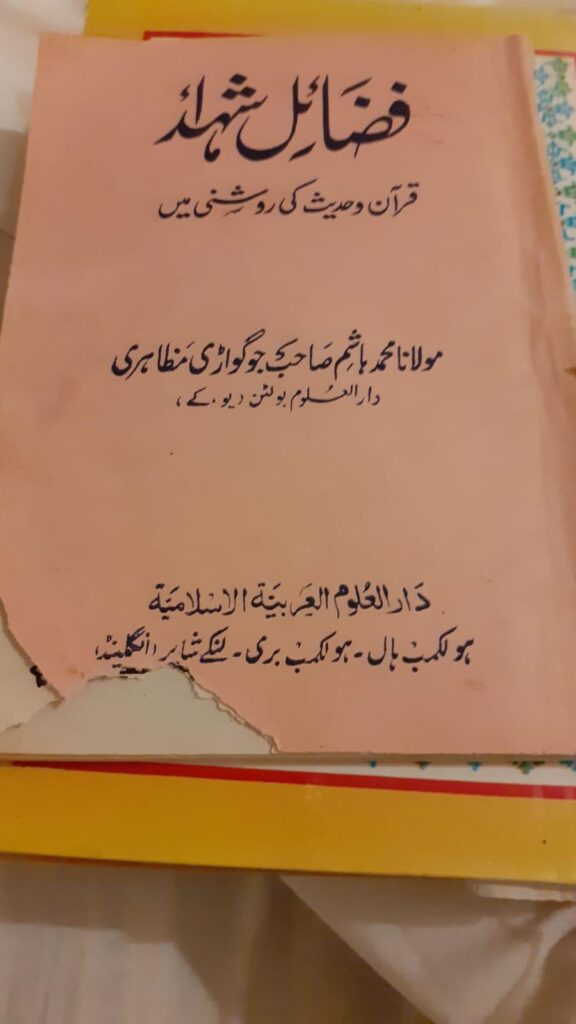
Virtues of Martyrs, by Hadhrat Mawlana Hashim Saheb (Allah preserve him)


We had a pamphlet titled ‘Martyrs of Darul-Uloom,’ consisting of 6 or 7 pages, printed on behalf of the Darul-Uloom which highlighted who these [scholars] people were, where they were from, what responsibilities they had, what knowledge they possessed and their characteristics were all mentioned.


[He young man continued] “Both [deceased] are passing it [pamphlet] to one another whilst smiling and saying, ‘Look, what they’ve written about us?”     

Categories
Current Affairs articles

Forty Hadith on Plagues and Epidemics

To proceed,

The tradition in Muslim religious literature of gathering collections of forty Hadiths dates as far back as the first century after the Hijrah. Abdullah ibn Mubarak al-Marwazi (Allah have mercy on him) is thought to be the first to have gathered forty Hadith in a collection. Perhaps the most well-known collection is that of Imam an-Nawawi (Allah have mercy on him), which has been translated into English, and on which there are several commentaries.

The practice of gathering forty Hadiths springs from a Hadith, narrated through several Companions, which puts the spiritual rank of religious scholarship within easy reach of the ordinary believer: “Whoever memorises forty narrations for my nation in matters of this religion, Allah will raise him up a scholar and I shall be an intercessor and witness for him on the Day of Rising.”

Allah make us from them.

Ismail ibn Nazir Satia (one who is in dire need of Allah’s forgiveness, mercy and pleasure)

15 Shaban 1441

Categories
Miscellaneous

Masa’il of Sitting on a Chair to Pray Salah

  1. If a person is ill or excused (mazoor) to the extent that he is unable to pray his full salah standing up with complete ruku and sujood, then he should stand up for the duration or for the number of rakats he has the power and strength to do so. Thereafter, when is unable to stand up, he should complete his salah sitting down with ruku and sujood
  2. If an ill person or excused person is such that he doesn’t have the strength to pray salah standing up, however, he is able to pray salah sitting down with complete ruku and sujood, then it is necessary for him to pray his salah sitting down on the ground with complete ruku and sujood. If such person prayed his salah on a chair, then his salah will be invalid because he is able to perform sujood completely, but on the chair, he will be missing it out and sajdah is a fardh act; salah is invalid by missing out a fardh act.
  3. If an ill or excused person is such who is unable to perform sujood on the ground, however, he is able to pray his salah sitting down on the ground, the ruling for such person is that he will pray salah sitting down on the ground and perform sajdah by gestures. Such a person has an option of praying salah on the chair. But it is more preferable for him to pray salah sitting down on the ground as this is much closer to show servitude and that is more rewarding.
  4. The ill and excused person is such that he cannot pray his salah sitting down on the ground, so then it is permissible for him to pray the full salah on a chair.

Approved by Mufti Ikramul Haq Saheb, Teacher at Jamiatul Ilm Walhuda, Blackburn

Categories
Current Affairs articles

LANTERNS OF GUIDANCE (33) NOTHING IS COINCIDENTAL

Hadhrat Mufti Muhammad Taqi Uthmāni Sahib حفظه الله has shared the advice of his illustrious father Hadhrat Mufti Muhammad Shafee Sahib رحمه الله who used to say; “It is wrong to say (as people often exclaim) that it was a ‘coincidence’ because nothing in this world was a coincidence.” Everything happens as Allah Ta’ala جل جلاله desires it to happen. It is our habit to describe anything we do not expect as a coincidence. The fact is that Allah Ta’ala جل جلاله is the Master and Creator of this universe; He جل جلاله maintains and sustains it and everything happens as He جل جلاله wishes. Nothing can happen against His جل جلاله desire.
Hadhrat Mufti Muhammad Taqi Uthmāni Sahib حفظه الله states that we must not rely on our plans and strategies but the underlying factor is that we must have faith in مسبب الاسباب – Allah Ta’ala جل جلاله is the Preparer of means or causes.
REFLECTIONS: TURN TO ALLAH TA’ALA جل جلاله
Hadhrat Mufti Muhammad Taqi Uthmāni Sahib حفظه الله has stressed that we turn to Allah Ta’ala جل جلاله in our duaas. Even if we have the means and power, we are compelled to turn to Allah Ta’ala جل جلاله. We are forgetting to turn to Allah Ta’ala جل جلاله.
Hadhrat Mufti Muhammad Taqi Uthmāni Sahib حفظه الله has said that when Pakistan was created, there was great turmoil. At that time, the houses of the Muslims reverberated with the Āyate Kareemah:
لا اله الا انت سبحانك اني كنت من الظالمين
There was no appeal for anyone to recite this duaa but rather it was a spontaneous response from the Muslims. Even the women made duaa excessively for the welfare of the Muslims. The result was that Allah Ta’ala جل جلاله saved the Muslims.
But let us examine the turmoil today. We witness murders before our eyes but we are unmoved and we do not turn to Allah Ta’ala جل جلاله. There is no concern for duaa and we do not hear of any household that is making a practice of duaa daily. On the contrary, Muslims stay in their homes in negligence tied down to their televisions (in the current scenario, being absorbed by social media). In the prevailing circumstances, are we not inviting the punishment from Allah Ta’ala جل جلاله? We are not willing to desist from transgression.
For the sake of Allah Ta’ala جل جلاله, let us have mercy on ourselves. Turn to Allah Ta’ala جل جلاله; every Muslim can do it. Let us each offer two rakaats Salatul Hajah (for the fulfillment of our needs). This will take two to three minutes. Thereafter, make duaa for three minutes. Please! Let us give the suffering Ummah five minutes of our time daily. Can we not stand before Allah Ta’ala جل جلاله and implore Him جل جلاله for mercy and favourable conditions? If we cannot sacrifice a few minutes, then what right do we have to say that we are saddened by the pitiful plight of the Ummah?
It is essential that we make a daily practice of Salatul Hajah. Furthermore, let us be a source of mercy to ourselves and the Ummah by removing the objects of disobedience in our homes. For the sake of Allah Ta’ala جل جلاله, let us give up sins! Make it a habit to weep before مسبب الاسباب and recite the Āyate Kareemah:
لا اله الا انت سبحانك اني كنت من الظالمين
Also let us repeat يا سلام repeatedly imploring Allah Ta’ala جل جلاله for peace and security.
ayat-kareematasbeeh-yunus2
Instead of wasting our time on futile discussions, the need of the hour is to turn to Allah Ta’ala جل جلاله. May Allah Ta’ala جل جلاله grant each one of us the ability to fortify our ta’alluq with Him جل جلاله and invite peaceful circumstances through acts of obedience.
آمين يارب العالمين
Categories
Poems

WORDS as sharp as sWORDS ⚔️

1-1-Cosplay-Free-Shipping-Sword-Movie-Lord-of-The-Rings-The-Hobbit-Frodo-Baggins-72cm.jpg_220x220.jpg
Words can be sharp, as sharp as a sword,
Sometimes we need to let them out because of the stuff we hoard.
But before you speak, take my advice on board,
Think before you speak, think of your Lord.
Don’t let your words out loosely, like marbles rolling down the road,
The cost of such a tongue is astronomical, one which you can’t afford.
When you speak, speak clearly, not like deciphering a code,
Some murmur and mutter, like they’re in sleep ? mode!
Using hurtful words can sometimes strike a chord,
They may get you in trouble or attract a nasty horde (a crowd).
We all make mistakes and we are all flawed,
We need to ensure before we wag our tongues our words are pored (examined).
If you have nothing good to say, keep your lips ? sewed,
Don’t let your words out, let them be stored.
Otherwise, on Qiyamah you will carry a heavy load,
Because words can be sharp, as sharp as a sWORD!?
Audio: https://www.youtube.com/watch?v=ejFLIy2Atx8
Sword_topNteaser
Ismail ibn Nazir Satia (one who is in dire needs of Allah’s forgiveness, mercy and pleasure).
19 Rabiul Awwal 1440
Categories
Current Affairs articles

ADVICE FROM BAGHDAD REGARDING OUR MADARIS

بسم الله الرحمن الرحيم

Hadhrat Mufti Muhammad Taqi Uthmani (  حفظه الله ) has written regarding his journey to Baghdad:
baghdad
“Baghdad is that city which for centuries had been at the center of the Islamic world. The mere sight of this city reminds one of the glorious days of the Abbāsi khilāfat.
Upon reaching Baghdad I enquired whether there were any Madāris (seminaries) present in which Islamic knowledge is imparted in accordance with the ways of the pious predecessors.
I was informed that all such Madāris had now been converted into schools and universities. Now, the knowledge of Deen can only be attained from university faculties, such places wherein Islam is taught as mere theory, similar to ancient philosophy. Islam can neither be seen in the lives of the students nor in the Ustādhs (teachers).  Forget bring religious scholars, on seeing their appearance, one wonders if they are even Muslim.
“This is just like how orientalists study Islam today, in the universities of America, Canada, and Europe. If you read their books and articles you will come across the names of such books that many of our Ulamā have never even heard about. It seems as if deep tahqīq (research) is being made. But [sadly], in spite of swimming in the ocean of Islamic knowledge from morning till evening, they return dry as bone. No effect of what they rigorously study can be seen in their lives. The soul of this knowledge has been destroyed. “
Mufti Taqi Uthmani thereafter asked if they could at least direct him to an Ālim (scholar) of the old school of thought, so that he could present himself at his service.
He was directed to a Masjid close to the tomb of Shaykh `Abd al-Qādir al-Jīlani (رحمة الله ), in which was a Maktab.
Here he met an old pious-looking man. Mufti Taqi Usmani described his meeting with him in the following words:
“On seeing him, I felt as if I was in the presence of a pious Allah-fearing Ālim. He was sitting on a straw mat, dressed in coarse clothing, and eating dry bread. The light of the Sharī`ah could be discerned on his forehead.
“After making salaam, he enquired regarding my name and the place from which I had come. He also asked about the condition of the Madāris of our country, their syllabus, and the manner in which the kitābs (books) are taught.
Tears flowed from his eyes as I mentioned the names of the kitābs found in the Dars-e-Nizami syllabus [the syllabus used by Islamic seminaries across the Indian subcontinent].
He asked, “Are these kitābs still being taught!?”
“I replied in the affirmative. He then explained, ‘Today, we have been deprived of even hearing the names of these kitābs.
These kitābs create Allah-conscious men, they create true Muslims. In our country these books are no longer taught.
I beg you to convey this message of mine to the Ulamā and the masses of your country, that for the sake of Allah عز و جل , they should bear everything , but should never allow the destruction of such Madāris wherein these kitābs are taught!’ ”
The enemies of Islam are fully conscious of the fact that as long as these simple Mawlānas, sitting on straw mats, are present in society, they cannot remove Īmān (faith) from the hearts of the Muslims.
Therefore the enemies of Islam are making all out effort to remove these Madāris.
iraq