Categories
Shaykh Saleem Dhorat

Importance of Small Deeds


By Hadrat Mawlānā Muhammad Saleem Dhorat hafizahullāh

The aim and objective of every believer is to acquire the Pleasure of Allāh ta‘ālā, and for that one has to carry out good deeds. These good deeds fall into two categories:fard(obligatory) and nafl (optional). Non-compliance with the obligatory deeds will leave a believer sinful; therefore, priority has to be given to the obligatory commands. But, together with this, an ardent effort needs to be made to perform as many optional deeds as possible.

The Prophet sallallāhu ‘alayhi wasallam says in a hadīth qudsīyy that Allāh ta‘ālā says:

“My servant does not get proximity to Me with anything more beloved to Me than what I have made compulsory upon him. Thereafter, he continues to gain proximity to Me by performing optional deeds, until I love him.” (Al-Bukhārī)

From this hadīth we understand that in order to acquire maximum proximity to Allāhta‘ālā and become His beloved, together with carrying out the obligatory actions, we need to go beyond and perform the optional deeds; then only will we become the beloved of Allāh ta‘ālā. It is therefore of utmost importance that we take the whole package and, whilst carrying out the obligatory deeds, try our utmost to carry out as many optional deeds as possible.

One should, upon seeing his/her weakness in performing obligatory actions, never feel that there is no benefit in performing optional actions. This is an incorrect mindset, as deficiencies in, or lack of obligatory deeds on the Day of Qiyāmah can somewhat be made up through optional devotions. The Prophet sallallāhu ‘alayhi wasallam said:

“Indeed, the first action that will be judged by Allāh on the Day of Judgement shall be Salāh. Our Lord, the Great, the Mighty, despite knowing, will say to the angels, ‘Check my servant’s account (for his Salāh); did he complete it or leave it incomplete?’ If it is complete, then it will be written as such. And if it is found lacking, then Allāh will say, ‘Check if my servant has any optional Salāh in his account. If he has optional Salāh, then complete his obligatory Salāh with this and then reckon him on this deed.’” (Abū Dāwūd)

Similarly, another benefit of performing optional actions, whilst being weak in obligatory actions, is that the nūr (light) created in the heart by these actions will make the heart healthy making obligatory actions easy to perform. Therefore, any small action should not be undermined or underestimated, as one is not aware of the spiritual effect it will have on the heart.

Moreover, many times optional actions which seemed trivial at the time become the means of Allāh ta‘ālā’s forgiveness. We have the famous story of the transgressing woman who upon seeing a thirsty dog gave it water to drink. On account of this one deed Allāh ta‘ālā forgave her and entered her into Jannah. (Al-Bukhārī) Similar is the story of the man who cut a branch from a tree which was hindering people who used that path. The Prophet sallallāhu ‘alayhi wasallam mentioned that he had seen the man strolling in Jannah on account of this deed. (Muslim)

Another important point to keep in mind regarding this is that any action, big or small, should be carried out as soon as the thought of performing it comes to mind. These thoughts to do good are like noble guests. If they are not entertained, they will not return.

Finally, with regards to optional deeds, we see people going to two extremes. Firstly, we have those who when hearing of incidents such as those quoted above about the dog and the branch, become complacent. They think that they have done many such optional deeds and helped many people, so they will most definitely go to Jannah! This is definitely not the correct mindset. Rather, the correct way to look at such incidents is to think that the person in the incident was fortunate. Take the example of a person who escapes a fine from the police for doing something wrong, this does not mean that another should also do the same because he too will escape in the same way! We should therefore continue performing as many deeds as possible. The other extreme people go to is thinking that they are so stooped in sin that a small optional deed will do no good for them whatsoever. This is also incorrect, for no matter how sinful a person may be, every good deed, even if it is the mere saying of subhānallāhor alhamdulillāh, will definitely be beneficial in one way or another.

It is therefore important that we do the utmost to maximise our good deeds with the intention of seeking the attention of Allāh ta‘ālā. If we do, then, inshā’allāh, Allāhta‘ālā will grant barakah in our actions and we will soon find ourselves practicing the whole Dīn, performing both the obligatory and optional acts. May Allāh ta‘ālā grant us the tawfīq.

© At-Tazkiyah


• Please forward this message on to all your contacts •
Categories
Du'aas

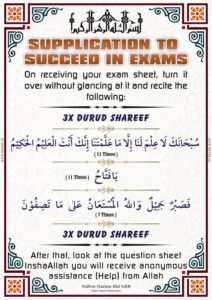
Du’a for Exams: GCSEs/A-Levels/Alim Class

Bismillahir Rahmanir Rahmeem

As exams kick off this week around the UK, we often get asked for Du’as to help and ease exam pressure. Here is one I have personally read and  found beneficial:

اللّهُـمَّ لا سَهْلَ إِلاّ ما جَعَلـتَهُ سَهْلاً وَأَنْتَ تَجْعَلُ الْحَزَنَ إِذا شِئْتَ سَهْلاً

O Allah, there is no ease except in that which you have made easy and you make the difficult, if You wish, easy. [1]

P.S. One should read with conviction and certainty. Also, offer two Rak’ah Salatul Hajah before the exam. It can be the night before or the day before, not necessarily the morning of the exam.

 [1] Sahih Ibn Ḥibbān (974);

‘Amal al-Yawm Wal-Laylah (351).

Ismail Ibn Nazir Satia (One who is in dire need of Allah’s forgivene

ss, mercy and pleasure)

12 Shaban 1437

Exam and Revision Tips by an Integrative Counsellor & Psychotherapist | Mufti Ismail ibn Nazir Satia

Categories
Ruqya

Black Magic and Satanic Possession

black-magic-moon

Praise be to Allah,

People who have had experience with such situations have related that the following are among the signs of a person who is possessed by jinn (or Satan):

Strong repulsion when hearing Qur’an or Adhan (call for prayers).

Episodes of losing consciousness and/or epileptic attacks, especially when Qur’an is recited for the possessed person.

Frequent nightmares during sleep.

Tendency to avoid people accompanied by out-of-the-norm behavior.

The jinn who possesses him might speak when Qur’an is recited for the possessed person.

Madness, as stated in the Qur’an (interpretation of the meaning): “Those who devour usury will not stand except as stands one whom Satan by his touch hath driven to [epileptic] madness…”2:275

Shaykh Muhammad Ibn Saleh al-‘Uthaymīn—رحمه الله—said:

“ينبغي على الإنسان أن يستعين بالله عز وجل في كل شيء حتى في الأمور الصغيرة : كالذهاب والمجيء والأكل والشرب واللباس. حتى يكون بذلك مدركاً لحاجته متعبدا لربه عز وجل لأن الاستعانة من العبادة وإذا استعان العبد بربه يسر له الأمر وسهله عليه.”

“It’s befitting for man to seek assistance with Allāh—عز وجل—in everything—even in the small matters like leaving to and from [somewhere], eating, drinking and dressing—so that with this, he can fulfill his need AND worship his lord—عز وحل. Because al-Isti’ānah (seeking assistance) is from the acts of worship and if the slave seeks assistance from his lord, He (Allāh) will facilitate the matter for him and make it easy.”

Ahkām Min al-Qur’ān al-Karīm, 1/3

As for a person struck by magic, he might experience the following:

Dislike of one’s spouse, as indicated in the Qur’an by the following verse (interpretation of the meaning): “And from these (angels) people learn that by which they cause separation between a man and his wife…” (Al-Baqarah, 2:102).

Different attitude in the house from that which is outside the house. For example, a person will feel that he is missing his family when is outside the house but when he goes home, love changes quickly to extreme hatred.

Inability to have sexual intercourse with one’s spouse.

Frequent miscarriage for pregnant women.

Sudden change in behavior without obvious reason.

Complete loss of appetite for food.

Thinking or imagining one has done something when in reality one has not.

Sudden obedience and/or love for a particular person.

It should be noted that if a person experiences some of the above symptoms this does not necessarily mean that he is either possessed by a jinn or struck by black magic. It might be due to physiological or psychological reasons.

As for curing this condition, the following steps are recommended:

Putting one’s trust in Allah with the sincere belief that He is the only cure for everything.

Reading Qur’an and known supplications expressing seeking refuge, the most important and effective of which is surah 113 and 114, Al-Falaq and Al-Naas, which were used to cure the Prophet himself. Surah 112, Al-Ikhlas, is recommended along with them, as well as the opening chapter of the Qur’an, Al-Fatihah. To cure black magic some have successfully used seven lotus-tree leaves. The leaves should be crushed, then mixed them with water enough for taking a bath. The following verses from the Qur’aan are then recited: verse Al-Kursi (2:255), surah Al-Kafiroon (109), surah 112, 113, 114; the verses which mention magic, which are: in surah Al-Baqarah (2:102), Al-A’raf (7:117-119), Yunus (10:79-82), and Taha (20:65-69). The possessed person drinks some of the water, and the rest is used to give him a bath.

Removing the elements of magic as was done by the Prophet SAW when he was struck by black magic by a Jewish man called Lubaid Bin Al-‘Aasim.

Eating seven Aa’liya Al-Barniy dates (among the dates of Al-Madinah) first thing in the morning; if not possible, any dates will suffice, by the will of Allah.

Cupping – removing excess blood.

Supplications/Duas.

And we ask Allah to cure you and ease your hardship, as He is the One who cures and there is no one else who can cure. Ameen

Categories
Poems

Two swords: Of Flesh & Of Steel.

In the name of Allah, the Just

.IMG-20121124-WA006

The truth is the truth; right is right,
To me it is clear – black and white.
At times you feel odd and at times you feel alone,
Tired, troubled and torn.

You may not seem intelligent or even very bright,
But speaking the truth will raise you in Allah’s sight.
It may cause a dispute; it may end up in a fight,
As the truth is bitter and certainly not welcomed with delight.
Sometimes you feel scared and just want to run,
But remember – that’s the cowards way, son.
You’d rather speak with courage and great might,
Go on, give them a fright! They might understand, this matter isn’t light.

We must use our intellect and insight,
To stick up for the truth and keep our left shoulder light.
As the dazzling day ends followed along by the dark night,
Similarly, it is clear what is wrong and what is right.

So dear friend, as I now end,

I hope my words didn’t bite, this is my last and final plight….

Please, stand firmly for truth and for justice and for what is right.

Ismail ibn Nazir Satia (One who is in dire need of Allah’s forgiveness, mercy and pleasure)

18 Safar 1436

(Written in memory of my late father, Haji NazirAhmed Daud Satia RH, one year after his demise. I believe he taught me courage, justice, morals, values and principles – Alhumdu Lillah. Out of sight, but not out of mind, Abba. Your voice has left us, but your legacy of justice remains In Sha Allah).

Categories
Dhulm/Oppression

Dhulm: Oppression or Depression?

In the Name of Allah the Most Beneficent, the Most Merciful.

IMG-20121124-WA006

All praise is due to Allah, the all-knowing, the all-seeing and we beseech Allah to send His noblest blessings on the Seal of the Prophets, Our Master and Prophet Muhammad (Sallallaho Alayhi Wasallam).

The first crime or sin we could say, committed on the surface of the earth was perpetrated by the son of the noble Prophet Adam (peace be upon him) whose name was Qabil RH. As it is known, the sin he committed was no ordinary sin; it was none other than murder and what degree of murder could be worse than murdering a family member, his own blood brother, Habil RH. So ever since that day, every person that gets killed unjustly, the burden of the sin not only falls on the killer, but also on Qabil RH as he initiated killings.

In this worldly life, we see many forms of oppression, and Almighty Allah allows this oppression. Many people, Muslim and Non-Muslim ask why? It is NOT because Allah is pleased to see his servants committing ‘dhulm’ , rather it is something termed as ‘al-Istidraaj’. Something you could loosely explain as Allah loosening the rope and giving respite to stop and repent. It is when Allah Almighty gives fortunes to someone despite Him not being pleased with him/her. Our Holy Prophet (peace be upon him) explained in a Hadith (Prophetic Tradition), “When you see that Allah Almighty gives good fortunes to his slaves who are always committing sins (disobedient), know that the person is being given istidraj by Allah.” (At-Tabrani, Ahmad and Al-Baihaqi)

However, it is the duty of others to stop dhulm as is explained in the Prophetic Tradition (Hadith),“Help your brother; be he the oppressor or the oppressed.” It was said, “O Messenger of Allah, I shall help him if he is oppressed but how do I help him if he is the oppressor?” He said:”Prevent him from oppression, that is you helping him.” Bukhari and Muslim.

But what exactly is oppression? It is normally termed for what goes on in war and when one takes another’s right. The literal meaning of al-Dhulm is, ‘to place something somewhere it does not belong’. For example, if one were to place his shoe on his head that would be classed as al-Dhulm as that is not the correct place for the shoe. But dhulm (oppression) in Islam has a much broader and deeper meaning. We only need to pick up a newspaper or turn on the television to see the oppression that goes on around the world, the young children suffering, the babies dying, women as well as the elderly tortured and their menfolk beaten and humiliated in front of them – the world accepts this as wrong, no matter which creed or race you are from and no matter which religion you follow.

But what I would like to shed light on is the dhulm you and I may commit; even though we would never like to be associated with dhulm or be called a ‘dhalim’ (oppressor), but sometimes we do commit oppression knowingly,or unknowingly.  Because oppression is not just what we see in Gaza or Syria, oppression is also what goes on here, in the UK; a man who beats his wife is oppression or vice versa, not treating your children fairly and equally is oppression, to show ingratitude and display disobedience to your parents is oppression, to deprive a sibling of their rights to inheritance is oppression, bullying and harassing someone weaker than you in school or college or at a workplace is oppression, taking one’s anger out on an innocent individual is oppression, showing favouritism at a work place to certain employees due to unjustified reasons such as family connections, being from the same race or same sex (sometimes the opposite sex simply because they are attractive) is oppression, being ungrateful to your spouse or not spending time with him/her is oppression, not letting a father see his child without a valid reason is oppression, to cast jealousy and perform black magic on people is oppression and relaying lies or slandering someone out of jealousy and spite is oppression! The list really can go on, unfortunately.

The very sad reality is oppression is everywhere and for many of us, our hearts bleed because others cause us to bleed. Usually it is those closest to us; a family member or a relative. Hence the title of this article has been named, ‘Dhulm: Oppression or depression?’ despite the fact dhulm is normally translated as oppression it can consequently ‘lead’ to depression. And this is what we see when we look around the world; people are either suffering from oppression or depression, they are either bleeding or weeping! My little message to every brother to every sister out there who is suffering, be it equal to a prick of a thorn or the weight of a mountain, “DO NOT DESPAIR IN THE MERCY OF ALLAH!” (39:53). “Indeed, Allah is with the patient ones” (2:249). We are promised time and again in Qur’an and Hadith that Allah will give us justice for the oppression we face in this world and the injustices we have  to endure. Abu Hurayrah reported that the Prophet (Allah bless him and grant him peace) said, “Give people their rights. Even the hornless sheep will take retaliation from the horned sheep (on Qiyamah)” (Adabul Mufrad).

Nothing is hidden from Allah, not even the black ant crawling on a stone in the darkness of the night nor its footprint! Let oppressors think not that Allah is unaware! Allah Almighty says, “And never think that Allah is unaware of what the wrongdoers do. He only delays them for a Day when eyes will stare [in horror]” (14:42). In another verse, “And those who have wronged are going to know to what [kind of] return they will be paid back” (26:227). And to serve as a final reminder and warning, Jabir ibn ‘Abdullah reported that the Prophet (Allah bless him and grant him peace) said, “Fear injustice. Injustice will appear as darkness on the Day of Rising. Fear avarice. Avarice destroyed people before you and led them to shed one another’s blood and to make lawful what was unlawful for them” (Adabul Mufrad).

To conclude In Sha Allah, we pray Allah protects us from committing dhulm and from being the victims of dhulm, as well as giving us the ability to help the oppressed and stop an oppressor, as the saying goes, ‘Evil spreads not because of the violence of bad people, rather because of the silence of good people’ .

Ismail Ibn Nazir Satia (In dire need of Allah’s mercy, forgiveness and pleasure).

27th Shawwal 1435