Categories
Muslim men

How smoking causes cancer


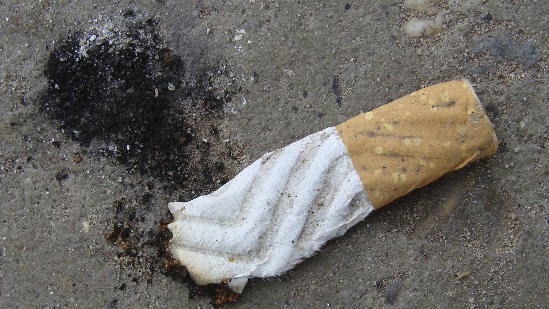
Butted out cigarette

Smoking is by far the biggest preventable cause of cancer. Thanks to years of research, the links between smoking and cancer are now very clear. Smoking accounts for more than 1 in 4 UK cancer deaths, and nearly a fifth of all cancer cases.

The good news is that many of these deaths are preventable, by giving up smoking. Speak to your GP or pharmacist, or visit the NHS Smokefree(link is external) pages for free advice and support to give you the best possible chance of quitting.

Which cancers are caused by smoking?

Chemicals in cigarette smoke enter our blood stream and can then affect the entire body. This is why smoking causes so many diseases, including at least 14 types of cancer, heart disease and various lung diseases.
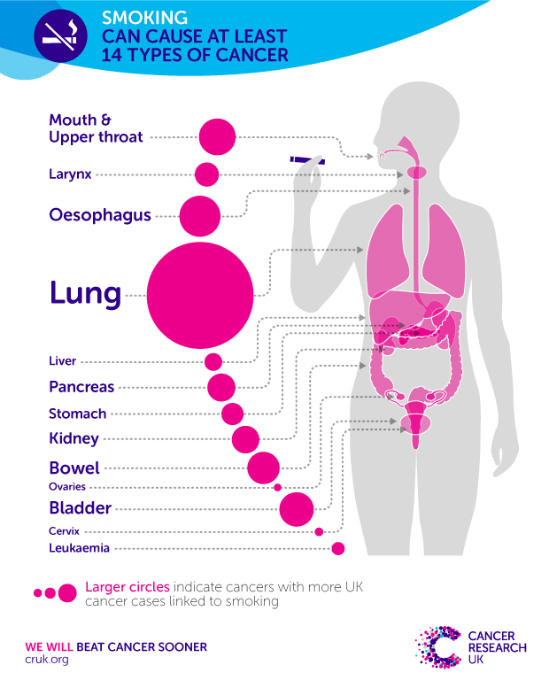
cancers caused by smoking

Smoking causes more than 4 in 5 cases of lung cancer. Lung cancer has one of the lowest survival rates of all cancers, and is the most common cause of cancer death in the UK.

Smoking also increases the risk of at least 13 other cancers including cancers of the mouth,  pharynx (upper throat), nose and sinuses, larynx (voice box), oesophagus (gullet or food pipe), liver, pancreas, stomach, kidney, bowel, ovary, bladder, cervix, and some types of leukaemia Smoking could increase the risk of breast cancer, but any increase in risk is likely to be small.

More information about different cancer types.

What influences the risk of cancer from smoking?

Smokers have a much higher risk of lung cancer than non-smokers, whatever type of cigarette they smoke. There’s no such thing as a safe way to use tobacco.

Filters and low-tar cigarettes make little difference – your lung cancer risk is not lower compared to smokers of average cigarettes. This may be because smokers tend to change the way they smoke in order to satisfy their nicotine craving, for example by taking bigger puffs or smoking more cigarettes.

The more cigarettes you smoke a day, the higher your risk of cancer. If you aren’t able to quit completely, cutting down the number of cigarettes you smoke a day can be a good first step. Even light or social smoking can harm your health so keep trying to stop entirely.

Scientists have found that the number of years you spend smoking affects your cancer risk even more strongly than the number of cigarettes you smoke a day. For example, smoking one pack a day for 40 years is even more dangerous than smoking two packs a day for 20 years.

The serious damaging effects of smoking cannot be cancelled out by leading an otherwise healthy lifestyle, like keeping fit and eating healthily. The best way to reduce your risk is to give up smoking completely(link is external).

How does smoking cause cancer?

The main way that smoking causes cancer is by damaging our DNA, including key genes that protect us against cancer. Many of the chemicals found in cigarettes have been shown to cause DNA damage, including benzene, polonium-210, benzo(a)pyrene and nitrosamines.

This is already bad news, but it’s made worse by other chemicals in cigarettes. For example chromium makes poisons like benzo(a)pyrene stick more strongly to DNA, increasing the chances of serious damage. And chemicals like arsenic and nickel interfere with pathways for repairing damaged DNA. This makes it even more likely that damaged cells will eventually turn cancerous.

Smokers are also less able to handle toxic chemicals than those with healthy lungs and blood. Chemicals in cigarette smoke make it harder for smokers to neutralise or remove toxins, and can make their immune systems less effective too.

How long does it take for smoking to cause cancer?

It usually takes many years, or decades, for the DNA damage from smoking to cause cancer. Our bodies are designed to deal with a bit of damage but it’s hard for the body to cope with the number of harmful chemicals in tobacco smoke. Each cigarette can damage DNA in many lung cells, but it is the build up of damage in the same cell that can lead to cancer. However research has shown that for every 15 cigarettes smoked there is a DNA change which could cause a cell to become cancerous. This is why it’s better to give up smoking sooner rather than later.

http://www.cancerresearchuk.org/about-cancer/causes-of-cancer/smoking-and-cancer/how-to-stop-smoking


Breathing in other people’s smoke, also called second-hand smoke, can cause cancer. Passive smoking can increase a non-smoker’s risk of getting lung cancer by a quarter, and may also increase the risk of cancers of the larynx (voice box) and pharynx (upper throat).

Second-hand smoke can cause other health problems too. Every year, second-hand smoke kills thousands of people in the UK from lung cancer, heart disease, stroke and the lung disease Chronic Obstructive Pulmonary Disease (COPD).

How does second-hand smoke affect children?

Second-hand smoke is particularly dangerous for children. Children exposed to passive smoke are at higher risk of respiratory infections, asthma, bacterial meningitis and cot death. Second-hand smoke has been linked to around 165,000 new cases of disease among children in the UK each year.

For children, the majority of exposure to second-hand smoke happens in the home. Smoke can spread throughout the home, even if you open the windows. Almost 85 percent of tobacco smoke is invisible and smoke particles might also build up on surfaces and clothes, although the impact of this is not yet clear. If you are a smoker, smoking outside can help reduce your child’s exposure.

Is smoking in cars bad for passengers’ health?

Second-hand smoke can reach very high levels inside cars because it is a small enclosed space.

During your journey, children in the backseat will be exposed to average smoke levels around three times the European recommended air pollution limit. But the level varies depending on how much you smoke, if you have all the windows fully open or air con on. Peak levels can reach as much as 35 times this limit.

Since 1 October 2015 it has been an offence to smoke in a vehicle carrying anyone under the age of 18 in England(link is external) and in Wales(link is external).

Does second-hand smoke contain dangerous chemicals?

There are 2 types of tobacco smoke:

  • Mainstream smoke, which is directly inhaled through the mouth end of the cigarette
  • Sidestream smoke, which comes from the burning tip of the cigarette

Second-hand smoke is made up of sidestream smoke and exhaled mainstream smoke, mixed with the surrounding air.

Sidestream smoke is about 4 times more toxic than mainstream smoke, although people inhale it in a more diluted form. This is because sidestream smoke contains much higher levels of many of the poisons and cancer-causing chemicals in cigarettes, including:

  • At least 3 times as much carbon monoxide
  • 10-30 times more nitrosamines
  • Between 15–300 times more ammonia

What’s in a cigarette?
 

You may think a cigarette is just tobacco wrapped in paper, but it’s much more than that. When a cigarette burns it releases a dangerous cocktail of over 5,000 different chemicals. Many of these chemicals are poisonous and more than 70 may cause cancer, according to the International Agency for Research on Cancer (IARC). And it’s not just the smoker who is exposed to these chemicals, because there are also high levels in the smoke coming off the tip of a cigarette while it burns. So anyone around the smoker breathes them in as well.

This page has information on some of the poisons in cigarette smoke that we know are linked to cancer. To learn more about the impact of these chemicals in the body, see our How smoking causes cancer page.

Chemicals can get into cigarettes in different ways. Some are found naturally in the tobacco plant, some are absorbed by the plant from the soil, air or fertilisers, and some are formed when tobacco leaves are processed or are added by the tobacco industry. Others form when a cigarette burns, so are only present in the smoke coming off a cigarette.

What's in a cigarette?

Many of the cancer-causing chemicals in tobacco and cigarette smoke have other suprising uses too:

  • Benzene – an industrial solvent, refined from crude oil
  • Arsenic – a poison, used in wood preservatives
  • Cadmium and lead – used in batteries
  • Formaldehyde – used in mortuaries and paint manufacturing
  • Polonium-210 – a highly radioactive element
  • Chromium – used to manufacture dye, paints and alloys
  • 1,3-Butadiene – used in rubber manufacturing
  • Nickel – used to protect metals from corrosion
  • Vinyl chloride – used to produce plastic and vinyl products
  • Beryllium – used in nuclear reactors
  • Ethylene oxide – a disinfectant used to sterilise hospital equipment
  • Polycyclic aromatic hydrocarbons – a group of dangerous DNA-damaging chemicals, including benzo(a)pyrene
  • Ortho-Toluidine – used in the production of weedkillers
  • 4-aminobiphenyl and 2-naphthyl-amine – used in dye manufacturing until it was banned in the EU

And then there are tobacco-specific nitrosamines – a group of cancer-causing chemicals only found in tobacco.

This cocktail of chemicals is why there is no safe way to use tobacco and the best thing a smoker can do for their health is to stop smoking completely.

The free Stop Smoking Services help thousands of people quit every year, so if you are looking for the best possible chance of success, talk to your doctor or pharmacist or visit NHS Smokefree(link is external).

Shisha and other types of tobacco


paan with tobacco

Tobacco can be used in many different forms – but all are linked to cancer. There is no safe way to use tobacco.

Other tobacco products aren’t safer than cigarettes

Tobacco can be used in many different forms – but all are linked to cancer. There is no safe way to use tobacco.

  • Cigars and pipes are known to increase the risk of many cancer types including lung, mouth and upper throat, food pipe (oesophagus), voice box (larynx) and stomach. Smoking these products is just as bad for you as smoking cigarettes.
  • Roll-up tobacco contains the same cancer-causing chemicals as manufactured cigarettes. Roll-up cigarettes aren’t any safer than regular cigarettes
  • Smoking bidis, the most common form of tobacco in South Asian communities, also causes the same types of cancer as other tobacco products such as cigars.

Does smokeless tobacco increase cancer risk?

Smokeless tobacco includes a wide variety of products which can be used in different ways, chewed (‘dry chewing tobacco’), sucked (‘moist oral tobacco’) or inhaled (‘nasal snuff’). Scientists have shown that many forms of smokeless tobacco increase your risk of mouth, oesophageal (food pipe) and pancreatic cancers.

Most smokeless tobacco products in the UK are used by South Asian communities. In these communities, dry chewing tobacco is often used as part of a ‘betel quid’ or ‘paan’. These consist of a mixture of betel nut (or areca nut), slaked lime and various herbs and spices, wrapped in a betel leaf.

Betel nut itself can cause cancer, so chewing betel quids can cause mouth cancer even if no tobacco is added.

Most types of smokeless tobacco contains at least 28 different chemicals that can cause cancer. Smokeless tobacco users can be exposed to similar, if not higher, levels of cancer-causing tobacco-specific nitrosamines (TSNAs) and nicotine than cigarette smokers. So, like cigarettes, smokeless tobacco is both dangerous and highly addictive.

Does shisha increase cancer risk?

Many people think shisha is harmless but this is not the case – shisha contains tobacco. Shisha, also called hookah or waterpipe, smokers inhale flavoured tobacco through a long pipe attached to a water bowl. Shisha smokers still inhale toxic cancer-causing chemicals and addictive nicotine.

A shisha pipe

Unlike cigarettes, shisha is burnt using charcoal so users can also be exposed to dangerously high levels of the poisonous gas carbon monoxide. Levels of carbon monoxide in the body from smoking shisha can be up to 17 times higher than from cigarettes and can cause carbon monoxide poisoning.

Looking at all the evidence together suggests that smoking shisha could at least double your risk of lung cancer and may be linked to some other cancer types.

Does snus increase cancer risk?

Snus is a special type of smokeless tobacco that is used in Sweden. It is banned in most other countries in the EU. Snus is manufactured using a special process that considerably lowers the levels of TSNAs in the finished product. Because of this, snus may be less dangerous than other types of tobacco.

But it still contains these cancer-causing chemicals at a low level. Snus use has been linked to pancreatic cancer, but not mouth or lung cancer.

It is possible that snus could be used specifically to help hardcore smokers, who are unlikely to quit through other means, to stop smoking altogether. But so far the evidence is uncertain and the International Agency for Research on Cancer has concluded that smokeless tobacco should not be recommended for quitting smoking.


http://www.cancerresearchuk.org/about-cancer/causes-of-cancer/smoking-and-cancer/smoking-facts-and-evidence


Categories
Muslim men Muslim women

My Suicide Letter…

And do not kill yourselves. Indeed, Allah is to you ever Merciful. (4:29)

suicide.jpg

Recently, I came across an article which made my hair stand and gave me goosebumps, as I live just next door: http://www.blogpreston.co.uk/2016/02/preston-has-highest-suicide-rate-in-the-uk/

A horrifying statistic about Preston has emerged in new figures about suicide. Preston has the highest suicide rate in the UK compared to other towns and cities. There are nearly 19 suicides each year in the city per 100,000 people. The figures, which come from the Office of National Statistics, are based on the period from 2012-2014. It also shows the suicide rate in Preston has been rising sharply in the last few years.

The highest level of suicide in UK towns and cities
Preston – 18.6
Middlesborough – 17.6
Hastings – 17.4
Blackpool – 17
Warwick – 16.6

A few points we all need to consider, as we all go through hardship, pain and suffering:

“Allah burdens not a soul more than its scope.” (2:286)

Allah only gives you what you can handle, in simple terms. If you cannot deal with it Allah will not give it to you. Because as Muslims we believe Allah is al-Hakeem (The Wise), al-Aleem (All-Knowing). Allah knows the past and the future.

So why do we feel we can’t cope anymore?

There are numerous reasons to this, first being our sins weigh us down. Excessive sinning leads one to become despondent. Secondly, we have become ungrateful. Instead of counting our blessings, we as humans tend to count our problems more.

“And He giveth you of all that you ask for. But if you count the favours of Allah, never will you be able to number them. Verily, man is given up to injustice and ingratitude.” (14:34)

Suicide is increasing in Britain and in Muslims, but it is a major sin in Islam. The Prophet (peace and blessings of Allah be upon him) stated that the one who commits suicide will be punished with something like that with which he killed himself.

Why do people commit suicide?

They have had enough of life or they have no hope left that they can carry on. Sometimes Muslims lose hope in Allah SWT and in their religion. They pray, they fast, give charity but Allah’s help doesn’t seem to come or is delayed. This happens to every single one of us in life, some more than others. But is suicide the solution? More importantly, is it permissible to end our own life?

At some point or another we all think about suicide, we all have bad days and ‘very’ bad days. Problems and difficulties are temporary but remember suicide is not temporary. Do you want to commit suicide to end your life or end the problems you have?

Suicide is not the solution AT ALL. A person must remain positive at all times, life is not perfect. Allah did not promise us a perfect life, otherwise this world would be Jannah.

Abu Hurairah narrated that the Messenger of Allah (peace and blessings of Allah be upon him) said: “The world is a prison for the believer and Paradise for the disbeliever.” (Tirmidhi)

Life is short and temporary, so are the problems and trials and calamities we face in life. Whether you are currently in a state of bliss or depression, “this time will pass.” Nothing lasts forever, not your happiness nor your sadness. This world does not even last forever, it will surely end.

If you think that nobody cares, or is there for you, then you have a loving Lord. Allah SWT loves you.

In Saheeh Muslim it is narrated from Abu Hurayrah (may Allah be pleased with him) that the Prophet (peace and blessings of Allah be upon him) said: “Allah has one hundred parts of mercy, of which He sent down one between the jinn, mankind, the animals and the insects, by means of which they are compassionate and merciful to one another, and by means of which wild animals are kind to their offspring. And Allah has kept back ninety-nine parts of mercy with which to be merciful to His slaves of the Day of Resurrection.” (Muslim, al-Tawbah, 6908)

It was narrated that ‘Umar ibn al-Khattab (may Allah be pleased with him) said: “Some prisoners were brought to the Messenger of Allah (peace and blessings of Allah be upon him), and there was a woman among the prisoners who was searching (for her child). When she found her child she embraced him and put him to her breast. The Messenger of Allah (peace and blessings of Allah be upon him) said to us, ‘Do you think that this woman would throw her child in the fire?’ We said, ‘No, by Allah, not if she is able not to.’ The Messenger of Allah (peace and blessings of Allah be upon him) said, ‘Allah is more merciful to His slaves than this woman is to her child.’”  (Agreed upon)

So do not despair in the mercy of Allah, rather turn to him and remember Him. Obey Him and His help will come. If we knew the wisdom behind Allah’s orders and decisions for us, our hearts would burst out of love for Him SWT. We have to understand and accept Allah always does what is best for us.

“And it may be that you dislike a thing which is good for you and that you like a thing which is bad for you. Allah knows but you do not know.” (2:216)

Abu Hurayrah (may Allah be pleased with him) narrated that the Prophet (peace and blessings of Allah be upon him) said: “Whoever throws himself down from a mountain and kills himself will be in the Fire of Hell, throwing himself down therein forever and ever. Whoever takes poison and kills himself, his poison will be in his hand and he will be sipping it in the Fire of Hell forever and ever. Whoever kills himself with a piece of iron, that piece of iron will be in his hand and he will be stabbing himself in the stomach with it in the Fire of Hell, forever and ever.” Narrated by al-Bukhari, 5442; Muslim, 109.

It was narrated from Thaabit ibn al-Dahhaak (may Allah be pleased with him) that the Messenger of Allah (peace and blessings of Allah be upon him) said: “Whoever kills himself with something in this world will be punished with it on the Day of Resurrection.” Narrated by al-Bukhari, 5700; Muslim, 110.

From these Hadith it is apparent that suicide is not permissible in Islam – it is Haram.

Suicide is not kufr that puts a person beyond the pale of Islam as some people think, rather it is a major sin that is subject to the will of Allah on the Day of Resurrection: if He wills, He will forgive it, and if He wills He will punish for it. So do not neglect to make du’aa for them and be sincere in doing so; perhaps that may be the means of Allah forgiving them.

It was narrated that Jundub ibn ‘Abdullah (may Allah be pleased with him) said: The Messenger of Allah (peace and blessings of Allah be upon him) said: “Among those who came before you there was a man who was wounded and he panicked, so he took a knife and cut his hand with it, and the blood did not stop flowing until he died. Allah said: ‘My slave hastened to bring about his demise; I have forbidden Paradise to him.” Narrated by al-Bukhari, 3276; Muslim, 113.

be-kindest

A FEW MORE FACTS:

Myth: People who are suicidal want to die.

Fact: The majority of people who feel suicidal do not actually want to die; they do not want to live the life they have. The distinction may seem small but is in fact very important and is why talking through other options at the right time is so vital.

Myth: Talking about suicide is a bad idea as it may give someone the idea to try it. 

Fact: Suicide can be a taboo topic in society. Often, people feeling suicidal don’t want to worry or burden anyone with how they feel and so they don’t discuss it. By asking directly about suicide you give them permission to tell you how they feel. People who have felt suicidal will often say what a huge relief it is to be able to talk about what their experiencing. Once someone starts talking they’ve got a better chance of discovering other options to suicide.

Myth: If a person is serious about killing themselves then there is nothing you can do.

Fact: Often, feeling actively suicidal is temporary, even if someone has been feeling low, anxious or struggling to cope for a long period of time. This is why getting the right kind of support at the right time is so important.

Myth: You have to be mentally ill to think about suicide.

Fact: Most people have thought of suicide from time to time and not all people who die by suicide have mental health problems at the time of death. However, many people who kill themselves do suffer from their mental health, typically to a serious degree. Sometimes it’s known about before the person’s death and sometimes not.

Myth: People who talk about suicide aren’t serious and won’t go through with it.

Fact: People who kill themselves have often told someone that they do not feel life is worth living or that they have no future. Some may have actually said they want to die. While it’s possible that someone might talk about suicide as a way of getting the attention they need, it’s vitally important to take anybody who talks about feeling suicidal seriously.

“The majority of people who feel suicidal do not actually want to die; they do not want to live the life they have.”

suicid


Ismail Ibn Nazir Satia (one who is in dire need of Allah’s Forgiveness, Mercy and Pleasure).


Key facts (2017)

  • In 2017 there were 6,213 suicides in the UK and Republic of Ireland.
  • Of these, 5,821 suicides were registered in the UK and 392 occurred in the Republic of Ireland.
  • In the UK, men are three times as likely to take their own lives than women.
  • In the Republic of Ireland, men are four times more likely to take their own lives than women.
  • In the UK, the highest suicide rate was for men aged 45-49.
  • In the Republic of Ireland, the highest suicide rate was for men aged 25–34 (with an almost identical rate for men aged 45–54).
  • In Northern Ireland, suicide rates for both men and women are higher than other UK nations – however, rates are not necessarily directly comparable.

Key trends (2017)

  • In the UK, there has been a significant decrease in male suicide. The male suicide rate is the lowest in over 30 years.
  • In Scotland, the overall suicide rate decreased between 2016 and 2017 – this appears to be driven by a decrease in the female suicide rate.
  • In Scotland, suicide in young men increased for the third consecutive year in 2017.
  • In Northern Ireland, the suicide rate has remained relatively stable between 2016 and 2017. There was an increase in the male suicide rate and a decrease in the female rate.
  • In the Republic of Ireland, suicide has continued to fall in both men and women.
  • In the Republic of Ireland, rates have fluctuated more than in the UK in recent years, but they are currently at their lowest since 1989.

Categories
Muslim men

“Giddy-up!”

Horse Riding

horse

The Prophet (peace and blessings of Allah be upon him) rode horses, camels, mules and donkeys. He rode horses both saddled and bareback, and he used to make them gallop them on occasion. He used to ride alone, which was most of the time, but sometimes he would put someone behind him on the camel, or he would put one person behind him and one in front, so there would be three men on one camel. So he would sometimes let some men ride on his camel with him, and on some occasions he let his wives ride with him. The animals which he rode most often were horses and camels.

(Narrated by Abu Dawood, 2565)

In a hadith narrated from Ibn Umar (R.A) in which our beloved Prophet said,

“Teach your children swimming, archery and horse riding”. In Sahih Muslim, the Prophet (s) said, “Practice archery and horseback riding.” The Prophet (s) said, “Any action without the remembrance of Allah is either a diversion or heedlessness except four acts: walking from target to target (during archery practice), training a horse and learning to swim.” (Reported by al Tabarani on good authority)

Horseback riding or horse riding referring to the skill of riding, driving, steeplechasing or vaulting with horses.This broad description includes the use of horses for practical working purposes, transportation, recreational activities, artistic or cultural exercises and competitive sport.

http://www.sunnahsports.org.uk/horse-riding.html

Categories
Muslim men Muslim women

Free Hajj Package?!

Bismillah,

hajj

If you did not have the ability to perform Hajj this year, worry not. Below are deeds equal to performing Hajj:

1 – Performing the obligatory prayers in congregation:

Abu Dharr (RA) narrated that a group of the Companions came to the Prophet (Sallallahu Alaihi Wasallam), and said, “O Messenger of Allah, the wealthy people will have higher grades and will have permanent enjoyment and they pray like us and fast as we do. They have more money, which they give in charity.” The Prophet (Sallallahu Alaihi Wasallam), replied: “Has Allah not rendered for you the ‘Isha’ prayer in congregation equal to Hajj, and the Fajr prayer in congregation equal to ‘Umrah?”

[Muslim]

The Prophet (Sallallahu Alaihi Wasallam), said: “Whoever walks to [perform] an obligatory prayer in congregation, it is like Hajj [in terms of rewards], and whoever walks to [perform] a voluntary prayer, it is like a voluntary ‘Umrah [in terms of rewards].”

[Hasan]

2 – Reciting Dhikr (Remembrance of Allah) after the five daily prayers:

Abu Hurayrah (Ra) narrated that a group of destitute people came to the Prophet (Sallallahu Alaihi Wasallam), and said, “O Messenger of Allah, the wealthy people will have higher grades and will have permanent enjoyment in high levels in Paradise. They pray like us and fast as we do, but they have more money by which they perform the Hajj, ‘Umrah, participate in Jihaad and give in charity.”

The Prophet (Sallallahu Alaihi Wasallam), replied: “Shall I not tell you something upon which if you acted you would catch up with those who have surpassed you? Nobody would surpass you and you would be better than the people amongst whom you live except those who would do the same. Say ‘Subhan Allah’, ‘Alhamdulillah’ and ‘Allahu Akbar’ thirty-three times each after every (compulsory) prayer.’” [Al-Bukhari]

3 – Praying Fajr with congregation & remaining seated in worship until after Sunrise:

The Prophet (Salallahu Alaihi Wasallam) said: ‘He who performs Fajr Salat with Jamaat (congregation) and remains seated in the same place while engaging in Dhikr (remembrance of Allah) until after sunrise and thereafter performs 2 Rakats Nawafil Salat, (Ishraq), he will obtain the Thawab (reward) of one Hajj and one Umrah.’ [Tirmidhi]

From `Abdullah bin `Aamir (RA) that Abu Umamah and `Utbah Bin `Abd (RA) related that Allah’s Messenger, (Sallallahu `alayhi wa sallam) said: “Whoever prays as-Subh. (i.e. Fajr prayer) in congregation then sits until he prays for Allah the prayer of Dhuha has the reward like that of a haajj (pilgrim performing Hajj) and a mu`tamir (pilgrim peforming `Umrah), complete reward of his Hajj and his `Umrah”

[Tabarani]

4 – Going to the Masjid to teach and learn carries the reward of Hajj

Abu Umamah al-Bahili (RA) that the Messenger of Allah (Sallallahu Alaihi Wasallam) said:

 من غدا إلى المسجد لا يريد إلا أن يتعلم خيرا أو يعلمه كان له كأجر حاج تاما حجته

“Whoever goes to the masjid, wanting nothing except to teach what is good or to learn, will have the reward of a completed Hajj.”

[Tabarani, Mu’jam al-Kabeer, 7348 and others]

5 – To recite “SubhanAllah” 100 times in the morning and evening.

عن عبد الله بن عمرو رضي الله عنهما قال قال رسول الله صلى الله علي وسلم:

من سبح الله مائة بالغداة ومائة بالعشي كان كمن حج مائة مرة…الخ

 رواه الترمذي (3471) وقال: حسن غريب.

‘Abdullah ibn ‘Amr (Ra) reported That Rasulullah (Sallallahu Alaihi Wasallam) said: “He who recites SubhanAllah 100 times in the morning and another 100 times in the evening is like one who performed Haj 100 times!”

[Sunan Tirmidhi, hadith: 3471 with a sound chain]IMG_9153

6 – Performing the Friday Prayer

Sa`id bin al-Musayyib (RA) said performing the Friday Prayer is “more beloved to me than a supererogatory (voluntary) Hajj.”

[Hafidh Ibn ‘Asakir (RA) has quoted a similar virtue via Imam Al-Awza’i (Ra). Hafidh Ibn Rajab (RA) also supported this content with two Ahadith]

7 – Fulfilling the needs of your brother or sister

Hasan Al-Basri (RA) said: “Your proceeding to fulfil the need a fellow Muslim is better for you than one Hajj after another!”

[Also quoted By Zabeedi (Ra) in Sharhul Ihyaa, vol.6 pg.292]

8 – Being good to your parents

Anas (RA) reports that a man came to  Rasulullah (Sallallahu ‘alaihi wa sallam) and said: “I wish to participate in Jihaad, but I cannot afford it” Rasulullah (Sallallahu ‘alaihi wa sallam) enquired if any of his parents were alive, to which he said: “Yes! My mother is alive” Rasulullah (Sallallahu ‘alaihi wa sallam) said: “Show Allah how you serve her. If you do so (duly) you will be like a: Haaji, a Mu’tamir (one doing ‘Umrah) and a Mujaahid (One striving in Allah’s way).”

[Abu Ya’la, hadith:2760, and Tabarani with good chains.-Targheeb, vol.3, pg. 315 & Mukhtasar Ithaaf, hadith:5721]

9 – Observing the 10 days of I’tikaf:

Ali Ibn Hussain (RA) narrates from his father that Prophet (Sallallahu Alaihi Wasallam) said: “He who observes the ten days I’tikaf during Ramadhan will obtain the reward of two Hajj & two Umrah.”

(Bayhaqi)

10 – Performing Umrah in Ramadan

Ibn `Abbas (RA) said that the Prophet (Sallallahu Alaihi Wasallam) said to a woman from among the Ansaar — Ibn `Abbas mentioned her name but I forgot it — “What kept you from performing Hajj with us?” She said, “We only have two camels,” and the father of her son and her son had gone for Hajj on one camel, and he left the other camel so that they could carry water on it. He said, “When Ramadan comes, go for ‘Umrah, for ‘Umrah in (Ramadhan) is equivalent to Hajj.”

[Al-Bukhari (1782) and Muslim (1256)]

1st Dhul Hijah 1437

Categories
Muslim men Muslim women

The Advice of Umar Ibn Abdul Aziz RH for Parents

images (3)The current situation with upbringing our children is truly alarming. If nothing is done soon, one cannot imagine how it will end up. There’s nothing more sad than “loosing” your child.
Tips by Khalifah ‘Umar ibn’Abdil ‘Azeez RH

I feel that Khalifah ‘Umar ibn ‘Abdil ‘Azeez’s (rahimahullah) advice below is very apt and pertinent.

وكتب عمر بن عبد العزيز إلى مؤدب ولده :

” خذهم بالجفاء فهو أمنع لاقدامهم ، وترك الصبحة فان عادتها تكسب الغفلة، وقلة الضحك فان كثرته تميت القلب ، وليكن أول ما يعتقدون من أدبك بغض الملاهي التي بدؤها من الشيطان ، وعاقبتها سخط الرحمن ، فانه بلغني عن الثقات من حملة العلم أن حضور المعازف واستماع الأغاني واللهج بهما ينبت النفاق في القلب كما ينبت العشب بالماء . وليفتتح كل غلام منهم بجزء من القرآن يثبت في قراءته ، فاذا فرغ منه تناول نبله وقوسه  وخرج إلى الغرض حافيا ، فرمى سبعة أرشاق ، ثم انصرف إلى القائلة ، فان ابن مسعود كان يقول : ” يا بني قيلوا ، فان الشياطين لا تقيل”

( ذكره ابن أبي الدنيا في : ” ذم الملاهي” ص: 9 )

Khalifah ‘Umar ibn ‘Abdul ‘Aziz (rahimahullah) wrote the following instructions to his children’s mentor

“ Be strict on them for this is more effective in restraining them. Stop them from sleeping after Fajr Salaah, for this causes stupidity / negligence. They should laugh less for a lot of laughing kills the heart / soul. Let the first thing you inculcate in them be the hatred for Music, for I have heard from various People of Knowledge (‘Ulamaa) that Music develops hypocrisy in the heart just as water grows grass.

Each of them should commence the day with the recitation of the Holy Quran in the proper manner. When they complete that, they should take their bows and arrows and proceed barefooted to the range. Each of them should shoot 7 times. Thereafter they should take mid-day sleep  (siesta). For Sayyiduna ‘Abdullah ibn Mas’ood (Radiyallahu’anhu) use to say: Oh my children! Take siesta, for verily the devils do not do so.”

(Kitaabu Dhammil Malahi of Hafiz Ibn abi Dunya pg. 9)

Morals

These words of Khalifah ‘Umar ibn ‘Abdil ‘Azeez (rahimahullah) give us the following lessons on upbringing of children:

To commence the day with the recitation of the Quran
Not to sleep after Fajr (until after sunrise at least)
To abstain from music
To laugh less
Engagement in physical activity, like archery
The importance of siesta (qailoolah)
Each of the above are valuable lessons of life, which we as adults can implement and also inculcate in our children.

Quran Recital every morning

Many of us commence our day by reading the news, -which is more depressing than informative- or by catching up on our timeline, or sifting through emails etc.

The recitation of Qur’an, first thing in the morning will bring barakah (blessing) in our affairs throughout the day. Our children should see us reciting the Qur’an after Fajr. This will subconsciously lead them on to the same.

Music; they are never too young to abstain

We often justify out leniency towards out kids’ indulgence in Haram or Makrooh (repulsive) deeds by saying: “They are too young”.

The fact that ‘Umar ibn ‘Abdil ‘Azeez RH detested music even for his under aged children, demonstrates to us how we should view the training of our own.

Don’t allow the seeds of hypocrisy to grow even at that tender age. The computer games that they play should be free of foul language, evil habits and the music should be turned off. Never underestimate the effect that these supposed “games” could have on an innocent mind. It’s sad, how lightly we take the issue of Music that we repeatedly need to be cautioned of our ringtones.

Who is there that can say he has never heard a musical ringtone go off while in Salah in the Masjid?!

Who would have believed it if we were told a decade ago, that a time will come when a muslim will play music -or at least allow it to be played- while in sajdah, the closest posture we could get to Allah Ta’ala?!

Entertainment

Today we all look for how to be best entertained rather than spend our time usefully.

Laughter and jokes have become so common, that at times one will notice people joking even at a janazah!

The rare opportunity we get to ponder about death doesn’t pass with an unnecessary joke or fable being shared.

Even in religious lectures, the crowds are inflated if the speaker can entertain better…

As mentioned earlier, these were ‘Umar ibn ‘Abdil ‘Azeez’s (Rahimahullah) guidelines for the upbringing of children. Alas many of us adults need this lesson too.

Natural physical activity

‘Khalifah ‘Umar ibn ‘Abdil ‘Azeez (Rahimahullah) specifically ordered the mentor to take them outdoors for archery daily. The pagan Arabs also preferred to send their kids to the villages where they could spend their time outdoors, herding goats and learning basic life skills. In fact, until a few decades ago, we too would spend our days outdoors in various activities.

Today’s child may be engaging in very similar activities too, but instead of it being outdoors they do it on a screen! It’s no more physical, it’s actually electronic!

Physical activity has its own benefit in early childhood development that can never be replaced with any electronic device. Parents need to carefully think of ways to keep their children occupied in a manner that won’t just keep them from bothering their parents, but ways that will enhance the child’s mind, body and Iman as well.

May Allah guide us all, and may He inspire us with the correct tact in upbringing our innocent offspring. Ameen .

19 Jamadul Awaal 1437

Categories
Muslim men Muslim women Spirituality

Do you talk to yourself?

self-reflection
‘Abdullahi Ibn ‘Abdan RH said:

حدثنا عبد الله أن رجلاً كان يتّبع سفيان الثوري فيجده أبداً يُخرج من لبنة – أي: طوب – رقعة ينظر فيها، فأحب أن يعلم ما فيها، فوقعت الرقعة في يده فإذا مكتوب فيها: سفيان ! اذكر وقوفك بين يدي الله عز وجل

“Abdullah told us that there was a man who used to follow Sufyan Ath-Thawri RH. He noticed that time and time again, Sufyan would take out a piece of paper from a small box which he had and gaze into it. This man became curious as per what was on the paper. It so happened that this paper fell into his hand and on it was written:

“Sufyan! Remember that you shall stand before Allah.”

What you just read was in fact common practice of our predecessors.

Many Muslims validate their lack of Islamic commitment by arguing that ‘my environment is full of haram’ or ‘no one is advising me’ This category of people won’t snap out of their sins till a third party comes along and advises them. The earlier generations didn’t wait for other people’s advice, but they would actively speak to themselves.

The companion, Anas Ibn Malik RA says:

سمعت عمر بن الخطاب يومًا، وخرجت معه، حتى دخل حائطًا، فسمعته يقول، وبيني وبينه حائط، وهو في جوف الحائط: “عمر بن الخطاب.. أمير المؤمنين.. بخ بخ، والله لتتقين الله يا ابن الخطاب، أو ليعذبنك!”

“I was once walking with ‘Umar Ibn Khattab till a walk separated us. I heard him saying to himself from the other side of the wall, “Umar Ibn Khattab?! Leader of the believers?! Well, you will either fear Allah, O ‘Umar or He will punish you!!”

It may be something which you hang up in front of your desk, or it may be Islamic lectures which you keep your ears plugged in with on the way to and back from work/school, or righteous friends whom you regularly ask for advice or it may even be a piece of paper which you keep with you, similar to Sufyan Ath-Thawri’s RH piece of paper.

Also, in recent times Muhammad Ali – the famous boxer used to say, “I don’t smoke but I keep a match box in my pocket. When my heart slips towards a sin, I burn a matchstick and heat my palm. Then I say to myself:‘Ali You can’t bear even this heat, how would you bear the unbearable heat of Hell?


Allah grant us his awareness and consciousness. Ameen Ya Rabb!

Anonymous.
Categories
Muslim men Muslim women

Why?

Today’s blog is totally unplanned, unintended and unexpected. I don’t normally do this – I actually never do this. Most of my self-written blogs are topics that have been flying around my head for weeks, sometimes months. I then eventually write something up! And the title doesn’t really help you all?

So, here goes… Bismillah!

eaa4ed5ecc52106e852ba4d1488fa3d0

Why, when you heard it, did not the believing men and believing women think good of one another and say, “This is an obvious falsehood”? (24:12)

The verse above is from Surah Noor, which deals with the greatest accusation in the history of Islam. It was against the Mother of the Believers; Aishah Bint Abu Bakr (Allah be pleased with them). I am sure you are all aware of the story from Jumu’ah lectures or Audio CDs or Tafseer Books. The verse is saying in basic terms, when the news was spread and rumours were relayed, why did the Muslims not think good of the situation or give benefit of the doubt. Rather than jump to conclusions and slander each other.

Before I delve into the whole issue of thinking good of the believers, I would deem it most unfair and unjust not mention thinking good of the One who created me, created you, our parents and all those who have passed. Yes, thinking good of Allah SWT is something which is forgotten and rarely talked about; not from the pulpits, nor written in many books. It is certainly neglected in my opinion.

“And they thought wrongly of Allah – the thought of ignorance”
~ Surah Aal ‘Imran, 3:154

Ibn ul-Qayyim RH said: “Most people have ill thoughts of Allah with regard to what pertains to them and what He does with other than them. So whoever despairs of His Mercy, then he has thought ill of Him; and whoever thinks that if he leaves something for His Sake, He will not replace it with better than it – or one who does something for His Sake, that He won’t give him better than it – then he has thought ill of Him; and whoever thinks that if he sincerely hopes in and fears Him, and humbles himself before Him and implores Him, and asks Him and seeks His help and puts his trust in Him, that He will disappoint him, then he has thought ill of Him.”

Allah is Al-Hannan – the Most compassionate, He is Al-Wakeel – the trustee. These names and attributes of Allah illustrate to us the kind, caring and generous nature of Allah, who, when a slave calls upon Him, turns to Him, and thinks good of Him gives them much good back in return. Allah says in a Hadith Qudsi:

The Prophet (sal Allahu alaihi wa sallam) said, “Allah the Most High said, ‘I am as My servant thinks (expects) I am. I am with him when he mentions Me. If he mentions Me to himself, I mention him to Myself; and if he mentions Me in an assembly, I mention him in an assembly greater than it. If he draws near to Me a hand’s length, I draw near to him an arm’s length. And if he comes to Me walking, I go to him at speed.’” (Bukhari)

Which means, if he has good thoughts about Allah, ‘that he will be answered’, then he will be answered bi’ithnillaah. But if he says ‘I don’t think I will be answered’ and the like, then he will be deprived of the answer – and refuge is sought in Allah – because he did not have good thoughts of his Lord.

How many of you are going to walk to Allah SWT so He comes at speed to you? How many of you are will draw closer to Allah, so He draws closer to you? How many of you are going to believe and hope that Allah SWT will do well to you, so that He grants you what you anticipate and more than you would ever imagined?

Whatever you’re going through in life, then remember Allah is directing you back in putting your trust in Him. When you totally depend on Allah for your every need, every situation, then not only does your heart fill with the sweetness of Iman, but you see doors opening from all around you. Those, which were locked, those that you never even knew existed. For an individual who relies on Allah is demonstrating his humble status as a slave and is acknowledging that absolutely no person, thing, or creature – whether living or dead, can change the situation, besides the one who is in control over everything… and that is, Allah.

When you trust in Allah SWT, He will surely make ways for you. Never forget that. If you didn’t get the person you wanted for marriage, if you failed your exam even after exerting so much effort in revision, if you lost a loved one, then think good of Allah. Your heart will feel at ease knowing that whatever Allah SWT wills is good. Be positive.

Allah SWT is what His slave expects of Him, and expect good things to happen to you, you won’t be disappointed. Remind yourself that in life, maybe some things are not meant to be because there is something else waiting for you. Something better, more amazing, more valuable to Allah SWT than the other thing you longed for. Allah SWT is as you think of Him. Think good of Allah SWt and He will do good to you, that is the Sunnah of Allah SWT; that is His way.

In addition to that, Imam Ibn al-Qayyim RH has stated, “The more you have good expectations of your Lord and hope in Him, the more you will rely on and trust in Him. This is why some explained true reliance and trust to be having good expectations of Allah. In reality, having good expectations of Him leads to relying on and trusting in Him, as it is unthinkable that one can trust in someone that he has bad expectations of or no hope in, and Allah Knows best” (Tahdhib Madarij as-Salikin).

I would like to end with a clip from one of my favourite Arab Scholars, Shaykh Salih Al Maghamsi (Hafidhahullah). He is the Imam of Masjid Al-Quba in Madeenah, Saudi Arabia. He is one of the most well known scholars of tafseer.

https://www.youtube.com/watch?v=BBrH-cGel-M

This hopeful attitude is a distinguishing quality of a Muslim. Allah says in the Guide for Mankind, “Whosoever puts his trust in Allah, then He will suffice him” (65:3). We should always try to consider the different possibilities and prepare for the future as much as we are able, but we don’t need to be pessimistic to do so. We have to remember that there are certain things that Allah has destined for us which will occur no matter how well we are prepared. And if He has destined disappointment for us at a point and time, we must take it as a reminder and as a lesson to better ourselves. So whatever happens, it can truly only benefit us. That is what Islam teaches us. May Allah enable us to take heed of his reminders and shine a ray of optimism wherever we may be.  Ameen.

The second part is thinking good of each other.

I am going to give everyday life examples; simple and basic! I may call somebody and he didn’t answer the first time, to jump to conclusions straight away – “He is ignoring me!” “He is avoiding me!” “He is not talking to me!” All of this is incorrect, he/she may simply be in the bathroom? They may be in Salah? They may be talking to someone else (not all phones tell you ‘call waiting’), or their phone may be on silent for some reason or other. And we need to think this way. Personally, I have never rang anyone expecting them to answer right away. They will either call me back when it is convenient or text me ‘busy call later’. You see these things sound so simple and ARE simple! We complicate matters by over thinking. If for example, somebody texts you or emails something which you are unsure about, what they meant and the tone used sounds different or unusual, then simply ask them. Asking, who, what, when, can clarify so many things and alleviate doubts. Considering in this day and age, people write more than they speak. Writing can often be misunderstood.

That was a simple example, other times it may involve news we hear of people; rumours or gossip. This is very common nowadays, if it occurred to A’ishah RA in the time of the Prophet SAW, it can certainly occur today.

“O you who have believed, if there comes to you a disobedient one with information, investigate, lest you harm a people out of ignorance and become, over what you have done, regretful.” (49:6)

The path of every Muslim is hiding others’ faults and having a good opinion of others. This is why Allah ‘Azza wa jall ordered the believers to have a good opinion of people when they hear slanders of their Muslim brothers.

So to have Husnu Al-Dhann is the practice of the righteous, people of understanding and wise men from among Muslims, the ones who fear their Lord and desire victory and predominance for Allah’s Deen.

A few incidents to relate to:

It was said about Abu Ishaq Rahimahullah, that once he took off his upper-garment (‘amamah) (which was worth 20 dinaar) so to make ablution – when suddenly a thief came and stole Abu Ishaaq’s garment and left an old garment instead of it. So when the Shaykh Rahimahullah finished his ablution he just took the old garment and wore it. He didn’t even notice it, until he was asked about it while he was teaching.

So he replied: “It might be that the one who took it, was in need of it.”

This is the highest degree of Husne Dhann, in my opinion.

From Zayd ibn Aslam RH who said: Someone entered upon Aba Dujanah Al-Ansary (Radiyallahu ‘Anhu) while he was sick. His face was glowing like the light of the Moon, so he was asked: “Why is your face shining?”
He replied: It is because of no other deeds but two I used to hold on to:
– I would never speak of that which does not concern me, and the second is that the Muslims would be unharmed and secure in my heart.
[Siyar A’lam Annubalaa]

Imām al-Nawawī (may Allāh have mercy on him) was deprived of the Night Prayer for six months because he thought negatively of one of his companions. After that, whenever he saw a person, he would tell himself that this person is the Qutb. Later, a man saw al-Nawawī in his dream in a beautiful state. He asked, ‘Who is this?’ He was told, ‘It is the Qutb!’

The man approached him in one of his lesson, but when Imām Nawawī saw him he said to him, ‘Keep what you know to yourself.’ He became a Qutb because of Husn al-Dhann (having a good opinion of others). No person should look down at any of the Muslims, because a small Muslim is big in the sight of Allāh, Exalted be He.

[Paraphrased from one of the Friday Lessons of Shaykh Ṣāliḥ al-Jaʾfarī (d. 1979), Imām of the Azhar, may Allāh Sanctify his secret]

At one point, Imam Shafi’ee (may Allaah have mercy on him) became sick, and one of his students – his most famous student al-Muzanee – made du’aa: “may Allah make your weakness stronger.”
Imam Shafi’ee RH said: “If my weakness became stronger, I would die.”
The student said: Wallahi, I didn’t intend anything except good.
{Shaikh as-Sindee commented: “And look how the Imam Ash-Shafi’ee dealt with his students”}
Imam Shafi’ee RH said: If you had cursed me explicitly, I (still) would have known that you really didn’t mean it.

[Source later supplied by Shaikh as-Sindee: In Shaikh ul-Islaam Ibn Taymiyyah’s refutation upon al-Bakri, and Ibn Taymiyyah (may Allaah have mercy on him) called it “a well-known story.”]

If we do not have good thoughts of others and give them the benefit of the doubt, this will result in the opposite, which is suspicion.

“O you who have believed, avoid much [negative] assumption. Indeed, some assumption is sin. And do not spy or backbite each other. Would one of you like to eat the flesh of his brother when dead? You would detest it. And fear Allah ; indeed, Allah is Accepting of repentance and Merciful.” (49:12)

From Abu Hurayrah (Radiyallahu ‘Anhu) who narrated: The Messenger of Allah  said: “Beware of suspicion, for suspicion is the worst of false tales, and do not look for the others’ faults, and do not do spying on each other, and do not practice Najash, nor be jealous of one another, and do not desert (stop talking to) one another. And O! Allah’s servants – Be Brothers!” [Saheeh Al-Bukhari]

We must excuse each other’s mistakes and defend each other’s honor, never speaking ill of, or deriding each other. We should keep each other’s secrets, advise each other sincerely, and never abuse each other. The Prophet (peace and blessings be upon him) said, “It is not permissible for one Muslim to distress another” (Abu Dawud).

Ismail Ibn Nazir Satia (One who is in dire need of Allah’s Forgiveness, Mercy and Pleasure).

30 Rabiul Awwal 1437

Categories
Muslim men

Masjid or Musalla?

By Mufti Abdurrahman ibn Yusuf Mangera – 29 Ramadan 1425

masjid1

What exactly is a masjid? Is there a difference between a masjid, musallâ, and jamât khâna, etc? These are questions which need detailed discussion.

Nowadays, in the west, many Islamic Centers being managed include, among other things, a prayer hall, musallâ, or jamât khâna. Some communities rent an industrial unit, a store front, a house, or an apartment in which members of the Muslim community gather to perform congregational prayer (and in many cases social activities). Many communities actually have purchased property which they consider their masjid.

Which of the above can technically be considered a masjid, and what are the related rulings?

There is a difference between a masjid and a musallâ (or jamât khâna). A musalla (or jamât khâna) literally means a place where prayer is performed or where congregations are held, or worded differently, any temporary place in which worshippers congregate to perform their prayers. A musalla is also a place that has not been made an endowment or not yet intended to become a permanent masjid until the Last Day. In many cases, it is a temporary place from which the community will transfer once they find a more suitable, convenient, or permanent location. Though Muslims today commonly refer to their “musallâ” as their “masjid,” which the literal meaning of masjid (a place where the prostration is made) allows, a musallâ cannot technically be considered a legal [shar’i] masjid. Likewise the reward for prayer in a musallâ is not the same as in a proper masjid.

The Masjid

The masjid is a sanctified area, in which the rewards of prayers in congregation increase 25 to 27 times and where the mercy of Allah descends. It is considered the best of places by the Messenger of Allah (upon him be peace). Ibn ‘Abbas (may Allah be pleased with him) relates:

Masjids are the houses of Allah on the earth. They shine up to the inhabitants of the heavens just as the stars in the sky shine down to the inhabitants of the earth (Tabarânî).

A true masjid, in the legal sense, is a place that has been permanently dedicated to Allah for the sake of prayer, recitation, and His remembrance. Any piece of land that has been dedicated permanently for the sake of congregational prayers will also become a proper masjid. The great Hanafî scholar of Egypt ‘Allâma Tahtâwî states:

Know that for it [piece of land] to be considered a masjid, a building [or structure] is not necessary. Tahtâwi, Kitâb al-Waqf, Ahkâm al-masjid and Qâdî Khân 4:712).

A masjid is normally made into a waqf or endowment (sometimes difficult to establish depending on the legal connotations of endowment in some countries). However, once a masjid is erected, it will always be a masjid and the property of Allah. It cannot return to being the property of any person or community even those who may have paid for establishing it. ‘Allâma Haskafî writes,

If the inhabitants surrounding the masjid wither away and the masjid becomes desolate, it will still remain a masjid according to Imam Abû Hanîfa and Imam Abû Yûsuf until the Last Day, and the fatwâ is on this opinion (Hâwî al-Qudsî)” (al-Durr al-Mukhtâr 3:371).

The Messenger of Allah (upon him be peace) said,

All the earth will disappear on the Day of Judgment with the exception of the masjids for they will join with one another (Suyûtî, Jâmi’ al-Shaghîr).

Designation of a Masjid

A masjid (to become a masjid) must be formally designated by the committee or persons in charge. They do this by defining the area it will occupy and its boundaries. Along with this they can designate other adjoining areas to be used as bathrooms, lobby, storage, etc. The latter however will be considered the auxiliary areas of the masjid and, though part of the endowment, will not classify as “masjid” area that was previously defined by the committee. Therefore, it is possible, for example, to designate only the front half of a large hall (i.e. the first 10 rows) as the “masjid,” while the rest of the hall is classified as a musalla. Once the front half has been designated as such, then that part, both above and below it, becomes a shar’i masjid. This means that neither above it nor below it on any floor can be used for anything but as a masjid. Hence, all rulings that apply to a masjid will now apply to the exact same area directly below it on each of the lower floors (including the basement); and likewise on all floors above it. Constructing toilets, bathrooms, or holding any non-suitable activities above or below the “masjid” area will also be impermissible. However, it is permissible to have toilets or bathrooms constructed out of the boundary of the designated masjid area on any of the floors, since those areas will be considered the auxiliary area of the masjid and not technically the masjid itself. ‘Allâma Haskafî writes in his well-accepted text al-Durr al-Mukhtâr:

“It is prohibitively disliked to have sexual intercourse above the masjid. Likewise it is disliked to urinate or defecate above it because it is a masjid to the peaks of the heavens (Ibn ‘Abidîn adds, “Likewise to the recesses of the earth below”) … it is disliked to enter any impurity into it.… [However] these are not disliked above a room which has been just set aside as a masjid [in a person’s home] nor in the room itself, since that is not a shar’i masjid.… It is permitted for those in a seminally defiled state or menstruating women to enter into it [i.e. a musalla or place especially prepared for ‘Id or funeral prayer] just as is permitted into the extended yard of the masjid [i.e. the overflow area].… (al-Durr al-Mukhtâr with Radd al-Muhtâr 1:441-442).

Hence, no area of the actual masjid prayer area can be excluded from the masjid once designated as a masjid. However, before the plans are finalized and the area is designated a masjid, portions can be excluded from any of the floors above or below where the masjid will be, to be used for something else that is related to the masjid, for instance, a storage area, office for the imâm, a basement for storing masjid amenities, a shop to bring in income for the masjid, etc. Ibn ‘Abidîn writes in his Radd al-Muhtâr,

If they build a room above it for the imam then there is nothing wrong with that, because that is part of the welfare of the masjid. However, once the construction [designation] of the masjid is completed then they want to add a room, it will be prohibited [to change the designated masjid area and add a room for something else in it]. If the committee states that we had intended to do such, their statement will not be upheld [in court] (Radd al-Muhtâr 3:371).

Likewise the Egyptian jurist Ibn Nujaym writes,

It states in the Mujtaba that it is not permitted for the guardian of the masjid to build shops in the masjid or in its courtyard [i.e. the courtyard in which salats are performed during summer in hot countries – also known as the external masjid] (al-Bahr al-Râ’iq 5:249).

Storage Areas and Water Reservoir Above or Below a Masjid

A masjid can have a storage area above or below the actual prayer hall. The storage space below the prayer hall however must be used solely for the amenities of the masjid and must have been designated as such in the masjid’s design phase. Likewise, it would be permitted to have constructed a water reservoir underneath the masjid (as in some Muslim countries). It states in the al-Durr al-Mukhtâr,

If they make a basement beneath the masjid for its welfare [however, ‘Allâma Ibn ‘Abidîn adds here that this should be of limited area], it would be permissible just as is in the Masjid in Jerusalem (al-Durr al-Mukhtâr ma’a ‘l-Radd al-Muhtâr 3:370).

A Residence or Bathrooms Above or Below a Masjid

Although it is permissible to allocate certain parts of the masjid as a room for the imam and other uses from the original plan, bathrooms or a complete apartment for the imam should not be planned directly above the actual masjid area, even during the masjid’s initial design phase, since it is impermissible to have sexual relations, relieve oneself, etc., above or below a masjid. In any case, adding a residence or office to the existing masjid area will not be permissible after the masjid area is designated. ‘Allâma Ibn ‘Abidîn writes,

“It remains [to be ruled], whether it would be permissible if the person making the endowment designates lavatories [bayt li ‘l-khalâ’] to be directly beneath the masjid, as is the case in Masjid Mahallat al-Shahm in Damascus. I have not seen a specific ruling on this. Yes, it states in the Chapter of Endowments [of al-Durr al-Mukhtar] ‘If they make a basement beneath the masjid for its welfare it would be permissible’ so ponder” (Radd al-Muhtar 1:441).

Ibn ‘Abidin however only mentions this analogy between a storage basement and bathrooms in passing, stating that it is an issue in need of further deliberation. It is not based on any strong analogy.

Islamic Centres and Musallas Today

In the case of large Islamic centres today, which include a prayer hall, the prayer hall area could be considered the shar’î masjid, if it has been intended and designated as such. However, the adjacent rooms, such as the lobby, dining hall, children’s room, gymnasium, or offices would be considered as supplementary or extensions of the masjid and hence, not part of the shar’î masjid area, even though they would be part if the endowment [waqf] (i.e. not returnable to any one’s ownership), but the rulings would be different for the two as we will highlight below.

Women in Menstruation

A menstruating women or one who is experiencing post natal bleeding or a person in a seminally defiled state is prohibited from entering into a masjid. The Prophet (upon him be peace) said:

I do not make the masjid lawful for the menstruating women or the one experiencing post natal bleeding (Abû Dâwâd, Ibn Mâja, Tabarânî, Zayla’î has considered it sound [hasan] 1:193-194).

Young Children in the Masjid

It is unlawful [haram] to bring in infants or young children into the masjid if there is a possibility of them polluting the area of the masjid. If they are in diapers and less likely to pollute any part of the masjid, it will still be somewhat disliked (makruh tanzihan) to bring them as they could be carrying filth in their diapers (Radd al-Muhtar ‘ala ‘l-Durr 1:441, Al-Ashbah wa ‘l-Naza’ir, al-Qawl fi Ahkam al-Masjid 407). The Messenger of Allah (upon him be peace said.

Keep your infants and the insane away from your masjids (Sunan Ibn Maja, babu ma yukrahu fi ‘l-masjid).

Sleeping & Eating in the Masjid

It is disliked to sleep or eat in a masjid without the intention of i’tikâf or unless one is a traveler (al-Ashbâh wa ‘l-Nazâ’ir 407)

Congregation for Five Daily Prayers in the Masjid is a Communal Obligation

A congregation for the five daily prayers have to be established in a masjid otherwise the local inhabitants would be sinful for negligence, since it is a wâjib to perform the congregational prayers for the locals in the masjid. ‘Allâma Ibn ‘Abidin writes regarding tarâwîh prayer which is a confirmed sunna and not wâjib:

The apparent purport of their [jurists] statement is that it is a communal sunna to perform it [tarâwîh] in congregation in the masjid, to the extent that if they performed it in congregation in their homes, and no congregation took place in the masjid, they would all be sinful (Radd al-Muhtâr 1:473).

Hence, if this is the case for a confirmed sunna congregation, it would be more binding to have a congregation for every obligatory prayers in each locality. The Messenger of Allah (upon him be peace) said,

There is no salât for the neighbor of the masjid except in the masjid (Dâraqutnî, Hâkim from Kashf al-Khafâ’).

Conversation in the Masjid

It is likewise disliked [makrûh] for one to speak about worldly affairs in the masjid, ‘Umar (may Allah be pleased with him) had designated a special place outside the masjid where people could go and talk.  Ibn ‘Abidin writes,

(It is disliked to speak in the masjid) this is  regarding that talk which is of [a] permissible nature, [and] not regarding other than that which would warrant much greater sin (i.e. if one were to speak of it in the masjid) (Radd al- Muhtâr 5:269).

The Musallâ or Temporary Place of Prayer

All the above restrictions (i.e. that it is disliked to speak of worldly matters in the masjid, etc.) do not technically apply to a musallâ since it is a temporary place for worship. Hence, it can have apartments, bathrooms, etc., above or below it; or itself even turned into such (i.e. an apartment), once it is no longer used as a musallâ. However, it is recommended to treat it as a masjid, since it is being used for similar purposes.

A third floor musallâ within an industrial complex, which has other activities and businesses operating on the other floors (basement included), cannot be considered a shar’î masjid, but rather comes within the definition of a musallâ. ‘Allâma Haskafî writes,

If the basement was designated for any other use [i.e. not for the masjid] or he [the owner] made a room above it and faced the door of the masjid to the street [meaning he made it separate], then it cannot be a masjid. Hence he may sell it… [if he wishes, since it does not become an endowment] the same as if he had made [a portion from] the middle of his home into a masjid, and permitted for the adhân to be called therein – it would not become a masjid.

‘Allâma Ibn ‘Abidîn comments on this by saying:

The reason for the place not being a masjid is because the additional rooms are not designated for the welfare of the masjid. This is explicitly mentioned in the Is’âf, where it says, “If the basement or the floor above it is endowed for the benefit of the masjid or they were properly endowed for that then it would become a masjid (Shurunbulâliyya). It states in al-Bahr [al-Râ’iq] that the summary of this [issue] is that it is a condition for it being considered a masjid that the lower and upper floors need to [also] be a masjid, so that the rights [and ownership] of people is waived from it, as Allah says ‘And verily the masjids are for Allah…'” (Radd al-Muhtâr 3:370).

Although similar laws should be observed in a musalla as in a masjid, since it is emulating a masjid, it is not legally necessary. Therefore:

  • It would be permissible for menstruating women to enter into a musalla to attend classes or lectures.
  • Performing prayer therein would not hold the same reward as praying in a masjid although it would be more than in the home. A hadîth related by Ibn Hajar al-‘Asqalânî from ‘Abdullâh ibn ‘Amr ibn al-‘As states that the reward for a congregation with one’s family members (aside from in a masjid) holds 15 times the reward of praying alone, whereas praying it in the congregation in the masjid holds twenty five times the reward. Ibn Hajar al-‘Asqalânî concludes that the 25 times extra reward is confined to performing it in congregation in the masjid and not in a congregation performed at home. See Fath al-Bârî 106, Mirqât al-mafâtîh 3:145, and al-Bahr al-râ’iq 1:346
  • It would be permissible to eat or sleep in a musalla without having the intention of i’tikâf, which is necessary in the masjid for one to eat or sleep.
  • One can also perform Tahiyyat al-Masjid in a musalla.

A useful setup for women’s prayer could be that there be two room: one connected to the back of the men’s prayer area, which could be intended as being included in the shar’i masjid; and another room behind the first room, which could be a musalla or a multi purpose room for menstruating women or women with children to stay in.

http://www.zamzamacademy.com/2010/08/masjid-or-musalla/

Categories
Muslim men Muslim women

I want to see. . .

red

I want to see men who are selfless, caring and compassionate.

I want to see men who stand up for the truth with courage, spirit and valour.

I want to see men who are protectors of their families, not cowards.

I want to see men who are full of ghayrah and jealousy, nerve and audacity, guts and gallantry.

I want to see men who are guardians – wary and watchful,  like shepherds watching their flock – not apathetic, not neglectful.

I want to see men who are ‘men’, not just males. Even animals have male species, but they are unable to do what we are capable of.

I want to see men who are good fathers, loving and devoted, playful and joyful, not moody and grumpy with regimental rules or over disciplined.

I want to see men with who are empathetic and sympathetic, who are thoughtful and considerate without reciprocation.

I want to see men who think intelligently, speak intelligently, and act intelligently – not docile and passive.

I want to see men who are articulate, eloquent and handsome in language; whose speech stirs fear in dead hearts and wakes up a sleepy mind.

I want to see men who are not beguiled by materialistic charm and charisma, rather they are content and appeased.

I want to see men who would give their lives fighting for what is right, standing for people’s rights; not fear anyone to gain the mist of peace even if they had to battle through a war of fog.

I want to see women who appreciate their true value, who are not limited to the colour of their skin and the size of their hips.

I want to see women who are fit and healthy, not forcefully anorexic and skinny to impress society’s desires.

I want to see women who comprehend what a ‘good woman’ is; it is far more than she who has the highest heels and tightest clothes.

I want to see women who understand being a mother is priceless; not every woman is blessed enough to be a mother.

I want to see women who have careers and jobs, but also realise there is no greater career and no superior job than the upbringing of children in a rightful manner.

I want to see women who dress to impress, yes, to impress Him SWT and only Him SWT.

I want to see women who are queens of their homes, without being bossy and dominant, be leaders of their children, be managers of their husband’s needs.

I want to see women who are good Muslimah daughters, give da’wah and attend circles without forgetting their obligation is with their family and parents first and foremost.

I want to see women who marry men for their character and piety, not just for his job, looks and salary.

I want to see women who support their husbands and encourage them without being negative or their first opponent.

I want to see men and women who will hopefully read this message in a positive light as that is the intention I have written it with. May we all take heed from the good and please forgive me and correct me on anything that comes across negative, In Sha Allah.

“A bitter truth is better than a sweet lie.”

Ismail Ibn Nazir Satia

(One who is in dire need of Allah’s Forgiveness, Mercy and Pleasure).

14 Rabiul Awwal 1436

Categories
Muslim men

Dear Abba

In memory of my late father, Haji NazirAhmed Daud Satia (Allah illuminate his grave).

The Eyes Tear,
The Heart is in Pain,
But (with my tongue) I will only say that which is pleasing to Allah,
And we are indeed sad at your departure.

20151212_154603[1]Dear Abba,

Today, 27th November 2015 we commemorate two years after you returned to Allah SWT. Two years since you left an empty spot in our hearts. Two years of grief, sorrow, memories and much patience. Two years since a vacuum has not been filled and indefinitely will not be filled. Simply because I believe you were not just a father and a grandfather. You were a unique man, a resilient, robust, righteous man. You were a man that stood up for his people, you stood up for what was right, if the whole world was against you. That’s all I saw for 28 years. There were and are few men in the world like you, but the world needed such great men, and still does.

A man asked the Prophet, when he had put his leg in the stirrup: “Which kind of Jihad is best?'” He said: “a word of truth spoken before an unjust ruler.” (Nisa’i)

People talk about Umar (Radhiy Allaho Anho) – who most certainly was a great man of justice and principles. People talk about Malcolm X (Rahimahullah) who was an advocate of truth and equality. These are my heroes too!

But Abba, I need not look far, when I had a role model in front of my own eyes. You taught us morals, values, justice and principles.

You taught us the true way of life.

You taught us how to defend and stand up for ourselves in the cruel and evil world we live in.

You taught us how money and power changes the best of people, and not to be materialistic. Rather keep a heart; a loving heart, a giving heart, a forgiving heart.

You taught us, rather reminded us how when you and your parents came from India, you had nothing. So be grateful for what we have as it is all from Allah, if you show ingratitude – He will take it away! Likewise, we came with nothing and we will leave this world with nothing.

The most amazing thing you taught us, was conviction in Allah. Something which even the most knowledgeable of people lack in this day and age. Your Yaqeen – that Allah does everything and how Allah’s help comes, was admirable.

Such were the lessons we learnt.

“That is Allah’s grace which He bestows on whom He wills, He is the Owner of Mighty Grace.” (62:4)

Abba, it is said in history books, Khattab the father of Umar (Radhiy Allaho Anho) was known for reconciling between tribes and his own people. Allah SWT made his son a leader, an Imam of justice and Taqwa. When I read this, I remembered you. You spent your entire life reconciling between people. How many marriages did you save, how many brothers and sisters who had stopped talking did you unite, and how many transactions did you witness to be carried out fair and honest. You never feared losing respect and honour, rather you did what was right. A great example of the verse below:

“You honour whom You will and You degrade whom You will. In Your hand is [all] good. Indeed, You are over all things competent.” (3:26)

You always prayed to Allah (and taught us too), to keep you independent. Never reliant upon anyone but Him. Allah granted this desire of yours.

No doubt, you were a respected and honourable man. A community man who was noble and worthy. A selfless and self-sacrificing man. A man who was principled and upright.

Ahumdu Lillah! All praise be to Allah (alone) for all of that.

Abba they say, “How you live is, how you will die.” Well, we certainly saw that in your life Ma Sha Allah! You spent over 20 years as a Chairman of the Sunnat Jamat in India. It was your life, your soul, your everything. And the last thing you did before your demise, you were in a meeting for the Sunnat Jamat, which went on half way through the night. Which inevitably was the cause of your heart attack. It is fair to say, you died fighting for what was right, for justice, for a cause you spent most your life doing.

Abba, you engaged and participated in many noble causes throughout your life, you were a generous and charitable man. You initiated many projects particularly in India, your birth place and it was always at the centre of your heart and mind.

The Messenger of Allah (ﷺ) said:

“Whoever starts a good tradition which is followed, then for him is a reward, and the likes of their rewards of whoever follows him, there being nothing diminished from their rewards. (Tirmidhi)

This was eloquently said in the speech given Mawlana Abul Qasim Saheb (Hafidhahullah), at your funeral. His words were loud and clear,

“Today we are bidding farewell to a good man, rather a good ‘friend’ to us all. He will surely, most definitely be missed. He was a religious, holy and spiritual man. He was devout and sincere. He took his people forward, he brought them together, and he was the epitome of unity. He cared for one and all, he was the height of brotherhood. A man of Da’wah and Tabligh. He was concerned and always asking about our Darul Uloom (Markaz, Dewsbury). His greatest worry was regarding the ‘Watan’ – India. As he felt he owed it to the people left behind, so they can better their lives just as we had done (in the UK). He would visit India every year but would not return until he had accomplished a new project or finished an old one.”

Abba, it was hard on your funeral day. I remember it like it was yesterday. There were scores of people at the Janazah – Fa Lillahil Hamd! It was hard to sprinkle the soil on your face and see you for the last time. People had travelled from all over the country, those who you kept good connections with. Something else you instilled and embedded in our hearts and minds, to keep good ties with people and particularly those who had favours (Ihsan) upon you.

Aishah RA who said: “The Prophet SAW said,

‘If a Muslim dies and his funeral prayer is attended by a group of a hundred Muslims, and they all sincerely pray for his forgiveness, he is forgiven’. (Ahmad, Muslim, and Tirmidhi)

Ibn ‘Abbas RA reported: “I heard the Prophet SAW saying:

‘If a Muslim dies and a group of forty people, who do not associate any one with Allah, pray for him, their prayer is accepted and he is forgiven’.” (Ahmad, Muslim, and Abu Daw’ud)

Abba, there were many signs of your ‘good death’. We all heard you praying and doing Dhikr as you lay in the hospital bed. Friends of mine who came to visit you said they heard you reading the last few Surahs of the Qur’an. Throughout your life you constantly did Dhikr and had a Tasbih in your hand.

The Messenger of Allah (ﷺ) said,

“He whose last words are: `La ilaha illallah’ (There is no true god except Allah) will enter Jannah.” Abu Dawood

After your heart attack, your kidneys were failing, you were unable to excrete the last few days. I remember the pain you suffered. But now all the pain is over In Sha Allah.

Abdullah Ibn Yasar RH said,

“I was sitting with Sulaiman bin Sard and Khalid bin ‘Urfutah, and they said that a man had died as a result of abdominal illness. They wanted to attend his funeral, and one of them said to the other: ‘Didn’t the Messenger of Allah say: Whoever is killed by an abdominal illness, he will not be punished in his grave? The other said: ‘Yes.”’ (Nasai)

Abba, some might wonder why I am writing this when you can’t read it? Well, I know you won’t read it today. But one day you will In Sha Allah. Maybe when we are in Jannah – where we meet next In Sha Allah. It’s going to be quite awesome, as we will both be the same age (what a thought being same age as your father?!).

Mu’adh bin Jabal RA narrated that the Prophet (s.a.w) said:

“The people of Paradise shall enter Paradise without body hair, Murd, with Kuhl on their eyes, thirty years of age or thirty-three years.” (Tirmidhi)

Today, I stood at your grave for a long time. Not stayed for that period since a while. It was cold, wet and windy. But I felt your warmth, I felt peaceful, and a soothing, calm atmosphere. Others have said the same about your grave site. We have full hope and faith that you are being showered in the Mercy of Allah SWT and you are lying in a garden of Jannah. I prayed a full Para today – 29th Juz and will finish the 30th tonight In Sha Allah. All that reward will be yours like a blossom of flowers in your grave.

It was narrated from Abu Hurairah that the Messenger of Allah said:

“When a man dies all his good deeds come to an end except three: Ongoing charity (Sadaqah Jariyah), beneficial knowledge and a righteous son who prays for him.” (Nasai)

Abba, maybe I wasn’t as you wanted me to be or perhaps I’m not as obedient as I ought to be. But one thing I know, I have prayed for you every day since the last two years and I shall continue to do so. I am sorry for not fulfilling your rights, we all are. Please forgive us.

“They rejoice on account of favour from Allah and (His) grace, and that Allah will not waste the reward of the believers.” (3:171)

Recently, someone saw you in a dream sitting with Hadhrat Mawlana Yusuf Motala Saheb (Hafidhahullah) and Mawlana Fadhle Haqq Wadi Saheb (Hafidhahullah). You were all eating on a Dastarkhan (table cloth). Upon interpreting, it was said this indicates your love for these two Alims and your love for Ulama. How can we forget how you were always at the beck and call of Hafidh Patel Saheb (Hafidhahullah) when he used to come Blackburn and your closeness to Hadhrat Mawana Ismail Wadi Saheb (Rahmatullahi Alayhi). And also, from India – Hadhrat Mawlana Talha Saheb (Hafidhahullah) and last but not least Shaykhul Hadith Hadhrat Mawlana Muhammad Yunus Saheb (Hafidhahullah). The latter to whom you sent me in service to him, and what an honour that was.

And lastly, we cannot forget your incredible love for tea. Here’s your mug!

20151128_211702

وَاللَّهِ مَا يُخْزِيكَ اللَّهُ أَبَدًا، إِنَّكَ لَتَصِلُ الرَّحِمَ، وَتَحْمِلُ الْكَلَّ، وَتَكْسِبُ الْمَعْدُومَ، وَتَقْرِي الضَّيْفَ، وَتُعِينُ عَلَى نَوَائِبِ الْحَقِّ

“By Allah, Allah will never disgrace you. You keep good relations with your kith and kin, help the poor and the destitute, serve your guests generously and assist the deserving calamity-afflicted ones.” (Bukhari)

These were the words said to the Prophet (peace and blessings be upon him) by his beloved wife, Khadijah (Allah be pleased with her) after he received the first revelation. I can certainly, without any hesitation say the same words to you In Sha Allah.

Your unworthy son – forever indebted to you.

20151212_154615[1]

O Allah! Grant my dear father Forgiveness. bless him with your Mercy, bestow upon him your Compassion, and make his grave a garden from the gardens of Jannah.

Ameen Ya Rabb.

Ismail Ibn Nazir Satia (One who is in dire need of Allah’s Forgiveness, Mercy and Pleasure).

16 Safar 1437.