Categories
Shaykh Saleem Dhorat

‘Īd – An Occasion of Happiness

By Hadrat Mawlānā Muhammad Saleem Dhorat hafizahullāh

Allāh ta‘ālā, through His sheer Grace and Mercy only, grants us many moments and days of happiness throughout our lives. When we hear of engagements and weddings, or of the birth of a child, or anticipate the day of ‘Īd, we experience joy in our hearts. Despite all our shortcomings, disobedience and subsequent unworthiness, He does not deprive us of such occasions of happiness. These occasions are unique in the sense that each individual, no matter what condition he is in, experiences happiness to some degree at the mere thought of their arrival. This happiness is from Allāh ta‘ālā alone, as He is the one in whose control lies joy and sorrow. 

One such occasion of happiness is the day of ‘Īd. However, when we entertain the thoughts of happiness that surround ‘Īd, many disobediences run through our minds. As far as the Dīnī aspects surrounding ‘Īd are concerned, only a handful are thought of, and even those, as mere rituals. At most, people will think of certain sunan of ‘Īd and ‘Īd salāh, and on ‘Īd-ul-Adhā the udhiyah (qurbānī). Thereafter, Zuhr, ‘Asr and the remaining salāhs of the day are almost unheard of. Even the Fajr salāh is missed by many especially when the days of ‘Īd fall in the summer months in the UK, because it is too early for them to make an effort to perform it. To perform the five times daily salāh is fard (compulsory) upon each and every believer, whilst the ‘Īd salāh is at most wājib, which, although of great importance, is albeit of a lower degree than fard. Therefore, being punctual in fulfilling a wājib whilst leaving aside a fard, is not the way a Muslim behaves, especially on an occasion of happiness. 

The happiness surrounding ‘Īd-ul-Adhā is based upon the great life of Ibrāhīm ‘alayhis salām, in which he was tested numerous times by Allāh ta‘ālā, but never once did he waver or falter in his obedience to Him. He was tested during his youth; he was exiled by his father when he had no resources and was in need of his father’s support. But for Allāh ta‘ālā, he left him. Then again he was tested during his old age, when he was commanded to sacrifice his son Ismā‘īl ‘alayhis salām, when he needed him the most. Allāh ta‘ālā says,

“When his Lord put Ibrāhīm to a test with certain Words, and he fulfilled them…” (2:124)

It is this great life that we remember on the days of ‘Īd-ul-Adhā, and we are made to understand by Allāh ta‘ālā that just as My Khalīl Ibrāhīm ‘alayhis salām, who gave all sacrifices in order to carry out My commands, is being remembered throughout the world by millions of people, year in, year out, and will be remembered in the Hereafter, if you also live your lives according to My commands, I will also grant you honour and dignity both in this world and the Hereafter. 

‘Īd in no way means that we enjoy ourselves as we like, disobeying Allāh ta‘ālā by watching movies, intermingling freely with the opposite gender, consuming harām and generally neglecting our duties as Muslims. We should at all times, especially on this happy day of ‘Īd, purify our hearts from harbouring grudges, jealousy, hatred and ill-feelings towards our fellow Muslim brothers and sisters, which is against the spirit of the way of our beloved Prophet sallallāhu ‘alayhi wasallam.

In contrast, we should have a greater sense of remembering Allāh ta‘ālā: the one who granted us this day of happiness. On the occasion of ‘Īd-ul-Fitr, Imām Abū Hanīfah rahimahullāh would complete the recitation of the entire Qur’ān during the night, and another during the day, after having already completed its recitation 61 times over the month of Ramadān. Our salaf as-sālihīn (pious predecessors) would spend their days of ‘Īd in the obedience of Allāh ta‘ālā and in His remembrance, whereas we spend ours in His disobedience.

We should learn our lesson from the blessed sīrah of Ibrāhīm ‘alayhis salām not to disobey Allāh ta‘ālā in the slightest, and submit totally to His command at every juncture in our lives, just like he ‘alayhis salām did. If we do this, then we will acquire the proximity of Allāh ta‘ālā and every day of our lives will be a day of ‘Īd; a day of happiness and ecstasy. A person who gains the proximity of Allāh ta‘ālā through obedience to Him experiences such happiness and ecstasy during every moment of his life, that in comparison to it the pleasures of the whole world amount to nothing. Moreover, the truth is that the pleasures we search for in the displeasure of Allāh ta‘ālā are superficial, fake, and hollow. They are nothing but illusions. True pleasure lies in the connection and strength of relationship with Allāh ta‘ālā, in love for the Prophet sallallāhu ‘alayhi wasallam, and in following his teachings in all aspects of life. 

It is this pleasure that our pious predecessors would experience. If that wasn’t the case, why would Ibrāhīm ‘alayhis salām have gone through so much for the sake of Allāh ta‘ālā? Why would Imām Abū Hanīfah rahimahullāh have recited the Qur’ān so much, even on the day of ‘Īd? One of our great predecessors, Mawlānā Fadl-ur-Rahmān Ganjmurādābādī rahimahullāh used to say that whenever he would go into prostration, he would not wish to raise his head again. Such was the feeling of ecstasy in worship and obedience. 

Ibrāhīm ibn Adham rahimahullāh would say, “By Allāh! If the kings were to know the pleasure we are in, they would fight us with swords [to snatch it away from us].”

Abū Sulaymān Ad-Dārānī rahimahullāh would say, “The worshippers of the night in their worship experience more pleasure than those who engage in futility.” 

This was the feeling of ecstasy and pleasure that compelled Bilāl radhiyallāhu ‘anhu to say, “Ahad, ahad (Allāh is One, Allāh is One)” despite being brutally tortured.

This lesson that we learn at the occasion of ‘Īd-ul-Adhā, should be revised each time Allāh ta‘ālā grants us any kind of happiness. At occasions of happiness we should not forget our Compassionate Creator who has granted us the happiness. May Allāh ta‘ālā grant us all the pleasure of His obedience, and keep us steadfast on the creed of Ibrāhīm ‘alayhis salām and his immense will of submission. Āmīn.

© Riyādul Jannah (Volume 21, Issue 11)


• Please forward this message on to all your contacts

Categories
Shaykh Saleem Dhorat

‘Īd-ul-Adhā

By Hadrat Mawlānā Muhammad Saleem Dhorat hafizahullāh

First Ten Days of Dhul-Hijjah

Ibn ‘Abbās radhiyallāhu ‘anhumā relates that the Prophet sallallāhu ‘alayhi wasallam said:

“Good deeds performed on other days are not superior to those performed on these (first ten days of Dhul-Hijjah).” The companions radhiyallāhu ‘anhum inquired: “Not even jihād?” He replied: “Not even jihād, except for that person who goes out putting himself and his wealth in danger and does not return with anything.” (Al-Bukhārī)

Night of ‘Īd

The nights of both ‘Īds are described in the hadīth as amongst the great and sacred nights in the Muslim calendar. To remain awake on the nights of ‘Īd and perform ‘ibādah is a source of great virtue and reward.

Mu’ādh ibn Jabal radhiyallāhu ‘anhu relates that Rasūlullāh sallallāhu ‘alayhi wasallam said:

“Jannah is wājib (incumbent) for those who stay awake with the intention of making ‘ibādah on the following nights: 8th & 9th, the night of ‘Īd-ul-Adhā (10th of Dhul Hijjah), the night of ‘Īd-ul-Fitr and the night of the 15th of Sha’bān.” (At-Targhīb)

Udhiyah (Qurbānī)

Udhiyah is a practice commanded by Allāh ta‘ālā:

“….so turn in prayer towards your Lord and sacrifice (animals).” (108:2)

‘Ā’ishah radhiyallāhu ‘anhā said:

“There is nothing more dearer to Allāh during the days of Udhiyah than the sacrificing of animals. The sacrificed animal shall come on the Day of Judgement with its horns, hair and hooves (to be weighed). The sacrifice is accepted by Allāh before the blood reaches the ground. Therefore sacrifice with an open heart.” (At-Tirmidhī, Ibn Mājāh)

Sunnahs on the day of ‘Īd-ul-Adhā

1. To rise early.

2. To clean the teeth with miswāk.

3. To have a masnūn bath.

4. To dress in one’s best garments in an Islāmic manner.

5. To use ‘itr.

6. To avoid eating before ‘Īd salāh.

7. To go early for ‘Īd salāh.

8. To go walking for ‘Īd salāh.

9. To read the Takbīrāt of Tashrīq in a loud voice while going for ‘Īd salāh.

Allāhu Akbar, Allāhu Akbar, Lā ilāha illallāhu wallāhu Akbar,
Allāhu Akbar, Walil lāhil hamd.

10.To use different routes to and from the place of ‘Īd salāh.

11.To eat the meat of Udhiyah (sacrifice) of one’s own offering, after the ‘Īd-ul-Adhā salāh.

Mas’alah: It is harām to fast on the 10th, 11th, 12th, and 13th Dhul Hijjah, (i.e. ‘Īd day and three days after) and the day of ‘Īd-ul-Fitr.

The Method of ‘Īd Salāh 

1. Make niyyah of performing two raka’āt wājib of ‘Īd-ul-Adhā behind the imām with six wājib takbīr.

2. The first takbīr in the first raka’at is the takbīr tahrīmah which is followed by three wājib takbīr. Raise your hands to the ears in all four takbīr (saying the takbīr). However, after the first takbīr fold the hands under the naval and read thanā (subhānakallāhumma…). Thereafter, in the following two takbīr raise the hands up to the ears and drop them on the sides and after the fourth takbīr fold again.

3. The imām will recite the Sūrah Al-Fātihah and another sūrah and go into rukū‘ and sajdah etc. as usual.

4. In the second rak‘at, after the recitation and before rukū‘ another three takbīr will be called. In all three takbīr raise the hands to the ears and drop them on the sides and go into rukū‘ when the fourth takbīr is called.

Note: Four takbīr are said together in each rak‘at; at the beginning of the first rak‘at and before going into rukū‘ in the second rak‘at. The easy method of remembering when to drop the hands and when to fold is mentioned hereunder:

(a) Remember the following words: fold, drop, drop, fold, for the first rak‘at; drop, drop, drop, rukū‘, for the second rak‘at.

(b) or keep the following general rule in mind: when there is something to be recited after a takbīr, the hands should be folded and when nothing is to be recited the hands are to be dropped to the sides.

Mas’alah: it is makrūh to offer any salāh, in the masjid where the ‘Īd salāh is to be performed, before or after the ‘Īd salāh. Hence, we should not perform nafl salāh such as Ishrāq on ‘Īd day.

Mas’alah: It is also makrūh to perform any salāh at home before the ‘Īd salāh, but it is not makrūh after salāh.

Mas’alah: If anyone missed the ‘Īd salāh then he cannot offer it individually.

Mas’alah: Khutbah after the ‘Īd salāh is sunnah. However, the listening of the khutbah is wājib.

Mas’alah: It is wājib to say the Takbīr of Tashrīq after the ‘Īd-ul-Adhā salāh, according to some ‘ulamā; therefore one should recite it after the salāh.

Mas’alah: If anyone joins the ‘Īd salāh after the imām has said the three takbīr in the first rak‘at he should say his three takbīr immediately. If he joins while the imām is in rukū‘, then if he feels and has strong hope that he will say three takbīr and join the imām in rukū‘ then he should complete the takbīr before going into rukū‘. Otherwise he should join the imām in rukū‘ and say the three takbīr instead of the tasbīh of rukū‘.

Note: Whilst saying the takbīr in rukū‘, he should not raise his hands.

Note: If the imām rises from rukū‘ before his takbīr are completed, he should also rise with the imām and his takbīr will be remitted for him.

Mas’alah: If anyone missed the first rak‘at and joined the imām in the second rak‘at he should say the three takbīr of the the first rak‘at after the recitation when he gets up to complete the missed rak‘at.

Mas’alah: If anyone joined the imām in the second rak‘at after rukū‘, then he should perform two raka‘āt as mentioned above.

© Islāmic Da’wah Academy


• Please forward this message on to all your contacts

Categories
Poems

Beautiful Silence

AbsoTOtALutely Fantastic!

Ma Sha Allah…

Categories
Spirituality

Effects of TV Violence on Children

By Fatima Hachem El Hamoui, March 4, 2015

screenshot_2017-11-19-14-53-45.png
Purpose

The purpose of this post is to attract the parents’ attention to the effects of TV violence on children and to spread knowledge among them in order to help lessen the problems that children might have as a consequence of seeing such violence.

Introduction

It’s obvious that parents are always concerned with the well-being of their children and try their best to provide them with the utmost suitable environment for their growth and development. That’s what parents are responsible for in front of Allah (swt), because they’ll be asked about their upbringing, nurturing, and education. Nonetheless, parents frequently lose control over their children’s safe atmosphere, specially in the presence of all this technology nowadays.

Threats are Everywhere

With all the threats that surround us today, children are the most vulnerable. That’s due to the fact that they still don’t have the mental abilities to analyze the data and input that their brain receives whenever they encounter new things. For this reason, parents are there to help them figure stuff out and guide them to what’s right. However, if parent’s aren’t careful enough, they might be causing their children to unsafely get exposed to inevitable threats they are better off without.

Children have Sensitive Personalities

Like we’re saying, children are known for their unstable personality; they are affected by everything that happens around them. And in the light of all that’s happening around the world, almost everyone is trying to keep up to date with the world’s news, that includes parents who have children. One of the things these parents are not aware of when they are watching news programs, is that their children are likely to be around watching as well. On the other hand, some parents are also interested in watching action and horror movies, and their inattention may end up letting the children watch these kinds of movies with or without them. These programs, whether the news or inappropriate movies, might show content that children are not supposed to see but, if they do, will affect them either by arousing their curiosity to imitate anything they observe, or by making them frightened by what they see.

Imitation

Imitation is one of the characteristics of childhood. Children tend to imitate everyone and everything new they see, even if it is wrong. That is why we see girls imitating their mothers by pretending to cook or by wearing their high heels, and boys imitating their fathers as well. So, when children sit next to their parents while they are watching TV, their attention will obviously be grabbed by certain scenes that show violence, and knowing that children have to examine everything before they become familiar with it, they might decide to try the violence scene without realizing what the consequences could be. For example, when the news programs present certain crimes or murders that happened, the child might copy what he sees, he might hurt himself or anyone else. Therefore, most of the time, such imitations lead to drastic results, because the child is unable to differentiate between what’s right or wrong, what is harmful or not, and what is good or evil.

Frightening Content

Moreover, children might get very scared and terrified when they see this violence. For instance, when a child watches how wars are happening and how planes and cannons are destroying many homes and  killing many people, he will be horrified by what he sees, and eventually these things will be printed in his mind and will be part of his personality later on. In addition, many children cannot sleep and have nightmares when they observe violence and scary stuff. Hence, they will give their parents a hard time at night. Also, children have a wide imagination that will make them, apparently, see things in the dark because of the stored violent images, like imagining that someone is coming to kill them or that a thief is robbing the house. As a result the child might turn out to be a coward, have a weak personality, and maybe have some mental problems.

Screenshot_2017-11-19-14-53-42.png
Childhood is Delicate, Be Alert

We should admit that childhood is a very delicate stage of life, that is why a child’s life should be full of happy, fun and enjoyable things, and clear of everything that is violent and scary. So, to every parent who cares about his children’s life and personality: keep your kids away from news programs and unsuitable movies, and make sure that they enjoy every part of this stage because it is the foundation of everyone’s life.

Don’t Forget About Adolescence

Just as childhood is very important, adolescence is likewise critical and care-demanding. That’s why you shouldn’t leave adolescents grow in cyberspace, as it poses similar threats on them like any other technology these days. You should also encourage them to improve their academic achievements by acquiring the good habit of taking notes. This could boost their academic performances for sure and they would be actively learning instead of just passively depending on the internet to get their homework done. It’s also very effective to try to help them stay motivated even when they don’t feel like it because it will have a positive impact on their everyday attitude.

Your Responsibility as a Parent

As parents, you have a great deal of responsibilities toward your children. You owe it to your children to keep them protected and comfortable. Allah (swt) says in Surah At-Tahrim, Verse 6:

يَا أَيُّهَا الَّذِينَ آمَنُوا قُوا أَنفُسَكُمْ وَأَهْلِيكُمْ نَارًا وَقُودُهَا النَّاسُ وَالْحِجَارَةُ عَلَيْهَا مَلَائِكَةٌ غِلَاظٌ شِدَادٌ لَّا يَعْصُونَ اللَّهَ مَا أَمَرَهُمْ وَيَفْعَلُونَ مَا يُؤْمَرُونَ

O, Believers Save yourselves and your dependents from the fire whose fuel are humans and the stones.

So, when a child of yours starts to adopt a certain way of life, it’ll either be a virtuous alteration that will change him into a good human being or a wicked alteration that will change him into a degraded individual. And whatever he turns into is fairly reliant on the upbringing he receives from you. The obligation you have in raising your children is highly essential. That’s why the greatest favor you could do for your children is show them how to be good, well-mannered, faithful, friendly, righteous, generous, just, wise, hard-working muslims, and demonstrate to them that their reference in life is the Qur’an and Sunnah because it’ll teach them everything they need to know in order to live a peaceful and honorable life.

Thank you for passing by my blog! I hope you enjoyed reading this post. If you liked it, don’t forget to give it a share! If you have any comments on it, please leave them below. I’d love to know what you think! XO

About the Author: Fatima Hachem El Hamoui  

She’s a Lebanese/Canadian, coffee-loving, web-developing/designing, blogging Muslimah. She’s the owner of the Diaries of The Positive Muslimah which is all about inspiration, motivation, and a positive attitude. You can contact her at ThePositiveMuslimah@gmail.com. She’d love to hear from you any time! You could also get in touch with her on social media: Facebook, Twitter, and Instagram.

Categories
Dhulm/Oppression

Denial and Delusion: he’s not abusive…is he?

https://openceilings.wordpress.com/2015/09/06/denial-and-delusion-hes-not-abusiveis-he/

I was married to a man who everybody, including myself, believed to be a gentleman. From university classmates, to university teachers, family friends, acquaintances in religious gatherings and the workplace – they all viewed this man as having a soft nature. Nobody could ever imagine him raising his voice, let alone raising his hands. But you know, as they say, things aren’t always as they seem.

Shortly into our marriage, the smoke screen slowly started disappearing. Slowly, the silhouette of a new figure began to appear and I stood there confused, squinching and anxiously guessing at what would emerge from the other side. It was frightening but I often talked myself out of my fears and uncertainties. He was the prince in shining armour and I must’ve not been seeing right…my mind must’ve been lying. And thus began the muddled conversations in my head…

Am I just exaggerating? I do admit; it is my fault, for I am so delusional. How can I think of him that way? Yeah, I am a liar. I’m being negative, definitely.

I mean, sure, he almost crushed my neck, but it was my wrongdoing. I was being too hardheaded, not submissive enough. The insults against my parents? What? Come on now, that’s just overstating things. Mocking and calling names do not necessarily mean that one’s being insulting. I need to learn to smile more and take jokes. He called me stupid, dumb and said my intelligence was less than that of a 6-year old – so what?  Lighten up.

No no, I wasn’t being put down; he was trying to compare me to other women so I can enhance myself and become a more pleasant spouse; what’s wrong with that? He’s not selfish or controlling. I shouldn’t feel devalued by him talking about other women, getting text messages from other women, hiding his phone, and intentionally talking to them right in front of me, whilst paying no attention to me outside or inside the home. I suppose other women, his video game addiction, gadgets and phone are all greater in value compared to me.  I shouldn’t feel belittled and ignored though. After all, he says I am his wife and his only love.

I need to get a grip. I need to wake up and realise that I’m not seeing right. I must be paranoid to think that he makes me feel worthless by forcing me out of my comfort zone and enslaving me to his desires. I shouldn’t feel degraded to think that I am a sex machine…stick a coin and my body will adjust to yours, don’t worry about the pain, don’t worry about my tears, don’t worry about me begging you to stop. Just keep going as you desire until my skin tears and my blood flows heavier than my tears. But it’s okay, because to you, that is what my marriage contract implies, right? That you now legally own the mind, body, heart, soul of your wife – it’s sort of like a financial deal, except it’s a one way transaction, right?

But hang on, slow down, mind. Rape doesn’t exist in marriages; you’re married and have a duty to fulfill his desires. It’s okay if he raises his voice and hands at you, he’ll just prove he loves you by pinning you down and forcing himself on you. Then in the aftermath, you’ll lay there feeling violated and objectified.

There’s something I’m not doing right. I may have triggered him to almost crush my hands and have him kick me out at 11pm. But look at the bright side, he publicly ridiculed me, grabbed my hand, forced me to go back home with him and be silent about everything, because he wants me to stay with him. It is not a form of imprisonment and definitely not a reason to feel insecure or trapped.  It’s good; he’s protecting our relationship from going downhill. He wants me to come back because he loves me and cares for me…right? My ribs almost crushed, but he immediately assured me into believing that “nothing happened” and to “stop making up and exaggerating things.”

Sounds of depression and suicide are playing in my mind. The next car on the road…I’ll try to walk in front of it. No, for real, I have to get back to my senses. He says he cares about me, loves me and that he’s nothing without me.

Categories
Muslim men

The Cancer next to the Masjid

Brother Ibrahim Khan – 1st Ethical

In every Muslim community there are two permanent fixtures wherever you go in the UK. You can go to the London heartlands, the Blackburn hills, the Bolton vales, Manchester, Leicester, Glasgow, Birmingham – everywhere you will find these fixtures. The first one is of course the Masjid. In nearly every street we have a Masjid, thriving and full of people who come to pray and children who come to study. In a way, the flourishing of this Islamic community makes the second fixture all the odder. In nearly every Muslim neighbourhood, sometimes right next to the Masjid, we will find the second fixture, a gambling shop.

Gambling has unfortunately become an acceptable practise in Muslim society due to its wide-scale promotion by the media. A large number of good Muslims are also caught in the web, not realising that they are gambling and that the earnings from the gambling are haraam.

In the early days of Islam the Prophet (PBUH) was questioned regarding the permissibility of gambling and alcohol. The first verse that was revealed regarding this is in Surah Baqarah:

“They ask thee concerning wine and gambling. Say, ‘In them is great sin and some benefit for men; but the sin is greater than the benefit.” (Qur’aan 2:19)

Nowadays, just like the epidemic of plague, the disease of gambling too has now become so common that it has become virtually a means of trade and commerce.  Thousands and millions of Muslim openly go against the clear order of Allah and his Holy Prophet (PBUH). Thousands and millions of Muslims become involved in this act of gambling with the result that it becomes an unending and everlasting vice.

How bizarre it is to see old men in their topis go to the Maghrib prayer, drop off their grandchildren to the madrasah, and then head next door to bet on the horses. And yet this is happening every single day all over the UK in our communities. People do no bat an eyelid when a Muslim buys lottery tickets in the shop; no one comments when they see a used scratch-card thrown on the pavement. We have become almost immune to the evil of this activity even though we see signs of it daily all around us.

Three things are going wrong here. Firstly, the masjid and the madrasah is failing in its purpose to warn its congregation of the ills of this activity. They may be encouraging people to pray, but they need to go much beyond that. Lut (as) did not go to his nation and preach to them to start praying. No, he tackled the problem of his people head-on.

Secondly, people do not have the basic Islamic education to know that what they are doing is haram. This is because financial Islamic education is nearly always neglected in every community and as a result we have 5-times praying bearded Muslims who deal in interest, sell alcohol, and gamble on the weekend.

Thirdly, our eman is weak. For many of the gambling Muslims out there they do in fact know that what they are doing is wrong. But unfortunately we lack the attachment to our deen that comes from basing our beliefs on firm reasons and logic rather than for cultural and social reasons. All three of these reasons must be remedied through education, the effective delivery of education, and the right kind of education.

And this education is sorely needed as the severity of this sin is such that if one was to suggest another to gamble, he would have to give away some sadaqah. The Prophet (PBUH) said:

“Whoever says to his companion, ‘Come, I will play you for stakes,’ must expiate by giving charity.” [Sahih Bukhari]

Hence we should repents sincerely to Allah if we have played any sort of gambling games such as lottery, scratch cards, roulette and raffles etc. And if we ever made some gains then we would purify our wealth by giving away an equivalent amount in charity.

May Allah Ta’ala bestow the entire mankind with salvation and freedom from this disease!

Categories
Dhulm/Oppression

Domestic Violence

In the short clip below, a couple (portrayed by actors) are walking through a London park and begin to argue. In the first scenario, the argument becomes increasingly intense, until the man starts to manhandle the woman. Almost immediately, bystanders intervene, firmly, threatening to call the police. In the second scenario, the argument again becomes increasingly intense but, this time, the woman takes to abusing the man, including grabbing him by the head and pushing him into a lamppost.  This time, the bystanders, well they just stand by, and even laugh at what they are witnessing.

40% of domestic violence is suffered by men. And these are obviously the cases that are reported, bearing in mind a lot of men keep it to themselves. They don’t like to talk about it. So the unreported cases must be many more, possibly making it more than 50%?

Violence is violence! Men shouldn’t suffer in silence!

This video highlights the deeply troubling double standard that society holds when it comes to domestic abuse – women, when victims, must be helped; men, when victims – well, they’re never really victims.

Relationships between men and women should be governed by covenants of mutual agreement and justice; no human being should be abused or humiliated by their spouse, regardless of gender. Domestic abuse, it goes without saying, is a degrading, painful, and traumatising experience – and it happens to men, too. Any cause for justice that is truly seeking remedy for victims of domestic abuse, and who seek prevention of this social ailment, must acknowledge that domestic abuse is not a gender-based problem and thus doesnot require a gender-based solution (such as feminism). Here are a few necessary myth busters that explain why.

Myth 1: “Domestic abuse is a thing men do to women”

Because the matter of ‘domestic abuse’ has largely been monopolised by women’s rights groups and feminists, it is almost always presumed that the victim is female.

Reality: more married men suffered from partner abuse in 2012 than married women (Source: British Crime Survey).
Reality: (at least) 40% of the victims of domestic violence are actually men (Source: Office for National Statistics).
Reality: in the US, an earlier study found that, in non-reciprocally violent relationships, women were the perpetrators in more than 70% of the cases (Source: American Journal of Public Health).

Yet, citing the reality that women strike almost just as much as men (sometimes more) is often met with outraged indignation from many quarters of society, including some feminists, as though acknowledging male victims’ injuries somehow invalidates a female victim’s injuries.

And if we put aside heterosexual couples, and look at domestic abuse between same-sex couples, we find yet another surprisingreality: amongst same-sex couples, lesbian couples experienced more domestic abuse than gay men!

According to findings by the Centers for Disease Control (CDC)[1], 44% of lesbians had been physically assaulted by a partner (more than two-thirds of them (i.e. 29%) only by women), compared to 35% of straight women, 26% of gay men, and 29% of straight men

One can only conclude that such feminists, and others who defend the above myth, have a stake in portraying the male as always being the aggressor, and the female as always being the victim, in order to perpetuate a bias against men that garners sympathy, license, and defences for women, and zero tolerance for men.

Myth 2: “Women cannot hurt men”

Some claim that the bystanders in the video laugh at the man’s predicament because he is physically stronger than the woman anyway so she cannot really hurt him, and he has the power to defend himself against her.

Reality: women can be just as hurtful as men. Whilst men have more physical power than women, female assailants are perfectly able to inflict physical harm on men (especially with use of objects), and also have far more psychological and legal power to silence them afterward.

The ManKind Initiative reported cases where men “have been laid out with iron bars, had glass put in their food and been set upon with a knife. Others have been stabbed, punched in the face and threatened with an axe.” Parity, another organisation, details that, from a sample of male victims, “[o]ver half had been threatened with a weapon and a significant proportion reported serious forms of injury. One third had been kicked in the genitals, and others burnt or scalded, stabbed, or hit with heavy objects.” Ergo, women can hurt men.

Not only this, but male victims were less likely than women to report what had happened to them. When they did, they were met with widespread prejudice or discrimination by the authorities, even the courts. Little action was taken by the police against female assailants unless the men had a visible and significant injury.

Parity further explained that “[z]ero tolerance and pro-arrest policies appeared to be directed mainly at men and offered little protection to genuine male victims and their children. […] A male victim appeared to be over twice as likely as a female assailant of being arrested when the police responded to an emergency call.” Approximately a fifth of male victims were themselves arrested.

So, not only can women hurt men, but they can even have their victim arrested when the police turn up – just because he is a man.

Myth 3: “”Gender Equality” will bring about harmony between men and women”

Movements like feminism that advocate “gender equality” seek to equalise the rights of men and women, so that women have the same “entitlements” as men do, putting them on a “level field” with men.

Reality: in the wake of feminism, and striving to become “equal” to men, patterns show that women are becoming increasingly violent. It was reported in The Independent, that female violent crime once rose by 12% in the space of only 5 years – that was four times the rate of increase among men. Offences involving women carrying out assault, robbery, murder and drug-related crimes had also increased by 250% since 1973. It was later reported that, by 2011, official figures showed that the number of women convicted of perpetrating domestic abuse had quadrupled in the past six years, from 806 in 2004-2005 to 3,494 in 2009-2010.

Movements like feminism that advocate “gender equality” seek to equalise the rights of men and women, so that women have the same “entitlements” as men do – but they do not always seek to equalise the responsibilities that justify having those entitlements in the first place.

When women are only seeking to obtain all of the “entitlements” that they perceive men to have, without the tempering responsibilities, they end up perpetrating the same injustices that they accuse men of perpetrating because it simply ends up being a wielding of power for its own sake.

In Islam, a woman is entitled to be provided for – but she has a matching duty to guard her husband’s property and is accountable for the actions and raising of the children; conversely, a husband is entitled to be the “head” of the household – but he is accountable for the wellbeing, and the actions of his wife and children. Thus, in current Muslim societies where “entitlements” are indulged in without the tempering duties being implemented, injustices such as domestic abuse occur.

In Western society, where neither men nor women tend to hold certainty or agreement as to what values to live by, frustration and anarchy between men and women is inevitable. Women can spend centuries trying to “equalise” with men – but they have not asked whether men’s entitlements represent correct values in the first place.

It is not “gender equality” that will bring about harmony between men and women in any society – but a clear understanding and agreement between a man and a woman as to what they expect from each other, and recourse to justice that does not disbelieve or mock at the injuries of either party, when those expectations are not fulfilled.

Footnotes:

[1] See: http://www.cdc.gov/violenceprevention/pdf/cdc_nisvs_ipv_report_2013_v17_single_a.pdf table 3.4 and 3.5, and http://www.cdc.gov/ViolencePrevention/pdf/NISVS_SOfindings.pdf at p.27

Categories
Muslim women

Secret Teacher: the working culture in teaching is impossible for mums

Courtesy of: http://www.theguardian.com/teacher-network/2015/jul/25/secret-teacher-working-culture-teaching-impossible-for-mums?CMP=new_1194&CMP=

Imagine the scene. I’m racing down the motorway, pedal to the metal, desperately trying to get to my daughter’s school. I’m running half an hour late for one of the most important events in the school calendar: parents’ evening. When I finally arrive, I pat myself down to try and look presentable, before scrambling into a seat next to my husband. I mouth “sorry” as I join the meeting, which is already in full flow.

In recent months I have been absent from countless events – from my children’s football matches to their school plays. The reason is ironic: it’s because I am a teacher. I struggle to find time to spend with my family because of the 12-hour days I am expected to work. My students get every bit of me and I would never want to give any less – but it seems unfair that my own children have to suffer.

It’s all the usual things that are tying me down: data and tracking progress, endless marking, pressure to prepare for Ofsted and proving that my pupils are working at the right level. But it’s not just the workload that makes it impossible for me to be there for my children. My main gripe is that there’s no flexibility about when my work gets done. There is a culture of staying until all hours, which means I can’t pick my children up from school or make them dinner. I am happy to do the work, but it doesn’t seem like a massive ask to leave on time every now and then, and finish bits off at home.

When I do occasionally leave early, the judgmental eyes of the senior leadership team look down on me. I left at 5.30pm one day to pick up my son from school because my husband was away and my mum was poorly. I had already spent hours planning lessons that I knew were good, but the fact that I wasn’t floating around the corridors until midnight just wasn’t acceptable. Comments were made. “Oh, you’re leaving early,” one colleague said. In the staff meeting the next morning, praise was showered on those who had worked late the night before.

Then there are the events that teachers are expected to attend, which also rob me of valuable family time. I am forced to go to staff meetings and curriculum evenings even when they aren’t related to my subject; sometimes I feel like a showpiece, there to be displayed to parents regardless of whether I’m needed or not.

All this means I am forced to compromise on the time I spend with my children. They don’t complain any more when I miss their school events, they just get a disappointed look on their faces. I feel I am shortchanging them. I am tired of giving excuses and I’m sure they are tired of hearing them.

I believe it is possible to be a good teacher and a mother. All we need is the support of schools and managers, and for them to allow us the flexibility we need. It’s about how we are allowed to manage our work. There shouldn’t be this pressure to be tied to our desks; staying later doesn’t necessarily mean that we’re working any harder. Managers need to understand that parents have their own children to care for – so what if we don’t stay late? We can work at other times.

It’s because of this lack of support that I’ve had to make the tough decision to leave teaching this year. I have little choice but to go for the sake of my family. I don’t know what I am going to do next – I need to spend the summer thinking about how I can use my skills in a role that will be more flexible. It’s a big step and one that I hadn’t anticipated making, but it’s got to the point where something has to change. My children are nine and 12, and I want to capture these last moments of them growing up.

Every day is a balancing act for mums in any profession and I guess we’ve all got to get used to that. But I worry about the future of education – I fear that this ridiculous working culture is making teaching unworkable for mums.

Categories
Miscellaneous

How life in a caravan set us free

Kerry and Ella on the Ayrshire Coastal Path

Courtesy of: http://www.bbc.co.uk/news/magazine-32974131

Tim Meek and his family decided they had had enough of their “ordinary” life, so they sold their house and went to live in a caravan.

My family and I wake up in a touring caravan. After packing away the temporary bed – and converting the bedroom space into the dining room – we eat breakfast together and share faded memories of last night’s dreams and excitedly discuss the activities of the day ahead.

It’s the excitement that comes with being away from home, and living a bit differently.

But unlike most “normal” people, we do this every morning. It’s our norm. Today was just like any other day, really, because our caravan is currently our home. It has been this way ever since we set out from Nottingham last summer.

We’re not on holiday, as such, but we are currently having the time of our lives.

On paper, and when measured in terms of how much disposable income we have though, it appears that we aren’t very well off. Or successful.

My wife Kerry and I and our daughters Amy, 11, and Ella, nine, are not living in poverty or anything – caravans are very comfortable these days – but compared with a lot of other people we know and people we meet, we are not very prosperous.

Kerry and I don’t have well-paid jobs. In fact, at this moment in time, we don’t have jobs, as such. We are self-employed – or as we like to call it, self-empowered.

We don’t have a big house. We don’t actually even have a house – we currently live in a modest four-berth Elddis Xplore caravan affectionately named Ellie by the girls. So, applying the normal measures of success in the Western world to our current circumstances, it turns out that we certainly are not keeping up with the Joneses.

The Caravan Handover
Image caption Tim, Amy, Kerry and Ella

But we are not bitter, nor disappointed. And we are certainly not seeking sympathy. You see, our predicament is completely self-inflicted. We have brought it upon ourselves deliberately.

In fact, we currently enjoy a richness that we could never have imagined.

How come?

Well, we believe that the real measure of modern success is nothing to do with your bank balance or the size of your house, but instead, the amount of free time you have at your disposal. We think disposable time, as a resource to strive for and spend, counts for much more than disposable income.

You see, time is much more valuable than anything else, be it natural resources such as gold or diamonds, or a man-made commodity such as money. Time is the currency of life itself.

Time is also a great leveller that, unlike other commodities, brings a certain equality. Because regardless of who you are, time and tide stand still for no man, woman, or child.

No matter how pseudo-important someone is in terms of their career or place in society, no matter what their salary or how much wealth they have accumulated, everyone ultimately has only a limited amount of time to cash in at the Bank of Life, a finite budget to use. Or abuse, waste or fritter away. Or to spend wisely and with meaning and value, with which to make a difference or to do something amazing.

And to us, at this stage in our lives with two young children to raise through their formative years, what matters more than anything – more than working to buy a big house or fancy car – is spending time together as a family.

A few years ago we were a textbook 21st Century nuclear family. We had a pretty average three-bedroom house on a modern housing estate. The girls were happy in the local primary school around the corner from where we lived. We had jobs.

Kerry and I both taught in Nottingham. I worked in a school specialising in Autistic Spectrum Disorder and Kerry was a well-established year-six teacher at the same school that the girls attended. We had enough income to live comfortably, security of employment and a pretty reliable pension fund to pay into.

Of course, sadly, the trade-off for these comforts was that we also had the ongoing monotony of working too many hours, with not having enough sleep, and with not having enough time to spend with Amy and Ella doing the things that we know are so important for parents to do with their children: reading with them, playing with them, or just having enough uncluttered quality family time.

And to cap it all, I saw Kerry on what seemed like a daily basis being psychologically and emotionally crushed under a growing pile of marking, pupil target matrices and pointless Excel spreadsheets that were being filled in because the data might one day make an Ofsted inspector happy.

I saw one of the most naturally gifted and enthusiastic teachers become utterly disillusioned with the job that teaching has become, to the extent that it was making her unhappy and unhealthy.

The result was that we felt like we were living for the weekends when we would get a temporary respite – breathing space – and the opportunity to make up the losses of the week before and attempt to repay the work/life deficit with which we were burdened.

The weekends gave us an opportunity to invest a repayment of time back into family life, in preparation for next week’s withdrawal. We would head off together into local woods, climb hills, go on long walks and often sleep out under the stars in our bivvy bags. Midweek we would look to squeeze in an extra opportunity for a mini-adventure and take a stove, a pan and some healthy ingredients and find somewhere exciting to eat “out” as a family. And I mean eat out – in the outdoors.

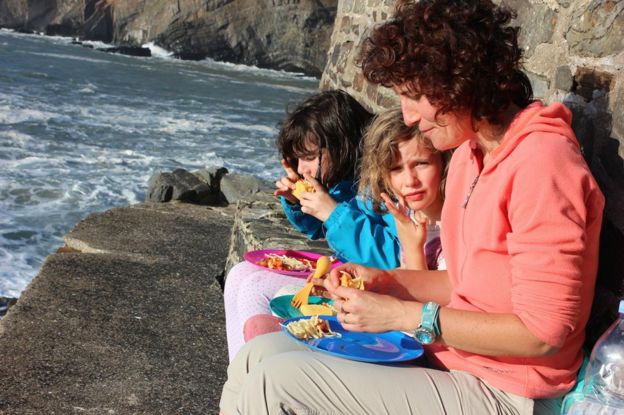
Eating Tacos by the sea
Image caption Eating ‘out’ – the Meek family enjoy tacos by the sea

Reassuringly for us, this was how many of our friends and colleagues were also living. Living for the weekends, I mean. It was normal. It is normal.

You see, as a culture, it seems we are almost accepting of this way of life. It’s a way of life that often seems to prioritise work and money above time spent together as a family or with friends, despite knowing that, according to Benjamin Franklin, “lost time is never found again”.

Too often the hours spent working, or in meetings, or away on business, or not having time to read the bedtime story – again – are justified by the designer trophies and possessions we collect in an attempt to compensate for the “work-time overdrafts” we have run up. Or by convincing ourselves that this is how it has to be, and that there are no other options available.

In our hearts and souls, it didn’t feel right, well not for us anyway. We kept asking ourselves – was this really what life was all about? The answer: “Surely not – it can’t be!”

Maybe it’s a sign of getting older or it’s just what happens when you become a parent. I don’t know, but somewhere along the way it dawns on you that the commodity that is time seemingly becomes much more valuable with every day, month, year that ticks away.

Free, available and unaccounted-for “disposable” time seemingly becomes rarer and rarer and more elusive and therefore highly desirable. And all of the cliches about having children take on an unnerving realness. “They grow so quickly”, “before you know it they are gone”, “don’t blink or you’ll miss them”.

Kerry and I re-evaluated our priorities and began thinking about how we could claw back precious family time from the grasp of modern living – to address the time deficit in our work/life balance.

We knew there was no World Bank or Royal Minute to pump more time into the system – no quantitative easing nor hand-outs available. We knew that we would have to take our own measures.

We felt we couldn’t afford to wait until we were pensioners before getting our hands on more disposable time – that was not an attractive option. I mean that Amy and Ella would have grown up and have left the roost by then and our bodies and minds would be less able to do the things we wanted to do.

It made much more sense to us to have time to enjoy while Kerry and I were young(ish) and we were all together as a family. We needed something more immediate. So, we began looking at how we could achieve a new lifestyle, no matter how temporary, that afforded us a lump sum of uncluttered free time to enjoy.

Girls canoeing
Image caption Kerry and Ella Meek kayaking

Late one night during one of our post-work, pre-sleep, bleary-eyed chats we were thinking about how we could give our family life the seismic jolt we felt it needed to put a significant positive change in motion, when the solution became apparent. As the bedroom light went off, the light bulb switched on. And the solution was simple – literally simple. The answer was to lead a simpler, less complicated life; a life of having less but doing more.

It would lead to us becoming a bit like modern versions of Barbara and Tom from the 1970s series The Good Life, and perhaps coming across, like they did, as slightly unusual and different to others – definitely not the norm.

We called our solution The Go > Do Life. It was a solution that would liberate us by freeing valuable time to enable us to go to places and do more of what we enjoyed.

You see we love the outdoors and spending time walking, climbing, cycling, scootering, camping, exploring, discovering, learning – living. From a young age, Amy and Ella have been encouraged to enjoy and respect the outdoor world and, thankfully, this means they are now perfectly at ease with the idea of spending all day hiking or all night bivvy bagging under the night sky marvelling at the Milky Way or wishing upon shooting stars.

They get enjoyment from doing simple outdoor activities, things that are actually low in financial cost but rich in rewards and, importantly, they seem to be quite content growing up with a close connection to nature.

And it is worth mentioning that this is against a global backdrop of evidence that suggests that the current generation of children – Amy and Ella’s generation – are growing up spending more and more time plugged into games consoles or social media, and less time playing outside.

Sadly, many children are becoming nature-deficient – apparently disconnected from nature, not valuing nature, not enjoying the natural world and sadly missing out on the associated benefits that spending time in the outdoors brings.

As a consequence, there has never been a more appropriate time to tell our kids: “You really need to get out more!” And, as parents, it is our duty to actively encourage (or at times even coerce) our children to do so – for their own wellbeing.

So, wanting to reap the rewards of time-rich opulence, in the summer of 2014 Kerry and I carried out a life changing plan. We quit our jobs, sold our house and took our children out of school to travel around the UK for a year looking for rich educational experiences and exciting opportunities for family adventure. We nicknamed it our Year of Ed-Venture.

A year free from the shackles of modern living; free to roam wherever we chose, at our own pace, able to enjoy every moment. No longer living for the weekends and wishing life away. Happier, less stressed and healthier.

Nine months in, and while we still don’t know if we are doing the right thing, it certainly feels right in lots of ways. We are very happy, active and healthy – and we are very appreciative of the time we are having together.

Of course, it doesn’t fit with the societal norm and not everybody could nor should do what we are doing, but sometimes you just have to go with your gut instinct, do what feels right – or at least give it a try – even if it means challenging the status quo and potentially sticking your neck out.

In some ways and on some days our journey is full of uncertainty and risk – particularly in financial terms. We don’t know what the future will bring us – but then no-one does really. You see, there are no guarantees in life, except for one thing – that one day time will eventually run out.

And, I believe it’s at this time in our lives, when we breathe no more, that our success or failure will ultimately be judged; not in terms of what we have acquired in life, but how wisely we have spent the most valuable resource we have at our disposal – time.

This is an edited transcript of Tim Meek’s Four Thought.

Categories
Du'aas

Wazeefah for Marriage.

If you want to see your grandchildren grow up, get married – quick! Here’s how…

  1. After Esha Salaah. recite Durood Shareef 11 times, followed by  Ya Lateefu 111 times, and again Durood Shareef 11 times. Thereafter make Du’a to Allaah, in sha Allaah, Allah will make matters easy for you. (Mufti Yusuf Ludhyanwi Saahib, Khawaateen Ke Masaa’il aur unka Hal)
  2. Write verses 131 and 132 of Surah Tahaa (Surah 20) and tie it on to your right upper arm. (A’maal-e-Qur’aani, Molana Ashraf Ali Thanvi)
  3. Recite Surah al-Mumtahinah (Surah 60) once daily for 21 consecutive days, after Esha Salaah and blow on your forehead. (Qur’aani Mustajaab Du’aaein, Darul Uloom Kanthaariyah)
  4. Recite verse 36 of Surah Yaseen (Suran 36) 121 times every night. 5. Recite “Rabbi innee limaa anzalta ilayya min kharin faqeer” (a part of verse 24 of Surah 28) 113 times, followed by the recitation of Surah ad-Dhuha (Surah 93) 3 times, from the first till the eleventh of every Islamic Month. Continue this for three months.

Allah Ta’ala knows best.