Categories
Muslim women

Advice for school leavers

Categories
Current Affairs articles

A few days in Spain (Part I)

Alhumdu Lillah! After having returned from the tour of Andalus with as-Suffa institute, it was a phenomenal experience and it left me in deep thought, worry and concern with regards to the lessons we can learn from Muslim Spain. I have decided to share my notes from the journey and the Dars of Shaykh Zahir (Hafidhahullah) with you all. Please forgive me if certain areas are brief and if there is a lack of references, as you can understand sometimes Hadith are mentioned but not under a reference. I will try to attach pictures where possible as well. If there is anything you would like further clarification about, please comment at the bottom. I would like to thank asSuffa from the depth of my heart for organising this trip, Allah reward them for their efforts and bless Shaykh with further knowledge and Barakah. Ameen.

عَنْ أَبِي هُرَيْرَةَ، أَنَّ رَسُولَ اللَّهِ صلى الله عليه وسلم قَالَ ‏ “‏ السَّفَرُ قِطْعَةٌ مِنَ الْعَذَابِ يَمْنَعُ أَحَدَكُمْ نَوْمَهُ وَطَعَامَهُ وَشَرَابَهُ فَإِذَا قَضَى أَحَدُكُمْ نَهْمَتَهُ مِنْ

وَجْهِهِ فَلْيُعَجِّلْ إِلَى أَهْلِهِ ‏”‏ ‏.‏

From Abu Hurayrah that the Messenger of Allah, may Allah bless him and grant him peace, said, “Travelling is a portion of the torment. It denies you your sleep, food, and drink. When you have accomplished your purpose, you should hurry back to your family.” (Muwatta Malik).

01-DSC_5137-be59c79665.JPG

Normally, we are in our daily routine, we do the same thing every day. We do not realise things about ourselves, our habits and temperaments etc. When we travel on a journey, especially with others these habits come out. Like we can see from the above Hadith, travelling deprives us from our food, sleep and drink etc. We all know what happens when we take a man’s sleep or food away. The quote of Umar (Allah be pleased with him) is famous, about how you only truly know a person once you have travelled with him.

Umar (Allah be pleased with him) asked about a man who had given testimony, wanting to find out whether anyone could vouch for him. A man said to him: “I will vouch for him, O’ Ameer al-Mumineen, ‘Umar asked, “Are you his neighbour?” He said, “No.” He then” asked, “Did you mix with him for a day and come to know his character?” He said, “No.” He asked next: “Did you travel with him, for traveling and being away from home reveal a man’s true essence?” He said, “No.” ‘Umar said, “Perhaps you saw him in the-mosque, standing, sitting and praying?” He said, “Yes.” ‘Umar said, Go away, for you do not know him.”

A very profound saying, when travelling with others especially in a group, our true colours are revealed through our conduct as:

1. Much patience is required because people desire & think differently.

2. Whilst we should neither keep others waiting nor impose our views on the rest, we should be prepared to be delayed by others as that is part of group travel.

3. We should be ready to serve the rest.

4. We should abstain from petty complaints.

5. We must be considerate of others esp. the weak, elderly & children.

09-DSC_5328-4e74c67be2Why do we study history?

A great portion of the Qur’an speaks about history, approximately 1/3. When one reads history it is as though he is reading the future because history often repeats itself, so if we can’t learn from our own mistakes we can learn from the mistakes of others. As we all know a man’s nature doesn’t fundamentally change.

“Narrate to them stories (of the past), so that they may reflect.” (al-A’raaf)

“We narrate to you [O Muhammad] the best of stories in what we have revealed to you of this Qur’an, although, you were, before it, from the unaware.” (Surah Yusuf)

Nations ascend and descend, some disappear. Nations ascend because they have something called impetus.

Ibn Khuldoon (Allah have mercy on him), he has a theory, the ‘cycle theory’ which scientists still use today. Anyone who has a surname ending in ‘doon’ or ‘coon’ means their ancestors were form Andalus.

Once upon a time the population was over 75% Muslims in Spain.

Umar (Allah be pleased with him) was sat one day, very worried. So, someone asked him as to why he look worried. As Islam was spreading far and wide into India and Central Asia and Africa. Umar (Allah be pleased with him) replied, “This is why I am worried!”

What Umar (Allah be pleased with him) was referring to was that most nations reach their pinnacle and prosperity, then they decline.

“And you will not find in our way (Sunnah) any alteration.” (17:77)

Allah has some principles that never change, in the same way man has some habits which never change. For example, water boils at 100 degrees, it has always boiled at 100 degrees.

We must remember Islam is continuous and will remain at all times. It is the truth and the truth must reach the people.

The word al-fath in Arabic means to conquer or open. Islam spread by sending armies to countries. They were not forced. Countries as far as Yugoslavia, Greece and Caucasus. There were two countries where armies were not sent and they accepted Islam, Indonesia and Malaysia.
04-DSC_5205-ca4ebd644d.JPG

Why study history of Spain?

Spain is very close to us British Muslims in Europe.

Only 1% of Muslims came to Spain, they went from a minority to a majority, then back to a minority. You had both types of leaders, good and evil. You had pious and knowledgeable leaders as well as very bad, very treacherous and very deceitful leaders.

You wonder why Muslims would become sell-outs and give in to the Christians. The answer is simple, if in 100 years’ time today’s history was written, people would say how did Burma happen, how did the issue of Palestine not get solved, how did Muslims get oppressed in Syria?

Just like we think today why did Muslims allow the Spanish to get 400 years of persecution. Morocco is 12 miles away from Spain, why didn’t they help?

Similarly, many places were pre-dominantly Muslims, but they no longer remain the majority. Like Malawi and Philippines.

Why have so many scholars/poets written about Spain?

  1. Far out-post of Islam
  2. Because of what it created. There was no place in the world equal to it.

Many people when hearing about the situation of the Ummah – current or past, tend to say, “Let them do what they want, this is Allah’s Deen.” My answer to this is do not live off slogans, live off actions/a’maal. Also, remember, Allah will protect his Deen, but will Allah protect you? Especially if you don’t act accordingly.

Background

The word Andalus is the Arabic name for the Iberian Peninsula what is known today as Spain and Portugal, the Greeks called it Iberia and the Romans called it Hespania. The land of Spain was ruled by the following, before the Muslims:

Greeks

Celts

Romans

Vandals

Visigoth

The Romans brought the Latin language and Spanish evolved from there. The word Andalus came from the word Vandals, these were people who were rough and evil.

The Muslims were generally known as Saracens or Moors.

Visigoths were Pagan but later embraced the Catholic religion. Within 200 years of ruling they began to oppress others and treat them like animals. Although the Goth conjures up a Barbarian perception, they inherited an advanced society with theatres, dams, bridges and circuses. An advanced political system all of which the Goths benefited from.

What was going on in Europe when the Muslims came?

The Europeans were generally unclean and unhygienic. They only bathed once a year, or at the most twice a year. This is because they thought it weakened their immune system. James Burke describes they mixed their impurity (stool and urine) in the middle of the road and walked in it. They had no issues with that nor was it frowned upon.

Amr ibn al Aas (Allah be pleased with him)

At the shortest point, there are only 12 miles between North Africa and Spain. Amr ibn al Aas (Allah be pleased with him) was the first person to conquer Africa, he was very intelligent. When he left Makkah, Khalid ibn Waleed (Allah be pleased with him) said, “Today Makkah has thrown away her liver.” When Umar (Allah be pleased with him) sent him to North Africa, he later sent a letter with a messenger:

“If this letter reaches you before the Rafah border, then do not cross it. If you have crossed it, then no matter.”

When Amr (Allah be pleased with him) received the letter, as he was intelligent he knew what it would have said – not to cross! So he crossed the border, then read it!

Uqba ibn Nafi (Allah be pleased with him)

After Amr ibn al Aass (Allah be pleased with him) the next conqueror to embark on the conquest of North Africa was Uqba ibn Nafi (Allah be pleased with him). He was the nephew of Amr ibn Aas (Allah be pleased with him). He was appointed the governor of North Africa in 50/67. He took great portions of Egypt with 4,000 men. He was ambushed on his return and martyred. He passed away in 638 A.D. Islam reached North Africa 23H.

Nusayr (Allah have mercy on him)

Nusayr (Allah have mercy on him) was studying to be a monk when Khalid ibn Waleed (Allah be pleased with him) conquered Ayn Tamr. He was born a Christian who embraced Islam. Employed by Muawiyah (Allah be pleased with him), he was in charge of the police. When the battle took place between Ali (Allah be pleased with him) and Muawiyah (Allah be pleased with him), Nusayr said his famous words to Muawiyah (Allah be pleased with him) when he rebuked him:

“I will not show my gratefulness to you by showing my ungratefulness to He who is greater than you.” Muawiyah (Allah be pleased with him) asked, “Who is that?” He replied, “Allah!” Muawiyah (Allah be pleased with him) put his head down and said, “Astaghfirullah.”

He once said about Uqba (Allah be pleased with him), “Did nobody tell Uqba (Allah be pleased with him) to consolidate what you have then advance?” This was because was Uqba (Allah be pleased with him) was conquering lands but not consolidating the areas i.e. educating them, building ties and winning the hearts of the local people. His son was Musa ibn Nusayr (Allah have mercy on him), who conquered the entire North Africa and Andalus. He was the most important man in the history of Spain.

Musa ibn Nusar (Allah have mercy on him)

He was born in 19H during the Caliphate of Umar (Allah be pleased with him). He was a Tabi’ee and narrated from the Sahabah (Allah be pleased with them). He began to assess the reason why the Berbers could not be kept in check. By 91H he had the entire North Africa subdued. He began to assess the reason wy the Berbers could not be kept in check. He realised that the victories were achieved very quickly without the consolidation of the conquered land. Uqba (Allah be pleased with him) would take a country swiftly, but only to rebel later. So he decided to consolidate any land that was conquered and win the hearts of the people. Once he was happy with the situation, only then he would move on. Secondly, no system of education was provided for the conquered people, so he brought scholars to educate them, until the Berbers began to love Islam and became great defenders of the religion. He built Madrasahs everywhere he went.

On a side note here, Shaykh Zahir mentioned, “short bursts don’t last long.” If we look at the French, they spent 130 years in Algeria. But, they didn’t convert a single person, why? Simply because they didn’t consolidate and win the hearts and minds of the people.

Remember, Da’wah has to be multi-faceted, Da’wah must be consolidated. There are many people out there giving Islam a bad name, we need to give Islam a good name in the right manner.

The first person to mention the conquering of Andalus was Uthman (Allah be pleased with him), when he talked about the conquering of Constantinople. The Prophet (peace and blessings be upon him) said, “Muslims will conquer Constantinople.” Everyone wanted to be a part of this army. 27H was the first time Muslims came to Andalus, they just stopped at the port.

When Muadh ibn Jabal (Allah be pleased with him) went to Roe, the Byzantines said, “Why are you going to attack us? Go to Ethiopia it is easier for you.” Muadh (Allah be pleased with him) related the verse:

“O you who believe! Fight those who re close to you of the disbelievers. Let them find in you harshness. And know that Allah is with those who fear him.” (9:123)

Umar (Allah be pleased with him) was very impressed by the history of Persia.

In an Islamic society in which the basic beliefs and principles are both deeply-rooted and dominant, behavioural motives are greatly influenced by the aspiration to please Allah and gain His reward in the hereafter. The best Muslim believers do not include any other motive for their actions. It is essential for the Muslim to ensure that his intention in all his deeds is aimed solely at pleasing Allah, be they acts of self-purification, or any social, economic, or political activities. The activities of a Muslim in all spheres of life must be directed towards pleasing God. The Muslim knows well that if he were to include anything else in his intention besides God, then his deed would be unacceptable, as stated in the hadith: “Allah does not accept any deed except that which is purely intended for Him and is done for His sake.” If this way of thinking is guiding many conscientious Muslims even today, then what was its influence on the generations of the companions of the Prophet and those who followed after them (tabi`un), who were the best of all generations?

The knowledge of the effect which Islam exerted on the education of its followers in the first period of Islam – and on the purification of their souls, and polishing their minds, the sincerity of their religious belief, together with their directing their worship to God alone – makes it abundantly clear that their participation in the military campaigns known as al futuh (the conquests or ‘opening up’ of other lands) was not primarily motivated by any worldly ambition. Rather, it was the compelling desire to propagate Islam, to enable it to take firm root in these lands and to organize and administer the newly-conquered territories. It was the wish to solve the economic problems of these lands, and any new problems which might arise, in accordance with the true teachings of Islam. The Muslims were not motivated by any desire to dominate those peoples or to acquire their wealth, nor were they attempting to escape from the hardship of life in the desert, as has been maintained by Caetani and other Orientalists.

Al Tabari (Allah have mercy on him) narrated that Rabi` ibn `Amir (Allah be pleased with him) entered the court of Rustum, the Persian leader, who asked him: “What brought you here?” Rabi` (Allah be pleased with him) said: “God sent us, and He brought us here in order to lead whom He wills from the worship of man to the worship of God alone; from the narrowness and oppression of this world to the space and abundance of the hereafter; and from the injustice of other religions to the justice of Islam. He has sent us with His religion of His creation, to call them to Him.”

What Rabi` ibn `Amir (Allah be pleased with him), the representative of the Muslims, said to the Persians was not only the expression of his personal feelings. Rather, it voiced the thought which was predominant among the Muslim leadership and most of the Mujahidin. This does not exclude the possibility that some of the Bedouin who had participated in the military expeditions had been attracted by the prospects of material gains and booty, in addition to the desire for jihad; but these Bedouin did not represent either the leadership of the movement or its motivating spirit. We must state this because the Muslim society is a human society. In it are found the elite who are committed to the highest moral and spiritual ideals, with their intentions directed purely towards God, who are desirous of earning His good pleasure and who direct their efforts towards achieving this end. But there are also lesser classes of Muslims who take it upon themselves to maintain the minimum standards which will entitle them to call themselves Muslims.

We must explain clearly that the interpretation of the course of Islamic history during the first period of Islam can only be undertaken by a Muslim who repeats daily what God said to his Prophet: “Say: ‘Truly my prayer and service of my sacrifice, my life and my death, are (all) for God, the cherisher of the worlds: No partner hath He; this am I commanded …’”. (Al-An`am 6:162-163). This is the Muslim whose mind and emotions have been affected by the Qur’an and the Sunnah, who has felt their impact in moulding his personality and determining his actions and conduct. This is why Westerners and Orientalists have failed to understand the true motives for the actions of Muslims during the first period of Islam. For example, when Henri Lammens, a well-known Orientalist, discussed the incident of the Saqifah of Banu Sa`idah (an early example of the application of the Shura, in which the majority was persuaded by the minority) his judgment of this incident was impaired by his recollections of the conspiracies at the French court of the fifteenth and sixteenth centuries, which distorted his eventual depiction of the incident. He concluded that the outcome of the meeting of Saqifah came about as the result of a conspiracy woven by Abu Bakr (Allah be pleased with him), `Umar (Allah be pleased with him) and `Uthman (Allah be pleased with him), who, in the Saqifah of the Banu Sa`idah, had agreed to seize the caliphate and succeed one another.

The studies of the Orientalists are numerous, and differ in their levels, quality, and freedom from religious and racial prejudice. However, these studies are usually carried out by scholars who live in environments which are remote from Islam, and which have their own philosophies and cultures. It is difficult for them to appreciate Islam and consequently, it is difficult for them to understand the true reasons for a Muslim’s conduct, both individually and socially. When they seek to interpret the history of Islam, they draw analogies with European history, despite the very different natures of the two histories. We must not forget, moreover, that the Europeans cannot but help looking at the world from their own perspective, which is militarily and technologically superior. Thus they tend to ascribe every possible merit to themselves, while ascribing defects to others. When Toynbee wrote his history of world civilizations, he allotted only a small space to the history of Islam, a space which was not commensurate with the size of Islam’s real contribution to world history.

The most glaring deficiency of the Orientalists’ studies is their failure to arrive at a correct understanding of Islam, its true spirit, and its effect on an Islamic society and on the course of that society’s history. This is a grave deficiency which prevents our acceptance and approval of these studies, especially those which are concerned with the Sirah and the era of the Rightly-guided Caliphs, when the practical implementation of Islamic theory coincided with the theory itself and faithfully reflected it.

Hitler once said, “Victorious are those who write history.”

“History would be kind to me, because I am going to write it.” – Winston Churchill

So, history belongs to those who write it. And history doesn’t do justice to Umayyads, it was written by Abbasids.

The Umayyads spread Islam in three different directions:

Muhammad ibn Qasim al-Thaqafi (Allah have mercy on him) = Sindh

Utaybah ibn Muslim al-Bahili (Allah have mercy on him) = China

Muslamah ibn Abdul Malik = Caucasus

23-DSC_5688-66ab4f9be2

Julian

The ruler of Spain at the time, before the Muslims conquered was a man called Roderick. He had sexually abused many young boys and girls at the time. One of which was the daughter of Julian, her name was Flora. This angered Julian, when he came to know if it and sought after help from the Muslims. This was because Musa ibn Nusayr (Allah have mercy on him) was already planning an attack on Andalus. But he said to Julian, “I cannot trust you, as you are a Christian and so is Roderick. And we are not familiar with the landscape of Andalus.” He tells Julian to initiate the attack to prove he is strong on his word. Julian attacks eastern coasts of Andalus, then reports back. Musa (Allah have mercy on him) then reports back to the Caliph in Baghdad – Waleed ibn Abdul Malik, who then sends a small army.

Tariq ibn Ziyad (Allah have mercy on him)

He was a Berber, he was blue-eyed and had blonde hair. It is said, that Berbers descended from Europeans.

Furthermore, a wife of a sorcerer when seeing Tariq said, “Your appearance resembles that of the conquerer of Andalus about whom my husband predicted.” She recognised him by a mole, Tariq (Allah have mercy on him) had a mole on his face. Tariq ibn ZIyad (Allah have mercy in him), landed in Gibraltar in 711/92 with 7,000 men and 300 Arab nobles. A stretch which is about 11 miles. He requested further reinforcements and the army swelled up to 12,000. The armies met at La Junda.

Tariq had a dream which inspired him and the soldiers. He saw the Prophet (peace and blessing be upon him) and his companions with their swords out, giving him glad tidings of a victory.

Roderick was the last Gothic King, he usurped the throne after the death of king Wizita. He was 80 years old at the time of the battle. Roderick confronted Tariq (Allah have mercy on him) with an army of 100,000. The two armies met at Guadelate. Musa prepared the Muslims, especially Berbers for Jihad. He placed at the head of the army, the most suitable person, Tariq ibn Ziyad (Allah have mercy on him).

So Musa (Allah have mercy on him) now sends Tariq ibn Ziyad (Allah have mercy on him) with an army. Tariq was considerably young. This is something which shouldn’t be frowned upon, as the last army which the Prophet (peace and blessings be upon him) sent had Usamah (Allah be pleased with him) as the commander under him were great Sahabah (Allah be pleased with them) like Umar (Allah be pleased with him) and others. The reason why Tariq (Allah have mercy on him) was chosen was due to his admirable piety and his inexhaustible desire for Jihad. Also, we must remember that Musa (Allah have mercy on him) was an Arab and Tariq was a Berber, the majority of the army was Berber. Tairq understood the culture, language and habits of the Berbers. An important point to note here is when giving Da’wah, especially abroad, we must also understand that culture, language and habits of the people. Another noteworthy reminder is that Musa (Allah have mercy on him) chose the best man for the job, he didn’t look in finding an Arab. He looked for who suited the role. “O mankind! We have created you from a male and a female, and made you into nations and tribes, that you may know one another. Verily, the most honourable of you with Allah is that (believer) who has al-taqwa [i.e., is one of the muttaqoon or pious]. Verily, Allah is All-Knowing, All-Aware” [al-Hujuraat 49:13]

The Prophet (peace and blessings of Allah be upon him) said in his last sermon: “O people! Verily your Lord is One and your father [Adam] is one. An Arab is no better than a non-Arab, and a non-Arab is no better than an Arab; a red man is no better than a black man and a black man is no better than a red man – except if it is in terms of taqwa (piety)…” (Reported by Imam Ahmad, 22391).

Unfortunately, we do not see this in our society today. Not even in Islamic institutes. When a father dies he makes his son the Ameer or principal, although he may not be fit for the role. We will see more examples of this causes failure in the history of Spain.

To the south of Spain there are three islands known as Balearic Islands; Ibiza, Majorca and Minorca.

Musa (Allah have mercy on him) first consolidated his power in these islands then moved on to Spain. Tariq (Allah have mercy on him) first landed on “Jabalut-Tariq,” which is known as Gibraltar today. He has a few battles then consolidates al-Jazeeratul Khadhra (Green Islands), also known as al-Jasairas. Meanwhile, Roderick was already having a battle in another country. His men sent him a message,

“We have been attacked! There are 7,000 men. Men, the like of which we have never seen before. We do not know if they are from Heaven or from Earth!”

Roderick pondered and thought, 7,000 is a small number and we will easily defeat this army.

I would like to narrate a story at this point, but unsure if it is true and authentic: A king had a dream many years ago before this war, that someone will come and takeover Spain. He went to a magician, and the magician confirmed this is true. But he said he will help the king by casting a spell in a room. So long as you do not open the door of this room, Spain is safe. This message was passed on each time a king passed away. Every new ruler would put an extra lock on. But when Roderick heard about this he was anxious to find out, what was in the room. He was advised by his ministers not to open the locks, but he refused to listen. They even said, “We will give you double the amount of gold of what is in there.” He ignored them and opened 27 locks! Inside was a table from the period of Sulayman (peace and blessings be upon him) and many other things were found. (Ahmed Thompson)

The battle started on 28th Ramadhan 22H/19th July 711and carried on for 8 days. The Muslims were fighting on Eid as well! The Christian army was five times the size of the Muslim army, Musa sent another 5,000 men which totalled 12,000 for the Muslims. When Roderick saw them, he lost his appetite. He sent emissaries to speak to them, Musa (Allah have mercy on him) beheaded the messenger and then they cooked him and sent him to the Christians. This was to give an impression to Roderick of how courageous they were. The Prophet (peace and blessings be upon him) said, “War is a deception.” Which means sometime what we think of the other party in terms of numbers and weaponry isn’t always as it seems. It is for this same reason we do ‘Ramal’ (jogging with the chest out) in Tawaf (circumambulation of the Ka’bah).

Tariq (Allah have mercy on him) led from the front, he was dressed simple and looked humble. Whilst Roderick was arrogantly sat on his throne, dressed in his crown and robes. You could say the Christians were ‘playing at home’, they were on their own land. But, slowly, the Muslims got the upper hand. Roderick knew the only way the Muslims could defeat them was to kill him, so he stayed behind his army. Finally, Tariq (Allah have mercy on him) attacked Roderick and killed him. They found one sandal of Roderick’s, which was worth 100,000 Dinar. He was the last Visigoth King of Spain. Tariq’s army was thoroughly enjoying the booty. He once said, “If you carried on with me, I would go all the way to Constantinople.”

We stopped here and Shaykh mentioned a point which every Muslim should remember and instil:

We should never be proud just on the basis of being Muslim. Just being Muslim will not get us anywhere! We need a vision and we need to become “people of substance.” I call these Shaykh’s favourite lines (hope he doesn’t mind), rightly so as well. Many of us rely on the fact we pray the Kalimah/Shahadah or we pray Salah and adorn a beard and sisters wear Hijab – which is all good and well, but not sufficient. The price of Jannah is not cheap! We are over a billion today, but let not our numbers deceive us. We need substance:

Look on the day of Badr, only 313. But they had substance! Allah says: “And Allah had given you victory at [the battle of] of Badr, while you were weak.” (3:123) The Arabic word ‘Athillah’ here means – i) few in number ii) disgraced and humiliated. So, here they were few but overcame 1,000 because they were humble and obeyed.

Let us look at the next battle after Badr – Uhud. Muslims had the upper hand initially. But 50 archers on a hilltop were ordered by the Prophet (peace and blessings be upon him) not to move from their places, if they are winning or losing or even vultures are pecking at their bodies. When the Muslims had the upper hand, these archers started rejoicing forgot the command of the Ameer SAW and descended. Which resulted in Muslims losing the upper hand. Again, we learn the lesson of following the Ameer – no matter what.

Numbers also deceive the Muslims, Allah talks about the battle of Hunayn. Muslims were many in number so thought they will ultimately win the battle. The battle turned upside down, they even left the side of the Prophet (peace and blessings be upon him), only ten Muslims were left with the Messenger (peace and blessings be upon him). Unfortunately, 3,000 Muslims were martyred. Inna Lillah… “Allah has already given you many victories and [even] on the day of Hunayn, when your great number pleased you.” (9:25)

Now, we would like to make some clarifications about the story so far, particularly about Tariq ibn Ziyad (Allah have mercy on him):

Did Tariq ibn Ziyad (Allah have mercy on him) burn the ships on the shore of Gibraltar?

This is a fabrication from amongst the fabrications told in history and there are many reasons for this –

  1. The ships did not all belong to Tariq, Julian owned most of them.
  2. Fuqaha RH did not speak about this incident and Ulama RH have not wrote about it.
  3. Waleed ibn Abdul Malik who was the Caliph at the time did not mention it.

The second fabrication was the famous Khutbah which Tariq ibn Ziyad (Allah have mercy on him) and has been attributed to him. Many scholars say that this was not given by Tariq. Simply because he was a Berber, and the Arabic was too eloquent.

In Islam before attacking a land the enemies were offered three choices:

  • Accept Islam
  • Pay the tax/Jizyah – 1 dinar
  • Fight against us

If a non-Muslim defended the Muslims or their army, Umar (Allah be pleased with him) uplifted the Jizyah from them. There was a certain time in the era of Abu Ubaydah (Allah be pleased with him) when the Muslims could not protect the non-Muslims. Their enemy was too strong, Abu Ubaydah (Allah be pleased with him) gave the Jizyah back to the non-Muslims. In the time of Umar (Allah be pleased with him), he saw a Jew begging. Umar (Allah be pleased with him) asked, “Why is he begging when he pays Jizyah?” He went to their leader and said pay him from Baytul Maal.

The rule was, you can only take Jizyah from those who can afford it.

Jews

When the Muslims came to Spain the Jews flung their doors open. The Jews had been persecuted by the Christians and were pleased to assist the Muslims. The Muslims even left the Jews in charge of many cities as they advanced; cities such as Cordoba, Granada and Malaga. Whilst the Christians were in the churches praying, the Jew flung open the doors of the Forts for the Muslims.

The largest Jewish population was in Muslim Spain.

Heretical Christian Sects

There were many Heretical Christian Sects. If you belonged to a group besides Catholicism life was hard for you. The Muslims then arrived and gave refuge to the heretic Christian refugees. It reminded people of Najashi giving refuge to the Muslims, this was like the Muslims paying Najashi back. Many people had previously sold themselves as slaves to the church or to Christians. As it was much easier, because their food and home was guaranteed. Now, so many Christians were flocking to Islam.

There was only one Sahabi, Munayzir al-Afriqi (Allah be pleased with him) who came to Spain. From 12,000 Muslims one Sahabi, the rest were Tabi’een (mostly).

Some European historians said: “Tariq beat Roderick up and imprisoned him.” The Muslims don’t have any record of this.

The son of Musa ibn Nusayr, Abdul Aziz (Allah have mercy on him) took Portugal. Musa (Allah have mercy on him) had now taken 18 cities.

Muslims showed tolerance like never before.

Muslims encouraged inter-marriages, Arabs marrying Berbers etc. This is why they felt the unity.

By 811 A.D Spain was 8% Muslim.

By 850 A.D. Spain was 12% Muslim.

By 900 A.D. Spain was 25% Muslim.

By 950 A.D Spain was 50% Muslim.

By 1000 A.D. Spain was 75% Muslim.923329_10151602549395813_1260670182_n

Ismail ibn Nazir Satia (One who is in dire need of Allah’s forgiveness, mercy and pleasure)

7 Sha’ban 1437

Categories
Current Affairs articles

The Fall of Andalus

Looking into the Court Yard, Alhambra

andalus

Listen brothers, listen sisters, listen carefully to a story of sorrow and pain,

This is the story of the fall of Andalus, known as Muslim Spain.

Long, long ago a man called Tariq RH, with the order of Musa Bin Nusayr RH,

Conquered the beautiful land and all of its terrain.

Allah SWT gave them glory because of their pure hearts and what they did contain,

They travelled from North Africa up to the Mediterranean.

Fiercely they fought, unafraid, strong soldiers, waging warriors, like lions – the whole country did they gain,

The glad tidings had already been received from the Messenger of Allah SAW and his companions RA.

The young boy, Tariq RH was made to be the captain,

A fleet of ships arrived with men who didn’t look back as they planned to remain.

Powerful and courageous, bold and brave,

The enemies were confused – are these people from Earth or descended from Heaven?

Tariq RH was spiritual, a holy boy, who sincerely worshipped Allah and from all evil did he abstain,

Recognised by a mole on his face, he stood like a commander, devout and honest, free from name and fame.

In the books of history, he is recorded and illuminated will be his name,

He understood the purpose of life and that life is not a game.

At this time Islam was flourishing like the speed of a train,

City after city, town after town, one after the other like a long chain.

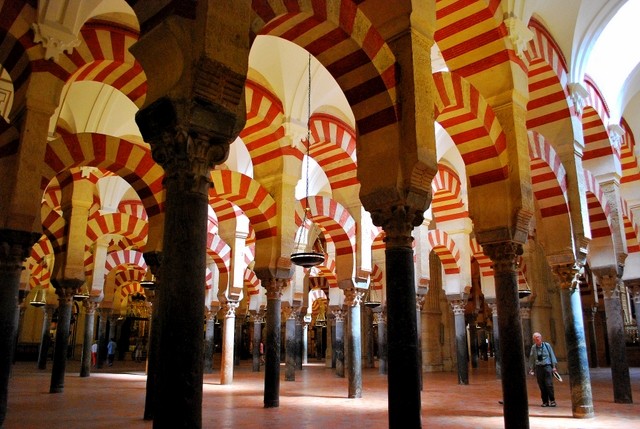
Let us not forget, this was the country that contained a Masjid – largest in the world, ‘Masjid Qurtuba’, larger than Haramayn (at that time),

They had palaces and castles, trees and gardens, overlooked by mountains.

Fruit was plentiful, vegetation was abundant, fields green and plain,

Allah’s SWT mercy descended generously by blessing them with rain.

But the tides became heavy and waves were uncertain,

When people forgot Allah SWT, Lord of the heavens, Rabbul Mashriqayn Wa Rabbul Maghribayn.

The rulers became unjust and acted like villains,

Many spent the night drinking wine and champagne.

Women were used to dance, used for lust and only to entertain,

The Masajid were empty and the pulpits (mimbar) began to cry and complain.

Evil was widespread, corruption was rife, the difference between right and wrong they could not ascertain,

All of a sudden, Allah’s SWT help disappeared as though it was uplifted by a crane.

The rulers were busy marrying maidens; hair of blonde; eyes of blue; that looked like Hoor Ayn,

For centuries the land was ruled by the pious, but now they also did not remain.

Their scholars were knowledgeable and they had rulers which were of piety, with Iman as high as a plane,

But they didn’t educate their sons & their daughters to relay the Deen, nor were they trained.


minaret

The minarets cry now for someone to call Allah’s SWT glorious name,

The rows for Salah are seen bare and very plain.

No sign of an Imam or even a chaplain,

Muslims were too busy fighting each other, their own brother had they slain.

They thought blood was cheap like a bargain,

Eventually the Muslims were expelled, or given a choice to be Christian.

Many were tortured, their actions were barbaric and inhumane,

Dear friends, think carefully upon the lessons from Muslim Spain.

Ponder with your intellect and think deeply with your brain,

Let the message sink in, let it ingrain.

For what lasted 800 years, we could not maintain, 

Will the Ummah rise to the challenge ever again?

al andalusandalus 1

Ismail Ibn Nazir Satia (One who is in dire need of Allah’s forgiveness, mercy and pleasure).

[Written 1st Shaban 1436, after returning from the asSuffa Andalus tour]


Categories
Spirituality

Learn to let go…!

I begin in the Name of Allah,

“And We place the scales of justice for the Day of Resurrection, so no soul will be treated unjustly at all. And if there is [even] the weight of a mustard seed, We will bring it forth. And sufficient are We as accountant.” (21:47)

justice of scales.jpg

If someone is earning Haram or committing fraud, leave them to Allah.

If someone is arrogant and narcissistic, leave them to Allah.

If someone is doing the work of Deen for name and fame, leave them to Allah.

If someone is always arguing, overconfident and conceited, leave them to Allah.

If someone is spreading lies about you, backbiting and slandering, leave them to Allah.

If someone is cheating on you, having an affair and lying to you, leave them to Allah.

If someone is oppressing you, bullying you or harassing you, leave them to Allah.

If someone does not pray and fast, don’t think you are better, just leave them to Allah.

If someone violated your rights and took even a shilling from you, leave them to Allah.

If someone disagrees with you, whether in religious or worldy matters, end the conversation, leave them to Allah.

If someone treats you unfairly, is biased and prejudiced, or shows favouritism, also leave them to Allah.

“So whoever does an atom’s weight of good will see it,  and whoever does an atom’s weight of evil will see it.” (99:7 & 8)

This article was written after being inspired by a poem of the Late Mother Theresa:

“People are often unreasonable, irrational, and self-centered. Forgive them anyway.

If you are kind, people may accuse you of selfish, ulterior motives. Be kind anyway.

If you are successful, you will win some unfaithful friends and some genuine enemies. Succeed anyway.

If you are honest and sincere people may deceive you. Be honest and sincere anyway.

What you spend years creating, others could destroy overnight. Create anyway.

If you find serenity and happiness, some may be jealous. Be happy anyway.

The good you do today, will often be forgotten. Do good anyway.

Give the best you have, and it will never be enough. Give your best anyway.

In the final analysis, it is between you and God. It was never between you and them anyway.

~Mother Teresa”

Ismail Ibn Nazir Satia (One who is in dire need of Allah’s Forgiveness, Mercy and Pleasure)

1 Rajab 1437

Categories
Spirituality

Are you Following The Crowd?

SHEEP GETS BUCKET STUCK ON HEAD

When Umar bin al-Khattab (رضي الله عنه) was walking in the market, he passed by a man who was supplicating,

اللهم اجعلني من القليل    اللهم اجعلني من القليل
“O Allah, make me from the few! O Allah make me from the few!”

So ‘Umar said to him, “Where did you get this du`a’ (supplication) from?” And the man said, “Allah in His Book says:
و قليل من عبادي الشكور
‘And few of My servants are grateful.’ (Qur’an 34:13)”

So ‘Umar wept and admonished himself, “The people are more knowledgeable than you, O Umar!
O Allah make us from Your ‘few’ servants.”
crowd.jpg

Sometimes when you advise someone to leave a sin, they respond with “But everybody does it, it’s not just me!”

But if you look for the words “most people” in the Qur’an, you will find that most people –

ولكن اكثرهم لا يعلمون
“And however most people do not know” (7:187)

ولكن أكثرهم لا يشكرون
– “and most people do not show gratitude” (2:243)

and
و لكن اكثر الناس لا يؤمنون
– “and most people do not believe” (11:17).

And if you look for “most of them”, you will find that most of them are

و آن أكثرهم فَاسِقُون
– “definitely disobedient” (5:59)

و لكن أكثرهم يجهلون
– “ ignorant” (6:111)

بل أكثرهم لا يعلمون الحق فهم معرضون
– “turning away” (21:24)

So be of the “few”, whom Allah says about them:

و قليل من عبادي الشكور
– “And few of My servants are grateful.” (34:13)

و ما امن معه الا قليل
– “But none had believed with him, except a few.” (11:40)

في جنات النعيم ثلة من الاولين و قليل من الآخرين
– “In the Gardens of Bliss, A [large] company of the former peoples, And a few of the later peoples.” (56:12-14)

Ibn al-Qayyim (رحمه الله) said, “Go on the path of truth and do not feel lonely because there are few who take that path, and beware of the path of falsehood and do not be deceived by the vastness of the perishers.”
[Found in Kitab al-Zuhd by Ahmad bin Hanbal (رحمه الله), and also in the Musannaf of Ibn Abi Shaybah.] –

May Allah Ta’ala make us of His few servants, Ameen.

Ibn al-Qayyim (رحمه الله) : “No servant is struck with a greater punishment than the punishment of a hard heart and distance from Allāh”

● [الفوائد ١٤٢]

1 Rajab 1437

Categories
Spirituality

Sunday Morning Thoughts!

In the name of Allah, the entirely Merciful, the especially Merciful.

Time Bomb

Dear Mankind,

For how much longer will you blame the world?

For how much longer will you see the faults in others, but not in yourself?

For how much longer you will continue in your Arrogance and Denial?

For how much longer will you think yourself better than others and ignore your Narcissism?

For much how longer will you continue with your uncontrolled Anger and Impatience? Have you forgotten Allah’s Wrath and Anger are far, far, FAR worse!

For how much longer will you be ungrateful and show ingratitude to your Lord, your parents, your spouse?

For how much longer will you show heedlessness and forgetfulness towards the One who created you from an impure clot?

For how much longer will you be oblivious to the right of others, the injustices and the lies told?

For how much longer will your hypocrisy continue to grow and expand as far as the eye can see? The two faces you show, the promises you break and the endless red lies.

For how much longer will men continue to not act like (true) men?

Because… I cannot wait any longer.

Ismail Ibn Nazir Satia (One who is in dire need of Allah’s Forgiveness, Mercy and Pleasure)

23 Jamadul Akhar 1436


Categories
Muslim women

Nursery or Adversary?

بسم الله الرحمن الرحيم

Assalamu Alaykum wR wB,

If we survey the Sunnah of the Prophet ﷺ, a similar understanding is found. The qualities of devotion to Allah and their families were at the centre of the praiseworthy qualities of women. For example, the Prophet clarifies the Islamic view regarding the best women and the central reason behind it saying, “The best women from the riders of the camels (the best Arab women) are the righteous among the women of Quraish. They are the kindest women to their children in childhood and the most careful of women in regards to the property of their husbands.” (Bukhari/Muslim) In this hadith the Prophet explains their goodness by being good wives and good mothers.

In another statement the Prophet ﷺ explains that one of the main aims of marriage is to produce and nurture children who follow the Sunnah of the Prophet (peace be upon him) in worshiping Allah and glorifying him. The companion Ma’qil ibn Yasaar narrated that a man came to the messenger of Allah (peace and blessings of Allah be upon him) and said: “O Messenger of Allah, I have found a woman who is from a good family and is pretty, but she does not bear children – should I marry her?” He told him not to. Then he came to him a second time and said something similar and he told him not to marry her. Then he came to him a third time and said something similar and he (peace and blessings of Allah be upon him) said: “Marry the one who is loving and fertile, for I will be proud of your great numbers before the nations on the Day of Resurrection.” (Abu Dawud/Nasa’i)

Shaykh ‘Abd al-‘Azeem Abaadi said in his commentary of this hadith, ‘Marry the one who is loving means the one who loves her husband; and the one who is fertile is the one who bears a lot of children.” {Awnul Mabud 6/33}

abcOh boy… I am going to do it again. I am opening the can of worms. Lighting a match in a dry forest. Shouting fire in a crowded theatre. Opening the floodgates. I am going to talk about something that will cause another round of Facebook unfriending, painful insults, and lots of people disagreeing with me. But as a man, a Muslim, and a chronically outspoken human being, I have to speak up. I have a platform – and I must use it. It is my moral responsibility to utilise my platform to speak up for those without such a public voice. I want to talk about… **takes deep breath**… ‘Working Mothers and their Responsibilities.’

“Most children are corrupted (and led to failure) because of their parents.” Ibn Qayyim RH, Tuhfatul Maudud bi-Ahkamil Maulud (p. 80)

By this point, some of you (especially those who know me “well”) will be thinking, “Oh God! What on earth is he going to say?” And others (who also know me, personally) will be thinking, “How can he talk about that issue? He doesn’t have kids!” Yes, what gives me the audacity to speak about such a topic, when I don’t have children? I actually thought about the same thing a few days ago, before writing this piece. I don’t know how long this article is going to be, simply because the whole thing has been going around my head for a long time. I wouldn’t be lying if I said a decade!

Just because I don’t have children, that doesn’t mean I don’t know anything ‘about’ children. I have taught children in a Primary School, and in a Madrasah setting for many years. And still offer tuition for teenagers in various subjects, as well as teaching Muslim youngsters Tafsir and Seerah. Which (hopefully) justifies my position, in writing this article. As I have understood and realised some of the causes and grounds why our youth are spiralling downwards.

You see I always wanted someone else to write it, I shall be totally honest. In particular – a female. And before writing it I scanned the web to see how much has already been written on the topic, especially by Muslims. I found a LOT of articles supporting the idea of working mothers, very few against it. I have a large extensive library (Alhumdu Lillah), I buy books on everything; things which are relevant and irrelevant, stuff that I need and don’t need (may need in future). So I searched how many books I had if any on ‘tarbiyyah/upbringing children, good mothers’ etc. I had a few on ‘tarbiyyah’, which contained sections on working mums, and others just generally in the early years with a child. But nothing extensive on working mothers, does it really work, the pros and cons.

This article below was written the day I started writing this blog believe it or not:

http://www.dailymail.co.uk/news/article-30342/Working-mothers-risk-damaging-childs-prospects.html

*A sign from Allah, perhaps?*

Silhouette of depressive man

Like I said, I wanted to write this piece many moons ago. But what recently triggered me to put pen to paper is the statistic below:

“25% of Women in the UK suffer from depression.” (NHS Stats)

Mental health problems affect both men and women, but not in equal measure.

“In England, women are more likely than men to have a common mental health problem.”

McManus, S., Meltzer, H., Brugha, T., Bebbington, P., & Jenkins, R. (eds) (2009). Adult Psychiatric Morbidity in England 2007: results of a household survey. NHS Information Centre for Health and Social Care. [online] Available at: http://www.hscic.gov.uk/catalogue/PUB02931/adul-psyc-morb-res-housur-eng-2007-rep.pdf [Accessed 25 August 2015].

“And are almost twice as likely to be diagnosed with anxiety disorders.”

Martin-Merino, E., Ruigomez, A., Wallander, M., Johansson, S. and GarciaRodriguez, L. (2009). Prevalence, incidence, morbidity and treatment patterns in a cohort of patients diagnosed with anxiety in UK primary care. Family Practice, 27(1), pp.9-16.

“10% of mothers and 6% of fathers in the UK have mental health problems at any given time.”

Parker, G., et al. (2008). Technical Report for SCIE Research Review on the Prevalence and Incidence of Parental Mental Health Problems and the Detection, Screening and Reporting of Parental Mental Health Problems. [online] York: Social Policy Research Unit, University of York. Available at: http://www.york.ac.uk/inst/spru/research/pdf/SCIEReview1.pdf [Accessed 14 Sep. 2015].

When I tried to read further, I also came across this:

http://www.theguardian.com/society/2013/jun/19/anxiety-depression-office-national-statistics

Nearly a fifth of adults in the UK experience anxiety or depression, according to the latest official figures.

The Office for National Statistics (ONS) said a higher proportion of women than men reported that they suffered from the conditions, with the highest indication of anxiety or depression occurring in the 50-54 age group.

There was evidence of anxiety or depression in 19% of people aged 16 or over, with 21% of women reporting the symptoms and 16% of men.

Also, see below: http://www.prisonreformtrust.org.uk/projectsresearch/mentalhealth

10% of men and 30% of women have had a previous psychiatric admission before they entered prison. A more recent study found that 25% of women and 15% of men in prison reported symptoms indicative of psychosis. The rate among the general public is about 4%.

26% of women and 16% of men said they had received treatment for a mental health problem in the year before custody.

And finally, more about depression: http://www.bbc.co.uk/news/uk-23553897

My point from all of the above is to give the readers the gist of what percentage of people in the UK suffer from anxiety, depression and stress. And more importantly what proportion are men and women.

So the million dollar question is “WHY?” In such a developed country, or in the West in general, why do we see more people suffering from depression in particularly women? Well, as this article is being written to ‘help’ women I will add the site below for reference:

http://www.nimh.nih.gov/health/publications/depression-in-women/index.shtml

Depression is not “one size fits all,” particularly when it comes to the genders. Not only are women more prone to depression than men, but the causes of female depression and even the pattern of symptoms are often different. Many factors contribute to the unique picture of depression in women—from reproductive hormones to social pressures to the female response to stress. Learning about these factors can help you minimize your risk of depression and treat it more effectively.

Figures for the lifetime prevalence of depression vary according to the criteria used to define depression. Using DSM-IV’s criteria for ‘major depressive disorder’ which are similar to the ICD-10 criteria for ‘moderate depression’, the lifetime prevalence of depression is about 15 percent and the point prevalence about 5 percent. This means that an average person has about a one in seven (15 percent) chance of developing depression in the course of his or her lifetime, and about a 1 in 20 (5 percent) chance of suffering from it at this very point in time.

However, these figures mask a very uneven gender distribution as depression is about twice as common in women than in men. The reasons for this uneven gender distribution are not entirely clear but are thought to be partly biological, partly psychological, and partly sociocultural.

Biological explanations Compared to men, women may have a stronger genetic predisposition to developing depression. Compared to men, women are much more subjected to fluctuating hormone levels. This is especially the case around the time of childbirth and at the menopause, both of which are associated with an increased risk of developing depression.

Psychological explanations Women are more ruminative than men, that is, they tend to think about things more—which, though a very good thing, may also predispose them to develop depression. In contrast, men are more likely to react to difficult times with stoicicism, anger, or substance misuse. Women are generally more invested in relationships than men. Relationship problems are likely to affect them more, and so they are more likely to develop depression.

Sociocultural explanations Women come under more stress than men. Not only do they have to go work just like men, but they may also be expected to bear the brunt of maintaining a home, bringing up children, caring for older relatives, and putting up with all the sexism!   Women live longer than men. Extreme old age is often associated with bereavement, loneliness, poor physical health, and precarity—and so with depression. Women are more likely to seek out a diagnosis of depression. They are more likely to consult a physician and more likely to discuss their feelings with the physician. Conversely, physicians (whether male or female) may be more likely to make a diagnosis of depression in a woman. Perhaps you can think of some other reasons why depression is twice as common in women than in men, in which case please do let me know!

https://www.psychologytoday.com/blog/hide-and-seek/201205/the-7-reasons-why-depression-is-more-common-in-women

1280x240-Homeworking-Hub-Image-1280x240Some of you at this point are thinking, what does all this has to do with the title and Mothers working. The aim of this article is to help women, not have a go at them, nor give them a blasting. It is to help them understand what they really need to do and what they should be doing. Where their priorities lie. I am not in a position to say this, but I don’t think most women understand. As humans, men and women, we are like sheep and just follow the trend. And women, in particular, are suffering from stress and depression because society demands too much from them I believe. Where they should have been placed and what their primary roles were, has been lost and disillusioned.

When you sit down to reflect on what your vision is for your life, how do you know that the vision you’ve chosen is, in fact, the right one? Is it by the level of happiness you are convinced that your vision is achieved, would give you? Or is it the fame and attention you know you’ll attain if you fulfilled it? It would be a shame if you spent years going up the ladder of life, only to find that the ladder was leaning against the wrong wall. Imagine if after all the effort you had exerted you found yourself on the Day of Judgment wishing you’d spent all that time and energy pursuing a different vision on Earth, one that would have given you a higher status in the hereafter which, after all, will last forever. On the Day of Judgment, things will become very clear to us in the starkest of ways. We will see reality as it truly is and realize how short was the opportunity that we had on Earth as the following hadith clearly illustrates:

Anas ibn Malik narrates that the messenger of Allah ﷺ  said, “The most affluent of the people in this world, of those who will go to Hell, will be brought on the Day of Resurrection and dipped once in the Fire. Then it will be said: O son of Adam, did you ever see anything good? Did you ever have any pleasure? He will say: No, by Allah, O Lord. Then the most destitute of the people in this world, of those who will enter Paradise, will be brought and dipped once in Paradise, and it will be said to him: O son of Adam, did you ever see anything bad? Did you ever experience any hardship? He will say: No, by Allah, O Lord. I never saw anything bad and I never experienced any hardship.” (Sahih Muslim)

Let us look at marriage…

In comparison to other countries, couples in the UK are rather old when they decide to get married. The average age that men in the UK get married is 30.8 and the average age to get married for women is 28.9 years.

Yes, besides the fact that a lot fewer people are getting married than for instance 30 years ago, the age at which people are marrying has increased quite a bit. The average age for getting married 30 years ago was about 24 years (about 23 years for women and about 25 years for men). That’s about 6 years earlier than the current average age.

The average age that people get married is dependent on a couple of factors, such as religion, culture and the level of development of the country where they live. In countries such as India and Pakistan, it is common that the parents of the bride and groom arrange the wedding. Therefore the average age of getting married in these countries is only 17 years old. In Scandinavian countries, it is more common to get married at a later age. In Denmark the average age people get married is almost 31 years old. Also in Sweden, Finland and Norway, the average age to get married is well above 30 years old.

So we can see that in Europe and the West, people tend to get married later. This again is due to the pressure from social norms and culture. E.g. getting a degree, building a career, having a job etc. All of which there is no harm in doing. But women need to understand, Islam does allow you to seek knowledge and education. Islam does allow you to work and earn for yourself. But the greatest virtue for a woman in Islam is being a good mother and a pious wife. Already, some of you will think I am backward or old-fashioned, not with the times and not up to date. False. There is no need for us to be sheep and follow society. If we really and truly follow Islam, then let us see what Allah says in the Qur’an and Hadith about women and their roles. Every woman praised in the Qur’an, namely Asiyah (Radhi Allahu Anha) – the wife of Pharoah and Maryam (Radhi Allahu Anha) the mother of Eesa (Alayhis Salam) were praised for being good wives and mothers.

“And Allah has set forth an example for those who believe, the wife of Pharaoh when she said: “My Lord! Build for me a home with You in Paradise, and save me from Pharaoh and his work, and save me from the people who are oppressors. And Maryam (Mary), the daughter of ‘Imran who guarded her chastity; and We breathed into her through Our spirit (Gabriel), and she testified to the truth of the words of her Lord and His Scriptures, and she was of the obedient.” [66:11-12]

The Prophet’s Companion Abu Musa Al-Ash’ari narrates that the Prophet (peace be upon him) described the status of these two women by saying, “Many amongst men attained perfection but amongst women, none attained perfection except Maryam (Mary), the daughter of ‘Imran, and Asiya, the wife of Pharaoh. And the superiority of Aishah to other women is like the superiority of tharid (a dish) to other meals.” (Bukhari)

People also talk a LOT about Khadijah (Radhi Allahu Anha), and how she was a businesswoman. No doubt about it! She was one of the richest women in Makkah. But, after marriage, she handed the business to the Prophet (Sallallahu Alayhi Wasallam). She (Radhi Allahu Anha) then had six children with the Prophet (Sallallahu Alayhi Wasallam). When the Prophet (Sallallahu Alayhi Wasallam) would meditate in the Cave of Hira, Khadijah (Radhi Allahu Anha) would walk from Makkah to Jabal Alnoor (Mount of Noor), then climb up to the Cave of Hira, twice a day to deliver the Prophet’s  (Sallallahu Alayhi Wasallam) food. Let us look at both sides of the coin, not just the fact she was a businesswoman. She was a mother to the children of the Prophet (Sallallahu Alayhi Wasallam), and what a great mother she was. Also, she was an amazing support to the Prophet  (Sallallahu Alayhi Wasallam).working-from-home-jobs

Being a mother is not an easy task, right from the moment of pregnancy, till labour, till breastfeeding, then the early years. I will try to outline some of the most important duties of mothers and how much neglect we see in the Ummah today. It is not as easy as sending our children to nurseries for someone else, strangers, to nurture our children. Babies need their mothers. There are many things women need to consider before they just dump, yes ‘dump’ children. It may not be neglect in the eyes of the law, but certainly is in my eyes and possibly in the eyes of Allah SWT.

Narrated ‘Abdullah bin ‘Umar: The Messenger of Allah (ﷺ) as saying: “Each of you is a shepherd and each of you is responsible for his flock. The amir (ruler) who is over the people is a shepherd and is responsible for his flock; a man is a shepherd in charge of the inhabitants of his household and he is responsible for his flock; a woman is a shepherdess in charge of her husband’s house and children and she is responsible for them; and a man’s slave is a shepherd in charge of his master’s property and he is responsible for it. So each of you is a shepherd and each of you is responsible for his flock.” (Abu Dawud)


A contented, confident and well-adjusted child does not come about by accident but is the result of hard work mainly on the part of the parents. It is not enough to send our children to nursery and expect teachers to do our job for us. Primary education comes from the home environment and the first best teachers, are parents themselves. As Muslim parents in a non-Muslim society, we have to work hard to ensure that Islam is the focus of our parenting efforts.

The pre-school years are the most important and rapid of development, so this is the golden opportunity for us to nurture our children and help them on the path to becoming good Muslims of the future. It is a grave mistake to think that children are too young to learn or understand their surroundings. In fact, the opposite is true; the younger the child, the faster they can absorb information. A lack of varied stimuli and unsettled emotional surroundings are major factors in disruptive behaviour. We all want the best for our children, but often either do not know where to start or cannot find the time to implement our intentions. Remember, as parents, you will play a central role throughout your child’s life, but more especially during the formative years when there are fewer external influences.

http://www.telegraph.co.uk/women/womens-business/10214544/The-five-pros-and-cons-of-being-a-working-mother.html

Cons of being a working mother:

  1. Tiredness. There are no words to describe what it is like doing a 10-hour working day with a long commute when you’ve been up half the night with a teething toddler or a hungry baby
  2. When you can hear your child still crying and shouting ‘mama’ as you’re halfway out of the driveway
  3. Missing out – first words, first steps, playdates and classes
  4. Rushing home from work ‘early’ to put toddler girl to bed only to find she fell asleep 10 minutes before you got home
  5. Managing the expectations of colleagues who just don’t get it

http://www.theguardian.com/lifeandstyle/2015/jan/01/mothers-work-children-school-survey

Siobhan Freegard, the co-founder of Netmums, said the needs of young teenagers often takes parents by surprise: “The truth is that the older your children get, the more they need you emotionally. Once they get to secondary school, they also need a great deal of help to organise all the homework and other academic demands they’re suddenly faced with.”

Those surveyed admitted feeling uncomfortable with their choice to give up work with 60% saying they feel embarrassed by the expectation that parents will work more, not less, when their child reaches school-age. Almost 40% said they are made to feel they are “setting a poor example to their child” by not working. Just 20% said they felt their choice meant they were seen as a better parent.

Freegard said: “Mothers – and it usually is mothers – have been trying and failing to talk about this issue for ages. It’s a hidden topic.”

MUST READ: https://www.tes.com/news/school-news/breaking-views/i-have-marked-my-daughter-crying-my-feet-because-there-are-deadlines 

In the United States today, more than half of mothers with young children work, compared to about one third in the 1970s. Working mothers are now the rule rather than the exception. Women have been moving into the workforce not only for career satisfaction but also because they and their families need the income.

Even when there are no problems, however, a two-career family has to deal with issues that do not come up in other families. Parents may feel so divided between family and career that they have little time for a social life or each other. Both parents need to share household and childcare responsibilities so that one will not end up doing most of the work and feeling resentful. Parents will lose an average of about ten work days per year due to the need to tend to a sick child, to care for their child when child care arrangements have broken down, or to take their child to necessary appointments.

So mothers really need to think twice before they resume work after having a child. We often hear the word “necessity” used. ‘I need to work’. Necessity is an abused term, we need to look carefully at what is a necessity. Wanting a luxurious lifestyle isn’t; fabulous car, large extended house, expensive getaways every year. If that is what you want, then sacrifice the welfare of your children for the above – harsh, but true. Your children don’t need holidays nor expensive presents. We look around today, parents have given their children every gadget, toy, doll, bike and game they can imagine having. But, have they given their children sufficient love and care and attention. Nobody said bringing up children was an easy task, nobody said women cannot work *full stop*. But it is different once you have children, you need to understand where your priorities lie, it is with your children. Don’t follow society, don’t follow the women in the magazine, because you deserve better and so do your children. This is a sincere plea from a brother of yours.

http://www.telegraph.co.uk/news/2016/07/07/the-chart-that-shows-how-feminism-is-ruining-womens-lives/

In conclusion, I say that the best role, the most honourable and worthy role for a woman is striving to be a fine wife, a good mother, or both. This role does not only secure the best for a woman in the hereafter but also fits perfectly with her natural disposition. In her study published by Centre for Policy Studies in 2009, Cristina Odone, former deputy editor of The New Statesman (1998-2004) concluded that “far from being committed to a career, the overwhelming majority of women would prefer to opt out of it. Instead of finding satisfaction in full-time work, most women realise themselves in their other roles as carers, partners, community members, and above all mothers”. Furthermore, McIntosh and Bauer concluded that working women are “often felt overwhelmed and unable to keep up with their job and family responsibilities”. They added that “the working mother felt she had two full-time jobs.”  {A thesis presented in partial fulfilment of the requirements for an MEd in the graduate school of Marietta College titled, “Working Mothers Vs Stay At Home Mothers: The Impact on Children.}

I ask our sisters in Islam to embrace their true role in society and reap the huge rewards that Allah has in store for them for fulfilling this role. I ask our brothers to support them in fulfilling this role. When we define a vision for our lives, we are seeking to make a contribution and leave a legacy. Your legacy, sisters is that if you take on the role that Allah has ordained for you, then you will positively affect the future of the Muslim ummah and ultimately the future of the world. That is a legacy beyond measure.

http://uswatulmuslimah.co.za/womens-issues/qaa/748-can-women-work.html

Please see Fatwa above

NB: I am not a sexist or a chauvinist. These are my sincere views for many sisters who seemed to have lost direction and guidance. If there is anything against Islam in this article which is explicit in Qur’an and Hadith, please state the evidence below. I shall happily retract my opinions. I understand many will disagree and disregard this article.

Allah knows best, to Him we turn and seek the truth.

Ismail Ibn Nazir Satia (One who is in dire need of Allah’s Forgiveness, Mercy and Pleasure)

16 Jamadul Akhar 1436

Categories
Ruqya

Abracadabra:Black Magic Exposed!

Narrated Abu al-Darda RA:

The Prophet (ﷺ) said: “Allah has sent down both the disease and the cure, and He has appointed a cure for every disease, so treat yourselves medically but use nothing unlawful.”

(Abu Dawood)

**FULL SERIES**

The Difference Between Magic & Possession
• Both involve the jinn.
• However, possession is the act of one or more jinn, acting on their own accord.
• Magic on the other hand is a contract between the jinn and the magician.
• Magic is stronger and more difficult to remove because the jinn are ‘forced’ to remain within the person and are ‘tied’ to the person through the magic. There is some empirical evidence that enforcers are sent among the jinn to scare and intimidate them into remaining inside of the person.
• However, none of the plots of the Shaytaan are strong: “Those who believe fight in the cause of Allah, and those who disbelieve fight in the cause of Taghut. So fight against the allies of Satan. Indeed, the plot of Satan has ever been weak.” [an-Nisaa’ 4:76]
Categories
Shaykh Saleem Dhorat

Advice for Intending Holiday Makers


16th Jumadal Akhirah 1437 AH ~ Friday 25th March 2016

By Hadrat Mawlānā Muhammad Saleem Dhorat hafizahullāh

It is a common trend in this day and age for people to take a break for recreation, including going on holiday. Undertaking leisure activities, such as travel, are regarded as promoting general wellbeing. This concept is not inconsistent with our Dīn, as from amongst the commands of Allāh ta‘ālā is the safeguarding of one’s health, both physically and mentally. Alhamdulillāh, as with all areas of life, we find guidance in our Dīn for this aspect too, so we can make our actions a means of acquiring the pleasure of Allah ta‘ālā.

Be a Healthy Believer

Health and strength are from the blessings of Allāh ta‘ālā that help us to excel in Dīn and in this worldly life. Rasūlullāh sallallāhu ‘alayhi wasallam has stated:

A strong believer is better than a weak believer. (Muslim)

We can understand from this Hadīth that a believer who looks after his health and wellbeing, will be able to perform those good actions, which a believer weaker in health will not. Health is of such importance that we find in another Hadīth Rasūlullāhsallallāhu ‘alayhi wasallam lamenting a sahābī radhiyallāhu ‘anhu who was neglecting his health:

Verily your body has a right upon you (Al-Bukhārī)

Rasūlullāh sallallāhu ‘alayhi wasallam has encouraged us to give our bodies rest and relaxation, so that a person remains motivated and does not fall prey to boredom or exhaustion. This will enable one to maintain enthusiasm and energy to carry out the Commands of Allāh ta‘ālā and perform good deeds. It is related by Anas ibn Mālikradhiyallāhu ‘anhu that once Nabī sallallāhu ‘alayhi wasallam entered the masjid and found a rope hanging between two pillars. He sallallāhu ‘alayhi wasallam asked, “What is this?” The Sahābah radhiyallāhu ‘anhum replied, “It is for Zaynab. When she feels tired (whilst praying), she holds onto it.” Nabī sallallāhu ‘alayhi wasallam said, “No, untie it (i.e. this is incorrect). Pray as long as you feel energetic; when you become tired, you should sit down.” (Al-Bukhārī)

Stay Focused

Like the need for a good balanced diet, sleep and exercise, a break from one’s daily routine, if spent in line with the principles of Sharī‘ah, can help to enhance a person’s health both physically and mentally. However, it is important to remember that in fulfilling this necessity, we do not take a break from our religious obligations, nor cross the boundaries laid down by the Sharī‘ah. Precautions must be undertaken to ensure that whilst engaging in any leisure activity, a person does not become heedless of the remembrance of Allāh ta‘ālā and compromise his religious and spiritual obligations, thereby causing harm to his eternal life of the hereafter.

The following advices will inshā’allāh help us achieve a balance and make our ‘time out’ fruitful in this world and the hereafter.

1. Intention and Objective

The intention for taking a break must be correct; it should not be to merely follow the prevalent culture of the day. Our every action should be to fulfil the objective of our existence and creation, the worship of Allāh ta‘ālā. Allāh ta‘ālā states:

I did not create the Jinns and the human beings except for the purpose that they should worship me. (56:51)

In light of this, if one’s objective for taking a break is to rest and refresh the body and mind, in order to return home and thereafter exert more effort to perform good deeds and fulfil the rights of the Creator and the creation, then this will be a rewarding action. Similarly, the aim to spend quality time with the family is also a worthy intention.

2. Ensure Suitability

We must ensure that the trip we are undertaking is in compliance with Sharī‘ah. Many are those who, without having undertaken research, book a holiday package. Only after arriving at their destination do they realise that they have arrived at an unsuitable place; an environment of irreligiousness, obscenity and nudity. On returning home, they are regretful and concede that the environment was such that they were unable to refrain from sin.

If one intends to travel abroad for a holiday, then it is not necessary to visit those places where everyone else is going. To avoid finding oneself in an unsuitable situation, thorough research should be undertaken on the proposed destination and to only proceed to such places wherein the disobedience of Allāh ta‘ālā is not taking place.

3. Shaytān’s Ploy

As stated earlier, during any leisure activity or holiday we should not overlook our obligations. Shaytān places into the mind this thought, ‘We have come here for rest and relaxation, there must be total freedom from every type of restriction’. Those on holiday therefore absolve themselves from tilāwah of the Glorious Qur’ān, dhikr, ma‘mūlāt etc. Only salāh remains and that too is of the lowest standard. In this respect, we should ask ourselves the following questions: Do I reduce the hours of my sleep while on holiday? Do I reduce the amount of food that I consume? When we do not reduce our sleep nor food intake, there is no excuse for reducing or altering one’s ‘ibādah.

It is therefore of paramount importance to prepare a timetable, so that one will remain punctual in all of one’s a‘māl. It should also be noted that, just as supplications made during travel are more accepted, similarly there is greater barakah in the dhikr and ‘ibādah performed while on a journey.

4. Avoid Extravagance

We should avoid unnecessary expenses and extravagance. Allāh ta‘ālā states:

Surely, squanderers are brothers of satans, and the Satan is very ungrateful to his Lord. (27:17)

As it has become common to take a break by travelling abroad, all too often people go on holiday packages that they cannot afford by taking out loans. In their desire for a luxury holiday, they become embroiled in unnecessary extravagance. It is incorrect to believe that rest and relaxation can only be achieved by travelling abroad for a holiday. Even if one cannot afford a holiday due to financial difficulty or is unable to identify a suitable destination, then what is the harm or loss? People in the past did not go on such holidays, yet arguably had greater peace and happiness in their lives in comparison to ours.

Beneficial Guidelines

In order to safeguard one’s time and a‘māl, in particular during a holiday journey, some further beneficial guidelines should also be borne in mind:

1.  Always remain engaged in the remembrance of Allāh ta‘ālā. Keep this thought in mind that my Allāh ta‘ālā is watching me with love.

2.  Maintain modesty and be mindful about unlawful gazes, dressing appropriately in accordance with Sharī‘ah and injunctions relating to contact with non-mahrams.

3.  Take out some time for muhāsabah (taking account of one’s past actions) daily. In particular, ponder over how much of life has passed and how much more remains.

4.  Make firm resolutions for the future by thinking about what one needs to and what one intends to do from now to make amends for the past.

5.  Refrain from the disobedience of Allāh ta‘ālā at all times. Stay away from places of sin and indecency and avoid unnecessary extravagance in spending.

6.  Abstain from all non-Islamic practices.

Spend your time in such a way that when you return, it is with both a healthy body and a healthy soul. May Allāh ta‘ālā safeguard us all and grant us the correct tawfīq. Āmīn.

© Riyādul Jannah (Vol. 25 No. 3, Mar 2016)


• Please forward this message on to all your contacts

Categories
Shaykh Saleem Dhorat

The Value of Humanity in Islām


14th Jumadal Akhirah 1437 AH ~ Wednesday 23rd March 2016


Please see below an editorial that the respected Shaykh-ul-Hadīth, Hadrat Mawlānā Muhammad Saleem Dhorat hafizahullāh wrote shortly after the Paris Attacks in November 2015.


By Hadrat Mawlānā Muhammad Saleem Dhorat hafizahullāh

Following atrocities committed in the name of Islām, such as those in Paris, once again misconceptions regarding Islām and Muslims make the headlines and infuse tensions in our society. I believe all of us are duty-bound to contribute to efforts that clear these misconceptions and misunderstandings and share the true nature of this beautiful religion.

The value of life

In light of Islām’s teachings of mercy and tolerance, it is impossible that oppression or the taking of innocent life is permitted in any circumstance. The life of every human, Muslim and non-Muslim, is equally precious and sacred. The value of life is captured in the following verse of the Glorious Qur’ān:

…whoever kills a person not in retaliation for a person killed, nor (as a punishment) for spreading disorder on the earth, is as if he has killed the whole of humankind, and whoever saves the life of a person is as if he has saved the life of the whole of humankind… (5:32)

As Muslims, we value human life irrespective of geography, race and gender. We do not distinguish between the poor and the wealthy, women from men, the less able from the able bodied, as a life is a life, hence sacred and precious. Therefore, a loss of life in any corner of the world is a cause of grief and sorrow for every true Muslim.

During such moments we pray to Allāh ta‘ālā, the Creator, that He grants everyone guidance and fills this world with peace and security. For those who have suffered loss of life, may Allāh ta‘ālā grant them patience and courage. If families have lost their breadwinner, may Allāh ta‘ālā safeguard them from want and poverty. May Allāhta‘ālā grant relief to all from oppression and give every human the good fortune to live in peace and prosperity.

When the hearts and minds of humans become corrupt, be they Muslims or non-Muslims, then they no longer remain human. In their eyes, the worth of a human life becomes devalued and no thought is given to who is being killed, how many are killed and how the lives of innocent people, children, the elderly and women are destroyed. There is total contempt for humanity.

We pray that Allāh ta‘ālā grant those involved in killing innocent people, whether they be individuals, groups or governments, the essence of humanity and the ability to recognise the value of human life.

Developing a proper understanding of Islām

Following the tragic events in Paris, there is a significant focus on Islām and Muslims. At this juncture I would urge my fellow citizens, Muslims and non-Muslims, to learn the teachings of Islām from practising Muslims with knowledge; not from the media. Those in the mainstream media, have not studied Islām in the correct manner and therefore do not appreciate the sciences of Islām and the relationship between them. Many times they comment on verses of the Qur’ān and Ahādīth which are out of context, as they are unaware of the method of how to interpret them and as a result reach incorrect conclusions and cause confusion. It is unfortunate that non-Muslims and ill-informed Muslims also express views based on their own interpretation, without the appropriate requisite knowledge. This has led to the distortion of Islām resulting in the misconceptions we see today amongst the general public, with regards to Islām and its teachings.

I therefore urge all Muslims to study and embrace the teachings of Islām and live their lives according to it. We need to deepen our understanding of the true essence of Islām by benefitting from reliable ‘Ulamā and reading authentic literature. This will enable us to spread the correct message to others and explain the true qualities, attributes and characteristics of Islām. We must also ensure our individual mistakes do not tarnish and distort the image of Islām and Muslims. We must all study Islām to the extent that we are able to present and explain, without any hesitation, the Islāmic point of view regarding topics that are commonly misunderstood by non-Muslims.

Bringing a change

We also need to bring a positive change in our lives by wholeheartedly turning to Allāh ta‘ālā and repenting sincerely from the disobedience to Allāh ta‘ālā. Not only have we neglected our Dīn on a personal level, we have also not shared its beauty with others; a major negligence on our part. In our current circumstances Tawbah and Istighfār will be extremely beneficial, as it is stated in a hadīth:

Whosoever holds fast to Istighfār, Allāh will make for him a way out from every difficulty and will grant him relief from every anxiety and will grant him sustenance from where he expects not. (Abū Dāwūd)

Let us refrain from every act of disobedience to Allāh ta‘ālā and become firm on our belief and worship. It is only when we become the personification of Islām through our dealings (mu‘āmalāt), social conduct (mu‘āsharat) and good character (husn akhlāq), that the true merciful and tolerant character of Islām will be observed and appreciated by all.

May Allāh ta‘ālā grant us all the tawfīq. Āmīn.

© Riyādul Jannah (Vol. 24 No. 12, Dec 2015)


• Please forward this message on to all your contacts