Categories
Current Affairs articles

The Dangerous Relationship Between Money & Dawah

http://www.islam21c.com/islamic-thought/muslim-speakers-dawah-money/

All praises be to Allāh, and may peace and blessings be upon His prophet Muḥammad (sall Allāhu ʿalayhi wa sallam). By the grace of Allāh, the following remarks are not indicative of most Du’āt and scholars, but it is nonetheless a growing problem which needs to be nipped in the bud…

Introduction

I have been contemplating talking about the issue of Muslim speakers charging a lot of money for “Dawah” for a long time. Although I was initially reluctant to speak about it, I came to the decision to do so as the problem is getting no better. I feel that treatment for this problem should be sought and the issue can no longer be taken lightly. The key issue for me is the fact that Muslim speakers are among the carriers of the legacy of our Prophet (sall Allāhu ʿalayhi wa sallam). As such, whether they realise it not, they are role models for Muslim communities. Allāh (subḥānahu wa taʿālā) says,

“Allāh will exalt in degree those of you who believe, and those who have been granted knowledge…”[1]

Likewise His Prophet (sall Allāhu ʿalayhi wa sallam) said,

“Scholars are the heirs of the Prophets, and the Prophets bequeath neither dinar nor dirham, rather their inheritance is knowledge, so whoever acquires it has gained a great share.”[2]

Dawah (calling) to Allāh is the noblest activity a person can be involved in. Allāh says in the Quran,

“And who is better in speech than one who invites to Allāh and does righteousness and says, ‘Indeed, I am of the Muslims!’?”[3]

This should not be treated as a job otherwise it will lose its spirit and the main factors that instil it with the power of influence: Barakah (divine blessing) and Ikhlās (true sincerity). These are not just two common Islamic words used to describe what is needed for giving simple reminders in Masājid. Rather, they are the fundamental ingredients for any successful Islamic movement that aims to transform complex societies. Hence, preachers, callers to Islām, speakers, students of knowledge and scholars need to build them and maintain them in themselves first, before asking others to have them. No Dawah will flourish and be successful, no matter how “professional looking” it may be, without the blessings of Allāh – which is a reward for the truthfulness of the people behind it. Allāh taught us the supplication of the Prophet Shuʿayb (ʿalayhi al-Salām):

“And my success is not but through Allāh. Upon Him I have relied, and to Him I return”.[4]

Allāh also says:

“And if only the people of the cities had believed and feared Allāh, We would have opened upon them blessings from the sky and the earth; but they denied [the messengers], so We seized them for what they were earning.”[5]

The Muslim community should also protect their Imāms, scholars and speakers. Although these remarks might be seen as criticism of Islamic speakers and scholars, they should also serve as a protection for them against their nafs (self; ego) and the temptations of earthly wealth. The Prophet (sall Allāhu ʿalayhi wa sallam) warned us that there is nothing more fearful and destructive to a person’s Dīn than the fitna (trial) of wealth and fame.

“Two hungry wolves set upon the midst of a flock of sheep are no more destructive to them than a man’s greed for wealth and fame is to his Dīn.’‘[6]

Muslim speakers should acknowledge that the fitna and desire for wealth and money are the second and third biggest temptations of the triangle of temptations: women, wealth and fame. Hence, they should read this article with a positive mind-set while seeking to improve and rectify their shortcomings. To illustrate what we are talking about, what follows are some unfortunate examples of the wrong practices that are becoming more and more common when Dawah organisations invite speakers to deliver Islamic courses or lectures.

It must be stressed, however, that this is not the case for Dawah in general, al-Hamdu lillāh. A great multitude of Imāms, du’āt and scholars continue to uphold the lofty standards set by the example of the Messenger of Allāh (sall Allāhu ʿalayhi wa sallam). This is why the rise of this problem is all the more crucial to highlight and nip in the bud before it begins to tarnish the carriers and conveyors of Prophetic guidance.

Real life examples of the problem

– A speaker was invited to a city to attend a conference. During his stay in the city he visited a mosque for a Friday prayer. For whatever reason, the Khatīb of the mosque was not present and the speaker was approached and asked to deliver the khutbah in the mosque in the city in which he was already present. He said he would do so if he were paid an extra £1,000.

– A speaker delivered a lecture at an event. After this he sat amongst the members of the audience. There so happened to be a 10 to 15 minute segment in which a brother was supposed to offer reminders to the audience but he was unable to do so. The organisers asked the speaker to cover these 15 minutes. He requested an extra £200 to step out of his chair and share a reminder with the audience.

– One speaker was invited to speak at an event as it was known he would be travelling nearby on his way back to his home country. The organisers requested he make a stop-over at their event and offered to pay the difference in the journey. The speaker agreed to attend on condition that his entire travel expense be paid for, including the full price of his ticket. He requested a stay at a 5-star hotel as it would be a 12 hour stop over, and he later called to inform the organisers that he would be bringing his wife and required her ticket to be paid for as well.

– An Imām was invited to lead Tarāwīḥ prayers in a mosque in Ramadān. Because his recitation was widely appreciated, the mosque requested he extend his time leading the prayers each night from one hour to an hour and fifteen minutes. For extending his Salah for fifteen minutes, the Imām demanded more money.

– Some speakers even assign their personal assistants to speak on their behalf. They claim they are professionals and hence ask for “professional” contracts between the organisation of the speaker and the organisation inviting the speaker. I was shown a “professional” contract in which a speaker outlined his payment demands and stipulated that if the money was not paid on time a charge of 20% would be added to the fee. Perhaps they thought that charging riba (interest) is part of “professionalism”!

This is becoming ridiculous. The sorts of things some speakers are asking to be paid for or compensated are getting out of hand. The organisations that are inviting them are usually grassroots organisations that depend on donations from the public sphere. These organisations have budgets managed by the penny in order to run their activities and events, and yet, some of our speakers, our shuyūkh and our du’āt are demanding business class flights, specific types of beds, chauffeurs, masseuses and all manner of luxury. A brother in an Islamic organisation once told me that a speaker specifically defined Evian bottled water as the only water he drinks!

– I was once invited to a particular country to take part in a conference for a new organisation. They invited a number of speakers from different countries and they offered all of us business class flights. As this is a far away country, the business class would cost them unbelievable amounts of money. I thought of the poor children who are dying everyday due to hunger across that country and of myself taking a business class flight to that country, or to any other country, for Dawah. I remembered how Sheikh ʿAbdulraḥman al-Sumait (raḥimahu Allāhu), the most active Muslim preacher in that same region, used to travel for over 30 years in many such countries to deliver real Dawah. I also remembered Sheikh Sāliḥ al-Hussayyin, a senior scholar of Saudi Arabia who was also the Chief of the Administration of the Affairs of the Two Holy Mosques. His position and family made it feasible for him to travel in first or business class, and yet, he refused to do so as he was giving Dawah; in fact there were reports that he used to sleep in a masjid instead of in hotels during his travels.

While I thought of this, I was so embarrassed that I could not bring myself to accept the offer to travel in business class for Dawah. When I arrived there, I found that all the other speakers had accepted the offer. No one denied it! I was utterly confused.

I showed my surprise at the offer and the acceptance of the offer despite the financial difficulties this organisation—and in fact its whole country—was going through. Their answer was simply: We never requested it, we just accepted their offer.

After my answer for a question regarding this issue was uploaded online, I received so many messages from many brothers, sisters and organisers who were suffering in silence. They provided detailed examples of speakers’ demands. A brother sent me the following:

“It’s a big crisis! I’ve seen du’āt who asked for £6K per day! One speaker from the U.S. asked for £75K for one weekend. Two speakers wouldn’t pray Tarāwīḥ in Ramaḍān when on tour and, instead, spent their nights playing PlayStation games in their hotel rooms. Some speakers have a list of restaurants they will eat in and refuse to eat anywhere else. Some are driven by brothers for an entire tour but don’t even bother to learn the brother’s name because ‘he’s only a driver’. Some even refuse to give reminders after jamaʿah prayer during Ramaḍān and when they do finally say some words, they repeat the exact same reminder that has been on their YouTube channel for years; nothing new.”

Another brother told me a speaker asked for 50% of the money that was raised during a fundraising event. Another told me about a speaker who was getting £1,500 every day in Ramaḍān for fundraising for different organisations. A fourth brother told me about an organisation that arranged a tour for an Imām leading Tarāwīḥ in Ramaḍān who was charging mosques or halls £5,000 per night. A speaker requested through his “secretary” a First Class ticket for making a journey within Europe, which would not take more than two hours despite the fact that it is four times the price of the Standard class.

Some of these examples are incomprehensible; the most ridiculous one being that the director of an Islamic organisation told me of a speaker who asked for 5 personal assistants to accompany him for his journey to deliver two or three talks in a conference. His justification was,

“We should not accept that actors and footballers are paid more than Islamic preachers.”

It is an unfortunate truth that on many occasions, many speakers from many countries seem to be more keen to capitalise on people’s needs. It is not about £10 or £1,000. The problem is the concept and the attitude some of these speakers have; that they would make inordinate demands to give Dawah, to give reminders to people, to lead Salāh. This is not Dawah, this is a holiday and a business.

Double Standards – Actions Speak Louder Than Words

The matter here is not about whether it is ḥalāl or ḥarām to make money from giving Dawah. One of the many issues we have towards this attitude is the double standards of these speakers who promote one manner of living and yet they take advantage of others to live another lifestyle. As speakers we are quick to quote a number of āyāt on the distractions of the life of this world, those āyāt that confirm that this life is merely an amusement or game.

“Know that the life of this world is but amusement and diversion and adornment and boasting to one another and competition in increase of wealth and children – like the example of a rain whose [resulting] plant growth pleases the tillers; then it dries and you see it turned yellow; then it becomes [scattered] debris. And in the Hereafter is severe punishment and forgiveness from Allāh and approval. And what is the worldly life except the enjoyment of delusion.”[7]

As speakers we encourage people to be fearful of Allāh so that they may be charitable and not be so indulged in the Dunya. We remind our listeners of the ḥadīth of the Prophet (sall Allāhu ʿalayhi wa sallam) who said, “Is not the world cursed and everything in it? It is so except for the remembrance of Allāh and what facilitates it…”[8] or his (sall Allāhu ʿalayhi wa sallam) advice to fear the Dunya.

Abū Saʿīd Khudri reported that Allāh’s Messenger (sall Allāhu ʿalayhi wa sallam) said,

“The world is sweet and green (alluring) and verily Allāh is going to install you as vicegerent in it in order to see how you act. So avoid the allurement of women: verily, the first trial for the people of Isrā’īl was caused by women. (And in the ḥadīth transmitted on the authority of Ibn Bashshar the words are:) so that He should see how you act.”[9]

How could I possibly discourage people from being so immersed in the luxury of the Dunya and then be the first one to chase its luxury and decoration?

Requesting travelling expenses or other such necessary expenses is understandable. Even requesting, openly and honestly, that you would appreciate any money the organisation is able to pay is acceptable, although it is not necessarily the best. But, why must it be a First Class flight? Why must it be a 5-star hotel? Why must the room be a particular width and length with a particular window view? We must bring an end to such nonsense and extravagance.

As a courier of the words of Allāh and His Messenger, I should feel embarrassed to ask for luxurious enticements of the Dunya that I have no need for. If we were to tell people who donate their money to our organisations that their money would go to pay for the luxury and ostentation of certain speakers we could be sure they would decline the need to listen to these speakers. Here I ask every single speaker who requests luxury treatment: do you really care for the hundreds of thousands of children who die every day due to a lack of basic necessities? If you are talking about Dawah and caring for people’s religion, then you should ask yourself whether you care for thousands of poor people who leave Islām due to evangelicals taking advantage of their financial needs.

Examples from the life of the Prophet (sall Allāhu ʿalayhi wa sallam)

In response to what I am sure is the primary ‘reason’ behind these speakers’ demands—that they have families to support—I must ask: Is this lecture you are going to deliver the only source of income you have? And, if it is so, do not make a business out of it. Dawah is not meant to be business or to make money. This leads us to another important point which is the need for Muslims to establish their own institutions that can fund these speakers. It is a call for businessmen to sponsor not only Dawah projects but imāms, scholars and speakers. Until then, speakers should remember that they are the leaders for the Ummah and leaders are required to sacrifice more than the rest of the Ummah. This is how all our leading predecessors lived their lives following the model of the Prophet (sall Allāhu ʿalayhi wa sallam):

The Prophet (sall Allāhu ʿalayhi wa sallam) was seen by ʿUmar (raḍiy Allāhu ʿanhu) with dust on his clothes from having slept on the floor. ʿUmar (raḍiy Allāhu ʿanhu) wished to provide the Prophet (sall Allāhu ʿalayhi wa sallam) with a more comfortable bed and the reply was,

“What have I to gain in this world? The like of this world is as that of a traveller who is travelling in the sun and he sits under a tree momentarily and then gets up and continues on.”[10]

It was narrated that ʿĀ’ishah (raḍiy Allāhu ʿanha) said: The Messenger of Allāh (sall Allāhu ʿalayhi wa sallam) never ate his fill of wheat bread for three days in a row, until he passed away.[11]

She (raḍiy Allāhu ʿanha) also said: We used to look at the new moon, then the new moon, then the new moon, three new moons in two months, and no fire would be lit in the houses of the Messenger of Allāh (sall Allāhu ʿalayhi wa sallam). She was asked: What did you live on? She said: The two black ones, dates and water, but the Messenger of Allāh (sall Allāhu ʿalayhi wa sallam) had some neighbours from among the Ansār and they had milk-animals; they would send some of their milk to the Messenger of Allāh (sall Allāhu ʿalayhi wa sallam) and he would give it to us to drink.[12]

It was narrated from her (raḍiy Allāhu ʿanha) that she said: The Messenger of Allāh (sall Allāhu ʿalayhi wa sallam) died when there was nothing on my shelf that a living being could eat except a handful of barley.[13]

And she (raḍiy Allāhu ʿanha) said: When the Messenger of Allāh (sall Allāhu ʿalayhi wa sallam) died, he had not eaten his fill of bread and olive oil twice in one day.[14]

It was narrated that an-Nuʿmān b. Bashīr (raḍiy Allāhu ʿanhu) said: ʿUmar mentioned what people had got of worldly gains and he said: I saw the Messenger of Allāh (sall Allāhu ʿalayhi wa sallam) spending the whole day suffering because of hunger, and he could not even find inferior-quality dates with which to fill his stomach.[15]

It was narrated from Anas b. Mālik (raḍiy Allāhu ʿanhu) that the Prophet (sall Allāhu ʿalayhi wa sallam) never ate soft bread or a roasted sheep until he met Allāh.[16]

It was narrated that Ibn ʿAbbās (raḍiy Allāhu ʿanhu) said: The Messenger of Allāh (sall Allāhu ʿalayhi wa sallam) would remain hungry for several nights in a row, and his family would not be able to find any supper, and most of their bread was barley bread.[17]

It was narrated from Abū Hurayrah (raḍiy Allāhu ʿanhu) that the Messenger of Allāh (sall Allāhu ʿalayhi wa sallam) used to tie a stone to his stomach because of hunger.[18]

ʿAmr b. al-Hārith (raḍiy Allāhu ʿanhu) said: The Prophet (sall Allāhu ʿalayhi wa sallam) left nothing behind except his weapon, his white mule and some land that he left behind as a charity.[19]

We could go on and on in describing the life of the Prophet (sall Allāhu ʿalayhi wa sallam) but I hope this will suffice for our speakers, imāms and duʿāt. Unfortunately, some will not be convinced and would still argue that this was the Prophet (sall Allāhu ʿalayhi wa sallam) and they cannot be like him. They may also say that the context has changed. It is for this reason I am dedicating an entire, and rather lengthy, article to discussing this issue.

Making money from Dawah:

On another note, it should be mentioned that scholars have differed on whether taking money to teach Qur’ān in particular or Islamic knowledge in general is acceptable. The two opinions are:

(i) that it should be taught for free;

(ii) that it is permissible to accept payment for it.

Each side has his own evidence and proofs and hence there is not much point of using these textual evidences themselves to give preference for one opinion over the other. Rather, we should focus on what is agreeable by all or most of the scholars. The speakers, when taking money for delivering lectures or any Islamic activity, should bear in mind some key points:

I. Their intention should not be money, wealth, the Dunya or doing business. Rather, it should be Dawah. Receiving salary or compensation should be, at best, a secondary intention. The best rule to apply here is what Ibn Taymiyyah mentioned regarding taking money to perform Ḥajj. If we make Ḥajj for someone with the intention of making money our Ḥajj will be invalid, however, if we accept money in order to facilitate us making Ḥajj then, inshā’Allāh, we receive the reward of Ḥajj. Similarly, we may take money to be able to give Dawah, but we should not give Dawah in order to take money.

II. Speakers should not take advantage of the situation as it means that they are using Dawah for a personal gain. Furthermore, it is unethical to take financial advantage of situations related to the Dīn. I have seen speakers take advantage while staying in the hotel as it was paid for by the organisers. In a single night, one speaker made a telephone call which cost more than £130. Another speaker was eating and drinking as if he had been starving for a year.

III. In the case of the speaker who does not have a job, then he should deal with Dawah as he would deal with a job, expecting similar payment, contractual agreements, penalties or even compensation. However, some du’āt and speakers have business managers to run the financial issues related to his Dawah. Before agreeing to deliver a lecture, the organisers have to go through a nightmare in negotiating the terms and conditions with personal assistants or business managers. If the speaker is in a difficult financial situation I recommend he make a request of the organisers to be given anything they can afford by way of a gift or help. He should not make it the fee for his talk. 

Anas b. Mālik narrated that the Messenger of Allāh (sall Allāhu ʿalayhi wa sallam):

“Whoever makes the Hereafter his goal, Allāh makes his heart rich, and organises his affairs, and the world comes to him whether it wants to or not. And whoever makes the world his goal, Allāh puts his poverty right before his eyes, and disorganises his affairs, and the world does not come to him, except what has been decreed for him.”[20]

IV. Speakers should remember that whatever amount of money they save an organisation will be considered as Sadaqah given by them. When the speaker avoids requesting luxury accommodation, transportation or food, then he is actually saving some money that will later be used for Dawah.

V. Speakers should remember that any behaviour can be given a justification. However, they should remember that they are dealing with Allāh. Allāh is supervising all of our actions.

“Rather, man, against himself, will be a witness, Even if he presents his excuses.”[21]

VI. It is impermissible, in many cases, for Muslim organisations to spend Dawah money on luxuries or what is beyond the need. Examples include business class tickets, expensive hotels, food and transportation or even spending money. The fundamental principle is, Sadaqah money is to be spent according to what it was requested for along with the intention of the giver. The organisation is just an agent to distribute the money on behalf of the giver and hence they do not have the freedom to spend it the way they decide. This is a topic I will elaborate on in further detail in another article, inshāAllāh.

My dear brothers and sisters, we have to remember that Allāh is our Master and our Lord. He owns everything and He controls everything. He turns the heart of people and He aids those who aid His Dīn. He is the one who said,

“O you who have believed, if you support Allāh, He will support you and plant firmly your feet.”[22]

Hence, we should remember that no matter how hard we try to be successful in our Dawah, the first element for success of our Dawah comes from Allāh. He (subḥānahu wa taʿālā) gives success in Dawah to those whom He knows are honest, sincere and truthful about Dawah.

“And Allāh will surely support those who support Him. Indeed, Allāh is Powerful and Exalted in Might.”[23]

Source: www.islam21c.com

Notes:

[1] Al-Qur’ān, 58:11

[2] Narrated by Tirmidhi, Abū Dāwūd and others.

[3] Al-Qur’ān, 41:33

[4] Al-Qur’ān, 11:88

[5] Al-Qur’an 7:96

[6] At-Tirmidhi

[7] Al-Qur’ān, 57:20

[8] Sunan At-Tirmidhi 2322

[9] Reported by Saḥīḥ Muslim, no 2742.

[10] Jami` at-Tirmidhi 2377, Book 36, Hadith 74

[11] Narrated by al-Bukhāri (5374) and Muslim (2970)

[12] Narrated by al-Bukhāri (2567) and Muslim (2972)

[13] Narrated by al-Bukhāri (3097) and Muslim (2973)

[14] Muslim (2974)

[15] Muslim (2978)

[16] Narrated by al-Bukhāri (5385)

[17] Narrated by at-Tirmidhi (2360); classed as Ḥasan by al-Albāni in Saḥīḥ at-Tirmidhi

[18] Narrated by Ibn al-A‘rābi in al-Mu‘jam (21); classed as Ḥasan by al-Albāni in as-Silsilah as-Saḥīḥah (1615)

[19] Narrated by al-Bukhāri (3098)

[20] Tirmidhi Vol. 4, Book 11, Ḥadīth 2465. Some scholars believe that it is strong and some believe that it is weak.

[21] Al-Qur’ān, 75:14-15

[22] Al-Qur’ān, 47:7

[23] Al-Qur’ān, 22:40

Categories
Current Affairs articles

Keeping Warm in Winter

Sulaym ibn Aamir RH narrates that when winter would come, Sayyiduna Umar ibn al-Khattab (Radhiallahu Anhu) would be extra mindful of them and write to them, advising: “Winter, which is an enemy, has come, so prepare for it with wool, leathers socks, and socks. Use wool as your under-clothing and outer-clothing, because the cold is an enemy that enters quickly but leaves slowly.”
winter
Ibn al-Rajab al-Hanbal (Rahimahullah) comments that Sayyiduna Umar (Radhiallahu Anhu) would write this advice to the people of Shaam when it was conquered in his era, as he was worried that the Companions RA and others who had not previously experienced such cold would be harmed by the cold of Shaam. This was out of his complete well-wishing, graceful vigilance, compassion and safeguarding of his subjects. May Allah be pleased with him. (Lataa’if al-Ma’aarif).
Following in the footsteps of Sayyiduna Umar (Radhiallahu Rnhu), the following is some important advice on what we can do to protect ourselves against the cold and stay warm this winter:
Wear warm clothes
The best way to protect against cold and stay warm is to wear warm clothes, especially when going outdoors into the cold.
Allah mentions warm clothing amongst His many favours: “And the grazing livestock He has created for you; in them is warmth [i.e., warm clothes] and [numerous] benefits” (Qur’an, 16:5). He also said, “And from their wool, fur and hair is furnishing and enjoyment for a time” (Qur’an, 16:80).
Wearing a number of thin layers, especially clothes made of cotton, wool and fleecy fibre, helps to keep the body warm. Keeping the feet warm and dry is particularly important, not forgetting footwear with good grips during icy/snowy periods.
Even if you are going out into the cold for a few minutes, to put the bins out perhaps or to get something out of the car, wrap up warm; a few moments of being exposed to the cold is enough to make a person ill.
Keeping your head warm with a scarf or hat is important, as a lot of body heat is lost through the head.
Eating Properly
Good nutrition is vital to keep the body warm. Hot meals (soups in particular) and hot drinks will help you stay warm throughout the day. Wholegrain, legumes (lentils, peas, chickpeas, beans) root vegetables (potatoes, carrots, turnips etc.), vegetables in general, citrus fruits, spices (in moderation!) and herbs (especially ginger), almonds, walnuts, pistachio and other nuts, dried fruits (especially dates and figs) are excellent choices to boost our health during winter.
Keep the House Warm
Cold and damp houses negatively affect our health, so keeping the house warm is a must for staying healthy during winter. We sometimes overlook the most obvious things which make our houses cold, such as unnecessarily opening windows and not attending to draughts under doors, so think about ways to minimise heat escaping from the house; this will also help to reduce heating costs.
Taking Care of Others
As Muslims, it is our duty to be concerned about the welfare of others and not just be concerned about ourselves. Allah’s Messenger ﷺ said, “None of you truly believes until he loves for others what he loves for himself.” (Bukhari, Muslim).
We should be checking on relatives, elderly neighbours or anyone who is more vulnerable during the cold, ensuring they have what they need to stay warm and safe, especially during the night. If we can save an elderly person the trouble of going out in the cold and do their shopping for them, or run other errands for them, we should do so and earn immense reward from Allah.
And let us not forgot the spirit of Sayyiduna Umar ibn al-Khattab (Radhiallahu Anhu) towards the people of Shaam, who are currently enduring extreme hardship and struggle, with many of them battling against the bitterness of winter without ample clothing, food and shelter.
There are a number of reliable charities that are providing much-needed provisions to our brothers and sisters in Shaam, and other parts of the world. Each Muslim home should aim to provide for at least one family this winter and help alleviate the suffering Allah, out of His Mercy, has saved us from.
May Allah keep us all in His protection, and make us all a means of blessings, comfort, guidance and happiness for others.
Ameen Ya Rabb!
29 Safar 1439
Categories
Current Affairs articles

(رسالة إلى كل من يقول ( أريد تأمين مستقبل أولادي

Categories
Current Affairs articles

Drugs! Are they worth it?

Categories
Current Affairs articles

A few days in Spain (Part II)

IMG_20160515_170842

Slaves

Generally, after a few years a slave would be freed, especially if he was a Muslim. The slaves saw how the Muslims treated them and it was far better than the Christians.

There was a rule in Spain, a non-Muslim could not keep a Muslim as a slave.

Abu Dharr (Allah be pleased with him) had a slave, he dressed just like Abu Dharr and ate the same food. Someone asked him why he did this. He narrated a Hadith:

Salam ibn ‘Amr reported from one of the Companions of the Prophet, may Allah bless him and grant him peace, said, “Your slaves are your brothers, so treat him well. Ask for their help in what is too much for you and help them in what is too much for them.” (alAdab alMufrad)

When Abu Dharr (may Allah be pleased with him) addressed to Bilal (Allah be pleased with him) with, “You son of a black woman!” and Bilal (Allah be pleased with him) got insulted, he went to the Prophet (peace and blessings of Allah be upon him).

He told the Prophet (peace and blessings of Allah be upon him) “O Messenger of Allah, this is what Abu Dharr has said to me.”

The Prophet (peace and blessings of Allah be upon him) called Abu Dharr and said, “O Abu Dharr you are a man who still has the traits of ignorance in him! I am equally the son of a black woman, as I am the son of a white woman.” (This is because He (peace and blessings of Allah be upon him) was breastfed by a black woman).

In another narration, the Prophet (peace and blessings of Allah be upon him) said, “You are a man who calls to Jahiliyyah, whoever calls to the call of Jahiliyyah, he will be in the fire of Jahannam!” And the Sahabah (may Allah be pleased with them) asked, “What if he prays and fasts?” He (peace and blessings of Allah be upon him) said, “Even if he prays and he fasts.”

Hatim Tai (Allah be pleased with them) had a son Adiy ibn Hatim (may Allah be pleased with them), Adiy was a prince. He once went to Medinah, he was walking in the streets of Medinah when an African girl came and said to the Prophet (peace and blessings be upon him), “My master is harsh on me.” The Prophet (peace and blessing be upon him) answered, “Do not worry, I will speak to him.” He then smiled and said, “Hold my hand and take me anywhere.”

Adiy (Allah be pleased with them) says, “When I saw this I knew the man (the Prophet) was not a prince, as you could not walk with a prince like this. But, I also knew he was not an ordinary man.”

IMG_20160515_170844
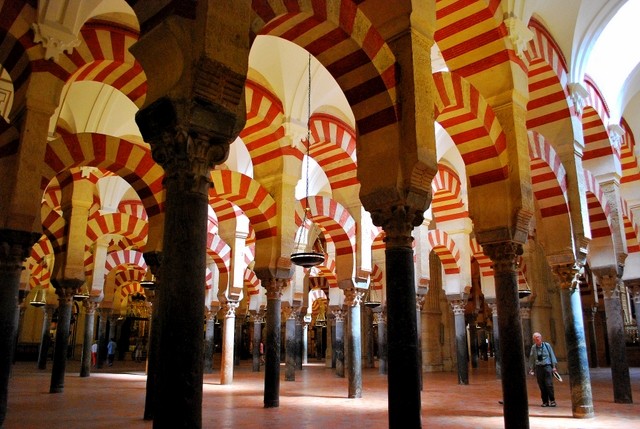
Inside Cordoba Mosque – The largest in Spain  (now a Cathedral)

Cordoba

Cordoba fell to the Muslims in 711 A.D. The Muslims marched north, finally reaching Cordoba. Magheeth Rumi exploiting a weak defence managed to enter Cordoba and conquer it. Tariq (Allah have mercy on him) conquered many cities, until the Christians flocked to him. Finally, his men became tired of fighting. Then he began to send small armies to different places, each army had only 700 men. Tariq (Allah be pleased with him) penetrated deep into Spain until men were exhausted of fighting. Then he returned to Cordoba and settled there. Musa (Allah have mercy on him) had instructed Tariq (Allah have mercy on him) to only fight with Roderick. He was annoyed with Tariq’s disregard for his command. Musa left with a large of 18,000 in 712 to Spain. It is reported that Tariq (Allah have mercy on him) was imprisoned for disobeying direct commands. He was later released and reinstated. The Muslims showed a tolerance never experienced before. The majority of the population embraced Islam. They took all of Andalus, besides the Northwest area, from where the Christians regrouped. The leader of this group was, Pelayo. Musa made roads into France, he wanted to take the entire Europe and finally reaching Damascus through Constantinople, but he was called back to Damascus before fulfilling his dreams.

Musa ibn Nusayr (Allah be pleased with them) stayed in Spain for three years. He was now 75 years old. The Caliph – Waleed ibn Abdul Malik (Allah have mercy on him) called him back to Baghdad. The actual reason we are unaware of, but possible reasons

  1. He was powerful and had conquered the whole of North Africa, so Waleed thought he is getting to much authority.
  2. Waleed became insecure, about himself and his relationship with Musa.

So, Tariq ibn Ziyad (Allah have mercy on him) and Musa ibn Nusayr (Allah have mercy on him) went to Waleed (Allah have mercy on him). By the time they reached the Caliph, he was dying. Whenever Musa (Allah have mercy on him) conquered a land, he would send the treasures and booty to the Caliph. On his journey back from Spain he brought all the treasures back but someone advised him not to give the treasures. Musa said he wanted to bring them back. This led to slight tension between Musa (Allah have mercy on him) and Sulayman ibn Abdul Malik, who was the brother of Waleed (Allah have mercy on him), as Sulayman wanted the wealth from Spain. Musa meets the Caliph and shortly afterwards, the Caliph dies in 94h.

When Sulayman took over the throne he despised Musa (Allah have mercy on him), so he tortured him. A 75 years old man was made to stand in the heat of the blazing sun, he already had asthma. Umar ibn AbdulAziz (Allah have mercy on him) was an Umayyid, he was around at that time. He says, “No day was worse for me than seeing the old man, an old mujahid, indebted on the Ummah, the conqueror of North Africa being tortured like this.”

Umar (Allah have mercy on him) went to the caliph and said, “I do not pledge allegiance to a king who tortures old men like this!”

Sulayman uplifted the torture, but paced heavy fines on Musa (Allah have mercy on him).

Some scholars say, they were both at peace with each other later. Others write, they went Hajj together.

He died either of poverty or illness.

Imam Shafi’ee (Allah have mercy on him) said, “Some people die and their evils remains on. Others die and their goodness remains on.”

We all remember the Khayr Musa ibn Nusayr (Allah have mercy on him) left behind. Just like When Hussayn (Allah be pleased with him) was martyred, Yazid was rejoicing. But, in the eyes of Allah Hussayn (Allah be pleased with him) was accepted. Also, Hamza (Allah be pleased with him) – the uncle of the Prophet (peace and blessings be upon him) had his liver chewed and his body mutilated. But, later was known as ‘Asadullah’, The Lion of Allah.

Ibn Mulhim (Allah have mercy on him) says, “It was amazing that Musa (Allah have mercy on him) even went to Waleed (Allah have mercy on him) when he was called. Because he already had Spain and parts of France under his rule.” This shows the sincerity of Musa (Allah have mercy on him). The same happened with Khalid ibn Waleed (Allah be pleased with him), the last four years of his life he did not fight. This was because Umar (Allah be pleased with him) demoted him. The last year of his life, was called the ‘Year of Women’, as he could not fight.

But the story of Musa (Allah have mercy on him) did not end there, they assassinated his son Abdul Aziz (Allah have mercy on him). He was reading Surah Waqiah at the time. All out of spite and hatred. And Abdullah, the other son was also martyred! Inna Lillah…

The head of Abdul Aziz (Allah have mercy on him) was bought to Musa (Allah have mercy on him) whilst he was alive. Sulayman asked Musa (Allah have mercy on him), “Do you know who he is?” Musa said, “This was a pious man who conquered Portugal and the Ummah is indebted to him.”

The reason for killing AbduAziz (Allah have mercy on him) was, he married Roderick’s wife to create ties between the Christians and Muslims. Sulayman thought he would be a sell-out.

Sulayman died in 99h.

IMG-20160515-WA0046.jpg
“Dominance is only for Allah!” Written on many of the palaces.

Over the next 40 years Spain had 21 or 22 governors, there was absolute mayhem. Muslims had a lot of loss, they were demoralised and lost motivation. There was 100 tonnes i.e. 100 opinions about everything. It was like what happened in Uhud, 50 archers and Saeed ibn Jubayr (Allah be pleased with them).

For this, we say, that the more the Dunya opens up before the people, and they end up concerning themselves with it, they will lose as much of the Akhira as they have gained from the Dunya. The Prophet (peace ad blessings be upon him) said: “By Allah, I am not afraid of your poverty,” meaning I am not afraid of poverty for you, for the Dunya will open up before you, “but I am afraid that you will lead a life of luxury as past nations did, whereupon you will compete with each other for it, as they competed for it, and it will destroy you as it destroyed them.” [Bukhari & Muslim].

The Messenger (peace and blessings be upon him) spoke the truth. This is what has destroyed the people today. What has destroyed the people today, is their competing with one another for the Dunya, and them being as if they were only created for it, and not it created for them. So they have preoccupied themselves with what was created for them over what they were created for. This is backwardness. We ask Allah for protection.

Amongst the famous rulers were:

Samh ibn Khawlani (Allah have mercy on him), the fourth viceroy. He was the viceroy in the time of Umar ibn AbdulAziz (Allah have mercy on him). He was martyred at the siege of Toulouse in 721 A.D. In 1030/721 a man called Bulai, with some renegade Christian took to the mountains to start a guerrilla against the Muslims. Anbasa, moved quite deep along the Rhone River. In 725 A.D. Anbasa was ambushed and killed.

The most successful and tragic expedition as that of Abdul Rehman Ghafiqi (Allah have mercy upon him). Eudes tried to stop but to no avail and called up Charles, who was later known as Martell (Hammer). The Battle of Poiters (Battle of Tours) is regarded as one of the most defining battles in the history of the West. The Muslim army was considerably smaller, Muslims were all infantry and Christians all cavalry. The battle began and raged doe an entire week from 25th to 31st October 732 A.D.

The most disturbing aspect of the history of Spain is the amount of internal strife amongst the Muslims. Arabs against Arabs, Berbers against Arabs, new Muslims against the ruling elite. There are three types of Arabs:

Al-Ba’idah – They existed but no longer do e.g. the people of ‘Aad and Thamud.

Al-Aaribah – The original Arabs i.e. The Yemenis aka Kelbites.

Al-Musta’ribah – Those who became Arabs later. The Prophet (peace and blessings be upon him) was from this category, as Ibrahim (peace and blessings be upon him) travelled to Makkah, Hajar (Allah be pleased with her) did not even speak Arabic. They were also known as Qaisites.

Two later rulers who ignited the wars of racism in Spain were Hudhayfah (728-730) and Haitham (729-730).

Then the Berbers revolted, this led from the inequities between the Arabs and the Berbers. The Berbers were looked down on before Islam, could now equal the Arabs on all fronts. The next to cause great mischief was a man called Shomal (the grandson of Shimr, the man who beheaded Hussain RA at Karbala).

The two armies met at the bank of the Guadelate in 745 A.D. Ibn Khattar’s army was routed.

IMG-20160520-WA0014

Abdul Rahman (The Hawk of Quraysh/Falcon of Andalus)

The largest opposition to the Umayyads was the Abbasids; their leader at the time was Abbas, the grandson of Abbas (Allah be pleased with him). Abdul Rahman (Allah have mercy on him) had to flee to save his life. He finally reached the Berber tribe of his mother, Nazfa, situated in Naqur, four years after fleeing. The time was right for Abdul Rahman to make his appearance. Andalus was in a state of chaos due to the internal feuding. He wrote a letter to the Syrians and Ummayads living in Andalus. This iletter was taken by Badr in June 754. Abdul Rahman (Allah have mercy on him) had to wait an entire year in suspense for the response. On August 14th 755 A.D. he arrived in Spain and had mass defection in his favour. He took Seville peacefully. With his victory at Cordoba on 15th May 756, he sealed his name in history. He defeated Yusuf and Shomal. He was crowned the ‘Ameer of the Muslims.’ Mansur often praised his foe and it was him who give him the title, “The Falcon of the Quraysh.”

Abdul Rahman (Allah have mercy on him) did not like to wage war unless there was no other option, hence he would always start with the option of peace. Others were children who were bought from Europe, but they were brought up in Islam and were fundamental to the army and state. He was always ready to help his subjects.

IMG-20160521-WA0038
Inside Cordoba Mosque
Zakariya master 20160513_171450
The gateway to Cordoba [al-Qil’ul Hurriya]

Ismail Ibn Nazir Satia (One who is in dire need of Allah’s forgiveness, mercy and pleasure).

15 Sha’ban 1437


Categories
Current Affairs articles

A few days in Spain (Part I)

Alhumdu Lillah! After having returned from the tour of Andalus with as-Suffa institute, it was a phenomenal experience and it left me in deep thought, worry and concern with regards to the lessons we can learn from Muslim Spain. I have decided to share my notes from the journey and the Dars of Shaykh Zahir (Hafidhahullah) with you all. Please forgive me if certain areas are brief and if there is a lack of references, as you can understand sometimes Hadith are mentioned but not under a reference. I will try to attach pictures where possible as well. If there is anything you would like further clarification about, please comment at the bottom. I would like to thank asSuffa from the depth of my heart for organising this trip, Allah reward them for their efforts and bless Shaykh with further knowledge and Barakah. Ameen.

عَنْ أَبِي هُرَيْرَةَ، أَنَّ رَسُولَ اللَّهِ صلى الله عليه وسلم قَالَ ‏ “‏ السَّفَرُ قِطْعَةٌ مِنَ الْعَذَابِ يَمْنَعُ أَحَدَكُمْ نَوْمَهُ وَطَعَامَهُ وَشَرَابَهُ فَإِذَا قَضَى أَحَدُكُمْ نَهْمَتَهُ مِنْ

وَجْهِهِ فَلْيُعَجِّلْ إِلَى أَهْلِهِ ‏”‏ ‏.‏

From Abu Hurayrah that the Messenger of Allah, may Allah bless him and grant him peace, said, “Travelling is a portion of the torment. It denies you your sleep, food, and drink. When you have accomplished your purpose, you should hurry back to your family.” (Muwatta Malik).

01-DSC_5137-be59c79665.JPG

Normally, we are in our daily routine, we do the same thing every day. We do not realise things about ourselves, our habits and temperaments etc. When we travel on a journey, especially with others these habits come out. Like we can see from the above Hadith, travelling deprives us from our food, sleep and drink etc. We all know what happens when we take a man’s sleep or food away. The quote of Umar (Allah be pleased with him) is famous, about how you only truly know a person once you have travelled with him.

Umar (Allah be pleased with him) asked about a man who had given testimony, wanting to find out whether anyone could vouch for him. A man said to him: “I will vouch for him, O’ Ameer al-Mumineen, ‘Umar asked, “Are you his neighbour?” He said, “No.” He then” asked, “Did you mix with him for a day and come to know his character?” He said, “No.” He asked next: “Did you travel with him, for traveling and being away from home reveal a man’s true essence?” He said, “No.” ‘Umar said, “Perhaps you saw him in the-mosque, standing, sitting and praying?” He said, “Yes.” ‘Umar said, Go away, for you do not know him.”

A very profound saying, when travelling with others especially in a group, our true colours are revealed through our conduct as:

1. Much patience is required because people desire & think differently.

2. Whilst we should neither keep others waiting nor impose our views on the rest, we should be prepared to be delayed by others as that is part of group travel.

3. We should be ready to serve the rest.

4. We should abstain from petty complaints.

5. We must be considerate of others esp. the weak, elderly & children.

09-DSC_5328-4e74c67be2Why do we study history?

A great portion of the Qur’an speaks about history, approximately 1/3. When one reads history it is as though he is reading the future because history often repeats itself, so if we can’t learn from our own mistakes we can learn from the mistakes of others. As we all know a man’s nature doesn’t fundamentally change.

“Narrate to them stories (of the past), so that they may reflect.” (al-A’raaf)

“We narrate to you [O Muhammad] the best of stories in what we have revealed to you of this Qur’an, although, you were, before it, from the unaware.” (Surah Yusuf)

Nations ascend and descend, some disappear. Nations ascend because they have something called impetus.

Ibn Khuldoon (Allah have mercy on him), he has a theory, the ‘cycle theory’ which scientists still use today. Anyone who has a surname ending in ‘doon’ or ‘coon’ means their ancestors were form Andalus.

Once upon a time the population was over 75% Muslims in Spain.

Umar (Allah be pleased with him) was sat one day, very worried. So, someone asked him as to why he look worried. As Islam was spreading far and wide into India and Central Asia and Africa. Umar (Allah be pleased with him) replied, “This is why I am worried!”

What Umar (Allah be pleased with him) was referring to was that most nations reach their pinnacle and prosperity, then they decline.

“And you will not find in our way (Sunnah) any alteration.” (17:77)

Allah has some principles that never change, in the same way man has some habits which never change. For example, water boils at 100 degrees, it has always boiled at 100 degrees.

We must remember Islam is continuous and will remain at all times. It is the truth and the truth must reach the people.

The word al-fath in Arabic means to conquer or open. Islam spread by sending armies to countries. They were not forced. Countries as far as Yugoslavia, Greece and Caucasus. There were two countries where armies were not sent and they accepted Islam, Indonesia and Malaysia.
04-DSC_5205-ca4ebd644d.JPG

Why study history of Spain?

Spain is very close to us British Muslims in Europe.

Only 1% of Muslims came to Spain, they went from a minority to a majority, then back to a minority. You had both types of leaders, good and evil. You had pious and knowledgeable leaders as well as very bad, very treacherous and very deceitful leaders.

You wonder why Muslims would become sell-outs and give in to the Christians. The answer is simple, if in 100 years’ time today’s history was written, people would say how did Burma happen, how did the issue of Palestine not get solved, how did Muslims get oppressed in Syria?

Just like we think today why did Muslims allow the Spanish to get 400 years of persecution. Morocco is 12 miles away from Spain, why didn’t they help?

Similarly, many places were pre-dominantly Muslims, but they no longer remain the majority. Like Malawi and Philippines.

Why have so many scholars/poets written about Spain?

  1. Far out-post of Islam
  2. Because of what it created. There was no place in the world equal to it.

Many people when hearing about the situation of the Ummah – current or past, tend to say, “Let them do what they want, this is Allah’s Deen.” My answer to this is do not live off slogans, live off actions/a’maal. Also, remember, Allah will protect his Deen, but will Allah protect you? Especially if you don’t act accordingly.

Background

The word Andalus is the Arabic name for the Iberian Peninsula what is known today as Spain and Portugal, the Greeks called it Iberia and the Romans called it Hespania. The land of Spain was ruled by the following, before the Muslims:

Greeks

Celts

Romans

Vandals

Visigoth

The Romans brought the Latin language and Spanish evolved from there. The word Andalus came from the word Vandals, these were people who were rough and evil.

The Muslims were generally known as Saracens or Moors.

Visigoths were Pagan but later embraced the Catholic religion. Within 200 years of ruling they began to oppress others and treat them like animals. Although the Goth conjures up a Barbarian perception, they inherited an advanced society with theatres, dams, bridges and circuses. An advanced political system all of which the Goths benefited from.

What was going on in Europe when the Muslims came?

The Europeans were generally unclean and unhygienic. They only bathed once a year, or at the most twice a year. This is because they thought it weakened their immune system. James Burke describes they mixed their impurity (stool and urine) in the middle of the road and walked in it. They had no issues with that nor was it frowned upon.

Amr ibn al Aas (Allah be pleased with him)

At the shortest point, there are only 12 miles between North Africa and Spain. Amr ibn al Aas (Allah be pleased with him) was the first person to conquer Africa, he was very intelligent. When he left Makkah, Khalid ibn Waleed (Allah be pleased with him) said, “Today Makkah has thrown away her liver.” When Umar (Allah be pleased with him) sent him to North Africa, he later sent a letter with a messenger:

“If this letter reaches you before the Rafah border, then do not cross it. If you have crossed it, then no matter.”

When Amr (Allah be pleased with him) received the letter, as he was intelligent he knew what it would have said – not to cross! So he crossed the border, then read it!

Uqba ibn Nafi (Allah be pleased with him)

After Amr ibn al Aass (Allah be pleased with him) the next conqueror to embark on the conquest of North Africa was Uqba ibn Nafi (Allah be pleased with him). He was the nephew of Amr ibn Aas (Allah be pleased with him). He was appointed the governor of North Africa in 50/67. He took great portions of Egypt with 4,000 men. He was ambushed on his return and martyred. He passed away in 638 A.D. Islam reached North Africa 23H.

Nusayr (Allah have mercy on him)

Nusayr (Allah have mercy on him) was studying to be a monk when Khalid ibn Waleed (Allah be pleased with him) conquered Ayn Tamr. He was born a Christian who embraced Islam. Employed by Muawiyah (Allah be pleased with him), he was in charge of the police. When the battle took place between Ali (Allah be pleased with him) and Muawiyah (Allah be pleased with him), Nusayr said his famous words to Muawiyah (Allah be pleased with him) when he rebuked him:

“I will not show my gratefulness to you by showing my ungratefulness to He who is greater than you.” Muawiyah (Allah be pleased with him) asked, “Who is that?” He replied, “Allah!” Muawiyah (Allah be pleased with him) put his head down and said, “Astaghfirullah.”

He once said about Uqba (Allah be pleased with him), “Did nobody tell Uqba (Allah be pleased with him) to consolidate what you have then advance?” This was because was Uqba (Allah be pleased with him) was conquering lands but not consolidating the areas i.e. educating them, building ties and winning the hearts of the local people. His son was Musa ibn Nusayr (Allah have mercy on him), who conquered the entire North Africa and Andalus. He was the most important man in the history of Spain.

Musa ibn Nusar (Allah have mercy on him)

He was born in 19H during the Caliphate of Umar (Allah be pleased with him). He was a Tabi’ee and narrated from the Sahabah (Allah be pleased with them). He began to assess the reason why the Berbers could not be kept in check. By 91H he had the entire North Africa subdued. He began to assess the reason wy the Berbers could not be kept in check. He realised that the victories were achieved very quickly without the consolidation of the conquered land. Uqba (Allah be pleased with him) would take a country swiftly, but only to rebel later. So he decided to consolidate any land that was conquered and win the hearts of the people. Once he was happy with the situation, only then he would move on. Secondly, no system of education was provided for the conquered people, so he brought scholars to educate them, until the Berbers began to love Islam and became great defenders of the religion. He built Madrasahs everywhere he went.

On a side note here, Shaykh Zahir mentioned, “short bursts don’t last long.” If we look at the French, they spent 130 years in Algeria. But, they didn’t convert a single person, why? Simply because they didn’t consolidate and win the hearts and minds of the people.

Remember, Da’wah has to be multi-faceted, Da’wah must be consolidated. There are many people out there giving Islam a bad name, we need to give Islam a good name in the right manner.

The first person to mention the conquering of Andalus was Uthman (Allah be pleased with him), when he talked about the conquering of Constantinople. The Prophet (peace and blessings be upon him) said, “Muslims will conquer Constantinople.” Everyone wanted to be a part of this army. 27H was the first time Muslims came to Andalus, they just stopped at the port.

When Muadh ibn Jabal (Allah be pleased with him) went to Roe, the Byzantines said, “Why are you going to attack us? Go to Ethiopia it is easier for you.” Muadh (Allah be pleased with him) related the verse:

“O you who believe! Fight those who re close to you of the disbelievers. Let them find in you harshness. And know that Allah is with those who fear him.” (9:123)

Umar (Allah be pleased with him) was very impressed by the history of Persia.

In an Islamic society in which the basic beliefs and principles are both deeply-rooted and dominant, behavioural motives are greatly influenced by the aspiration to please Allah and gain His reward in the hereafter. The best Muslim believers do not include any other motive for their actions. It is essential for the Muslim to ensure that his intention in all his deeds is aimed solely at pleasing Allah, be they acts of self-purification, or any social, economic, or political activities. The activities of a Muslim in all spheres of life must be directed towards pleasing God. The Muslim knows well that if he were to include anything else in his intention besides God, then his deed would be unacceptable, as stated in the hadith: “Allah does not accept any deed except that which is purely intended for Him and is done for His sake.” If this way of thinking is guiding many conscientious Muslims even today, then what was its influence on the generations of the companions of the Prophet and those who followed after them (tabi`un), who were the best of all generations?

The knowledge of the effect which Islam exerted on the education of its followers in the first period of Islam – and on the purification of their souls, and polishing their minds, the sincerity of their religious belief, together with their directing their worship to God alone – makes it abundantly clear that their participation in the military campaigns known as al futuh (the conquests or ‘opening up’ of other lands) was not primarily motivated by any worldly ambition. Rather, it was the compelling desire to propagate Islam, to enable it to take firm root in these lands and to organize and administer the newly-conquered territories. It was the wish to solve the economic problems of these lands, and any new problems which might arise, in accordance with the true teachings of Islam. The Muslims were not motivated by any desire to dominate those peoples or to acquire their wealth, nor were they attempting to escape from the hardship of life in the desert, as has been maintained by Caetani and other Orientalists.

Al Tabari (Allah have mercy on him) narrated that Rabi` ibn `Amir (Allah be pleased with him) entered the court of Rustum, the Persian leader, who asked him: “What brought you here?” Rabi` (Allah be pleased with him) said: “God sent us, and He brought us here in order to lead whom He wills from the worship of man to the worship of God alone; from the narrowness and oppression of this world to the space and abundance of the hereafter; and from the injustice of other religions to the justice of Islam. He has sent us with His religion of His creation, to call them to Him.”

What Rabi` ibn `Amir (Allah be pleased with him), the representative of the Muslims, said to the Persians was not only the expression of his personal feelings. Rather, it voiced the thought which was predominant among the Muslim leadership and most of the Mujahidin. This does not exclude the possibility that some of the Bedouin who had participated in the military expeditions had been attracted by the prospects of material gains and booty, in addition to the desire for jihad; but these Bedouin did not represent either the leadership of the movement or its motivating spirit. We must state this because the Muslim society is a human society. In it are found the elite who are committed to the highest moral and spiritual ideals, with their intentions directed purely towards God, who are desirous of earning His good pleasure and who direct their efforts towards achieving this end. But there are also lesser classes of Muslims who take it upon themselves to maintain the minimum standards which will entitle them to call themselves Muslims.

We must explain clearly that the interpretation of the course of Islamic history during the first period of Islam can only be undertaken by a Muslim who repeats daily what God said to his Prophet: “Say: ‘Truly my prayer and service of my sacrifice, my life and my death, are (all) for God, the cherisher of the worlds: No partner hath He; this am I commanded …’”. (Al-An`am 6:162-163). This is the Muslim whose mind and emotions have been affected by the Qur’an and the Sunnah, who has felt their impact in moulding his personality and determining his actions and conduct. This is why Westerners and Orientalists have failed to understand the true motives for the actions of Muslims during the first period of Islam. For example, when Henri Lammens, a well-known Orientalist, discussed the incident of the Saqifah of Banu Sa`idah (an early example of the application of the Shura, in which the majority was persuaded by the minority) his judgment of this incident was impaired by his recollections of the conspiracies at the French court of the fifteenth and sixteenth centuries, which distorted his eventual depiction of the incident. He concluded that the outcome of the meeting of Saqifah came about as the result of a conspiracy woven by Abu Bakr (Allah be pleased with him), `Umar (Allah be pleased with him) and `Uthman (Allah be pleased with him), who, in the Saqifah of the Banu Sa`idah, had agreed to seize the caliphate and succeed one another.

The studies of the Orientalists are numerous, and differ in their levels, quality, and freedom from religious and racial prejudice. However, these studies are usually carried out by scholars who live in environments which are remote from Islam, and which have their own philosophies and cultures. It is difficult for them to appreciate Islam and consequently, it is difficult for them to understand the true reasons for a Muslim’s conduct, both individually and socially. When they seek to interpret the history of Islam, they draw analogies with European history, despite the very different natures of the two histories. We must not forget, moreover, that the Europeans cannot but help looking at the world from their own perspective, which is militarily and technologically superior. Thus they tend to ascribe every possible merit to themselves, while ascribing defects to others. When Toynbee wrote his history of world civilizations, he allotted only a small space to the history of Islam, a space which was not commensurate with the size of Islam’s real contribution to world history.

The most glaring deficiency of the Orientalists’ studies is their failure to arrive at a correct understanding of Islam, its true spirit, and its effect on an Islamic society and on the course of that society’s history. This is a grave deficiency which prevents our acceptance and approval of these studies, especially those which are concerned with the Sirah and the era of the Rightly-guided Caliphs, when the practical implementation of Islamic theory coincided with the theory itself and faithfully reflected it.

Hitler once said, “Victorious are those who write history.”

“History would be kind to me, because I am going to write it.” – Winston Churchill

So, history belongs to those who write it. And history doesn’t do justice to Umayyads, it was written by Abbasids.

The Umayyads spread Islam in three different directions:

Muhammad ibn Qasim al-Thaqafi (Allah have mercy on him) = Sindh

Utaybah ibn Muslim al-Bahili (Allah have mercy on him) = China

Muslamah ibn Abdul Malik = Caucasus

23-DSC_5688-66ab4f9be2

Julian

The ruler of Spain at the time, before the Muslims conquered was a man called Roderick. He had sexually abused many young boys and girls at the time. One of which was the daughter of Julian, her name was Flora. This angered Julian, when he came to know if it and sought after help from the Muslims. This was because Musa ibn Nusayr (Allah have mercy on him) was already planning an attack on Andalus. But he said to Julian, “I cannot trust you, as you are a Christian and so is Roderick. And we are not familiar with the landscape of Andalus.” He tells Julian to initiate the attack to prove he is strong on his word. Julian attacks eastern coasts of Andalus, then reports back. Musa (Allah have mercy on him) then reports back to the Caliph in Baghdad – Waleed ibn Abdul Malik, who then sends a small army.

Tariq ibn Ziyad (Allah have mercy on him)

He was a Berber, he was blue-eyed and had blonde hair. It is said, that Berbers descended from Europeans.

Furthermore, a wife of a sorcerer when seeing Tariq said, “Your appearance resembles that of the conquerer of Andalus about whom my husband predicted.” She recognised him by a mole, Tariq (Allah have mercy on him) had a mole on his face. Tariq ibn ZIyad (Allah have mercy in him), landed in Gibraltar in 711/92 with 7,000 men and 300 Arab nobles. A stretch which is about 11 miles. He requested further reinforcements and the army swelled up to 12,000. The armies met at La Junda.

Tariq had a dream which inspired him and the soldiers. He saw the Prophet (peace and blessing be upon him) and his companions with their swords out, giving him glad tidings of a victory.

Roderick was the last Gothic King, he usurped the throne after the death of king Wizita. He was 80 years old at the time of the battle. Roderick confronted Tariq (Allah have mercy on him) with an army of 100,000. The two armies met at Guadelate. Musa prepared the Muslims, especially Berbers for Jihad. He placed at the head of the army, the most suitable person, Tariq ibn Ziyad (Allah have mercy on him).

So Musa (Allah have mercy on him) now sends Tariq ibn Ziyad (Allah have mercy on him) with an army. Tariq was considerably young. This is something which shouldn’t be frowned upon, as the last army which the Prophet (peace and blessings be upon him) sent had Usamah (Allah be pleased with him) as the commander under him were great Sahabah (Allah be pleased with them) like Umar (Allah be pleased with him) and others. The reason why Tariq (Allah have mercy on him) was chosen was due to his admirable piety and his inexhaustible desire for Jihad. Also, we must remember that Musa (Allah have mercy on him) was an Arab and Tariq was a Berber, the majority of the army was Berber. Tairq understood the culture, language and habits of the Berbers. An important point to note here is when giving Da’wah, especially abroad, we must also understand that culture, language and habits of the people. Another noteworthy reminder is that Musa (Allah have mercy on him) chose the best man for the job, he didn’t look in finding an Arab. He looked for who suited the role. “O mankind! We have created you from a male and a female, and made you into nations and tribes, that you may know one another. Verily, the most honourable of you with Allah is that (believer) who has al-taqwa [i.e., is one of the muttaqoon or pious]. Verily, Allah is All-Knowing, All-Aware” [al-Hujuraat 49:13]

The Prophet (peace and blessings of Allah be upon him) said in his last sermon: “O people! Verily your Lord is One and your father [Adam] is one. An Arab is no better than a non-Arab, and a non-Arab is no better than an Arab; a red man is no better than a black man and a black man is no better than a red man – except if it is in terms of taqwa (piety)…” (Reported by Imam Ahmad, 22391).

Unfortunately, we do not see this in our society today. Not even in Islamic institutes. When a father dies he makes his son the Ameer or principal, although he may not be fit for the role. We will see more examples of this causes failure in the history of Spain.

To the south of Spain there are three islands known as Balearic Islands; Ibiza, Majorca and Minorca.

Musa (Allah have mercy on him) first consolidated his power in these islands then moved on to Spain. Tariq (Allah have mercy on him) first landed on “Jabalut-Tariq,” which is known as Gibraltar today. He has a few battles then consolidates al-Jazeeratul Khadhra (Green Islands), also known as al-Jasairas. Meanwhile, Roderick was already having a battle in another country. His men sent him a message,

“We have been attacked! There are 7,000 men. Men, the like of which we have never seen before. We do not know if they are from Heaven or from Earth!”

Roderick pondered and thought, 7,000 is a small number and we will easily defeat this army.

I would like to narrate a story at this point, but unsure if it is true and authentic: A king had a dream many years ago before this war, that someone will come and takeover Spain. He went to a magician, and the magician confirmed this is true. But he said he will help the king by casting a spell in a room. So long as you do not open the door of this room, Spain is safe. This message was passed on each time a king passed away. Every new ruler would put an extra lock on. But when Roderick heard about this he was anxious to find out, what was in the room. He was advised by his ministers not to open the locks, but he refused to listen. They even said, “We will give you double the amount of gold of what is in there.” He ignored them and opened 27 locks! Inside was a table from the period of Sulayman (peace and blessings be upon him) and many other things were found. (Ahmed Thompson)

The battle started on 28th Ramadhan 22H/19th July 711and carried on for 8 days. The Muslims were fighting on Eid as well! The Christian army was five times the size of the Muslim army, Musa sent another 5,000 men which totalled 12,000 for the Muslims. When Roderick saw them, he lost his appetite. He sent emissaries to speak to them, Musa (Allah have mercy on him) beheaded the messenger and then they cooked him and sent him to the Christians. This was to give an impression to Roderick of how courageous they were. The Prophet (peace and blessings be upon him) said, “War is a deception.” Which means sometime what we think of the other party in terms of numbers and weaponry isn’t always as it seems. It is for this same reason we do ‘Ramal’ (jogging with the chest out) in Tawaf (circumambulation of the Ka’bah).

Tariq (Allah have mercy on him) led from the front, he was dressed simple and looked humble. Whilst Roderick was arrogantly sat on his throne, dressed in his crown and robes. You could say the Christians were ‘playing at home’, they were on their own land. But, slowly, the Muslims got the upper hand. Roderick knew the only way the Muslims could defeat them was to kill him, so he stayed behind his army. Finally, Tariq (Allah have mercy on him) attacked Roderick and killed him. They found one sandal of Roderick’s, which was worth 100,000 Dinar. He was the last Visigoth King of Spain. Tariq’s army was thoroughly enjoying the booty. He once said, “If you carried on with me, I would go all the way to Constantinople.”

We stopped here and Shaykh mentioned a point which every Muslim should remember and instil:

We should never be proud just on the basis of being Muslim. Just being Muslim will not get us anywhere! We need a vision and we need to become “people of substance.” I call these Shaykh’s favourite lines (hope he doesn’t mind), rightly so as well. Many of us rely on the fact we pray the Kalimah/Shahadah or we pray Salah and adorn a beard and sisters wear Hijab – which is all good and well, but not sufficient. The price of Jannah is not cheap! We are over a billion today, but let not our numbers deceive us. We need substance:

Look on the day of Badr, only 313. But they had substance! Allah says: “And Allah had given you victory at [the battle of] of Badr, while you were weak.” (3:123) The Arabic word ‘Athillah’ here means – i) few in number ii) disgraced and humiliated. So, here they were few but overcame 1,000 because they were humble and obeyed.

Let us look at the next battle after Badr – Uhud. Muslims had the upper hand initially. But 50 archers on a hilltop were ordered by the Prophet (peace and blessings be upon him) not to move from their places, if they are winning or losing or even vultures are pecking at their bodies. When the Muslims had the upper hand, these archers started rejoicing forgot the command of the Ameer SAW and descended. Which resulted in Muslims losing the upper hand. Again, we learn the lesson of following the Ameer – no matter what.

Numbers also deceive the Muslims, Allah talks about the battle of Hunayn. Muslims were many in number so thought they will ultimately win the battle. The battle turned upside down, they even left the side of the Prophet (peace and blessings be upon him), only ten Muslims were left with the Messenger (peace and blessings be upon him). Unfortunately, 3,000 Muslims were martyred. Inna Lillah… “Allah has already given you many victories and [even] on the day of Hunayn, when your great number pleased you.” (9:25)

Now, we would like to make some clarifications about the story so far, particularly about Tariq ibn Ziyad (Allah have mercy on him):

Did Tariq ibn Ziyad (Allah have mercy on him) burn the ships on the shore of Gibraltar?

This is a fabrication from amongst the fabrications told in history and there are many reasons for this –

  1. The ships did not all belong to Tariq, Julian owned most of them.
  2. Fuqaha RH did not speak about this incident and Ulama RH have not wrote about it.
  3. Waleed ibn Abdul Malik who was the Caliph at the time did not mention it.

The second fabrication was the famous Khutbah which Tariq ibn Ziyad (Allah have mercy on him) and has been attributed to him. Many scholars say that this was not given by Tariq. Simply because he was a Berber, and the Arabic was too eloquent.

In Islam before attacking a land the enemies were offered three choices:

  • Accept Islam
  • Pay the tax/Jizyah – 1 dinar
  • Fight against us

If a non-Muslim defended the Muslims or their army, Umar (Allah be pleased with him) uplifted the Jizyah from them. There was a certain time in the era of Abu Ubaydah (Allah be pleased with him) when the Muslims could not protect the non-Muslims. Their enemy was too strong, Abu Ubaydah (Allah be pleased with him) gave the Jizyah back to the non-Muslims. In the time of Umar (Allah be pleased with him), he saw a Jew begging. Umar (Allah be pleased with him) asked, “Why is he begging when he pays Jizyah?” He went to their leader and said pay him from Baytul Maal.

The rule was, you can only take Jizyah from those who can afford it.

Jews

When the Muslims came to Spain the Jews flung their doors open. The Jews had been persecuted by the Christians and were pleased to assist the Muslims. The Muslims even left the Jews in charge of many cities as they advanced; cities such as Cordoba, Granada and Malaga. Whilst the Christians were in the churches praying, the Jew flung open the doors of the Forts for the Muslims.

The largest Jewish population was in Muslim Spain.

Heretical Christian Sects

There were many Heretical Christian Sects. If you belonged to a group besides Catholicism life was hard for you. The Muslims then arrived and gave refuge to the heretic Christian refugees. It reminded people of Najashi giving refuge to the Muslims, this was like the Muslims paying Najashi back. Many people had previously sold themselves as slaves to the church or to Christians. As it was much easier, because their food and home was guaranteed. Now, so many Christians were flocking to Islam.

There was only one Sahabi, Munayzir al-Afriqi (Allah be pleased with him) who came to Spain. From 12,000 Muslims one Sahabi, the rest were Tabi’een (mostly).

Some European historians said: “Tariq beat Roderick up and imprisoned him.” The Muslims don’t have any record of this.

The son of Musa ibn Nusayr, Abdul Aziz (Allah have mercy on him) took Portugal. Musa (Allah have mercy on him) had now taken 18 cities.

Muslims showed tolerance like never before.

Muslims encouraged inter-marriages, Arabs marrying Berbers etc. This is why they felt the unity.

By 811 A.D Spain was 8% Muslim.

By 850 A.D. Spain was 12% Muslim.

By 900 A.D. Spain was 25% Muslim.

By 950 A.D Spain was 50% Muslim.

By 1000 A.D. Spain was 75% Muslim.923329_10151602549395813_1260670182_n

Ismail ibn Nazir Satia (One who is in dire need of Allah’s forgiveness, mercy and pleasure)

7 Sha’ban 1437

Categories
Current Affairs articles

The Fall of Andalus

Looking into the Court Yard, Alhambra

andalus

Listen brothers, listen sisters, listen carefully to a story of sorrow and pain,

This is the story of the fall of Andalus, known as Muslim Spain.

Long, long ago a man called Tariq RH, with the order of Musa Bin Nusayr RH,

Conquered the beautiful land and all of its terrain.

Allah SWT gave them glory because of their pure hearts and what they did contain,

They travelled from North Africa up to the Mediterranean.

Fiercely they fought, unafraid, strong soldiers, waging warriors, like lions – the whole country did they gain,

The glad tidings had already been received from the Messenger of Allah SAW and his companions RA.

The young boy, Tariq RH was made to be the captain,

A fleet of ships arrived with men who didn’t look back as they planned to remain.

Powerful and courageous, bold and brave,

The enemies were confused – are these people from Earth or descended from Heaven?

Tariq RH was spiritual, a holy boy, who sincerely worshipped Allah and from all evil did he abstain,

Recognised by a mole on his face, he stood like a commander, devout and honest, free from name and fame.

In the books of history, he is recorded and illuminated will be his name,

He understood the purpose of life and that life is not a game.

At this time Islam was flourishing like the speed of a train,

City after city, town after town, one after the other like a long chain.

Let us not forget, this was the country that contained a Masjid – largest in the world, ‘Masjid Qurtuba’, larger than Haramayn (at that time),

They had palaces and castles, trees and gardens, overlooked by mountains.

Fruit was plentiful, vegetation was abundant, fields green and plain,

Allah’s SWT mercy descended generously by blessing them with rain.

But the tides became heavy and waves were uncertain,

When people forgot Allah SWT, Lord of the heavens, Rabbul Mashriqayn Wa Rabbul Maghribayn.

The rulers became unjust and acted like villains,

Many spent the night drinking wine and champagne.

Women were used to dance, used for lust and only to entertain,

The Masajid were empty and the pulpits (mimbar) began to cry and complain.

Evil was widespread, corruption was rife, the difference between right and wrong they could not ascertain,

All of a sudden, Allah’s SWT help disappeared as though it was uplifted by a crane.

The rulers were busy marrying maidens; hair of blonde; eyes of blue; that looked like Hoor Ayn,

For centuries the land was ruled by the pious, but now they also did not remain.

Their scholars were knowledgeable and they had rulers which were of piety, with Iman as high as a plane,

But they didn’t educate their sons & their daughters to relay the Deen, nor were they trained.


minaret

The minarets cry now for someone to call Allah’s SWT glorious name,

The rows for Salah are seen bare and very plain.

No sign of an Imam or even a chaplain,

Muslims were too busy fighting each other, their own brother had they slain.

They thought blood was cheap like a bargain,

Eventually the Muslims were expelled, or given a choice to be Christian.

Many were tortured, their actions were barbaric and inhumane,

Dear friends, think carefully upon the lessons from Muslim Spain.

Ponder with your intellect and think deeply with your brain,

Let the message sink in, let it ingrain.

For what lasted 800 years, we could not maintain, 

Will the Ummah rise to the challenge ever again?

al andalusandalus 1

Ismail Ibn Nazir Satia (One who is in dire need of Allah’s forgiveness, mercy and pleasure).

[Written 1st Shaban 1436, after returning from the asSuffa Andalus tour]


Categories
Current Affairs articles

Stay in your lane!

images
LONG READ..but essential reading:

“The number of Muslims who don’t stay in their lane, speaking about things they are not qualified on, or ready for, is growing fast; it’s like a viral breakout, a disease which has become endemic amongst us.

Social media really has become a fitnah for them. It gave a platform to those who should not be on it.

Perhaps they were saved from clubbing or dating or doing drugs etc, and instead started “practising” only to become addicted to another drug which is even worse: speaking without knowledge, “educating” without being educated, “warning” when ignorant, typing because they simply can, and so on.

Once one is bitten by the bug of fame and attention, it is near impossible to go back. You think you can start talking about usul because of a few classes you take, and you think you can talk about bid’ah because you can pronounce the letter ‘ayn – in fact, they always seem to have a great letter ‘ayn, right? – and you think you can teach when you are wholly ignorant of the Shari’ah, and you think you can try and explain matters when you don’t even know the Arabic language, let alone all the sciences that follow.

Is this status about YOU? Yes it is. I don’t need to mention one name as a flag-bearer of this disease when I aiming this at 50 of you who try and do the same but at varying levels of success. If you’re thinking “it’s me he’s talking about”, then you’d be right. If you’re feeling paranoid right now, you should be. Because I *am* talking about you. Yes I’ve read your statements. Yes I also have a personal account on social media too and see and read what everyone else is talking about on my friends and liked lists. You shouldn’t have gone there in the first place. This is what happens. If you rise like a balloon, full of gas, then expect someone to pop you when you talk nonsense or try to come across as someone you’re not and mislead people. Is that me judging you? Sure thing. Hatin’ on you? Absolutely. Forcing you to only stick to what you’re good at. Correct.

You wanted to give da’wah? Your keeping silent for a good few years will be the best da’wah you will ever give. You want to be an activist? Get off FB and actually get active and help someone. We don’t need any more heroes online. The world doesn’t need you. Believe me, it doesn’t. Your style isn’t so new, and your approach isn’t so unique so as to justify the masses being exposed to an ignoramus. There is a huge difference between sharing content from qualified people and reminding folks that way – a great and encouraged thing – and you trying to do reminding from your own pocket and not knowing what you’re talking about.

And sometimes, you *will* know what you’re talking about, but you should remain silent. Just to learn the system. Just to learn the skill of patience and humility. It will serve you well later when it is time for you to lead.

I studied for nearly seven years – that’s full time, not part time classes, and that’s proper studying, not “practising” and living as a Muslim – before my teacher told me to go public with da’wah. My mouth and my fingers were quiet during that time. I studied for another seven before I had the belief and support from my teachers that I should have an opinion that is worth listening to. It’s taken me another five years to realise that opinion isn’t worth much at all, wa Allahu’l-Musta’an.

Son, just stay in your lane. Please. For your own sake.”

(Shaykh Abu Eesa Niamatullah via his FB page 4/1/2016)

Categories
Current Affairs articles

Interest or Contest? (With Allah).

Simple-interest---Compound-interest

http://www.inter-islam.org/Prohibitions/intrst.htm

The Definition Of Interest

The literal meaning of interest or Al-RIBA as it is used in the Arabic language means to excess or increase. In the Islamic terminology interest means effortless profit or that profit which comes free from compensation or that extra earning obtained that is free of exchange. Hazrat Shah Waliullah Dehlvi a great scholar and leader has given a very concise and precise definition of interest. He says,

Riba` is a loan with the condition that the borrower will return to the lender more than and better than the quantity borrowed.”

Interest In Pre-Islamic Times

Hafiz Ibn Hajr writes in his commentary of Sahih Bukhari (Fathul Bari):

“Imam Malik reports on the authority of Zaid Ibn Aslam that in the period of ignorance (pre-Islamic times) interest was changed according to the following scheme. One person had a right in the property of another person. It may have been a general right because of the amount lent or the price of something purchased or in any other form. A time was set when the claim would be settled. When the appointed time arrived the creditor would ask the debtor if he wanted to settle the claim or pay interest with an extension to the time. If the claim was settled then there was no increase in the payment. Otherwise the debtor would increase the amount payable and the creditor would extend the period further.

(Vol. IV P.26)

Islam’s View Of Trade

Interest is not a subject without trade and commerce. Islam recognises trade and commerce not only as a lawful profession but also as a moral duty. Islam has laid down a complete set of rules for trade. The reason for these rules is to specify what halal earning is. There are many traditions (Ahaadith) concerning halal provision that can also be found in the books containing the traditions of the prophet (peace be upon him). Actually, Islam has encouraged men to earn their own provision and to provide it to their families. The condition is that the earning has to be according to the conditions set by the Shari’ah. Any sort of transaction that does not correspond to the rules of trade will not be allowed. These rules can be found under the heading of trade in the books of jurisprudence. Interest is amongst those conditions which all dealings must be free from.

How Is Interest Illegal

The definition of interest has already been mentioned as well as that it is prohibited. If we explore the Qur’an we will come across at least four places where Allah has mentioned interest.

The first one is in Surah Al-baqarah verse no.275

“Those who devour usury will not stand except as stands one whom the Satan by his touch has driven to madness. That is because they say, “trade is like usury”, but Allah has permitted trade and has forbidden usury”,

In the next verse verse 276 in the same place he says,

“Allah will deprive usury of all blessing, and will give increase for deeds of charity, for he does not love any ungrateful sinner.”

Two verses later in verse 278 he says,

“Oh you who believe! Fear Allah and give up what remains of your demand for usury if you are indeed believers.”

In verse 279 he says,

“If you do not, take notice of war from Allah and his Messenger sallallahu alaihe wasallm but if you repent you shall have your capital sum. Deal not unjustly and you shall not be dealt with unjustly.”

In the second place in Surah Aal-Imran, verse no.130 Allah says,

“Oh you who believe! Devour not usury doubled and multiplied; but fear Allah that you may prosper.”

In the third place in Surah Al-Nisaa’ Allah states in verse 161,

“That they took usury though they were forbidden and they devoured peoples wealth wrongfully; we have prepared for those amongst them who reject faith a grievous chastisement.”

In the fourth place, Surah Al-Room, verse no.39 Allah mentions

“That which you give in usury for increase through the property of people will have no increase with Allah: but that which you give for charity seeking the countenance of Allah, it is these who will get a recompense multiplied.”

Ahaadith Concerning Interest

These ahaadith have been taken from Mishkat-ul-Masabih under the section of interest and the English translation has been taken from its English version written by Al Hajj Moulana Fazl Karim (218-227 vol. II)

Hazrat Jabir radiyallahu anhu has reported that the Messenger of Allah sallallahu alaihe wasallm cursed the devourer of usury, its payer, its scribe and its two witnesses. He also said that they were equal (in sin).

(Muslim)

Hazrat Abu Hurairah radiyallahu anhu reported that the Holy Prophet sallallahu alaihe wasallm said: A time will certainly come over the people when none will remain who will not devour usury. If he does not devour it, its vapour will overtake him.

(Ahmed, Abu Dawood, Nisai, Ibn Majah.)

Hazrat Abu Hurairah radiyallahu anhu reported that the Messenger of Allah sallallahu alaihe wasallm said : Usury has got seventy divisions. The easiest division of them is a man marrying his mother.

(Ibn Majah)

Hazrat Abu Hurairah radiyallahu anhu reported that the Messenger of Allah sallallahu alaihe wasallm said: I came across some people in the night in which I was taken to the heavens. Their stomachs were like houses wherein there were serpents, which could be seen from the front of their stomachs. I asked: O Gabriel! Who are these people? He replied these are those who devoured usury.

(Ahmed, Ibn Majah)

Hazrat Ali radiyallahu anhu reported that he heard the Messenger of Allah sallallahu alaihe wasallm cursing the devourer of usury, its giver, its scribe and one who refuses to give Zakat and he used to forbid mourning.

(Nisai)

Hazrat Umar bin Al-Khattab radiyallahu anhu reported: the last of what was revealed was the verse of usury. The Messenger of Allah sallallahu alaihe wasallm was taken and he had not explained it to us. So, give up usury and doubt.

(Ibn Majah, Darimi)

Hazrat Abdullah bin Hanzalah radiyallahu anhu (who was washed by the angels) reported that the Messenger of Allah sallallahu alaihe wasallm said: A dirham of usury that a man devours and he knows is greater than 36 fornications.

(Ahmed, Darqutni)

Baihaqi reported from Ibn Abbas radiyallahu anhu in shuabul iman. He added and said: (as for) one whose flesh has grown out of unlawful food, the fire is more suitable for him.

After narrating all these verses from the Qur’an and relating all the Ahaadith it is apparent to us that interest could never be legal and halal. How could anybody even take the time out to think about a matter in which Allah has declared war on the user and his Beloved Prophet sallallahu alaihe wasallm has cursed him? As sensible people we can understand that what our creator has chosen for us is for our own prosperity only.

Interest From A Jurisprudical View

We should deeply thank the Sahaabah radiyallahu anhum in their efforts to spread the religion as they learnt it from the Prophet sallallahu alaihe wasallm. Then when the religion started to spread vastly Allah brought about four imams who described the religion in general terms in order to make the common public understand. They spent their lives trying to put the whole religion in a collective form through the Qur’an and the Ahaadith and the concise decisions of the Sahaabah radiyallahu anum. In the case of interest, all four imams established a general rule mainly concentrating on this statement made by the Prophet sallallahu alaihe wasallm.

Hazrat Al-Khudri radiyallahu anhu reported that the Prophet sallallahu alaihe wasallm said: Gold in exchange for gold, silver in exchange for silver, wheat in exchange for wheat, barley in exchange for barley, dates in exchange for dates, salt in exchange for salt is in the same category and (should be exchanged) hand to hand, so who ever adds or demands increase he has practised usury. The giver and taker are the same.

Out of the four imams, Imam Abu Hanifah rh has ruled that if the measurement system (volumetric or in compounds) is the same and the two items are in the same category, then they should be sold in the same amount and direct not in credit otherwise interest will be found.

Imam Shaf’ee rh says that if the items are valuable and could be considered food then there is the chance of interest. Imam Malik rh says that if the items are valuable and are edible then interest is a subject.

Advice

As you may have realised, giving and taking interest is unlawful. Unfortunately, the basis of many of the transactions (especially in banking and insurance), personal or business involve interest. Thus it is becoming increasingly difficult for the majority of the Muslims, especially those who are comercially orientated to abstain from dealings involving interest. Many of us purchase items on ‘Buy now, Pay later’ schemes thinking that this sort of scheme is of great benefit to us. Sadly, what we fail to recognize at the time of purchasing this ‘supposed bargain’ is the fact that if we fail to pay the required amount at the due time, we will be liable to pay interest.

Now, suppose a couple of months ago, we were purchased an item on a ‘Pay later’ scheme in which there was no question about us keeping upto date with payments, however due to a change in our financial situation, we have failed to pay the required amount, and are paying interest now as a result. We would have joined a group of those unfortunate people who have been cursed by the Prophet Sallallahu Alayhi Wassallam.

Our advice to anyone who is involved in any form of interest is that the individual should minimise his expenditure in these dealings and if possible abstain completely from these transactions. In any case, every individual should continue to seek Allah’s forgiveness. The philosophy shows that a person who takes interest does not gain anything in reality but through the explanation of the Qur’an verse,

” Allah decreases interest and increases sadaqah

That in reality the money just goes to waste and the person does not even realise, and a person who gives money in the path of Allah, in whatever form it may be, actually gains although in reality it seems as though he is loosing out.

Every person should take all necessary precautions in their financial and social dealings. If a person neglects in keeping a watchful eye on financial dealings, this negligence will slowly spread to other aspects of religion. This will have a very detrimental effect on religious matters.

The dealings of usury and interest are not only a disadvantage to us in this world but will also be a source of great discomfort and pain for us in the hereafter. The Prophet Sallallahu Alayhi Wassallam has informed us about the punishment that awaits those people who deal with interest:

“Hazrat Abu Huraira Radhiallaho Anhu has reported the saying of the Prophet Sallallahu Alayhi Wassallam that during his ascension (Mi’raaj), he noticed a group of men whose stomachs were bloated to the size of big rooms and their wanting to move from their positions was impossible. They would be crushed in a stampede by the friends of Fir’awn. The Prophet Sallallahu Alayhi Wassallam seeing their condition asked Hazrat Jibra’eel Alayhis Salaam about their identity. He was informed that they were the people who indulged in dealings of usury and interest.”

The summary of the matter is that interest is hazardous and should be abstained from in all manners. If anybody has a case they wish to solve then they should contact a Mufti and present their problem as it is.

I conclude by asking you my dear reader, is it really worth destroying the eternal life of the hereafter, just so that we may have a few more comforts in a life which can come to an end any moment.

https://www.youtube.com/watch?v=DT56CVn2NXI

Categories
Current Affairs articles

InterestED or not InterestED?

http://www.albaraka.co.za/Islamic_Banking/Prohibition_of_interest/Has_Islam_really_prohibited_interest.aspx 

Has Islam really prohibited interest?

bogomil-mihaylov-633910-unsplash.jpgInterest or Ribâ: Which is Prohibited?

Is interest prohibited in Islam? This question is often repeated at different social gatherings because some people tend to argue that it is ribâ which has  been prohibited by Islam and that ribâ is not equivalent to interest.

There is no doubt that what has been prohibited by both the Qurân and the hadîth is ribâ. The Qurán has prohibited it in four different revelations, the first of which (30:39) was in Makkah, and the other three (4:161, 3:130-2 and 2:275-81) were in Madinah. The last of these (2:275-81) came near the end of the Prophet’s life, peace and blessings of God be on him. It severely censured those who took ribâ, and declared them to be at war with God and His Prophet. It also established a clear distinction between trade and ribâ, and enjoined Muslims to forego all outstanding ribâ, enjoining them only to take the principle amount, and to remiss even this in case of the borrower’s hardship.

The Prophet, peace and blessings of God on him, also prohibited ribâ in the most unambiguous words, and condemned not only those who take it, but also those who give it, those who record the transaction, and those who act as witnesses to it. He even equated the willful taking of ribâ with committing adultery thirty-six times or being guilty of incest with one’s own mother.2

Since Ribâ has been censured severely by both the Quran and the Sunnah it is difficult to believe that it would be left so undefined that even after fourteen centuries some people would fail to understand its meaning clearly. Hence, it is necessary to go back to the classical sources of Islam to determine what the term ribâ really stands for.

Ribâ literally means increase, addition, expansion or growth.3IT is, however not every increase or growth which has been prohibited by Islam. Profit also leads to an increase in the principal amount, but it has not been prohibited. So what has been prohibited?

The best person to answer this question is the Prophet himself, peace and blessings of God be on him. He prohibited the taking of even a small gift, service or favour as a condition for the loan.4This answer of the Prophet equates ribâ with what is commonly understood to be interest. This meaning of ribâ has become reflected in the writings of all scholars in Muslim history. There is hardly any classical Qur’an commentary or Arabic dictionary which gives a different meaning. For example, al-Qurtubi (d.671AH/1070AC), indicates that “Muslims are agreed on the authority of their Prophet that the condition for an increase over the amount lent is ribâ, irrespective of whether it is a handful of fodder, as indicated by Ibn Mas’ud, or a particle of grain.”5Ibn Manzur (d.711AH./1311AC) also clearly states in his authoritative dictionary of the Arabic language (lisan al-‘Arab) that “what is prohibited is the extra amount, benefit or advantage received on any loan”.6The term ribâ has, thus been understood from the earliest times to stand for the ‘premium’ that the borrower is requires to pay to the lender along with the principal amount as a condition for the loan or for an extension in its maturity.7This is also the unanimous verdict of a number of international conferences of fuqaha’ held in modern times to discuss the question of ribâ, including the Mu’tamar al Fiqh al-Islami held in Paris in 1951 and in Cairo in 1965, and the OIC and the Rabitah Fiqh Committee meetings held in 1985 and 1986 in Cairo and Makkah resectively.8In the presence of such an overwhelming consensus there is no room for arguing that interest is not prohibited in Islam? A few isolated opinions expressing a different view do not, therefore, create a dent in the consensus.

This gives rise to the question of what is it that confuses some people about its meaning. The reason may perhaps lie in the terms ribâ being used in the Shariah in two different senses, and the difficulty of some people in clearly understanding the meaning and implication of both. The first is ribâ al-nasi’ah and the other is ribâ al-fadl.

Ribâ al Nasiáh

The term nasi’ah comes from the root nasa’a (äÓA) which means to postpone, defer, or wait, and refers to the time that is allowed to the borrower to repay the loan in return for the ‘addition’ or the ‘premium’. Hence ribâ al-nasi’ah is equivalent to the interest charged on loans. It is in this sense that the term ribâ has been used in the Qur’an in verse 2:275, which states that “God has allowed trade and forbidden ribâ (interest).” This ribâ is termed as ribâ al-Qur’an (ribâ specified in the Qur’an) or ribâ al-duyun (ribâ on loans).

The prohibition or ribâ al-nasi’ah essentially implies that the fixing in advance of a positive rate of return on a loan as a reward for waiting is not permitted by the Shari’ah. It makes no difference whether the rate of return is small or big, or a fixed or variable per cent of the principal, or an absolute amount to be paid in advance or on maturity, or a gift or service to be received as a condition for the loan. The point in question is the predetermined positiveness of the return. It is important to note that, according to the Shari’ah, the waiting involved in the repayment of a loan does not by itself justify a positive reward.

There is no room even for arguing that the prohibition applies only to the consumption loans and not to business loans. This is because the borrowing during the Prophets’ times was not for consumption purposes but rather for financing long distance trade. Accordingly, the late Shaykh Abû Zahrah, one of the most prominent Islamic scholars of this century, has rightly pointed out that:

There is absolutely no evidence to support that the ribâ of al-jâhiliyyah [re-Islamic days] was on consumption and not on development loans. In fact the loans for which a research scholar finds support in history are production loans. The circumstance of the Arabs, the position of Makkah and the trade of Quraysh, all lend support to the assertion that the loans were for production and not consumption purposes.9

Even Professor Abraham Udovitch, Ex-Xhairman of the Department of Near Eastern Studies at the Princeton University, has clarified that “Any assertion that the medieval credit was for consumption only and not for production, is just untenable with reference to the medieval Near east.” 10

There is, thus, absolutely no difference of opinion among all schools of Muslim jurisprudence the ribâ al-nasi’ah stand for interest and, is harâm or prohibited. Then nature of the prohibition is strict, absolute and unambiguous. However, if the return on the principal can either be positive or negative, depending on the final outcome of the business, which is not known in advance, it is allowed provided that it is shared in accordance with the principles laid down in the Shari’ah.

Ribâ al-Fadl

While Islam has prohibited interest on loans and allowed trade, it has not allowed everything in trade. This is because it wishes to eliminate not merely the injustice that is intrinsic in the institution of interest on loans, but also that which is inherent in all forms of dishonest and unjust exchanges in business transactions. Anything that is unjustifiably received as ‘extra’ by one of the two counterparties to a trade transaction is ribâ al-fadl, which may be defined in the words of Ibn al-‘Arabî as “all excess over what is justified by the counter-value.”  12

The prohibition of ribâ al-fadl is intended to ensure justice, to remove all forms if exploitation through ‘unfair’ exchanges, and to close all back-doors to ribâ because, according to the unanimously accepted legal maxims of Islamic jurisprudence, anything that serves as a means to the unlawful is also unlawful. Since people may be exploited or cheated in several different ways, the Prophet warned that a Muslim could indulge in ribâ in seventy (= several) different ways. 13This is the reason why the Prophet, peace and blessings of God on him, said: “Leave what creates doubt in your mind in favour of what does not create doubt”, 14and Caliph ‘Umar was inspired to say: “Abstain not only from ribâ but also from ribâh.”15Ribâh is from rayb which literally means “doubt’ or ‘suspicion’ and refers to income which has the sembance of ribâ or which raises doubts in the mind about its rightfulness. It covers all income derived from injustice to, or exploitation of, others.

The Prophet, peace and blessings of God be on him, has indicated, by way of example, at least four different ways of indulging in ribâ al-fadl. The first of these is the exploitation that may take place in trade through the use of unfair means even though trade is by itself allowed. He equated with ribâ even the cheating of an unsophisticated entrant into the market (ghabn al-mustarsil) and the rigging of prices in an auction with the help of an agent (al-najash).16Analogically one may conclude that the extra money earned through such exploitation and deception falls within the ambit of ribâ al-fadl.

Another way of being guilty of indulging in ribâ al-fadl is by accepting a reward in return for making recommendation in favour of a person. This implies that the performance of an apparently charitable act with the intention of making money surreptitiously is also prohibited. The rationale behind this may be that such money-motivated recommendation might give benefit to a person who does not deserve and, thereby, indirectly deprive others who are more deserving.17

A third way of indulging in ribâ al-fadl is through barter transactions because of the difficulty of measuring the counter-values precisely in such transactions. The Prophet, peace and blessings of God be on him, therefore encouraged barter in a monetized economy and required that the commodity to be exchanged on the basis of barter be sold against cash and the proceedings used to buy the needed commodity.

This leads to the fourth way of indulging in ribâ al-fadl which has received the maximum attention of the fuqaha’. A number of authentic ahadith stipulate that if the same genus of commodity is exchanged against each other than the same weight of the commodities should be exchanged (sawa’an bi sawa’in and mithlan bi mithlin or equal for equal and like for like) hand-to-hand (yadan bi yadin). If the commodities exchanged are different, it does not matter if there is difference in weight and quantity, provided that the exchange takes place hand to hand. One of the implications of this requirement is the elimination of the backdoor to ribâ (which is referred to in fiqh as sadd al-dharî’ah). Another implication of these ahadith, as understood by the fuqahâ’, is the prohibition of futures transactions in foreign exchange. However, whether hedging, which is one way of managing the risks involved in exchange rates fluctuations, is possible within the constraints of the Sharî’ah is a question which need the attention of the fuqahâ.

Ribâ al-nasî’ah and ribâ al-fadl are, thus, essentially counterparts of the verse “God has allowed trade and prohibited ribâ “(2:275). While ribâ al-nasiah relates to loans and is prohibited in the second part of the verse, ribâ al-fadl relates to trade and is implied in the first part. Because trade is allowed in principle, it does not mean that everything is allowed in trade. Since the injustice inflicted through ribâ may also be perpetuated through transactions in commodities and currencies, ribâ al-fadl refers uncertainty and speculation. It demands a fair knowledge of the prevailing prices and the quality of goods being purchased or sold on the part of both the buyer and the seller. It necessitates the elimination of cheating in prices or quality, and in measures or weights. All business practices which lead to the exploitation of the buyer or the seller must be effectively eliminated.18

While ribâ al-nasî’ah can be defined in a few words, ribâ al-fadl, interspersing a vast array of business transactions and practices, is not so easy to specify. This what may have prompted ‘Umar, the Second Caliph, to say: “The Prophet, peace and blessings of God be on him, was taken without elaborating it to us.”19The attempt to justify ribâ al-nasî’ah or the interest on loans on the basis of this saying of ‘Umar is absolutely fallacious because the reaction of ‘Umar, by way of caution, was to give up not only ribâ but also ribâh.

It is true that the Prophet specified only a few ways of indulging in ribâ al-fadl and did not indicate all the different ways, as one may have desired. However this was not necessary and not even feasible. Form of injustice and exploitation in trade and exchange of currencies have changed over the centuries and it was not possible for anyone to foresee and specify them all 1400 years ago. The Qur’ân and the Sunnah are there to provide the principles on the basis of which the Ummah can do so. This is the ongoing challenge to all Muslims – to examine their economic practices continually in the light of Islamic teachings and to eliminate all shades of injustice. This is a more difficult task than eliminating ribâ al-nasî’ah. It requires a total commitment and an overall restructuring of the entire economy within the Islamic framework to ensure justice. This was, and is, the unique contribution of Islam. While ribâ al-nasî’ah was well-known in the Jâhiliyyah, the concept of ribâ al-fadl was introduced by Islam and reflects the stamp of its own unflinching emphasis on socio-economic justice.

Concluding remarks

The principal reason why the Qur’ân has delivered such a harsh verdict against interest is that Islam wishes to establish an economic system where all forms of exploitation are eliminated, and particularly the injustice perpetuated in the form of the financier being assured of a positive return without doing any work or sharing in the risk, while the entrepreneur, in spite of his management and hard work, is not assured of such a positive return. Islam wishes to establish justice between the financier and the entrepreneur.

Under these circumstances it is difficult to see how anyone could justify interest in an Islamic society. The difficulty to understand the prohibition comes from lack of appreciation of the whole complex of Islamic values, and particularly its uncompromising emphasis on socio-economic justice and equitable distribution of income and wealth. Any attempt to treat the prohibition of ribâ as an isolated religious injunction and not as an integral part of the Islamic economic order with its overall ethos, goals and values is bound to create confusion.


Notes

1Narrated by Muslim from Jâbir and also by al-Tirmidhî and Ahmad. For the full texts and complete references to the ahâdith quoted in this paper, see Chapra 1985, pp. 236-40
2The first hadîh is narrated by Ahmad and Al-Dâraqutnî from Abdallah ibn Hanzalah, while the second is narrated by Ibn Mâjah and al-Bayhaqî (Shu’ab al-Îmân) from Ibn ‘Abbâs.
3See the word Ribâ in Ibn Manzur’s Lisan al-‘Arab; 1968; al-Zabidi’s Taj al-Arus; and Raghib al-Isfahani’s al-Mufradat. The same meaning is also unanimously indicated in all classical Qur’an commentaries.
4The Prophet, peace and blessings of God be on him, said: “If a man extends a loan to some one he should not accept a gift”(Bukhari in his Tarikh and Ibn Taymiyyah in al-Muntaqa). In another hadith the Prophet said:”When one person grants a loan to another and the borrower offers him a dish [of food] or a ride on his camel, he should not accept unless the two of them have been previosly accustomed to the exchange of such favours mutually”(Sunnan al-Bayhaqi, Kitab al-Buyu, Bab Kullu qardin jarra manfa’atan fa huwa ribân). Is it possible to conceive a lower rate of interest than a plate of food or a ride in one’s car?.
5Tafsir al-Qurtubi, 1967, Vol.3, p.241.
6Ibn Manzur, 1968, p.304. See also the commentary on verse 2:275 in Tafsir al-Kabir of Fakhruddin al-Razi, Akham al Qur’an of Abu Bakr al-Jassas, and Akham al-Quran of Ibn al-‘Arabi.
7See, al-Jaziri, Vol. 2, p.245
8See al-Sanhuri, 1953, Vol.3, pp.241-2 and al-Qaradawi, 1994, pp.129-42. See also Abdel Hamid al-Ghazali, 1990, pp.35-60, for verdicts about ribâ geven from 1900-89.
9Abû Zahrah, 1970, pp.53-4.
10Udovitch, 1970, p.86.
12Ibn al-‘Arabî, Ahkâm al-Qur’an, 1957, p.242.
13Reported byIbn Mâjah and al-Bayhaqî – (Shu’ab al-Îmân) from Abû Hurayrah.
14Cited by Ibn Kathîr in his commentary on verse 2:275.
15Reported by Ibn Mâjah and al-Dârimî from ‘Umar ibn al-Khattâb.
16The first hadîth is reported by al-Bayhaqî and al-Suytî (al-Jâmi’al Saghîr) from Anas ibn Mâlik. The second hadîth is reported from Abdallah ibn Abî Awfâ by al-‘Asqalanî in his commentary on al-Bukhârî and by also al-Bayhaqî in his Sunan from Anas ibn Mâlik.
17Reported from Abû Umâmah by Bulûgh al-Marâm on the authority of Ahmad and Abu Dâwûd.
18Several types of sales have been prohibited in the Shariah with the objective of safeguarding the right of both buyers and sellers. Examples are: najash (rigging and collusion), ghabn al-mustarsil (chaeting of an unsophisticated entrant into the market), bay’al-hâdir li al-bâdî and talaqqî al-rukbân (both implying monopsonistic or monopolistic collusion or exploitation to munâbadhah, mulâmasah and muzâbanah (sales involving uncertainty and speculation or gambling). See, for example, al-Jaziri, Vol.2, pp. 273-8 and 283-91).
19Reported by Ibn Mâjah from ‘Umar ibn al-Khattâb